
CMPS 256 Final, Fall 2001
American University of Beirut · Advanced Algorithms and Data Structures · 4 pages

More CMPS 256 files
- Final Solutions · Fall 2013Final exam · with solutionView
- Final · Fall 2013Final examView
- Final Solutions · Fall 2012Final exam · with solutionView
- Final · Fall 2005Final examView
- Final · Spring 2004Final examView
- Final · Fall 2004Final examView
- Final · Fall 2004Final examView
- Final · Fall 2003Final examView
Show the text of this final exam
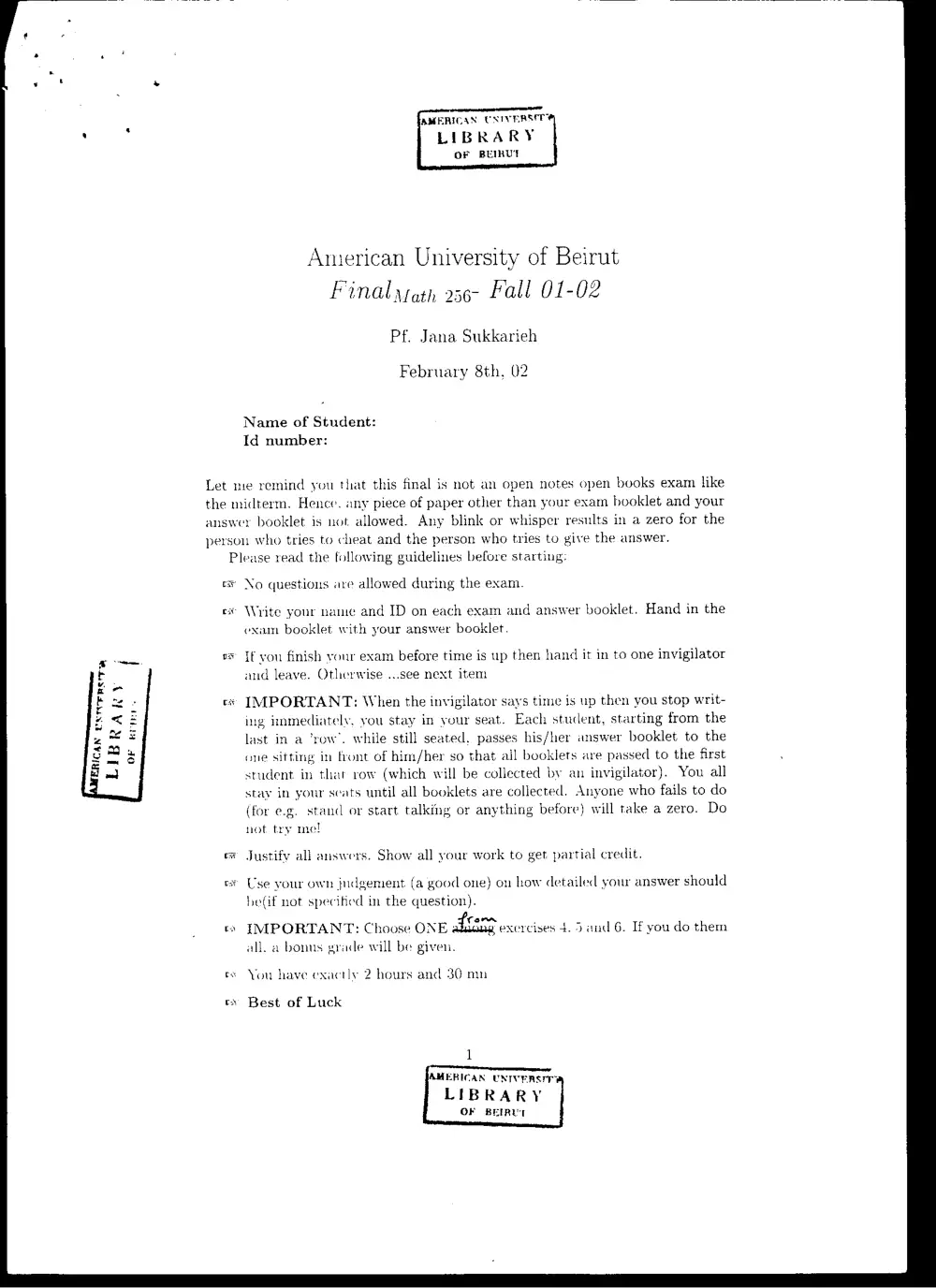
AMERICAN UNIVERSITY
LIBRARY
OF BEIRUT
American University of Beirut
Final sath, 2567 Fall 01-02
Pf. Jana Sukkarieh
February 8th, 02
Name of Student:
Id number:
Let me remind you that this final is not an open notes open books exam like
the midterm. Hence. any piece of paper other than your exam booklet and your
answer booklet is not allowed. Any blink or whisper results in a zero for the
person who tries to cheat and the person who tries to give the answer.
Please read the following guidelines before starting:
cx No questions are allowed during the exam.
ex Write your name and ID on each exam and answer booklet. Hand in the
exam booklet with your answer booklet.
If you finish your exam before time is up then hand it in to one invigilator
and leave. Otherwise ...see next item
IMPORTANT: When the invigilator says time is up then you stop writ-
ing immediately, you stay in your seat. Each student, starting from the
last in a ‘row’. while still seated, passes his/her answer booklet to the
one sitting in front of him/her so that all booklets are passed to the first
student. in that row (which will be collected by an invigilator). You all
stay in your seats until all booklets are collected. Anyone who fails to do
(for e.g. stand or start talking or anything before) will take a zero. Do
not try me!
Justify all answers. Show all your work to get partial credit.
Use your own judgement (a good one) on how detailed your answer should
be(if not specified in the question).
~
t. IMPORTANT: Choose ONE ¢ wang exercises 4.5 and 6. If you do them
all. a bonus grade will be given.
ts You have exactly 2 hours and 30 mn
tx Best of Luck
AMERICAN UNIVERSITY
LIBRARY
OF BEIRUT
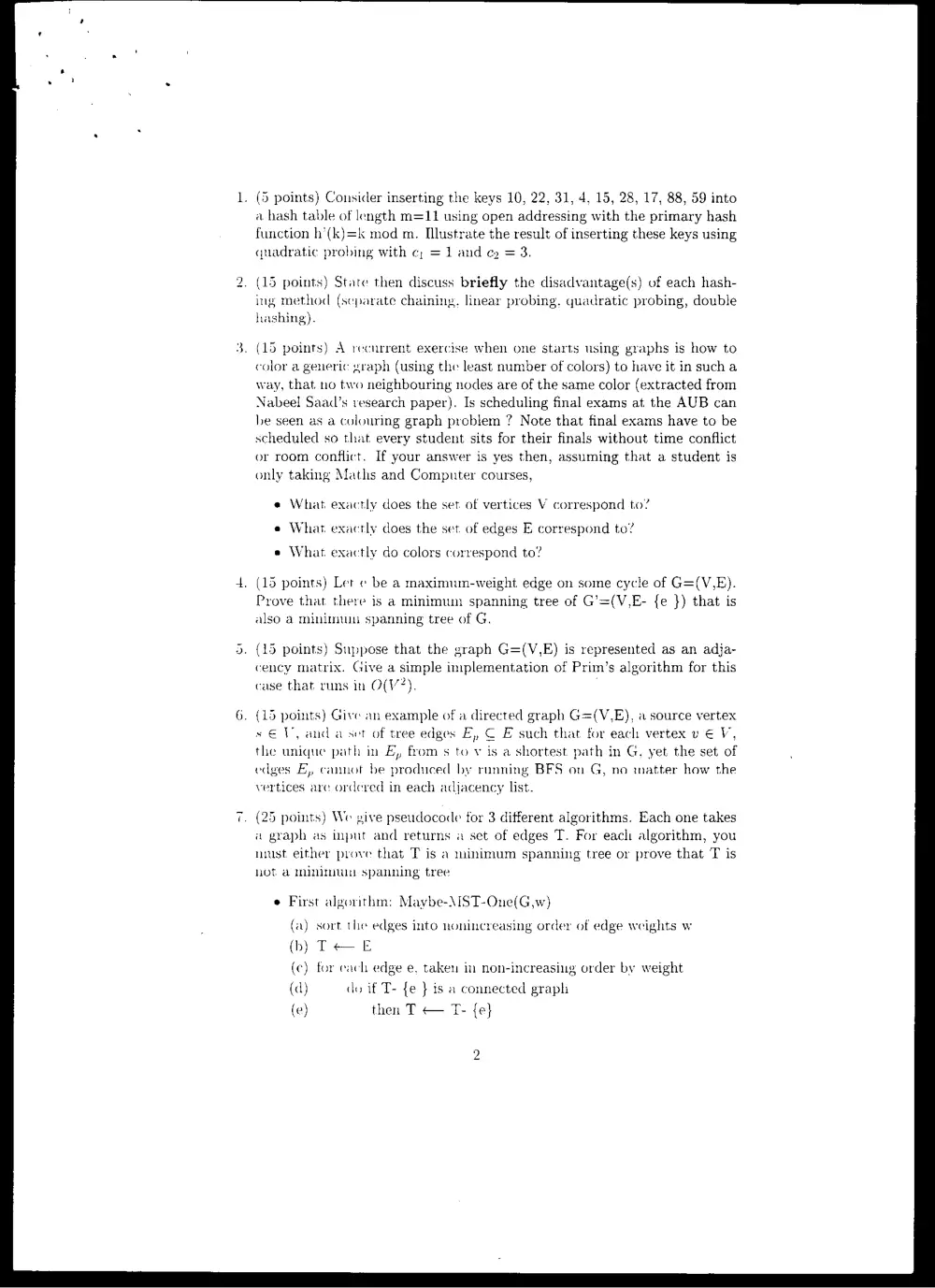
1. (5 points) Consider inserting the keys 10, 22, 31, 4, 15, 28, 17, 88, 59 into
a hash table of length m=11 using open addressing with the primary hash
function h’(k)=k mod m. Illustrate the result of inserting these keys using
quadratic probing with c; = 1 and c = 3.
2. (15 points) State then discuss briefly the disadvantage(s) of each hash-
ing method (separate chaining. linear probing. quadratic probing, double
hashing).
(15 points) A recurrent exercise when one starts using graphs is how to
color a generic graph (using the least number of colors) to have it in such a
way, that no two neighbouring nodes are of the same color (extracted from
Nabeel Saac’s research paper). Is scheduling final exams at the AUB can
he seen as a colouring graph problem ? Note that final exams have to be
scheduled so that every student sits for their finals without time conflict
or room conflict. If your answer is yes then, assuming that a student is
only taking Maths and Computer courses,
e What exactly does the set of vertices V correspond to?
e What. exactly does the set of edges E correspond to?
e What exactly do colors correspond to?
. (15 points) Let ¢ be a maximum-weight edge on some cycle of G=(V,E).
Prove that there is a minimum spanning tree of G’=(V,E- {e }) that is
also a minimum spanning tree of G.
. (15 points) Suppose that the graph G=(V,E) is represented as an adja-
cency matrix. Give a simple implementation of Prim’s algorithm for this
case that runs in O(V?).
). (15 points) Give an example of a directed graph G=(V,E), a source vertex
s € Vand a set of tree edges E, C E such that for each vertex v € V,
the unique path in &, from s to v is a shortest path in G, yet the set of
edges E, cannot be produced by running BFS on G, no matter how the
vertices are ordered in each adjacency list.
(25 points) We give pseudocode for 3 different algorithms. Each one takes
a graph as input and returns « set of edges T. For each algorithm, you
must either prove that T is a minimum spanning tree or prove that T is
hot a minimun spanning tree
© First algorithm: Maybe-MST-One(G,w)
sort. the edges into nonincreasing order of edge weights w
for cach edge e, taken in non-increasiug order by weight
do if T- {e } is a connected graph
then T —— T- {e}
(f) return T
Second algorithm: Maybe-MST-Two(G,w)
{a) Te- ¥
(b) for each edge e, taken in arbitrary order
(
(
dy then T ¢+— TU {e }
e) return T
Third Algovithm: Maybe-MST-Three(G,w)
(fa) Te
for each edge e, taken in arbitrary order
do Fe 'T Ue }
c) doif TU {e } has no cycles
l
if T has a cycle c
then let e’ be the maximum-weight edge on c
T — T- {e’}
return T
8. (25 points) The goal of the GRAPH-THEORIST Professor Parone
game is to start with any faculty member at AUB who has worked in a
research group. RS;, and connect these members to Professor Parone in
the smallest nmmber of links possible. Two people are linked if they have
been members of the same research group at some point (Note then that
one person may be in different groups).
For example. Given that Jana was in the same group RS, with
Abdul in 1995 and Abdul was in the same group RS» with
Roger in 1997 and Roger was in the same research group RS3
with Rodrigo in 1998 and Rodrigo was in the same research
group RS, as Professor Parone in 1999, we say that Jana is
linked to Professor Parone and give this link a Parone-score 4
ic. miniinim number of links that were necessary.
Given a database of research groups with their members. «lescribe in En-
glish how vou could compute the Parone-score of all faculty members at
AUB. Carefully describe all the major data structures and algorithms you
would use in order to solve this problem as efficiently as possible. Write
tho running tine of your algorithma(e) and osplain why it ie Noto that
cach record in the database is a research group name (a string), followed by
the number of members in that group, followed by the names of members
of that group (a string). You may assume that no two faculty members
have the same name and no two research groups have the same names.
Hint: Model vour database as a graph.
. Bonus: Trees - Be brief though without jeapordizing essential
concepts
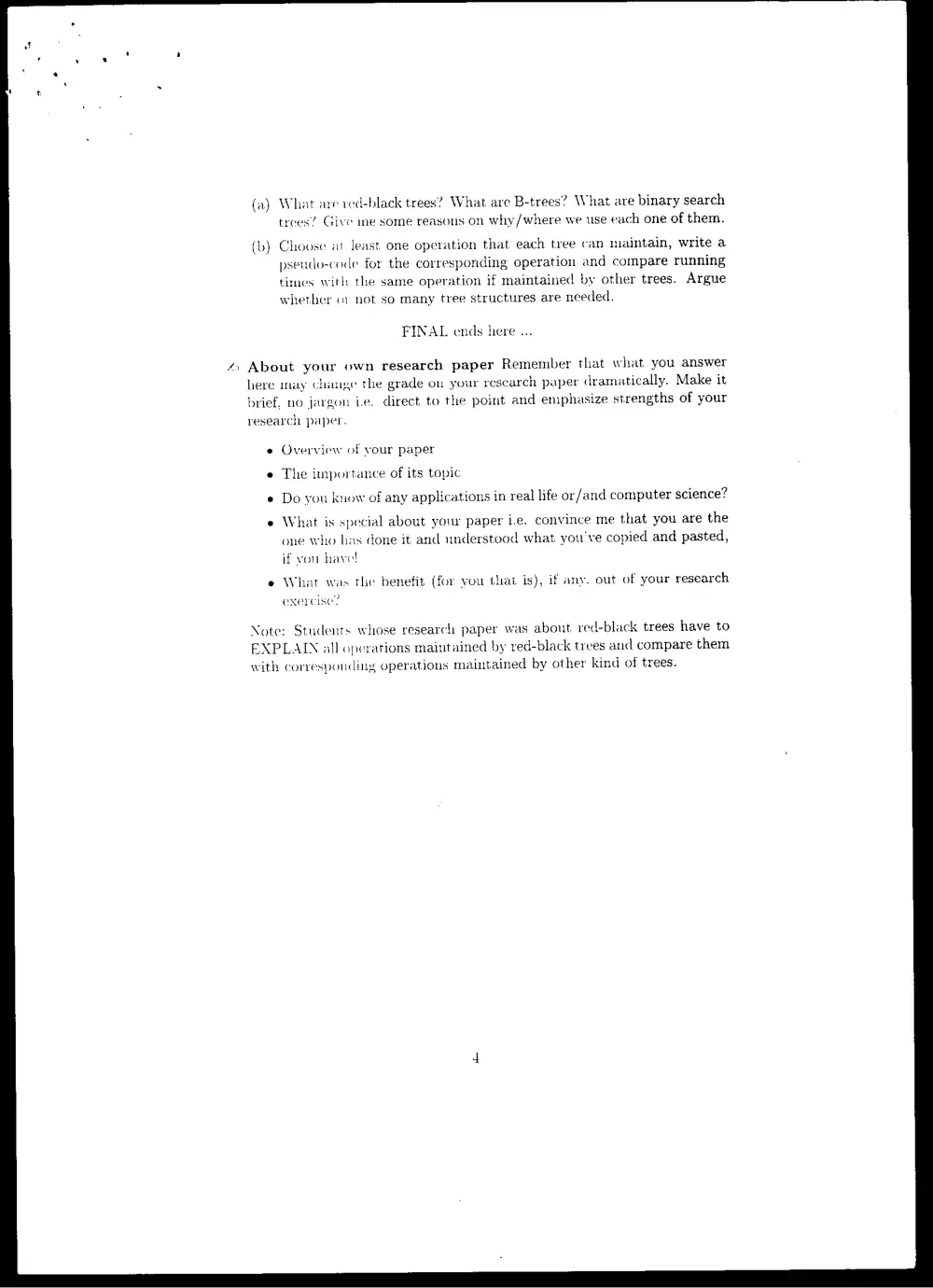
(a) What are ved-black trees? What are B-trees? What are binary search
trees? Give ine some reasons on why/where we use each one of them.
(b) Choose at least one operation that each tree can maintain, write a
psendo-code for the corresponding operation and compare running
times with the same operation if maintained by other trees. Argue
whether or not so many tree structures are needed.
FINAL ends here ...
4, About your own research paper Remember that what you answer
here may change the grade on your rescarch paper dramatically. Make it
brief, no jargon i.e. direct to the point and emphasize strengths of your
research paper.
Overview of vour paper
The importance of its topic
Do you knew of any applications in real life or/and computer science?
What is special about your paper i.e. convince me that you are the
one who las done it and understood what you've copied and pasted,
if vou have!
What was the benefit (for you that is), if any. out of your research
exercise?
Note: Students whose research paper was about red-black trees have to
EXPLAIN all operations maintained by red-black trees and compare them
with corresponding operations maintained by other kind of trees.