
CMPS 256 Final, Spring 2004
American University of Beirut · Advanced Algorithms and Data Structures · 7 pages



More CMPS 256 files
- Final Solutions · Fall 2013Final exam · with solutionView
- Final · Fall 2013Final examView
- Final Solutions · Fall 2012Final exam · with solutionView
- Final · Fall 2005Final examView
- Final · Fall 2004Final examView
- Final · Fall 2004Final examView
- Final · Fall 2003Final examView
- Final · Fall 2003Final examView
Show the text of this final exam
franRicas UNIVERSIT
LEBRARY
OF CEIRUT
American Un
American University of Beirut
CMPS 256
Advanced Algorithms and Data Structures
Spring 2004
Final Exam
Date: June 7" 11:00am — 1:00pm. Name? -----een---nnananneseennn=
Instructor: Chiraz Ben Abdelkader
e This exam is closed-book and closed notes. You are allowed to use nor more than 2 pages of
notes, front and back.
e There are 7 problems over 8 pages and for a total of 105 points.
Please write as legibly as you can, otherwise I will NOT mark your answer!
¢ Important note: Justify all your answers. Only partial credit will be given to unjustified
answers.
Prob. 1 | Prob. 2 | Prob. 3\ Prob. 4| Prob. 5 | Prob. 6| Prob. 7| Total
Max Grade 15 8 7 15 20 25 15 105
Your Grade
eo
jamcRICAN UNIVERST®
LIBRARY
OF UFIROT
Question 1. (12-15 pts) Sorting, Selection, Hash Tables
a) (3 pts) Bucket-Sort runs in O(n) time and QuickSort in O(nlogn), but why is it that
QuickSort is more widely used in practice?
b) (4 pts) We want to design efficient algorithms for the following operations on a hash-
table of n elements: (i) Extract-Max, and (ii) Inorder-walk (i.e. printing all elements in
increasing order). Briefly explain how you would design each algorithm and determine
its running time.
c) (5-8 pts) Do exactly one of the following two problems (I will only grade one problem
— there is no extra credit for doing both or part of each).
Hint: Both problems may be solved by using the SELECT algorithm somehow ...
(i) 5 pts) Give an O(n) algorithm which, given a list A//..n] of numbers, a positive
integer k (I Sk Sn) and number 4, outputs the & numbers of A that are closest to X in
value. (These numbers may be greater than, less than, or equal to X.) For example,
suppose we have: A = {9.5, 1.3, 5.2, 0.1, 7.5, 6.6, 2.5, 9.1}, k=4 and X=8.2. The
algorithm should output the set {9.5, 7.5, 6.6, 9.1} (in any order). Briefly explain your
algorithm and show that it runs in O(n).
(ii) (8 pts) Suppose you are given an unsorted array A of n distinct integers in the
range 0..n except for one integer, denoted the missing number. For example, if A =
{2,4,0,3} then the missing number is 1. Design a O(n) divide-and-conquer algorithm to
find the missing number of an input array A. Briefly explain the correctness of your
algorithm and analyze its running time.
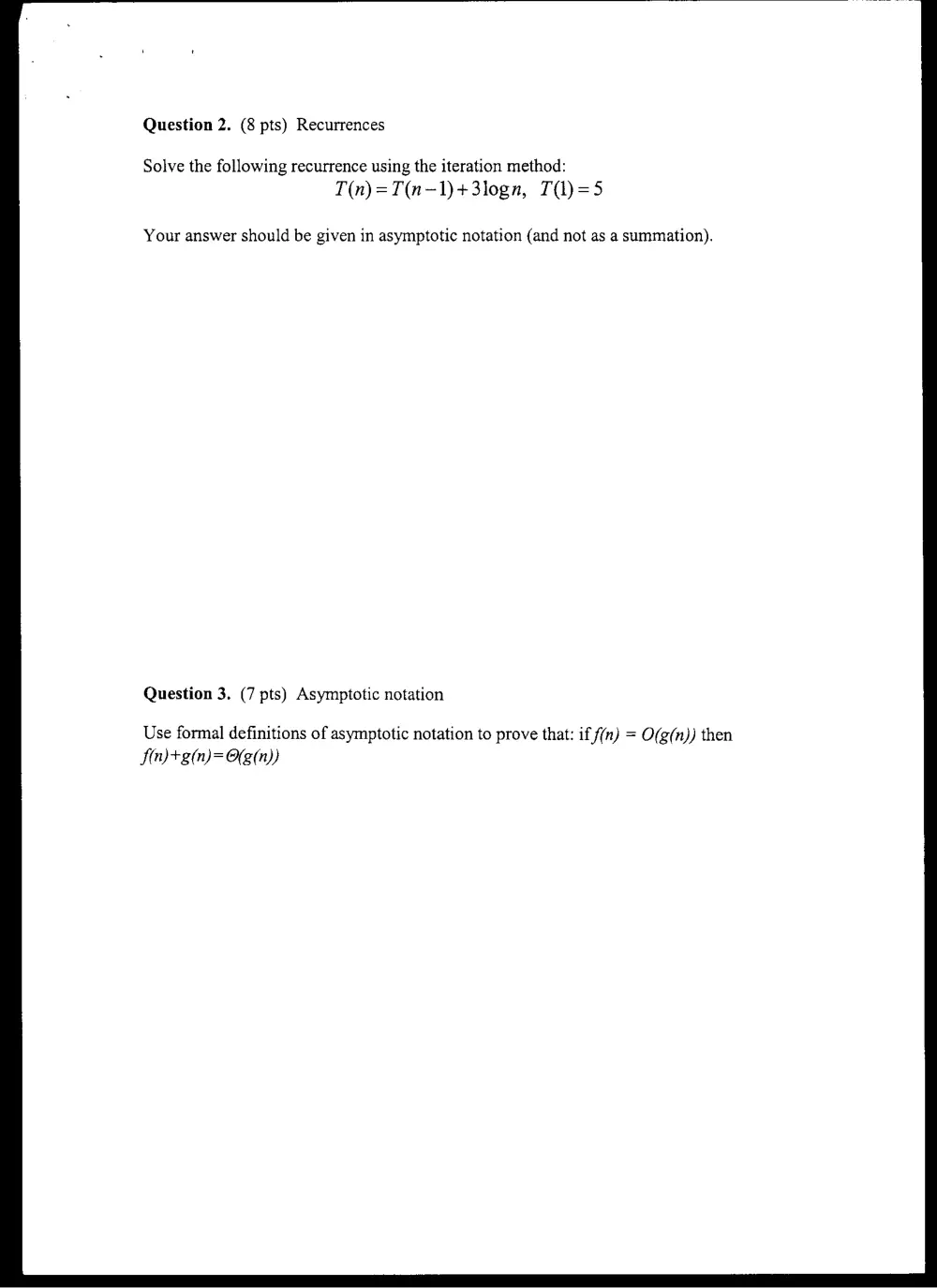
Question 2. (8 pts) Recurrences
Solve the following recurrence using the iteration method:
T(n)=T(n-1)+3logn, T(1)=5
Your answer should be given in asymptotic notation (and not as a summation).
Question 3. (7 pts) Asymptotic notation
Use formal definitions of asymptotic notation to prove that: if f(n) = O(g(n)) then
Sin) tg(n) = Og(n))
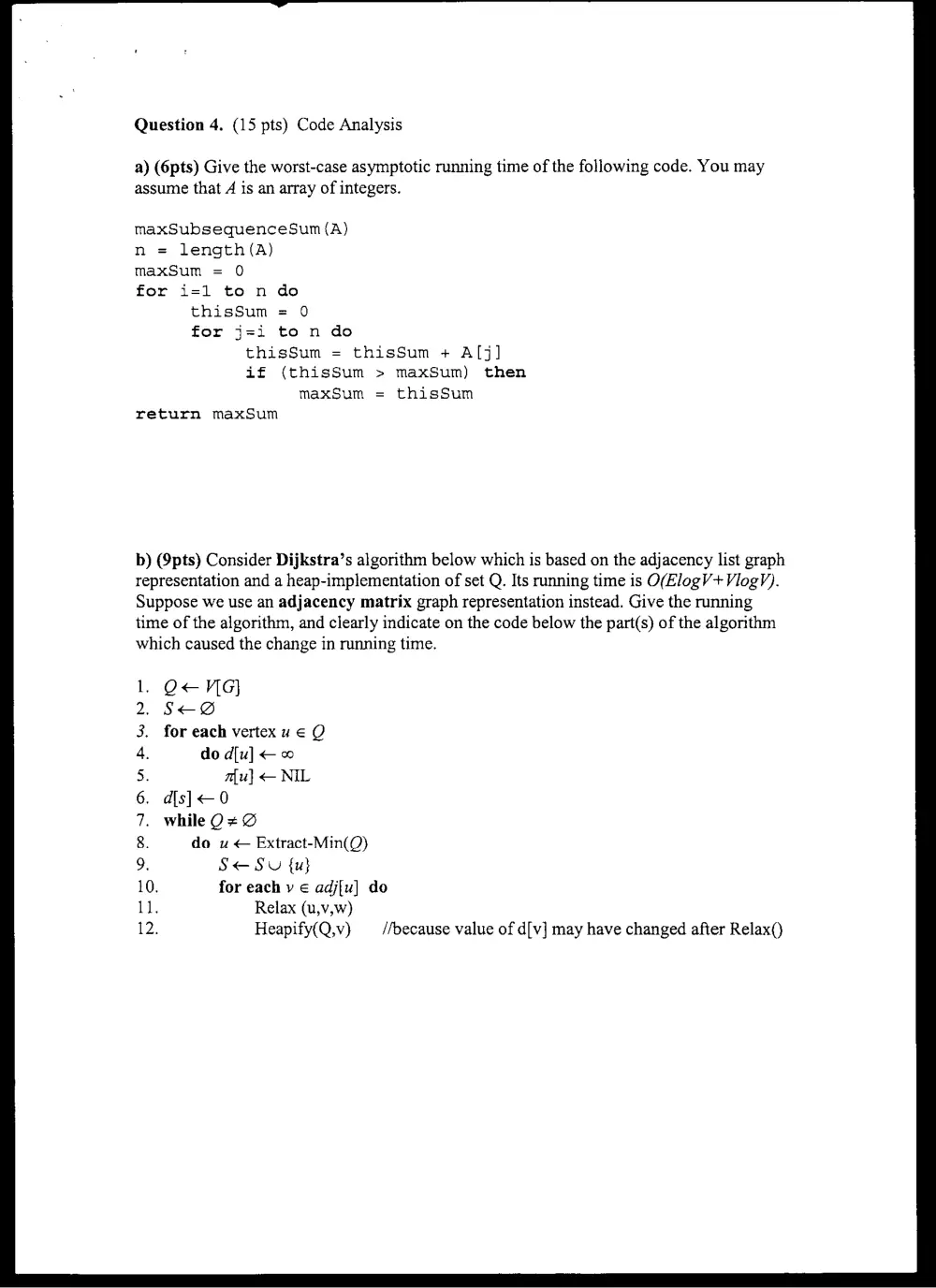
Question 4. (15 pts) Code Analysis
a) (6pts) Give the worst-case asymptotic running time of the following code. You may
assume that A is an array of integers.
maxSubsequenceSum (A)
n = length(A)
maxSum = 0
for i=1 to n do
thisSum = 0
for j=i to n do
thisSum = thisSum + A[j]
if (thisSum > maxSum) then
maxSum = thisSum
return maxSum
b) (9pts) Consider Dijkstra’s algorithm below which is based on the adjacency list graph
representation and a heap-implementation of set Q. Its running time is O(ElogV+VlogV).
Suppose we use an adjacency matrix graph representation instead. Give the running
time of the algorithm, and clearly indicate on the code below the part(s) of the algorithm
which caused the change in running time.
O< VIG}
S<@
for each vertex u € Q
do d[u] <0
amu] <— NIL
d{s] <— 0
while 0 # ©
do u < Extract-Min(Q)
Se Su {u}
for each v € adj[u] do
Relax (u,v,w)
Heapify(Q,v) —_ //because value of d[v] may have changed after Relax()
RPNAM PWNS
eno)
Nro-
Question 5. (20 pts) Graph Algorithms — Short Answer
a) Why does a shortest path contain at most |V| vertices and [V|-1 edges in any graph
G=(V,E)?
b) In the DFS of a directed graph, let (u,v) be any edge in the graph and suppose d[u] <
d[v]. What are the possible types of this edge? (tree, back, forward, cross.)
c) Student Cluelessenberg ran Dijkstra’s algorithm on a graph containing a negative-cost
cycle. True or False: the algorithm may go into an infinite loop. Justify your answer.
d) In the DFS of a directed acyclic graph, let (u,v) be any edge in the graph. Show that
we must have f[v] < fu].
Hint: Use proof by contradiction; Suppose f[v] > flu] and give all possible cases for the
relative positions of intervals (d[u],f[u]) and (d[v],f[v]). Then show that there is a
contradiction in each case.
ANSWERS (use back side if necessary)
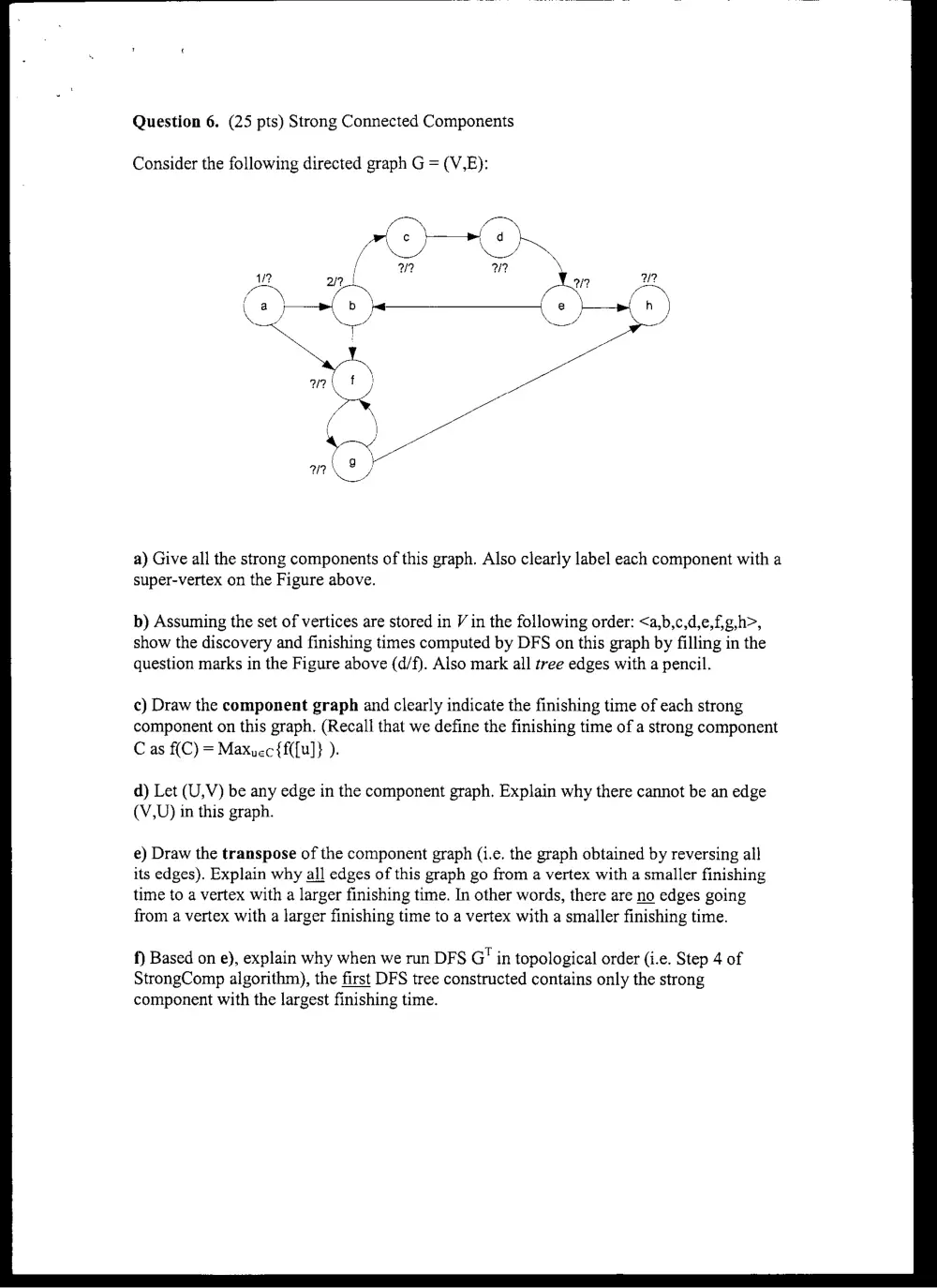
Question 6. (25 pts) Strong Connected Components
Consider the following directed graph G = (V,E):
a) Give all the strong components of this graph. Also clearly label each component with a
super-vertex on the Figure above.
b) Assuming the set of vertices are stored in V in the following order: <a,b,c,d,e,f,g,h>,
show the discovery and finishing times computed by DFS on this graph by filling in the
question marks in the Figure above (d/f). Also mark all ree edges with a pencil.
c) Draw the component graph and clearly indicate the finishing time of each strong
component on this graph. (Recall that we define the finishing time of a strong component
Cas f(C) = Maxuec{f({u]} ).
d) Let (U,V) be any edge in the component graph. Explain why there cannot be an edge
(V,U) in this graph.
e) Draw the transpose of the component graph (i.e. the graph obtained by reversing all
its edges). Explain why all edges of this graph go from a vertex with a smaller finishing
time to a vertex with a larger finishing time. In other words, there are no edges going
from a vertex with a larger finishing time to a vertex with a smaller finishing time.
f) Based on e), explain why when we run DFS G’ in topological order (i.e. Step 4 of
StrongComp algorithm), the first DFS tree constructed contains only the strong
component with the largest finishing time.
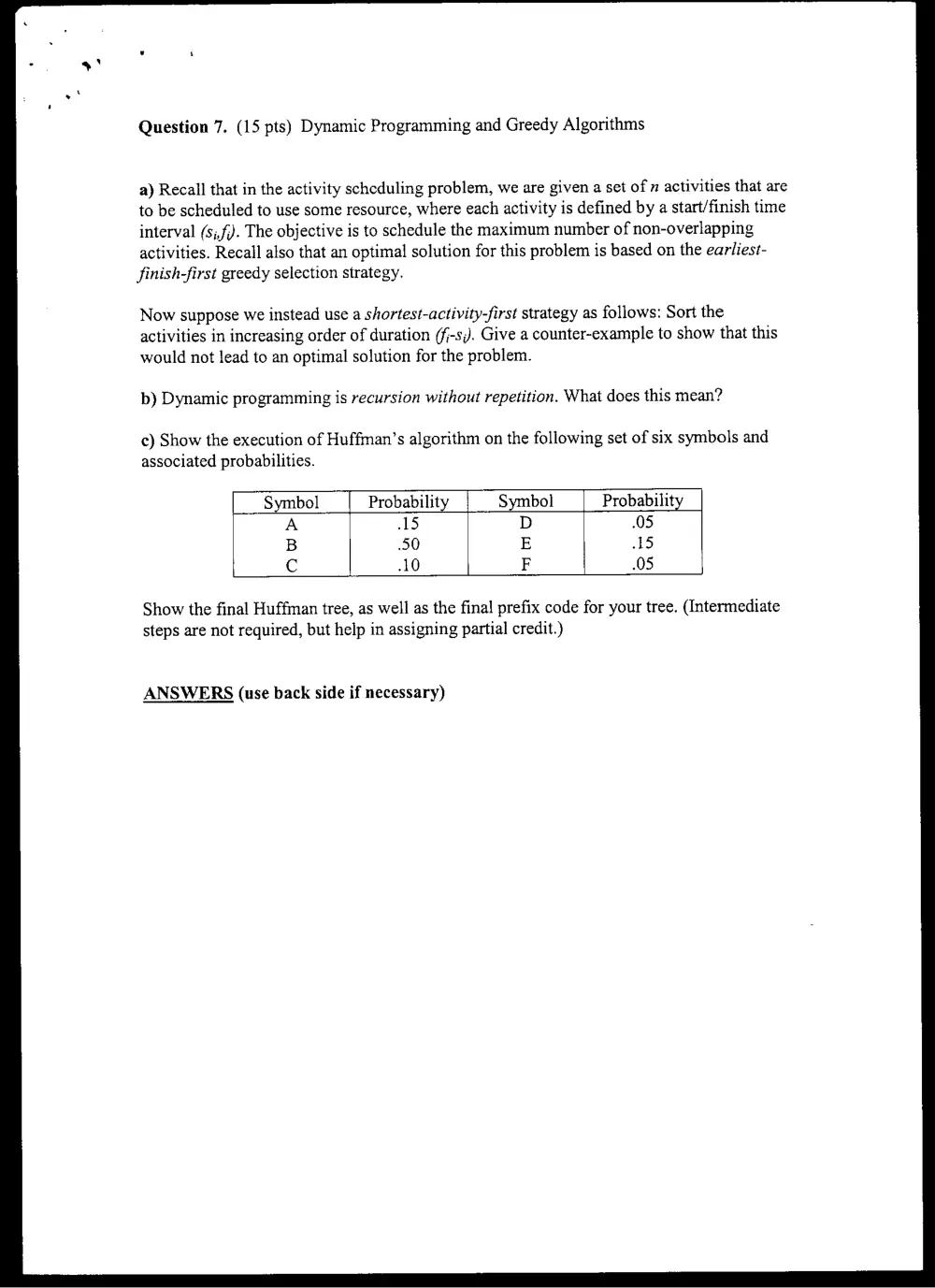
Question 7. (15 pts) Dynamic Programming and Greedy Algorithms
a) Recall that in the activity schcduling problem, we are given a set of activities that are
to be scheduled to use some resource, where each activity is defined by a start/finish time
interval (s;,f). The objective is to schedule the maximum number of non-overlapping
activities. Recall also that an optimal solution for this problem is based on the earliest-
Jinish-first greedy selection strategy.
Now suppose we instead use a shortest-activity-first strategy as follows: Sort the
activities in increasing order of duration (f;-sj. Give a counter-example to show that this
would not lead to an optimal solution for the problem.
b) Dynamic programming is recursion without repetition. What does this mean?
c) Show the execution of Huffman’s algorithm on the following set of six symbols and
associated probabilities.
Symbol
Probability
Symbol
Probability
A
B
C
15
50
10
D
E
F
05
1S
-05
Show the final Huffman tree, as well as the final prefix code for your tree. (Intermediate
steps are not required, but help in assigning partial credit.)
ANSWERS (use back side if necessary)