
CMPS 256 Final, Fall 2005
American University of Beirut · Advanced Algorithms and Data Structures · 10 pages



More CMPS 256 files
- Final Solutions · Fall 2013Final exam · with solutionView
- Final · Fall 2013Final examView
- Final Solutions · Fall 2012Final exam · with solutionView
- Final · Spring 2004Final examView
- Final · Fall 2004Final examView
- Final · Fall 2004Final examView
- Final · Fall 2003Final examView
- Final · Fall 2003Final examView
Show the text of this final exam
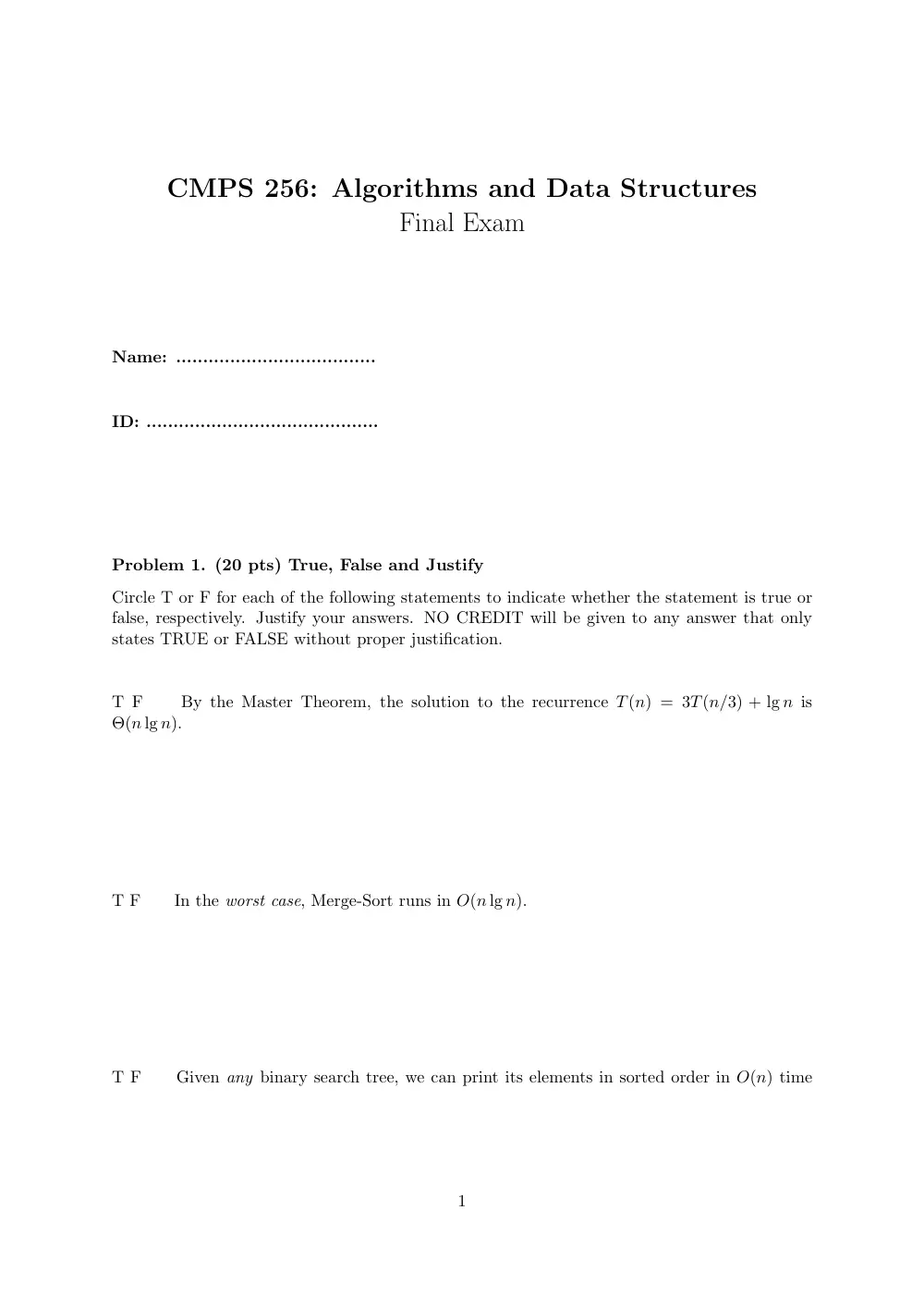
CMPS 256: Algorithms and Data Structures
Final Exam
Name: .....................................
ID: ...........................................
Problem 1. (20 pts) True, False and Justify
Circle T or F for each of the following statements to indicate whether the statement is true or
false, respectively. Justify your answers. NO CREDIT will be given to any answer that only
states TRUE or FALSE without proper justification.
T F
By the Master Theorem, the solution to the recurrence T(n) = 3T(n/3) + lg n is
Θ(n lg n).
T F
In the worst case, Merge-Sort runs in O(n lg n).
T F
Given any binary search tree, we can print its elements in sorted order in O(n) time
1
by performing an Inorder-Tree-Walk.
T F
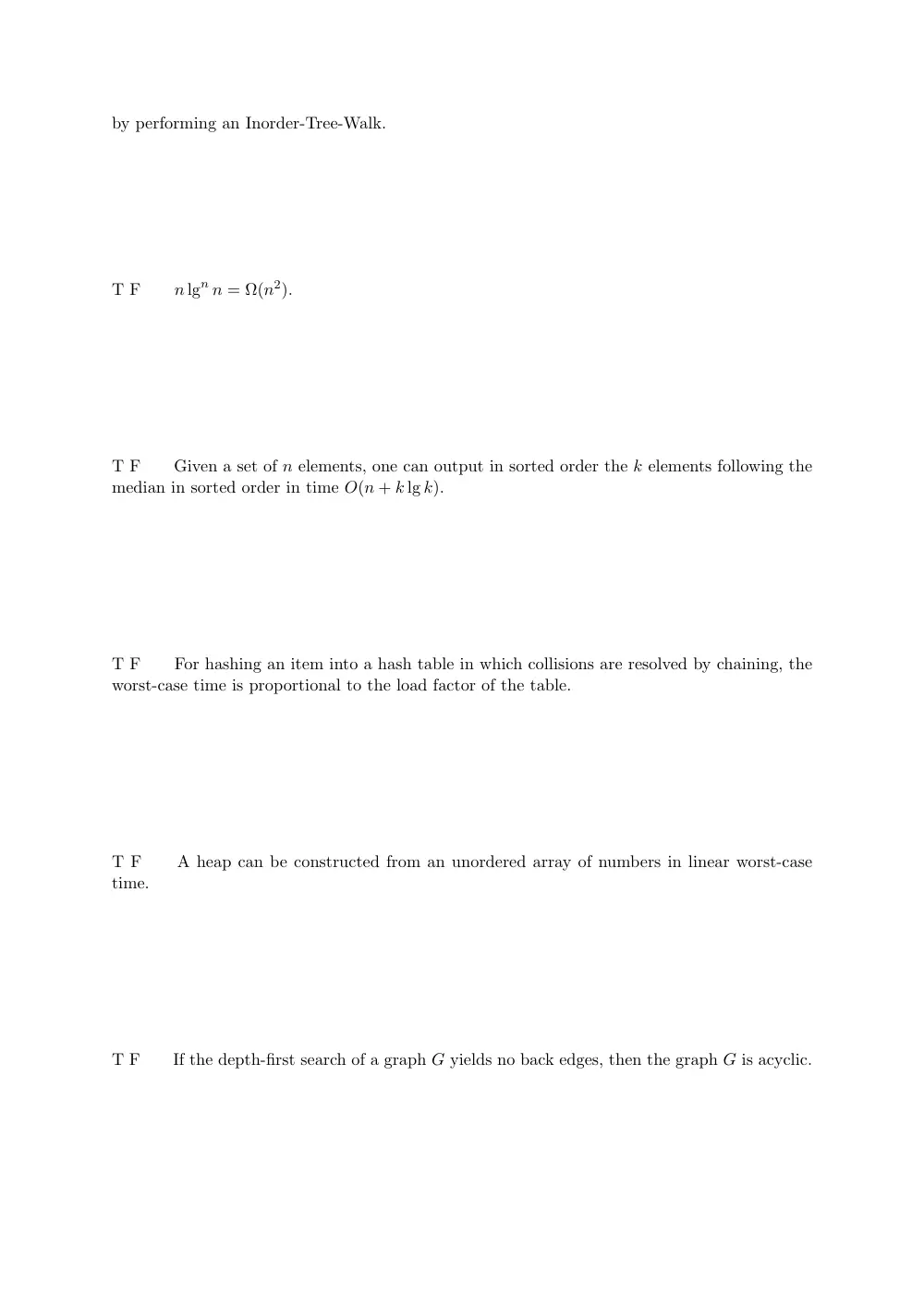
n lgn n = Ω(n2).
T F
Given a set of n elements, one can output in sorted order the k elements following the
median in sorted order in time O(n + k lg k).
T F
For hashing an item into a hash table in which collisions are resolved by chaining, the
worst-case time is proportional to the load factor of the table.
T F
A heap can be constructed from an unordered array of numbers in linear worst-case
time.
T F
If the depth-first search of a graph G yields no back edges, then the graph G is acyclic.
T F
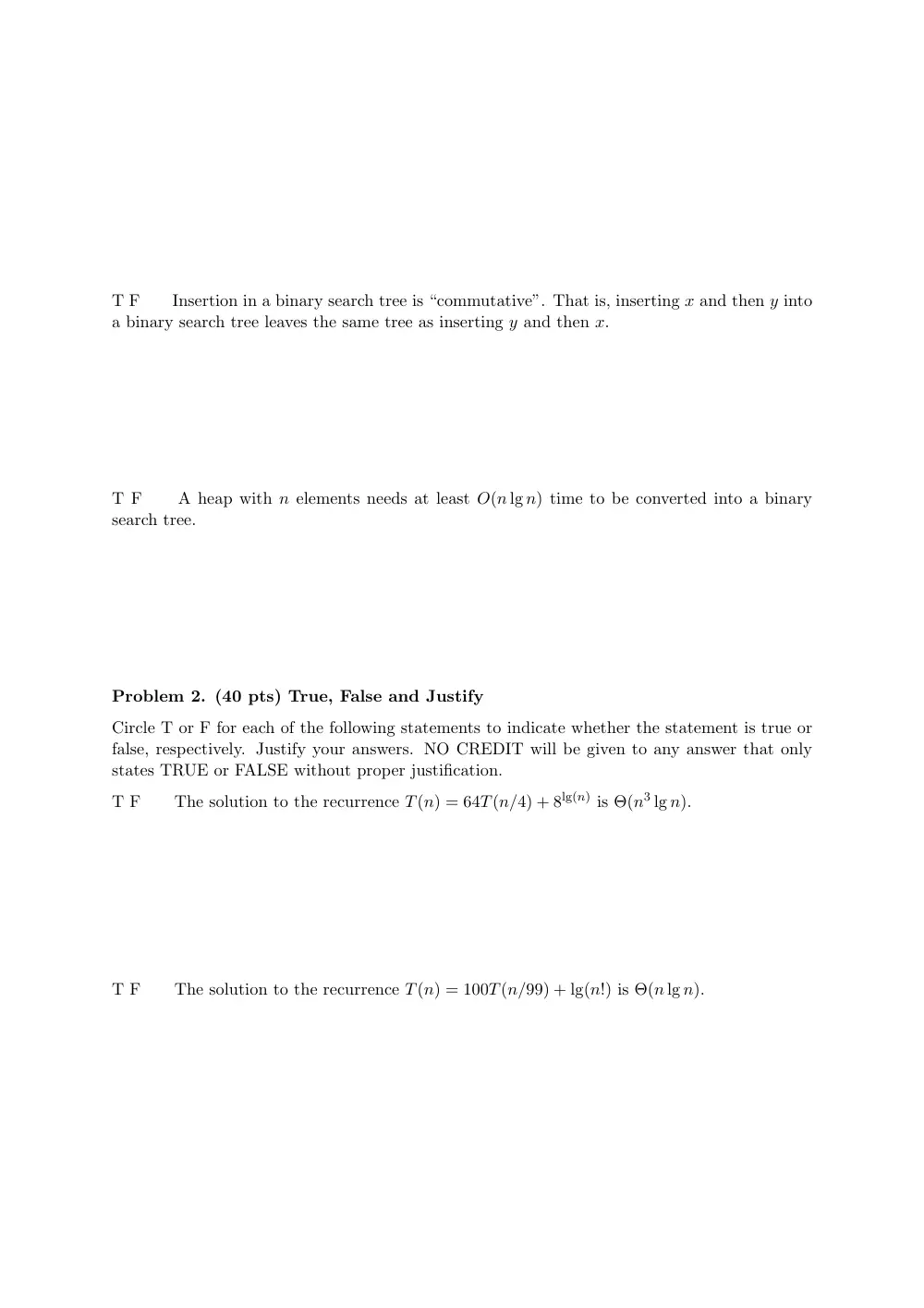
Insertion in a binary search tree is “commutative”. That is, inserting x and then y into
a binary search tree leaves the same tree as inserting y and then x.
T F
A heap with n elements needs at least O(n lg n) time to be converted into a binary
search tree.
Problem 2. (40 pts) True, False and Justify
Circle T or F for each of the following statements to indicate whether the statement is true or
false, respectively. Justify your answers. NO CREDIT will be given to any answer that only
states TRUE or FALSE without proper justification.
T F
The solution to the recurrence T(n) = 64T(n/4) + 8lg(n) is Θ(n3 lg n).
T F
The solution to the recurrence T(n) = 100T(n/99) + lg(n!) is Θ(n lg n).
T F
For an undirected graph with integer edge weights and where each vertex is degree 2,
a Minimum Spanning Tree (MST) can be found in O(V ) time.
T F
For any directed acyclic graph, there are always several topological orderings of the
vertices.
T F
A longest path in a DAG G = (V, E) can be found in O(V + E) time.
T F
A graph algorithm with O(E lg V ) running time is asymptotically better than an
algorithm with a O(E lg E) running time for a connected, undirected graph G(V, E).
T F
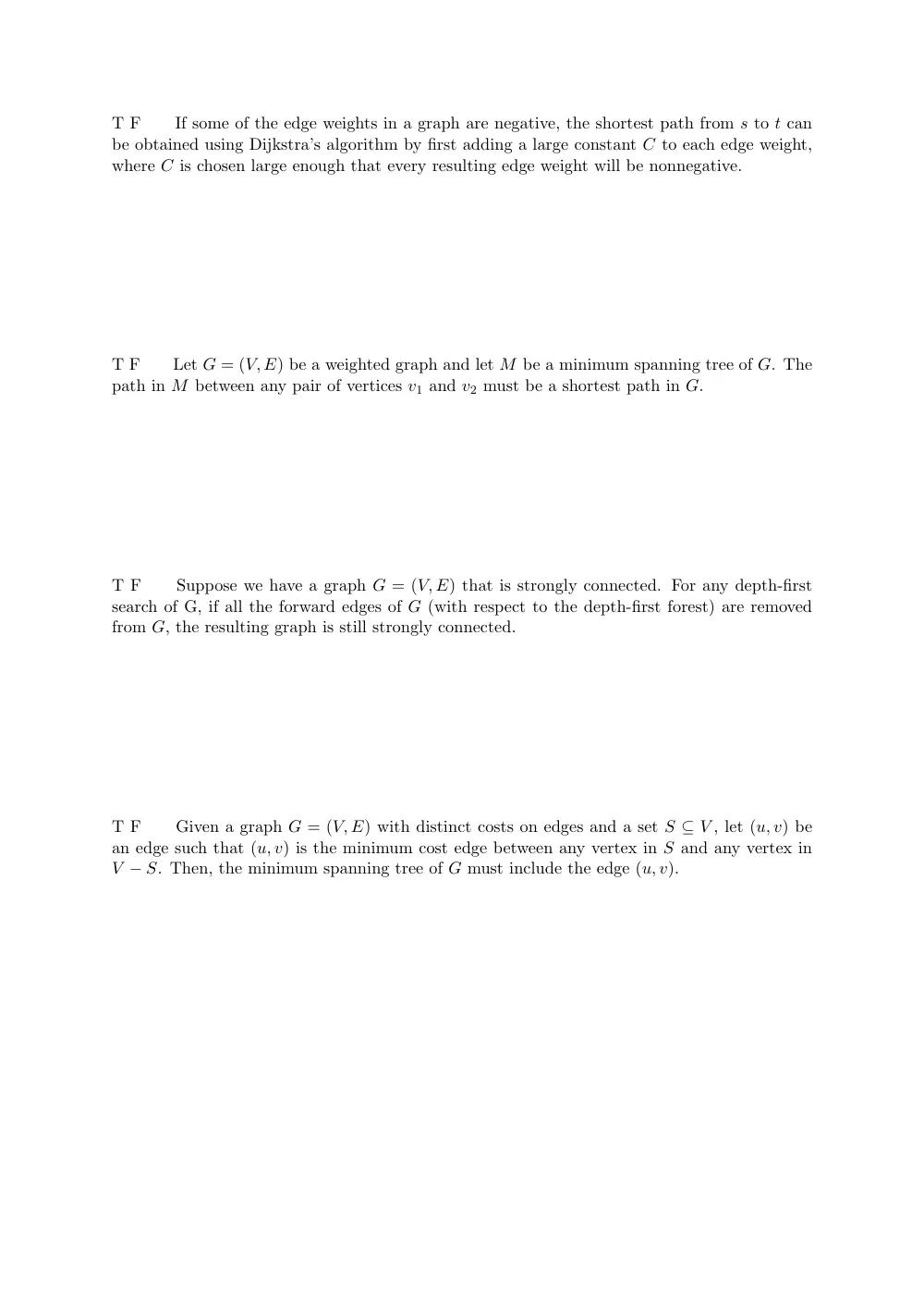
If some of the edge weights in a graph are negative, the shortest path from s to t can
be obtained using Dijkstra’s algorithm by first adding a large constant C to each edge weight,
where C is chosen large enough that every resulting edge weight will be nonnegative.
T F
Let G = (V, E) be a weighted graph and let M be a minimum spanning tree of G. The
path in M between any pair of vertices v1 and v2 must be a shortest path in G.
T F
Suppose we have a graph G = (V, E) that is strongly connected. For any depth-first
search of G, if all the forward edges of G (with respect to the depth-first forest) are removed
from G, the resulting graph is still strongly connected.
T F
Given a graph G = (V, E) with distinct costs on edges and a set S ⊆ V , let (u, v) be
an edge such that (u, v) is the minimum cost edge between any vertex in S and any vertex in
V − S. Then, the minimum spanning tree of G must include the edge (u, v).
Problem 3. (10 pts) Pattern Matching
You are given a text array T[1 . . . n] containing characters from the Latin alphabet (i.e. T[i] ∈
{a, b, . . . z} for i = 1 . . . n. Moreover, you are given another array P[1 . . . m], m < n, which also
contains characters from the Latin alphabet. For any sub-array T m
i
= [i . . . i + m − 1] of T, we
say that T m
i
is a pattern match of P if there is a way of permuting symbols in T m
i
so that the
resulting array is equal to P.
Give what you think is the most efficient algorithm that, given indices i and m, determines if
T m
i
is a pattern match to P.
Problem 4. (10 pts) Modifying MST
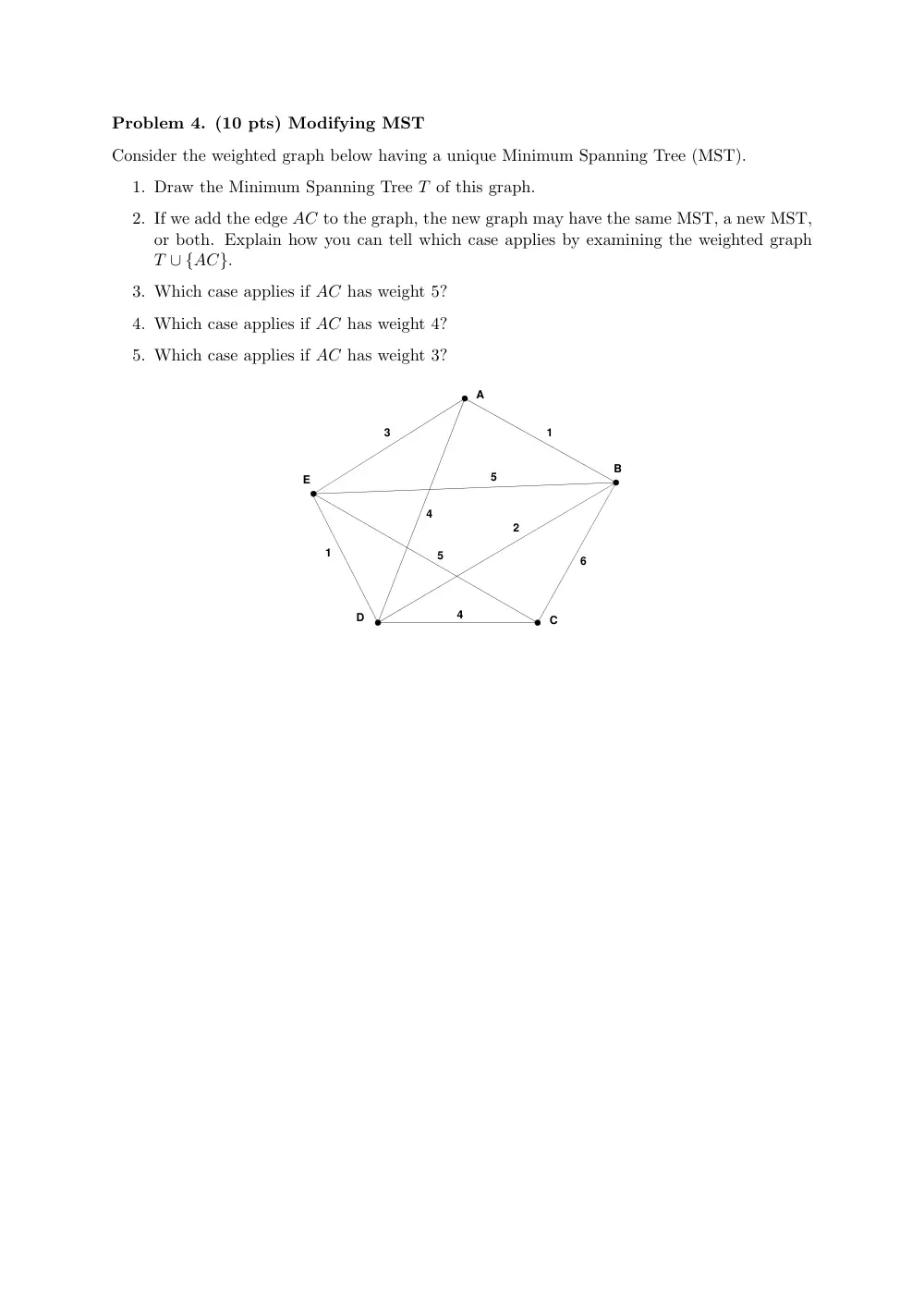
Consider the weighted graph below having a unique Minimum Spanning Tree (MST).
1. Draw the Minimum Spanning Tree T of this graph.
2. If we add the edge AC to the graph, the new graph may have the same MST, a new MST,
or both. Explain how you can tell which case applies by examining the weighted graph
T ∪ {AC}.
3. Which case applies if AC has weight 5?
4. Which case applies if AC has weight 4?
5. Which case applies if AC has weight 3?
A
D
C
B
3
1
5
1
2
6
4
4
5
E
Problem 5. (20 pts) Directed Acyclic Graphs
a. Consider a directed acyclic graph (DAG) G = (V, E). A topological sort of the vertices V of
the graph is a linear ordering of the set V so that if an edge (u, v) exists in G, vertex u appears
before v in the order. It is possible to generate a topological ordering of the vertices of a graph
from the information generated by the depth first traversal algorithm. Write pseudo-code for
topological sort, and analyze the runtime of your algorithm.
b. Give, in pseudo-code, an efficient algorithm for counting the total number of paths in a
directed acyclic graph starting from a given vertex s.
Your algorithm should generate and
store, for every vertex v, the number of paths from s to v. This number should be stored at the
vertices. Analyze your algorithm. Hint: Use Topological Sort.