
CMPS 256 Final, Fall 2004
American University of Beirut · Advanced Algorithms and Data Structures · 10 pages




More CMPS 256 files
- Final Solutions · Fall 2013Final exam · with solutionView
- Final · Fall 2013Final examView
- Final Solutions · Fall 2012Final exam · with solutionView
- Final · Fall 2005Final examView
- Final · Spring 2004Final examView
- Final · Fall 2004Final examView
- Final · Fall 2003Final examView
- Final · Fall 2003Final examView
Show the text of this final exam
at
oa EMI ENEFE
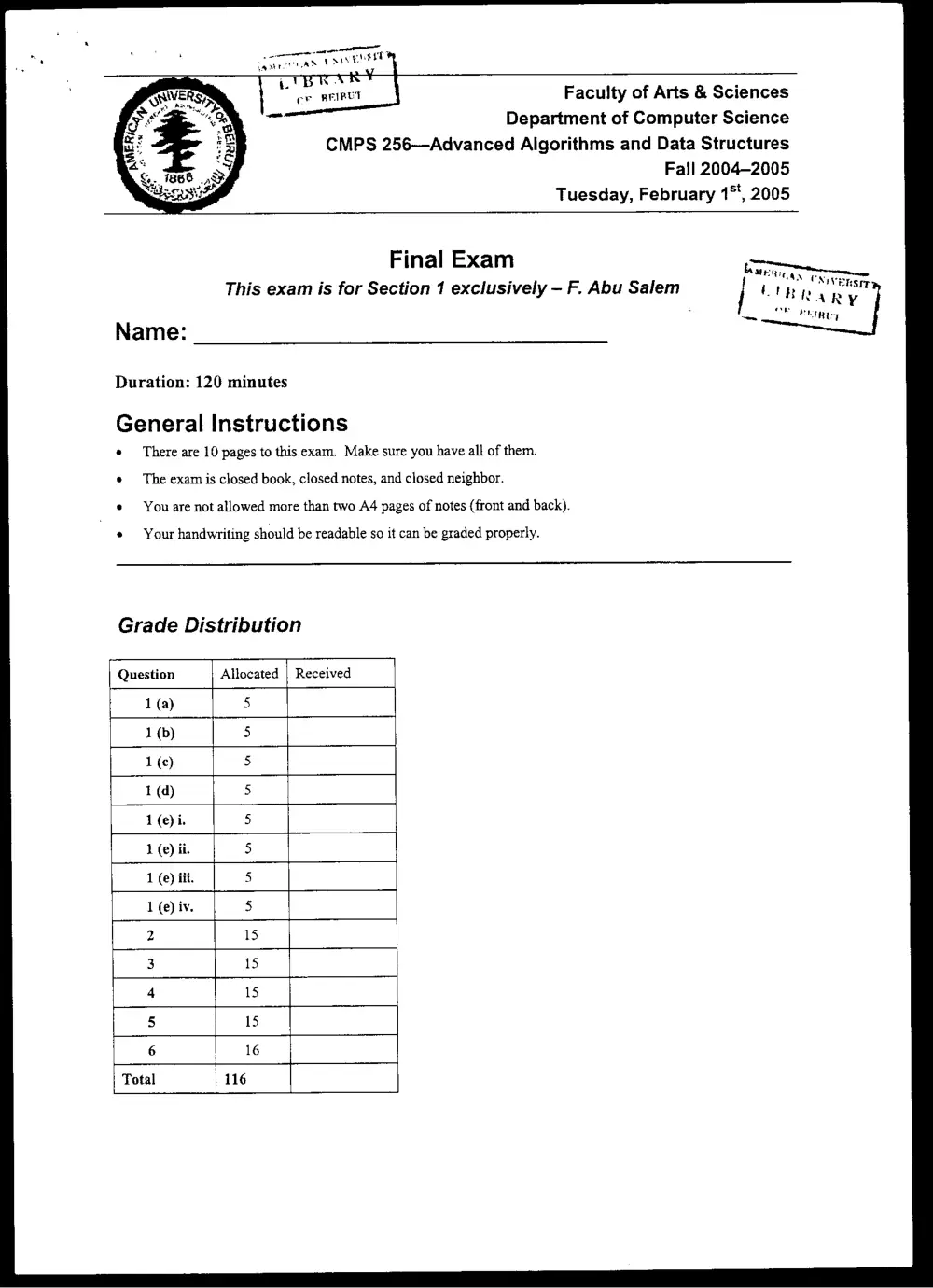
Faculty of Arts & Sciences
Department of Computer Science
CMPS 256—Advanced Algorithms and Data Structures
Fall 2004-2005
Tuesday, February 1°, 2005
Final Exam
This exam is for Section 1 exclusively — F. Abu Salem
Name:
Duration: 120 minutes
General Instructions
e There are 10 pages to this exam. Make sure you have all of them.
e The exam is closed book, closed notes, and closed neighbor.
e You are not allowed more than two A4 pages of notes (front and back).
¢ Your handwriting should be readable so it can be graded properly.
Grade Distribution
Question Allocated | Received
1 (a) 5
1(b)
1(c)
1 (d)
1 (epi.
1 (©) ii.
1 (ec) iii.
1 (e) iv.
Final Exam (2005-02-05) Initials:
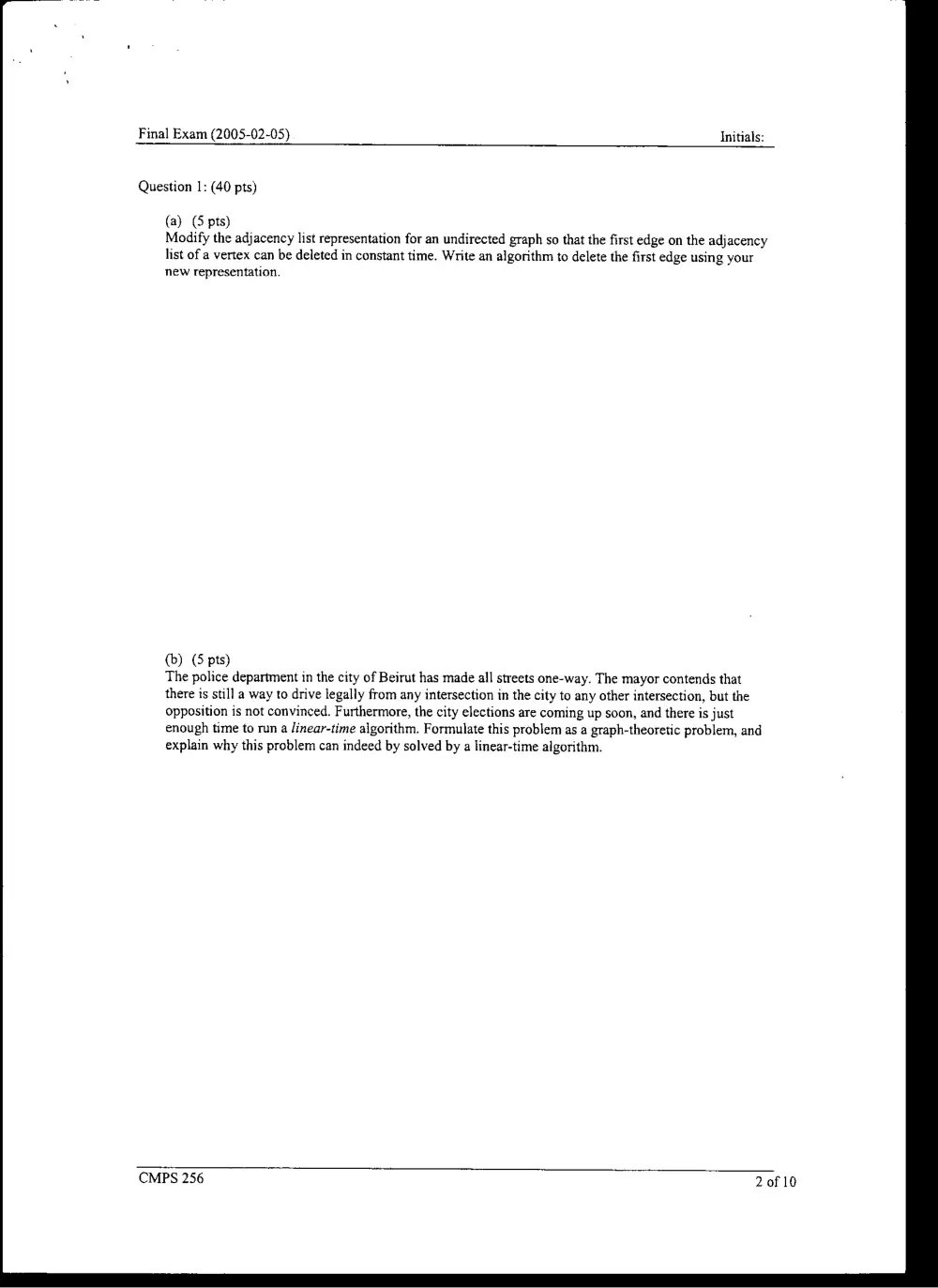
Question 1: (40 pts)
(a) (S pts)
Modify the adjacency list representation for an undirected graph so that the first edge on the adjacency
list of a vertex can be deleted in constant time. Write an algorithm to delete the first edge using your
new representation.
(b) (5 pts)
The police department in the city of Beirut has made all streets one-way. The mayor contends that
there is still a way to drive legally from any intersection in the city to any other intersection, but the
opposition is not convinced. Furthermore, the city elections are coming up soon, and there is just
enough time to run a Jinear-time algorithm. Formulate this problem as a graph-theoretic problem, and
explain why this problem can indeed by solved by a linear-time algorithm.
CMPS 256
2 of 10
Final Exam (2005-02-05)
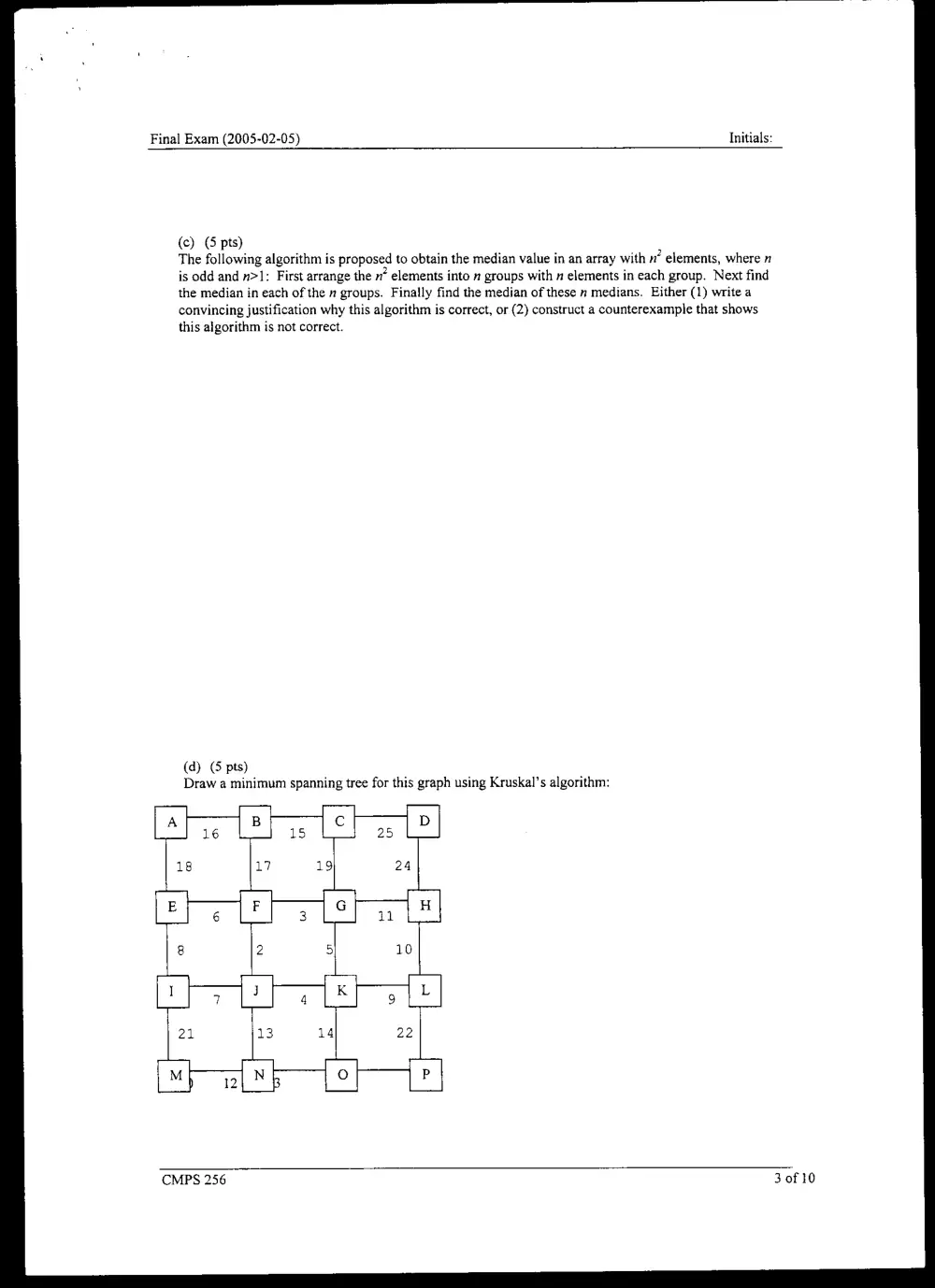
(©) (pts)
The following algorithm is proposed to obtain the median value in an array with n’ elements, where
is odd and n>1: First arrange the r’ elements into n groups with n elements in each group. Next find
the median in each of the n groups. Finally find the median of these n medians. Either (1) write a
convincing justification why this algorithm is correct, or (2) construct a counterexample that shows
this algorithm is not correct.
(d) G pts)
Draw a minimum spanning tree for this graph using Kruskal’s algorithm:
B Cc D
16 15 25
17 24
CMPS 256
Final Exam (2005-02-05) Initials:
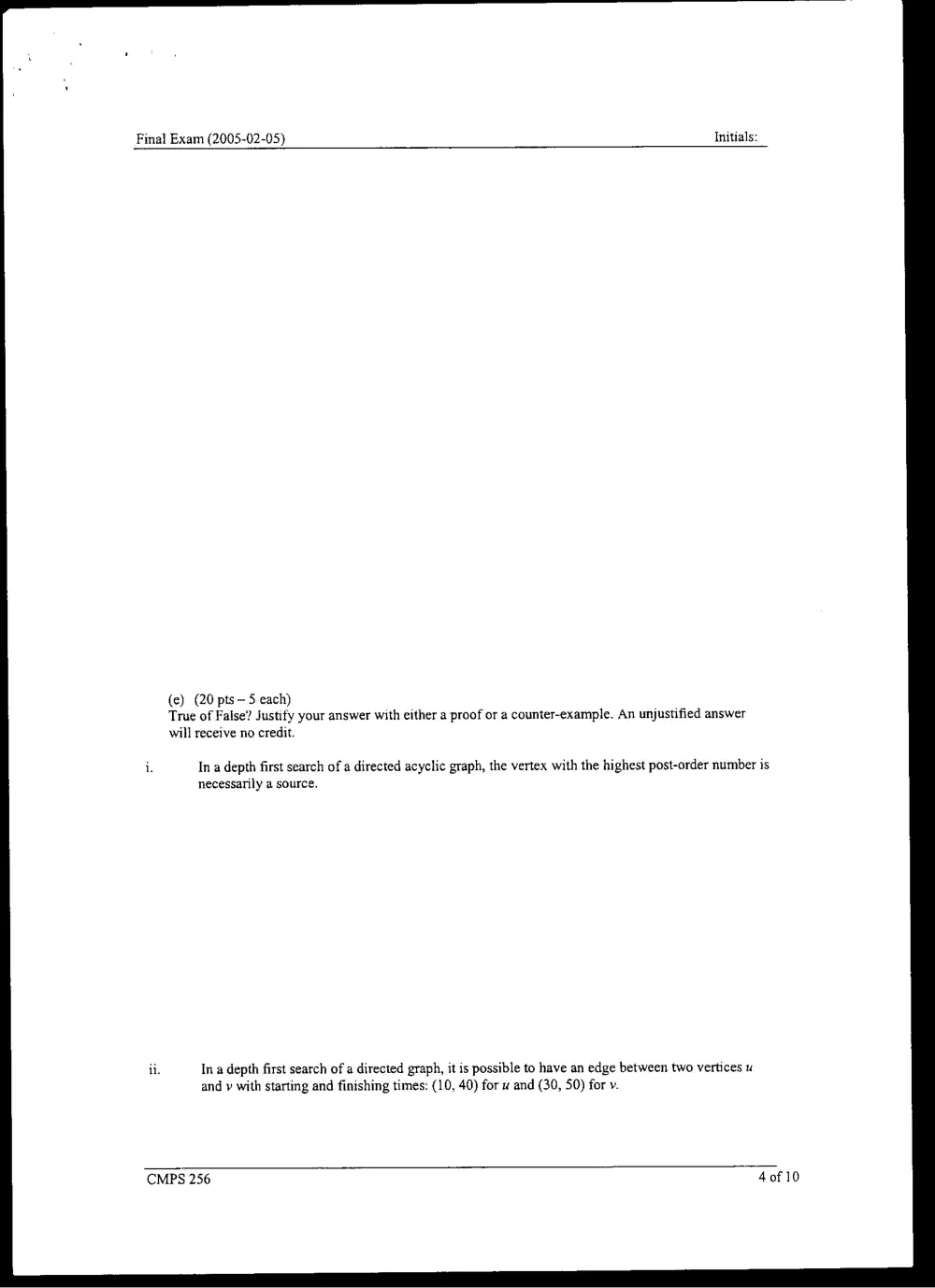
(e) (20 pts—5 each)
True of False? Justify your answer with either a proof or a counter-example. An unjustified answer
will receive no credit.
Ina depth first search of a directed acyclic graph, the vertex with the highest post-order number is
necessarily a source.
In a depth first search of a directed graph, it is possible to have an edge between two vertices u
and v with starting and finishing times: (10, 40) for u and (30, 50) for v.
CMPS 256
Final Exam (2005-02-05) Initials:
ii. Ina depth first search of an undirected graph, it is possible to have an edge between two vertices
u and v with starting and finishing times: (5, 20) for w and (30, 50) for v.
iv. Ina depth first search of a directed graph, if u has starting and finishing times (10, 20) and v has
corresponding times (15, 18), then (v, u) must be a back edge.
CMPS 256 5 of 10
Final Exam (2005-02-05)
Question 2: (15 pts) Kruskal’s algorithm and Prim’s algorithm
(a) Will either Kruskal’s or Prim’s algorithm work correctly on graphs that have negative edge
weights? If yes, justify your answer with a proof; else, provide a counter-example.
(b) The notion of a minimum spanning tree is applicable to a connected weighted graph. Do we have
to check a graph’s connectivity before applying Prim’s algorithm or can the algorithm do it by
itself?
CMPS 256
Final Exam (2005-02-05) Initials:
Question 3: (15 pts) Simple cycles
We say that a relation = on a set A is an equivalence relation if it satisfies the following three conditions:
R (Reflexivity): For every a € A,a =a.
S (Symmetry): For every a,b € A, a = bimplies b = a.
T(Transitivity}: For every a, b,c € A, ifa = bandb =, thena = c.
Now, let G = (VE) be a graph. Let = be a relation on V such that u = v if and only if u and v lie ona
common (not necessarily simple) cycle. Prove that = is an equivalence relation.
CMPS 256
Final Exam (2005-02-05) Initials:
Question 4: (15 pts) Minimum cost spanning tree
(a) Suppose that you are given an undirected graph with distinct positive costs on its edges. How can the
minimum cost spanning tree change if we change the cost of one edge?
(b) Suppose that you are given an undirected graph G = (V, E) with distinct positive costs on its edges and
a minimum cost spanning tree of the graph. Suppose that the cost of exactly one edge is changed.
Assuming an adjacency list representation of the graph, give an O(|E|) running time algorithm that finds a
new minimum cost spanning tree.
CMPS 256
Final Exam (2005-02-05)
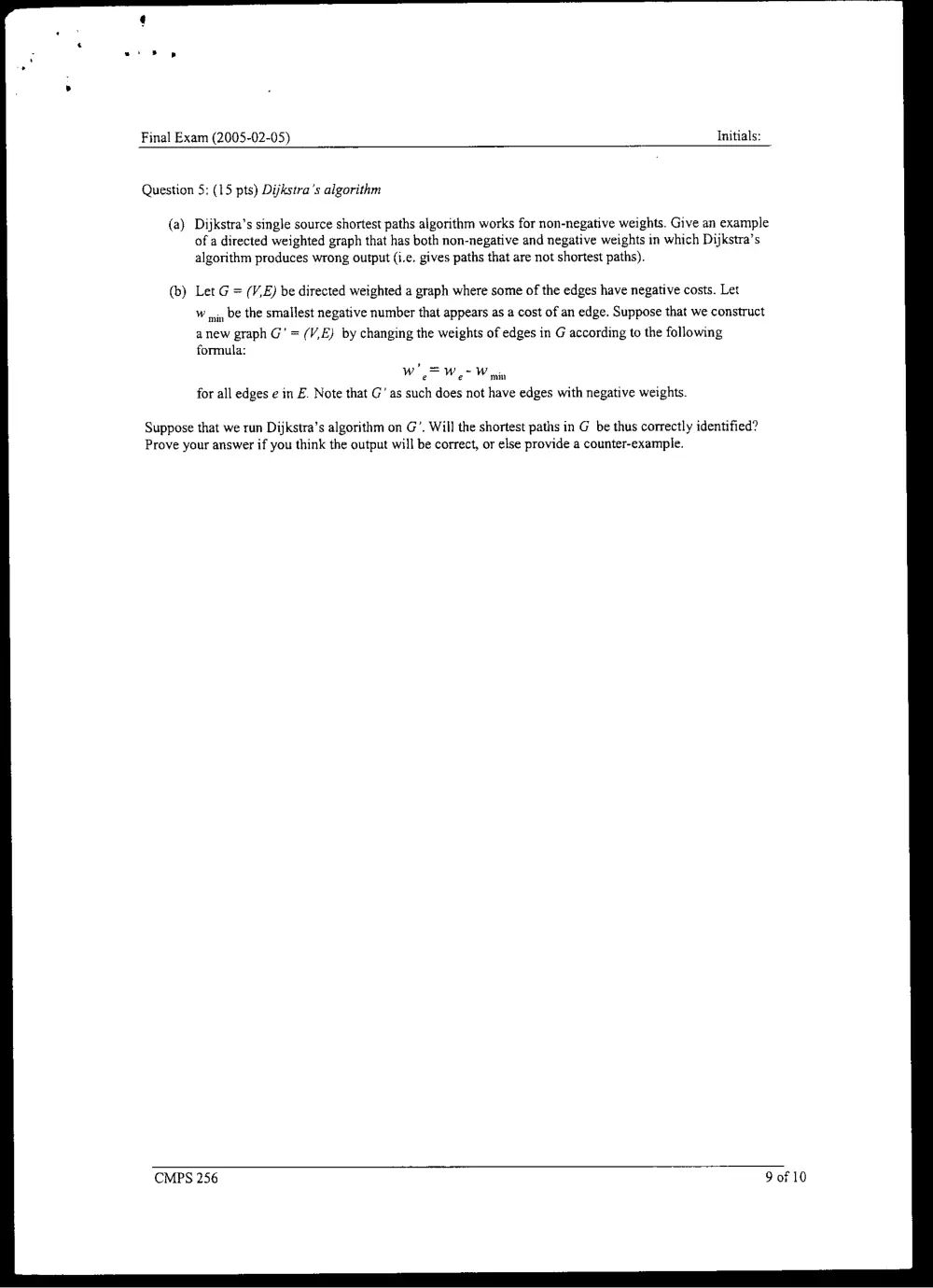
Question 5: (15 pts) Dijkstra’s algorithm
(a) Dijkstra’s single source shortest paths algorithm works for non-negative weights. Give an example
of a directed weighted graph that has both non-negative and negative weights in which Dijkstra’s
algorithm produces wrong output (i.e. gives paths that are not shortest paths).
Let G = (V,E) be directed weighted a graph where some of the edges have negative costs. Let
W min be the smallest negative number that appears as a cost of an edge. Suppose that we construct
anew graph G’ = (V,E) by changing the weights of edges in G according to the following
formula:
Ww i=W,-Ww
min
for all edges e in E. Note that G’ as such does not have edges with negative weights.
Suppose that we run Dijkstra’s algorithm on G’. Will the shortest paths in G be thus correctly identified?
Prove your answer if you think the output will be correct, or else provide a counter-example.
CMPS 256
Final Exam (2005-02-05)
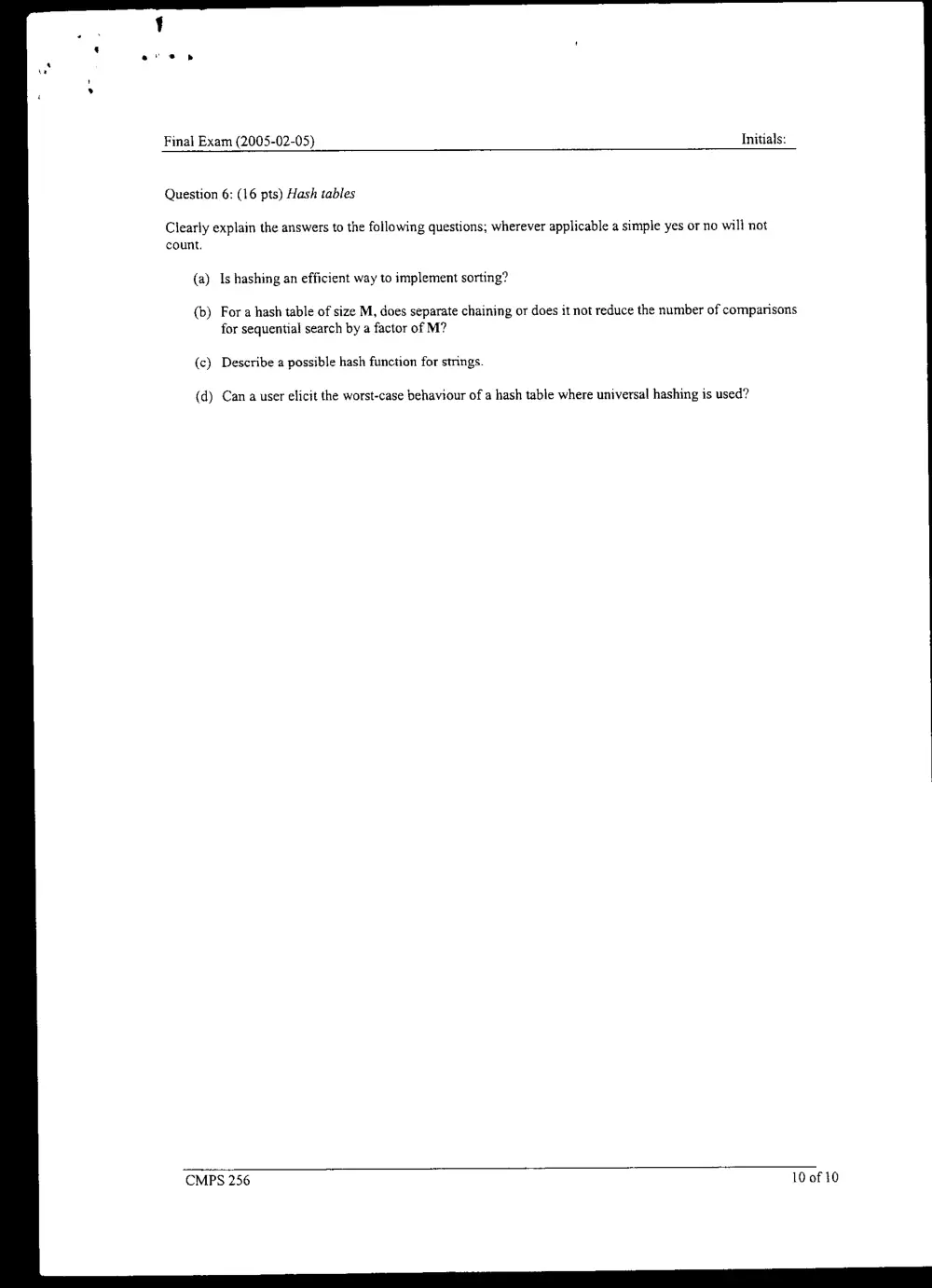
Question 6: (16 pts) Hash tables
Clearly explain the answers to the following questions; wherever applicable a simple yes or no will not
count.
(a) Is hashing an efficient way to implement sorting?
For a hash table of size M, does separate chaining or does it not reduce the number of comparisons
for sequential search by a factor of M?
Describe a possible hash function for strings.
Can a user elicit the worst-case behaviour of a hash table where universal hashing is used?
CMPS 256