
CMPS 256 Final, Fall 2004
American University of Beirut · Advanced Algorithms and Data Structures · 11 pages



Showing the first 10 of 11 pages. Download the PDF to see all of it.
More CMPS 256 files
- Final Solutions · Fall 2013Final exam · with solutionView
- Final · Fall 2013Final examView
- Final Solutions · Fall 2012Final exam · with solutionView
- Final · Fall 2005Final examView
- Final · Spring 2004Final examView
- Final · Fall 2004Final examView
- Final · Fall 2003Final examView
- Final · Fall 2003Final examView
Show the text of this final exam
AMEKICAN UNTVERSIT
LIBRARY
OF BEIRUT
CMPS 256 Fall 2004
Exam 3: Final Exam
C. BenAbdelkader 01/02/05
(This exam is for Sections 2& 3 only)
Section: 0.0.0... cece cee cece reece
Time: 120 MINUTES
Important Notes ...
e This exam is closed-book and closed notes. You are allowed to use no more than
TWO PAGES of notes (A4 paper), front and back.
You may NOT use any calculators.
Make sure there are 11 pages and 7 problems for a total of 104 points.
Use pseudo-code notation discussed in class to write any algorithms you are asked
to write.
Write as legibly as you can, otherwise your answer will NOT be marked!
Unless otherwise stated, assume the adjacency list representation for all graphs.
Question | Your Grade
1
Exam 3: Final Exam
Question 1: (30 Points) Short-Answer Questions
(a) (4 points)
Write an algorithm Rearrange(A) that takes an array of numbers (but not neces-
sarily integers!), A, and rearranges it in-place such that all the negative numbers
(< 0) precede all the nonnegative numbers (> 0). What is the running time of your
algorithm? For full credit, your algorithm should use only constant additional
storage, regardless of the size of A, and should be as efficient as possible. A naive
Q(n?)-time solution will get ZERO credit.
(6 points)
Consider the following weighted graph G = (V.£), where the edges are stored
in the adjacency list in the following order: (s,u), (s,v), (u,v), (v, 2), (2, y), (YU).
Suppose path p = (s,u,v,2) is a shortest path from vertex s to vertex z. As-
suming arbitrary edge weights, circle the correct answer in each of the following
questions.
(i) True or False: if we run Dijkstra’s algorithm on this graph, then d[x] might
converge to its true value before d[v| converges to its true value.
(ii) True or False: if we run Bellman-Ford algorithm on this graph, then dz]
might converge to its true value before d|v] converges to its true value.
(iii) True or False: if we run Dijkstra’s algorithm on this graph, then diu} is
always the first to converge to its true value (aside from d{s] of course).
(iv) True or False: if we run Bellman-Ford algorithm on this graph, then d[u]
is always the first to converge to its true value (aside from d{s] of course).
(v) True or False: if we run Dijkstra’s algorithm on this graph, then d{y] is
always the last to converge to its true value.
(vi) True or False: if we run Bellman-Ford algorithm on this graph, then d[y] is
always the last to converge to its true value.
Exam 3: Final Exam
(c) (6 points)
Given a directed graph G = (V, E) and a source vertex s € V, prove that if at any
point during the Bellman-Ford algorithm, 7[(s] is set to a non NIL value, then G
must contain a negative-weighted cycle. For partial credit, illustrate your answer
with an small graph, clearly indicating vertex s and values of edge weights.
(d) (4 points)
Based on (c), consider the following modification to Bellman-Ford algorithm: in-
stead of checking whether d{v] > d[u]+w/(u, v) for all edges (u,v) in the graph, we
simply check if 2[s]=NIL. Is this correct? why or why not?
Exam 3: Final Exam 3-4
(e) (4 points)
Compute the asymptotic time complexity of the following divide-and-conquer al-
gorithm. You may assume that n is a power of 2. (NOTE: It doesn’t matter what
this does!).
Useless(A)
n < length[A]
ifn ==1
then return A[1]
let Al and A2 be two arrays of size n/2
for i=1 to n/2
do Alfi} — Afi]
A2li] — A[n/2 + i}
fori=1 to n/2
do for j =i+1 to n/2
do if Alfi] == A2[j]
then A2[j] -— 0
bl — Useless(Al)
b2 — Useless(A2)
return max(b1, b2)
(f} (6 points)
Given a graph G = (V, £) and a vertex v € V, describe a O(V + E)-time algorithm
that outputs all vertices that are reachable from v in G. Your algorithm can call
DFS, but it cannot call any other algorithm. Briefly discuss the running time of
your algorithm.
Exam 3: Fina] Exam
Question 2: (12 Points)
(a) Suppose you wish to create a hash table of all the computer science students using
as the key each student’s AUB number (which as you know is a nine-digit number),
and suppose you have decided to implement the hash table using an unsigned long
integer array of size 499§with quadratic probing to resolve conflicts. (by the way,
both 4999 and 997 are prime numbers.)
Consider the following three possible hash functions. Explain which one you think
might be the best to use. Note that digit; is the ith digit of the student’s AUB
number (and hence an integer value between 0 and 9).
1. (digits + digit, + digit, +---+digitg) mod 4999.
2. AUBNumber mod 4999.
3. (digits + digit, * 997 + digit, * 997? + ...digits + 9978) mod 4999.
(b) You are inserting the strings shown in the Table below with their corresponding
hash values into a hash table of size 11.
String | Hash value
*pea” 12
leek” 26
”bean” 20
yam” 37
*corn” 33
”kale” 10
” okra” 31
Assuming the hash table is implemented with open addressing and linear probing,
and that the strings are inserted in the order they appear in the Table above (Le.
pea” first and “okra” last), fill in the slots of the hash table below.
9) 1 2 3 4 =) 6 7 8 9 10
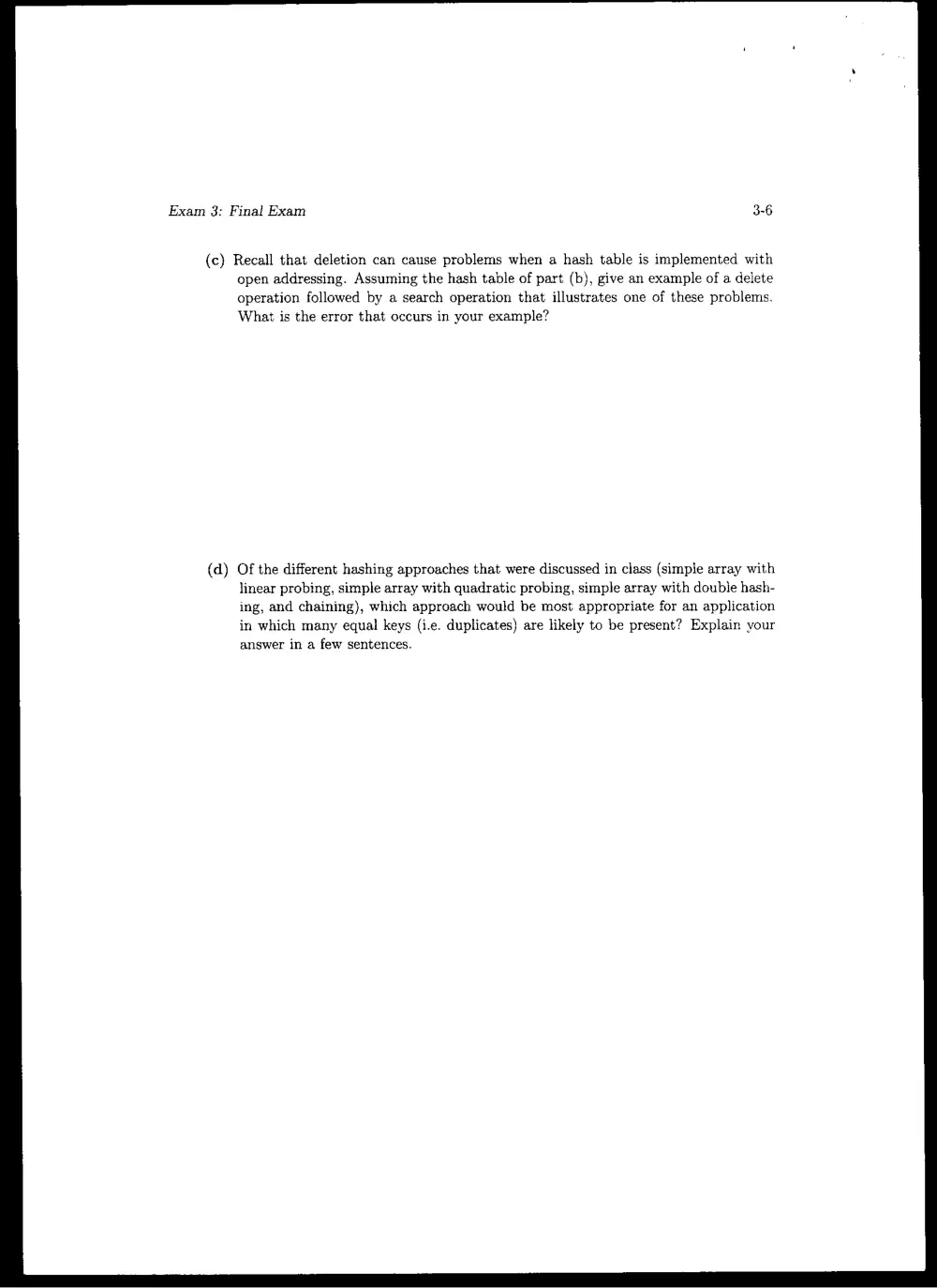
Exam 3: Final Exam 3-6
(c) Recall that deletion can cause problems when a hash table is implemented with
open addressing. Assuming the hash table of part (b), give an example of a delete
operation followed by a search operation that illustrates one of these problems.
What is the error that occurs in your example?
(d) Of the different hashing approaches that were discussed in class (simple array with
linear probing, simple array with quadratic probing, simple array with double hash-
ing, and chaining), which approach would be most appropriate for an application
in which many equal keys (i.e. duplicates) are likely to be present? Explain your
answer in a few sentences.
Exam 3: Fina] Exam
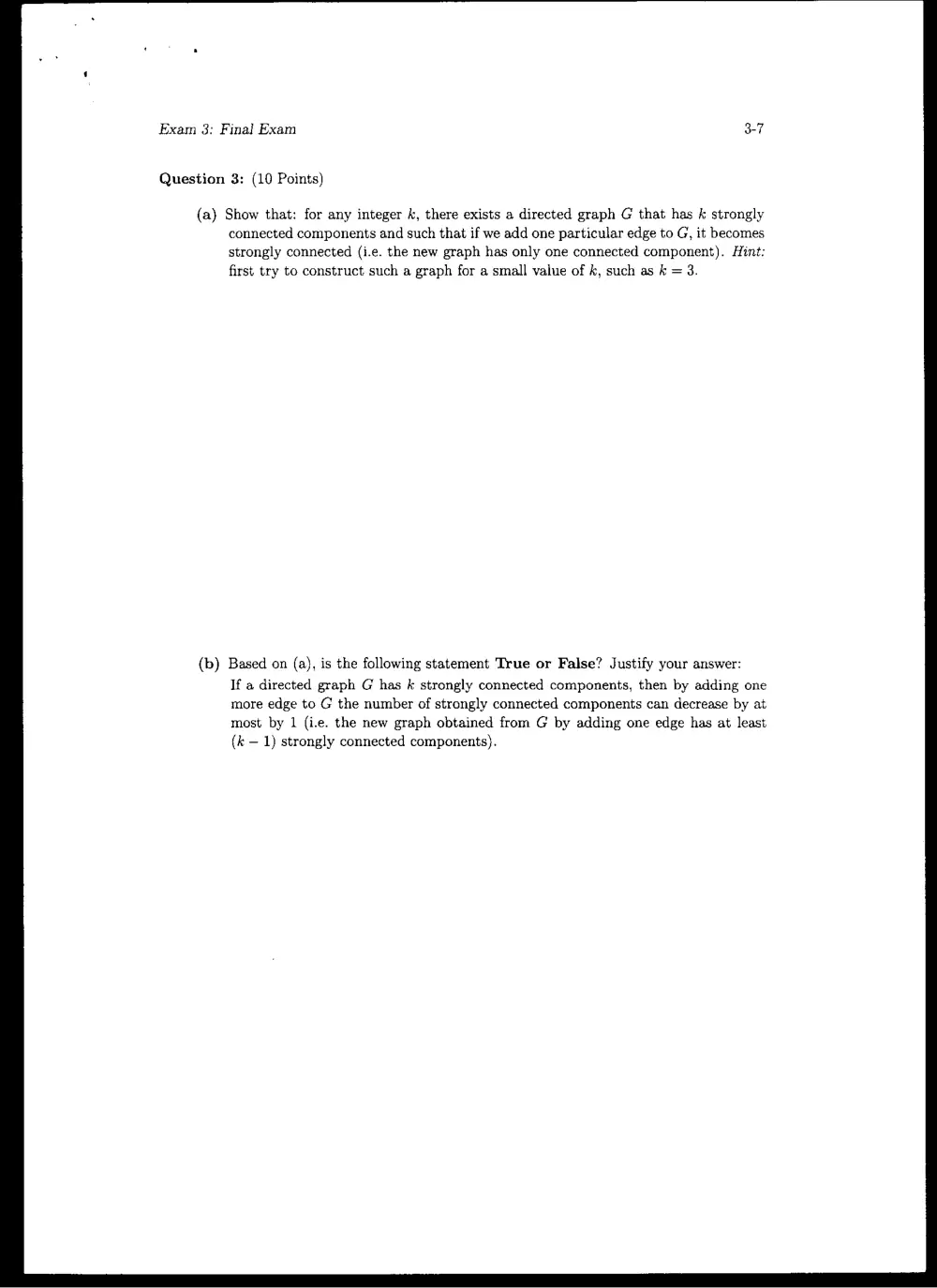
Question 3: (10 Points)
(a) Show that: for any integer k, there exists a directed graph G that has k strongly
connected components and such that if we add one particular edge to G, it becomes
strongly connected (i.e. the new graph has only one connected component). Hint:
first try to construct such a graph for a small value of k, such as k = 3.
(b) Based on (a), is the following statement True or False? Justify your answer:
If a directed graph G has k strongly connected components, then by adding one
more edge to G the number of strongly connected components can decrease by at
most by 1 (ie. the new graph obtained from G by adding one edge has at least
(k — 1) strongly connected components).
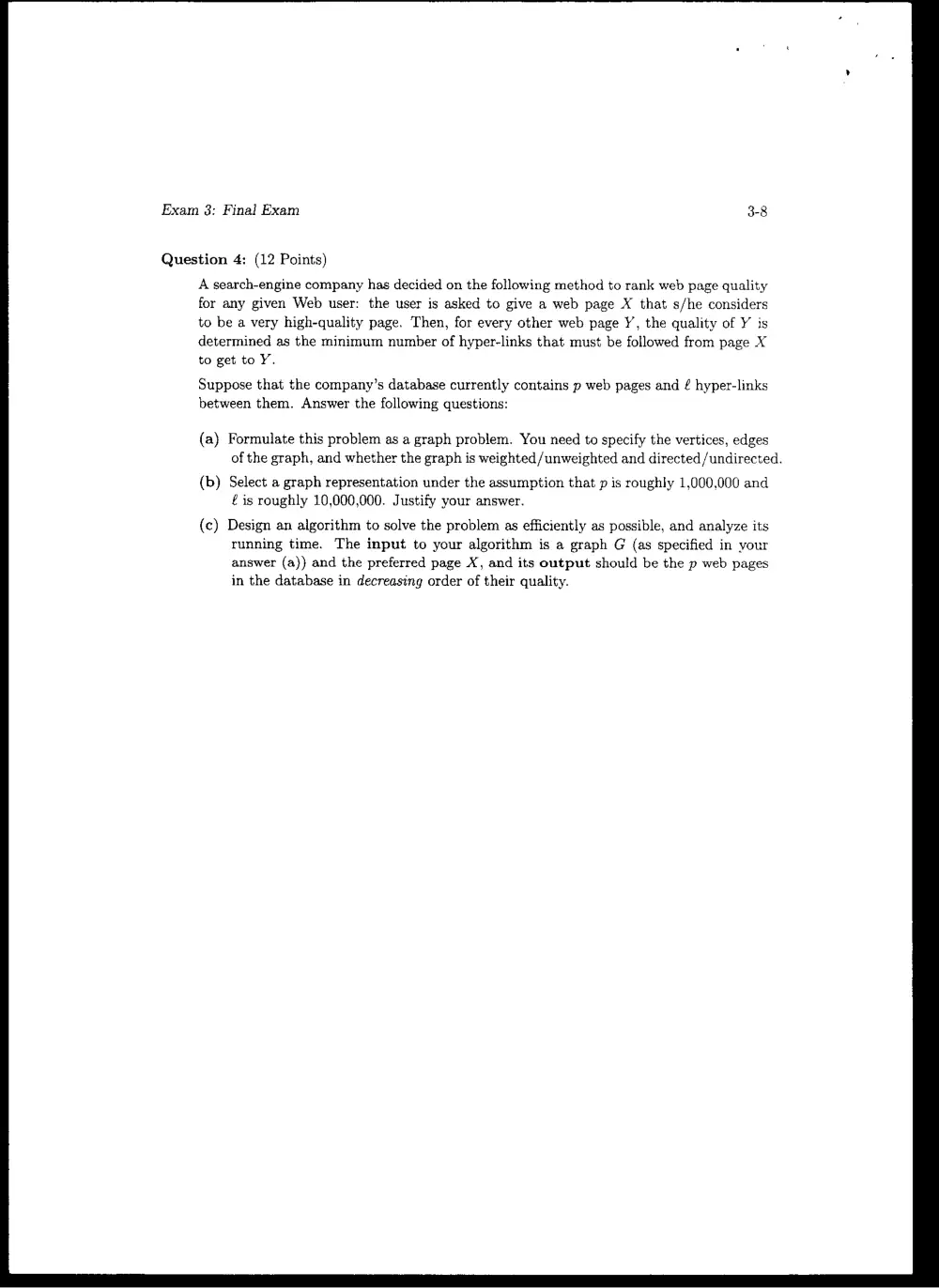
Exam 3: Final Exam
Question 4: (12 Points)
A search-engine company has decided on the following method to rank web page quality
for any given Web user: the user is asked to give a web page X that s/he considers
to be a very high-quality page. Then, for every other web page Y, the quality of Y is
determined as the minimum number of hyper-links that must be followed from page X
to get to Y.
Suppose that the company’s database currently contains p web pages and @ hyper-links
between them. Answer the following questions:
(a) Formulate this problem as a graph problem. You need to specify the vertices, edges
of the graph, and whether the graph is weighted / unweighted and directed /undirected.
(b) Select a graph representation under the assumption that p is roughly 1,000,000 and
£ is roughly 10,000,000. Justify your answer.
(c) Design an algorithm to solve the problem as efficiently as possible, and analyze its
running time. The input to your algorithm is a graph G (as specified in your
answer (a)) and the preferred page X, and its output should be the p web pages
in the database in decreasing order of their quality.
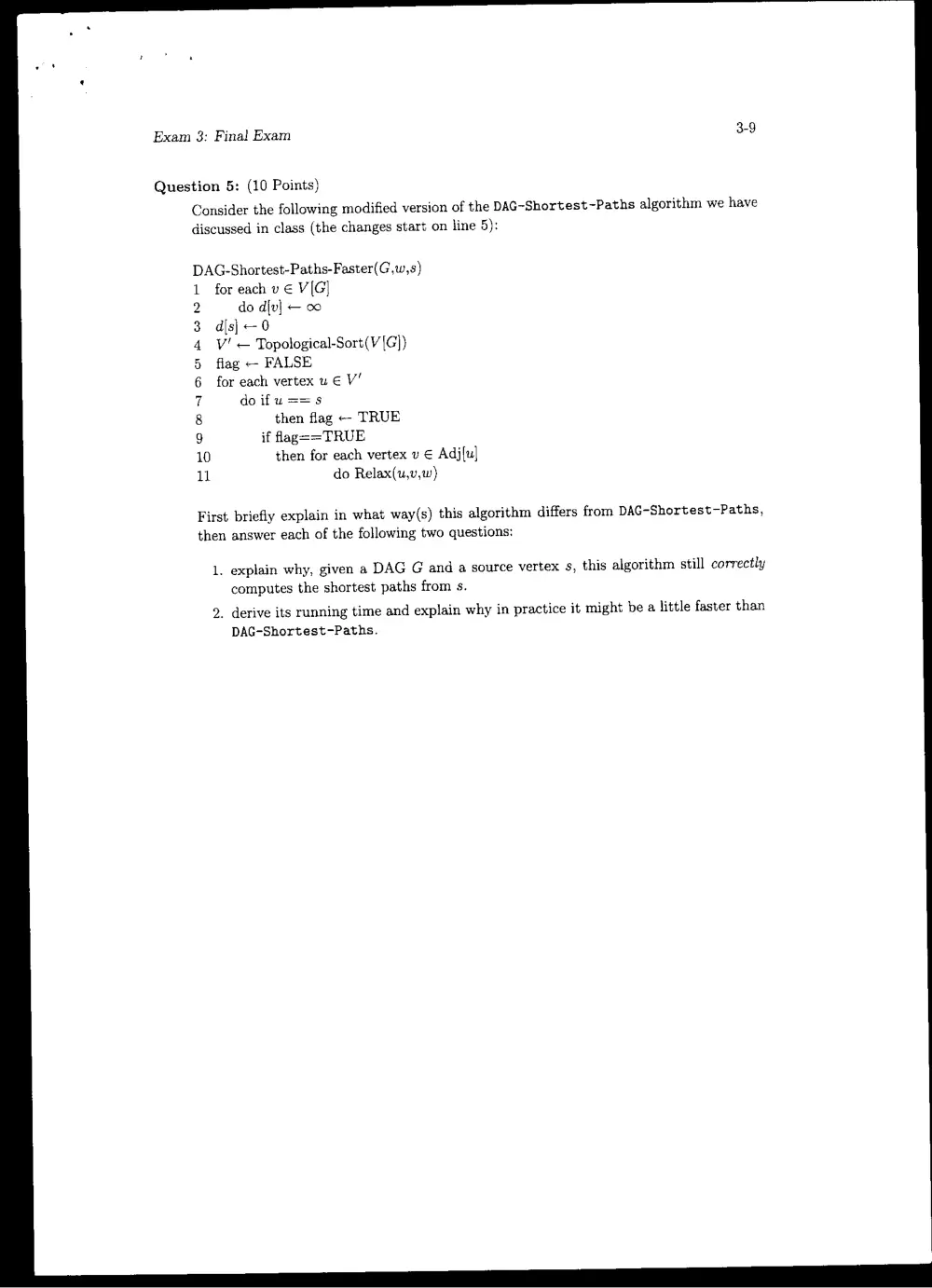
Exam 3: Final Exam 3-9
Question 5: (10 Points)
Consider the following modified version of the DAG-Shortest~Paths algorithm we have
discussed in class (the changes start on line 5):
DAG-Shortest-Paths-Faster(G,w,s)
for each v € V[G]
do div] — co
d{s] — 0
V! — Topological-Sort(V [G]}
flag «- FALSE
for each vertex u € V’
do ifu == s
then flag -- TRUE
if lag==TRUE
0 then for each vertex v € Adj{u]
1 do Relax(u,v,w)
PrP oOwONaankhwWnr
First briefly explain in what way(s) this algorithm differs from DAG-Shortest-Paths,
then answer each of the following two questions:
1. explain why, given a DAG G and a source vertex s, this algorithm still correctly
computes the shortest paths from s.
2. derive its running time and explain why in practice it might be a little faster than
DAG-Shortest-Paths.
Exam 3: Final Exam
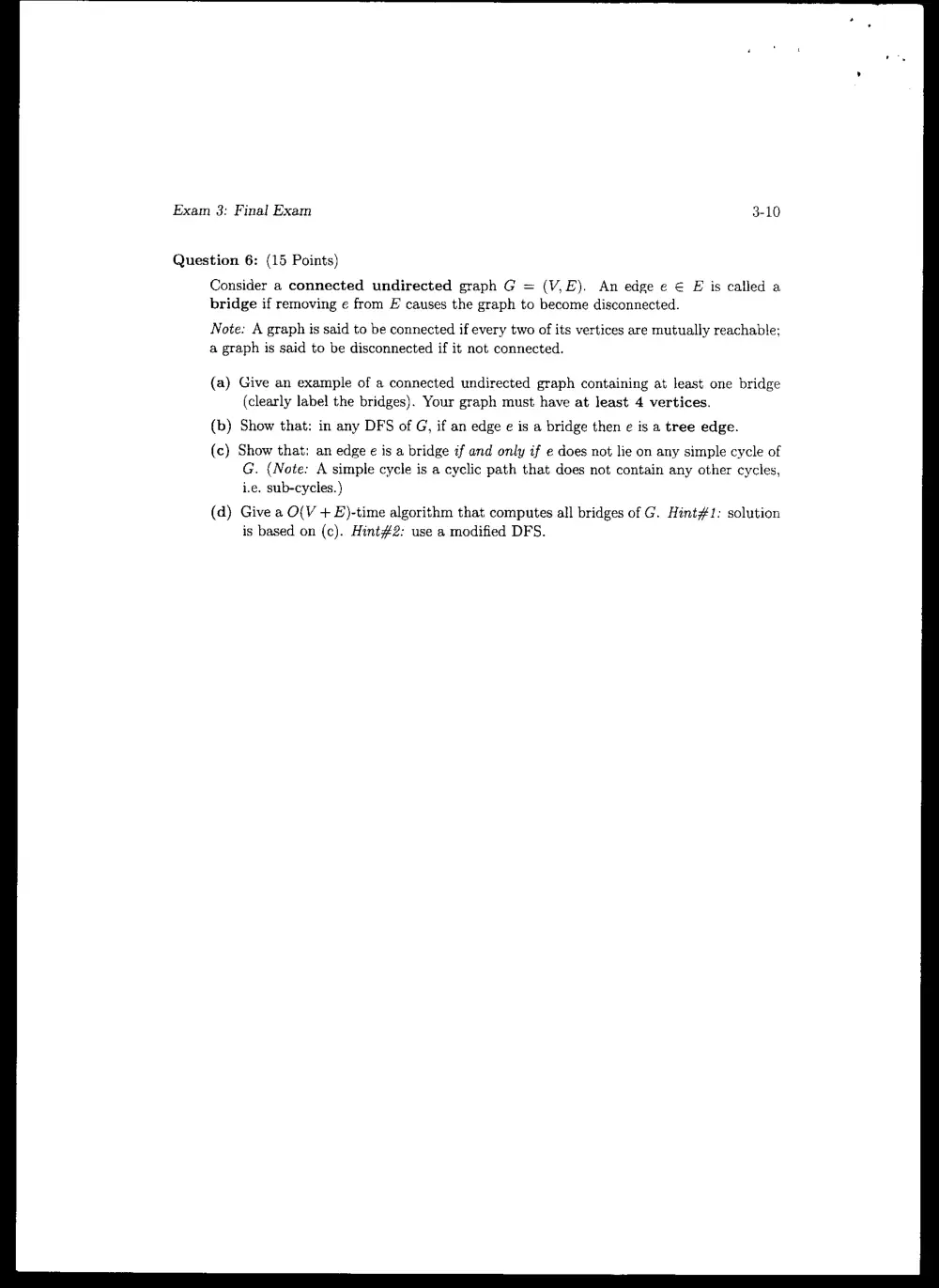
Question 6: (15 Points)
Consider a connected undirected graph G = (V,E). An edge e € E is called a
bridge if removing e from & causes the graph to become disconnected.
Note: A graph is said to be connected if every two of its vertices are mutually reachable;
a graph is said to be disconnected if it not connected.
(a) Give an example of a connected undirected graph containing at least one bridge
(clearly label the bridges). Your graph must have at least 4 vertices.
(b) Show that: in any DFS of G, if an edge e is a bridge then e is a tree edge.
(c) Show that: an edge ¢ is a bridge if and only if e does not lie on any simple cycle of
G. (Note: A simple cycle is a cyclic path that does not contain any other cycles,
ie. sub-cycles.)
(d) Give a O{V + E)-time algorithm that computes all bridges of G. Hint#1: solution
is based on (c). Hint#2: use a modified DFS.