
CMPS 256 Final, Fall 2003
American University of Beirut · Advanced Algorithms and Data Structures · 5 pages



More CMPS 256 files
- Final Solutions · Fall 2013Final exam · with solutionView
- Final · Fall 2013Final examView
- Final Solutions · Fall 2012Final exam · with solutionView
- Final · Fall 2005Final examView
- Final · Spring 2004Final examView
- Final · Fall 2004Final examView
- Final · Fall 2004Final examView
- Final · Fall 2003Final examView
Show the text of this final exam
American University of Beirut
CMPS 256
Advanced Algorithms and Data Structures
Fal! 2003-2004
Final Exam
Date: Jan. 24", 2004. 11:00 — 1:00pm.
Instructors: Chiraz Benabdelkader & Jihad Boulos
TD fy nanan nnn
Section: -------------------------------
This is NEITHER an open-book, NOR an open-notes exam. You are allowed to have 6
A4 format papers (front-and-back) on which you can write whatever you like.
Your exam should have 14 pages, and there are 7 questions totaling 100 points. Your
answers should be concise, and when possible should be a list of important points rather
than prose. Solve as many problems as you can. We recommend that you start with
problems you think look the easiest. We also advise you to spend time on understanding
what is being asked by each problem and budget your time wisely to be able to solve all
problems.
Beware, wordy and/or irrelevant answers might reduce your score for that problem. Your
answers should be the summary of work done on scratch paper that you do not hand in.
Also, do not expect that the instructor will spend much time trying to decipher your hand
writing. S/he will give a ZERO to illegible answers. The space allocated for answers
should be sufficient. If not, use your own additional papers.
Max Grade
Your Grade
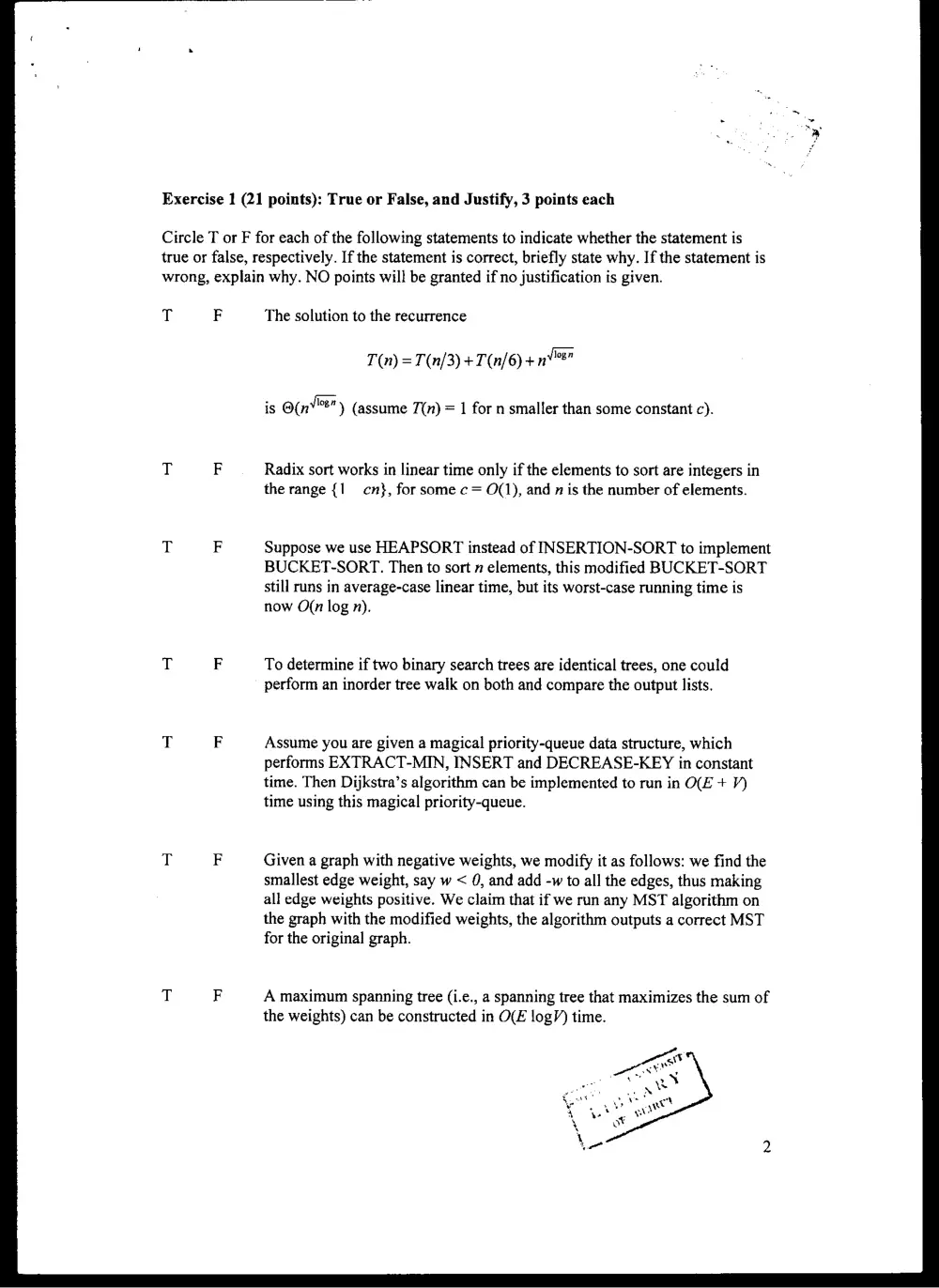
Exercise 1 (21 points): True or False, and Justify, 3 points each
Circle T or F for each of the following statements to indicate whether the statement is
true or false, respectively. If the statement is correct, briefly state why. If the statement is
wrong, explain why. NO points will be granted if no justification is given.
T F The solution to the recurrence
T(n) =7(n[3) +T(n/6) + n¥8"
is @(n"8") (assume 7(n) = 1 for n smaller than some constant c).
T F Radix sort works in linear time only if the elements to sort are integers in
the range {1 cn}, for some c = O(1), and n is the number of elements.
T F Suppose we use HEAPSORT instead of INSERTION-SORT to implement
BUCKET-SORT. Then to sort n elements, this modified BUCKET-SORT
still runs in average-case linear time, but its worst-case running time is
now O(n log 7).
T F To determine if two binary search trees are identical trees, one could
perform an inorder tree walk on both and compare the output lists.
T F Assume you are given a magical priority-queue data structure, which
performs EXTRACT-MIN, INSERT and DECREASE-KEY in constant
time. Then Dijkstra’s algorithm can be implemented to run in OE + VY)
time using this magical priority-queue.
T F Given a graph with negative weights, we modify it as follows: we find the
smallest edge weight, say w < 0, and add -w to all the edges, thus making
all edge weights positive. We claim that if we run any MST algorithm on
the graph with the modified weights, the algorithm outputs a correct MST
for the original graph.
T F A maximum spanning tree (i.e., a spanning tree that maximizes the sum of
the weights) can be constructed in O(E logV) time.
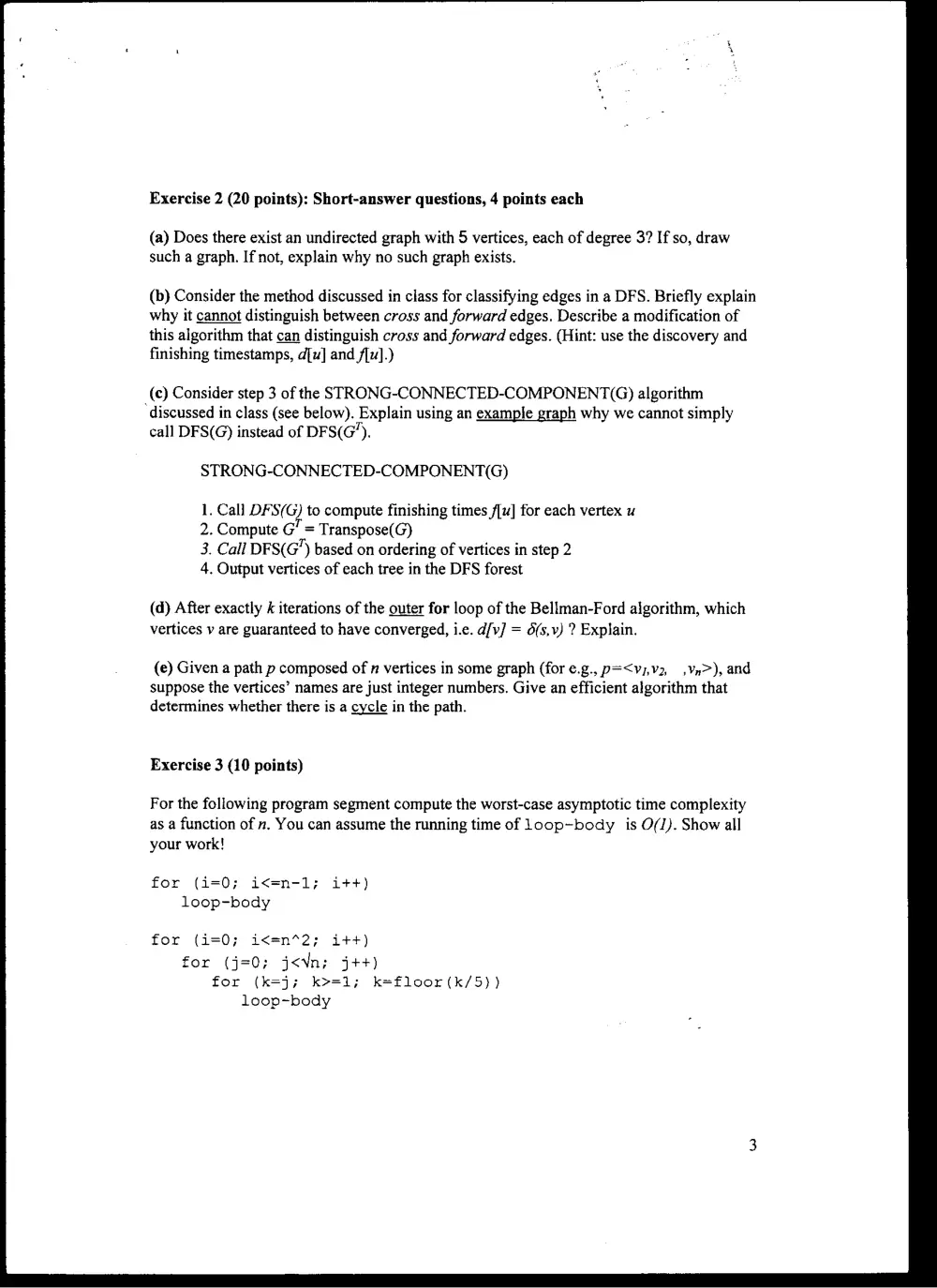
Exercise 2 (20 points): Short-answer questions, 4 points each
(a) Does there exist an undirected graph with 5 vertices, each of degree 3? If so, draw
such a graph. If not, explain why no such graph exists.
(b) Consider the method discussed in class for classifying edges in a DFS. Briefly explain
why it cannot distinguish between cross and forward edges. Describe a modification of
this algorithm that can distinguish cross and forward edges. (Hint: use the discovery and
finishing timestamps, d[u] and f[u].)
(c) Consider step 3 of the STRONG-CONNECTED-COMPONENT(G) algorithm
‘discussed in class (see below). Explain using an example graph why we cannot simply
call DFS(G) instead of DFS(G’).
STRONG-CONNECTED-COMPONENT(G)
1. Call DFS(G) to compute finishing times f[u] for each vertex u
2. Compute G" = Transpose(G)
3. Call DFS(G’) based on ordering of vertices in step 2
4. Output vertices of each tree in the DFS forest
(d) After exactly & iterations of the outer for loop of the Bellman-Ford algorithm, which
vertices v are guaranteed to have converged, i.e. d/v] = o(s,v) ? Explain.
(e) Given a path p composed of n vertices in some graph (for e.g., p=<vj,v2,_ ,Vn>), and
suppose the vertices’ names are just integer numbers. Give an efficient algorithm that
determines whether there is a cycle in the path.
Exercise 3 (10 points)
For the following program segment compute the worst-case asymptotic time complexity
as a function of n. You can assume the running time of loop-body is O(/). Show all
your work!
for (i=0; i<=n-1; i++)
loop-body
for (i=0; i<=n*2; i++)
for (j=0; 4<Vn; j++)
for (k=j; k>=1; k=floor(k/5))
loop-body
ween
Exercise 4 (10 points) BFS
Suppose we run the BFS algorithm on a given graph G = (V, E) and some source vertex
Ss.
(a) Show that: V (u, v) € E, if (u, v) is a non-tree edge (i.e. it is not contained in the BFS
tree) then |d5(s, u) - dfs, v)| < 2
(b) Is the converse true? i.e., V (u, v) € E, if |d(s ,uw) - O(s, v)| < 2 then (wu, v) is a non-tree
edge. Justify your answer.
Exercise 5 (12 points) DFS
Suppose we run the DFS algorithm on a graph G = (V, E), where |V|=n, and let d and fbe
the two n-element arrays output by the algorithm and containing respectively the
discovery and finishing timestamps for each vertex in V.
(a) Write an efficient algorithm that determines the root vertex of each DFS tree in the
DFS forest based only on arrays d and f. Your algorithm should return the result in an
array R containing the indices of all root vertices.
(b) Write an efficient algorithm that determines all the leaves in the DFS forest based
only on arrays d and f- Again, your algorithm should return the result in an array L
containing the indices of the leaf vertices.
Exercise 6 (12 points): Pattern Matching
Assume you are given a text array 7[1 _n] containing letters from the standard English
alphabet. In other words, 7[i] € {a,b, z}fori=1 n. In addition, you are given a
pattern array P[1 m), m <n, which also contains letters from the English alphabet. For
any sub-array 7,” = 7[i...i+m-—T] of T, we say that 7,” is an anagram of P if there is a
way of permuting symbols in 7,” so that the resulting array is equal to P. For example, if
T= “solutionislimited” and P="time” then 73 is an anagram of P.
a. Give an O(m) algorithm that, given an index i (and m), determines whether 7,” is
an anagram of P.
b. Design an algorithm, which given T and P as an input, reports all i's such that 7,”
is an anagram of P. Ideally, your algorithm should run in O(7 + m) time.
However, partial credit will also be given for less efficient solutions.
Exercise 7 (15 points):
Imagine you found yourself stranded on an island in the middle of the ocean. The island
is connected by bridges to other islands, which are in turn connected to other islands by
other bridges, and eventually connected to the land. Unfortunately, it turns out that these
bridges are rickety, i.e. each has some probability of failure. Furthermore, every bridge is
marked at both entrances with some reliability measure stating its probability of failure,
i.e. a value between 0 and | that measures the likelihood that the bridge will collapse (it
is close to 0 if the bridge is very unlikely to collapse and close to | if it is very likely to
collapse).
Your goal is ultimately to get from that island s to the land ¢ safely, by trying to cross the
most reliable bridges. To this end, you’ve created a weighted graph with each island as a
vertex and each bridge as an edge. .
a) For any edge (u,v), let p(u,v) be the probability of failure of the corresponding bridge,
and for any path p=<v,, vz,__, vg>, let A(p) be the probability of failure of that path.
Assuming that a path fails if any of the bridges on that path fails, and that bridges fail
independently of each other, express A(p) as a function of p(v,,v2), p(v2, v3), Pen,
vid
b) To maximize your chances of reaching land safely, you want to find the path from s
to ¢ that has the minimum probability of failure. Design a polynomial-time algorithm
that finds such a path. Briefly analyze the running time of your algorithm.
Hint: The shortest-paths algorithms discussed in class work when the weight of a path
w(p) is equal to the sum of all the edge weights on path p.