
CMPS 256 Final, Fall 2003
American University of Beirut · Advanced Algorithms and Data Structures · 16 pages





Showing the first 10 of 16 pages. Download the PDF to see all of it.
More CMPS 256 files
- Final Solutions · Fall 2013Final exam · with solutionView
- Final · Fall 2013Final examView
- Final Solutions · Fall 2012Final exam · with solutionView
- Final · Fall 2005Final examView
- Final · Spring 2004Final examView
- Final · Fall 2004Final examView
- Final · Fall 2004Final examView
- Final · Fall 2003Final examView
Show the text of this final exam
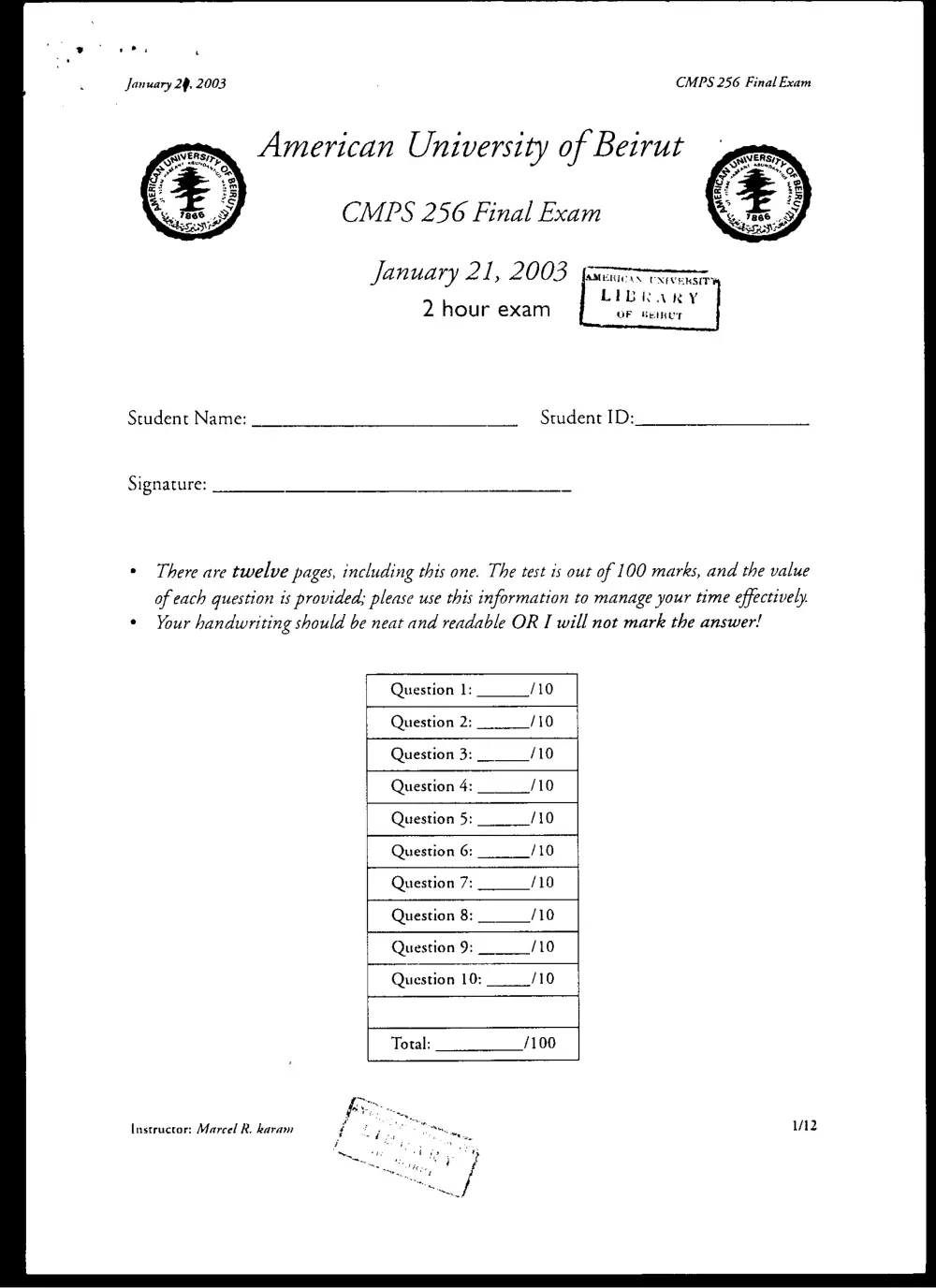
January 29, 2003 CMPS 256 Final Exam
American University of Beirut
CMPS 256 Final Exam
January 21, 2003 AMERICAN CXEVERSITY
LIBRARY
2 hour exam OF GeMUT
Student Name: Student ID:
Signature:
* There are twelve pages, including this one. The test is out of 100 marks, and the value
of each question is provided: please use this information to manage your time effectively.
* Your handwriting should be neat and readable OR I will not mark the answer!
Question 1: /10
Question 2: __ /10
Question 3: /10
Question 4:___/10
Question 5: 110
Question 7: /10
Question 6: /10
Question 8: __. /10
Question 9: __ /10
Question 10: /10
Toral: CS / 1:00
Instructor: Marcel R. karam
‘
January 20, 2003 CMPS 256 Final Exam
Question | [20 points] Multiple Choice
True or false? No explanation required. Each correct answer is worth | points, but | points will
be subtracted for each wrong answer, so answer only if you are reasonably certain.
1-T F By the master theorem, the solution to the recurrence: 7(n) = 37(n/3) + log nis:
O(n dog n)
2-T F Givena graph G= (VE) with cost on edges, anda set Sin V Let (x, v) be an edge
such that (1, v) is the minimum cost edge between any vertex in S and any vertex
in V- S. Then, the minimum spanning tree of G must include the edge (u, v). (You
may assume the costs on all edges are distinct, if needed.)
F Let P bea shortest path from some vertex s to some other vertex ¢ in a graph G.
if the weight of each edge in the graph is increased by one, ? remains a shortest
path from s to ¢.
The breadth first search algorithm makes use of a stack.
The Bellman-Ford algorithm is not suitable if the input graph that has negative-
weight edges
Depth-first search of a graph is asymptotically faster than breadth-first search.
Dijkstra’s algorithm is an example of a greedy algorithm.
The maximum number of edges that can be removed from a graph with
nodes in order to construct a spanning tree is: n(n-1)/2 - (n-1) = (n-1) (n/2 - 1)
You are given a graph in which all edges have non-negative weights, except those
leaving the source vertex s. Then Dijkstra’s algorithm may fail to correctly deter-
mine the shortest paths from s.
Suppose 7 is a minimum spanning tree for a graph G. Then the largest edge
weight of 7 is no larger than the largest edge weight of any other spanning tree
of G.
Instructor: Marcel R. karam
L
January 20, 2003 CMPS 256 Final Exam
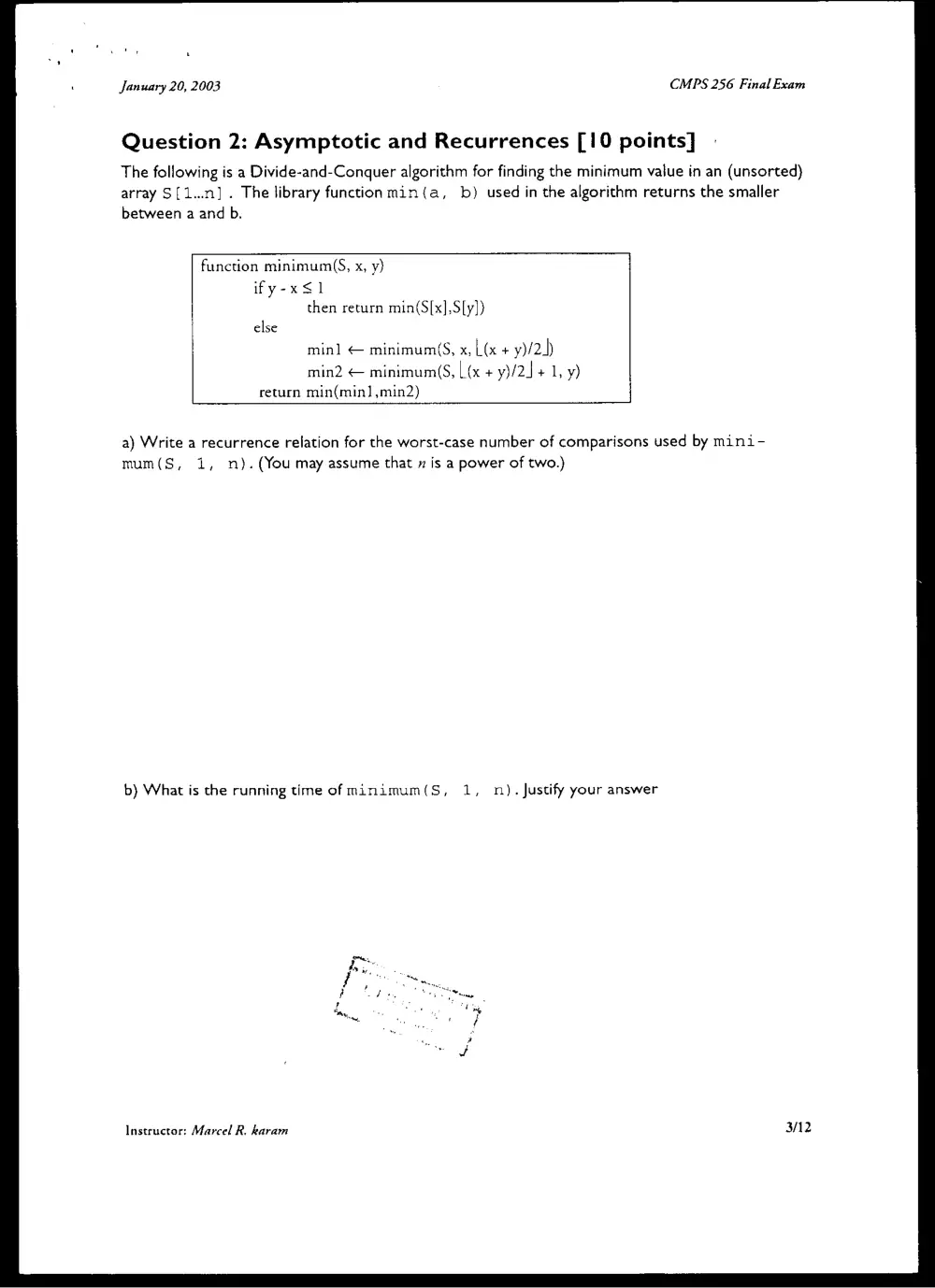
Question 2: Asymptotic and Recurrences [10 points]
The following is a Divide-and-Conquer algorithm for finding the minimum value in an (unsorted)
array S[{1.n]. The library functionmin(a, b) used in the algorithm returns the smaller
between a and b.
function minimum(S, x, y)
ify-x<l
then return min(S[x],S[y])
else
min] © minimum(S, x, L( (x + y) yi2))
min2 © minimum(S, L( (x + y) 2) +l,y)
return min(min] ,min2)
a) Write a recurrence relation for the worst-case number of comparisons used by mini-
mum(S, 1, n). (You may assume that » is a power of two.)
b) What is the running time of minimum(S, 1, n). Justify your answer
Instructor: Marcel R. karam
January 20, 2003 CMPS 256 Final Exam
vy
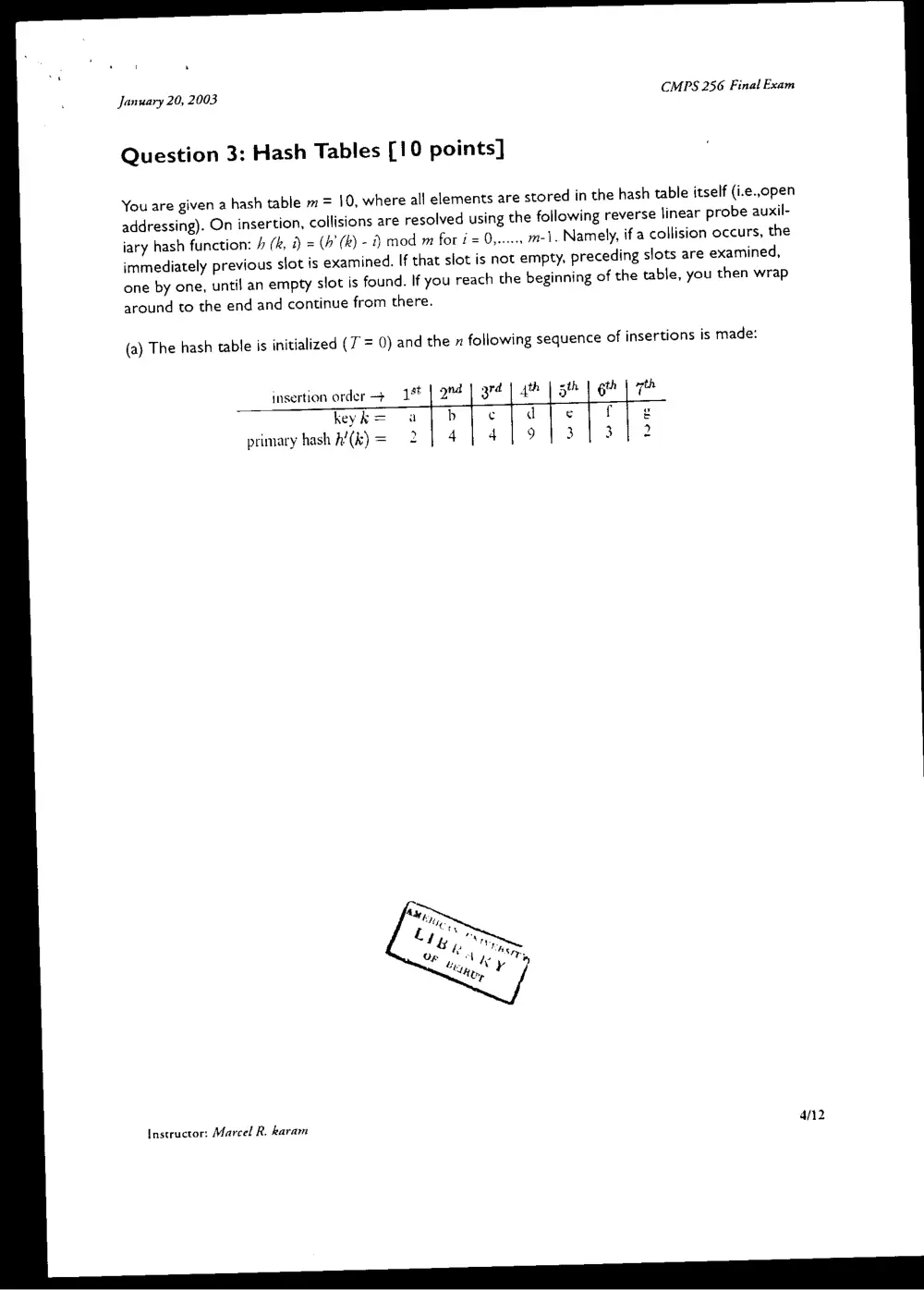
Question 3: Hash Tables [1 0 points]
You are given a hash table m = 10, where all elements are stored in the hash table itself (i.e.,open
addressing). On insertion, collisions are resolved using the following reverse linear probe auxil-
iary hash function: h (hk, i) = (# (2) - i) mod m for i = 0, m-). Namely, if a collision occurs, the
immediately previous slot is examined. If that slot is not empty, preceding slots are examined,
one by one, until an empty slot is found. If you reach the beginning of the table, you then wrap
around to the end and continue from there.
(a) The hash table is initialized (7 = 0) and the x following sequence of insertions is made:
insertion order + 1 | gna | ard | fh | 5th | ge | 7
keyh = a b ¢ d © f g
primary hash A(k)= 2 | 4 4/9 |]3 13 42
Instructor: Marcel R. karam
January 20, 2003 CMPS 256 Final Exam
Question 4: Minimum Spanning Trees [10 points]
Find a minimum spanning tree for the following graph using Prim’s algorithm. Start with vertex A
and show only the final stage of the constructed tree.
Instructor: Marcel R. karam
January 20, 2003 CMPS 256 Final Exam
Question 5: Shortest path [10 points]
Does Dijkstra’s shortest path algorithm produce a correct shortest path for input graphs with
negative edge weights. Prove using an example:
Instructor: Marcel R. karam 6/12
January 20, 2003 CMPS 256 Final Exam
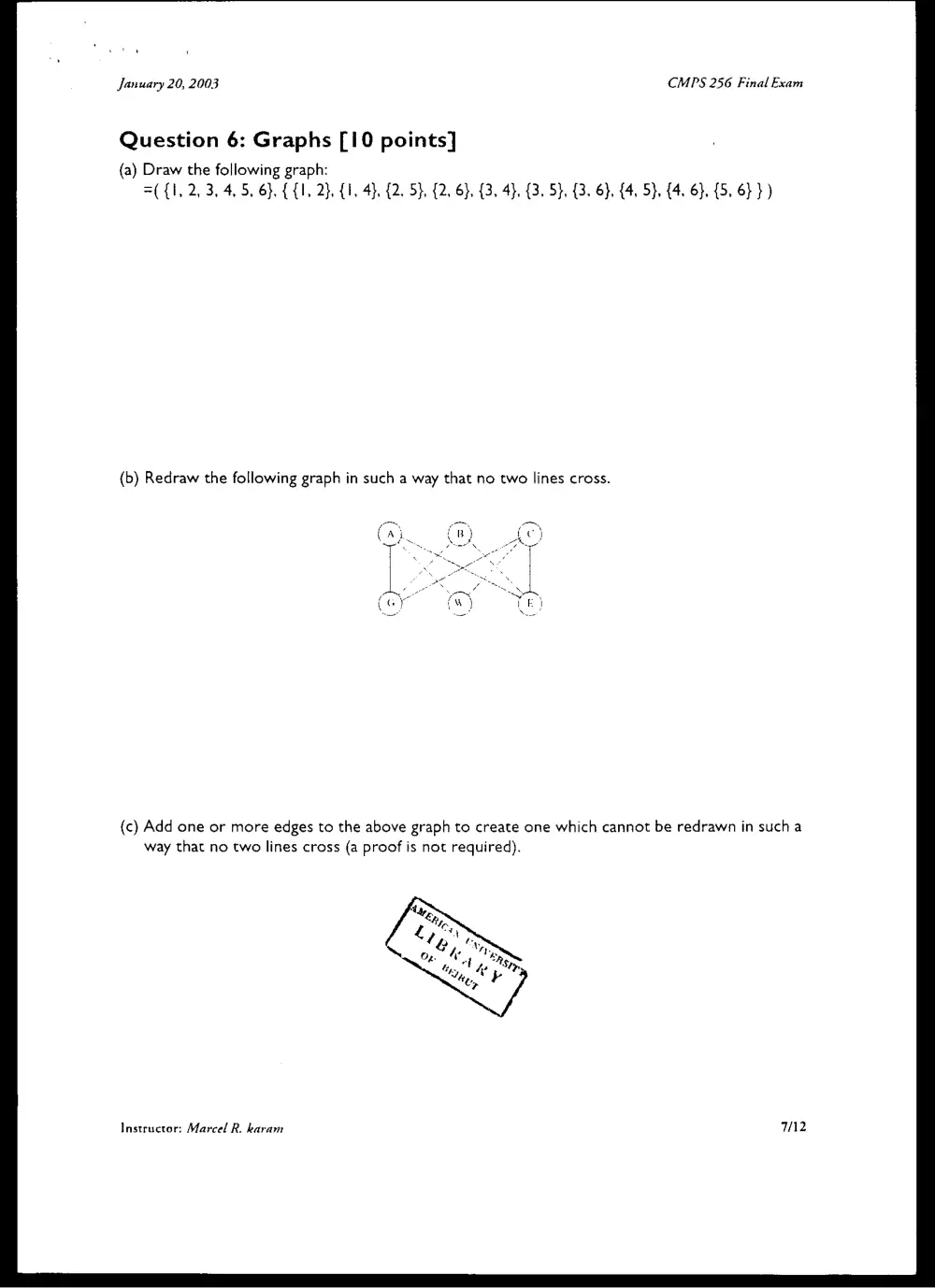
Question 6: Graphs [10 points]
(a) Draw the following graph:
=({I, 2, 3,4, 5, 6}, {{1, 2}, (1, 4}, (2. 5}, (2, 6}, (3, 4}, (3, 5}, 3, 6}, (4, 5}, {4, 6}, (5, 6} })
(b) Redraw the following graph in such a way that no two lines cross.
cn
L»
(c) Add one or more edges to the above graph to create one which cannot be redrawn in such a
way that no two lines cross (a proof is not required).
Instructor: Marcel R. karam TAZ
January 20, 2003 CMPS 256 Final Exam
Question 7 [10 points]
Given a specific edge (u, v) of a graph G =(V E) devise an algorithm which constructs a spanning
tree of G containing (u, v)
Instructor: Marcel R. karam
January 20, 2003 CMPS 256 Final Exam
Question 8 [10 points]
You are given a connected directed graph G = (V £) where every edge has the same positive
integer weight & There is a distinguished vertex ¢ in this graph and we want to know the shortest
distance from each of the other vertices to this distinguished vertex ¢. Present an algorithm, with
the best asymptotic upper bound for the worst case running time, that solves this problem.
Hint: You can solve this in a couple of ways, using algorithms and data structures we have cov-
ered in this course. Your first approach may, or may not, be the best asymptotic one. So, think
twice.
Instructor: Marcel R. karam
‘
January 20, 2003 CMPS 256 Final Exam
Question 9 [10 points]
Recall Kruskal’s algorithm to produce a Minimum Spanning Tree (MST). For convenience, the
algorithm from the book is copied here:
MST-KRUSKAL(G, 18)
1 Acd © A will be MST.
2. for each vertex v € VG]
3. do MAKE-SET(v) ‘i Create forest of singleton trees.
4. sort the edges E into nondecreasing order by weight w
5. for each edge (u,v) € E. taken in nondecreasing order by weight
6. do if FIND-SET(u) # FIND-SET(v) — 4 Are wand v in disjoint trees?
7. then A+ AU{(u,v}} ff Yes. Add edge (u,v) to MST.
8. UNION(u, 0) “ Join disjoint trees connected by edge (u,?
9. return 4
Describe how to modify Kruskal’s algorithm to find a Maximum Spanning Tree, instead o fa Mini-
mum Spanning Tree.
Instructor: Marcel R. karam 10/12