
EECE 491 Lecture 11, Spring 2016
American University of Beirut · Discrete-time Signal Processing · 27 pages





Showing the first 10 of 27 pages. Download the PDF to see all of it.
More EECE 491 files
Show the text of this lab
Prof.
M.
Mansour
EECE
491:
Discrete-‐time
Signal
Processing
1
EECE
491:
Discrete-‐time
Signal
Processing
Mohammad
M.
Mansour
Dept.
of
Electrical
and
Compute
Engineering
American
University
of
Beirut
Lecture
11:
Multirate
Signal
Processing
Prof.
M.
Mansour
EECE
491:
Discrete-‐time
Signal
Processing
2
Announcements
§
Reading
–
O&S
• Chapter
4
Prof.
M.
Mansour
EECE
491:
Discrete-‐time
Signal
Processing
3
Outline
§
Filtering
and
compression/expansion
§
Polyphase
decompositions
§
Multirate
filter
banks
Prof.
M.
Mansour
EECE
491:
Discrete-‐time
Signal
Processing
4
Sample-‐Rate
Conversion
§
We
can
change
the
sample
rate
of
D.T.
signal
by
a
combination
of
interpolation
and
decimation
–
To
obtain
a
new
sampling
rate
of
1.01T,
we
can
first
interpolate
by
L =
100,
then
decimate
by
M
=
101.
–
These
large
intermediate
changes
in
sampling
rate
would
require
large
amounts
of
computations.
§
Can
take
advantages
of
techniques
broadly
known
as
multirate
signal
processing
–
They
utilize
upsampling,
downsampling,
compressors,
and
expanders
to
increase
efficiency
of
SP
systems
–
Applications
besides
sample
rate
conversion:
• A/D
and
D/A
systems
that
exploit
oversampling
and
noise
shaping
• Filter
banks
for
the
analysis
and
processing
of
signals
§
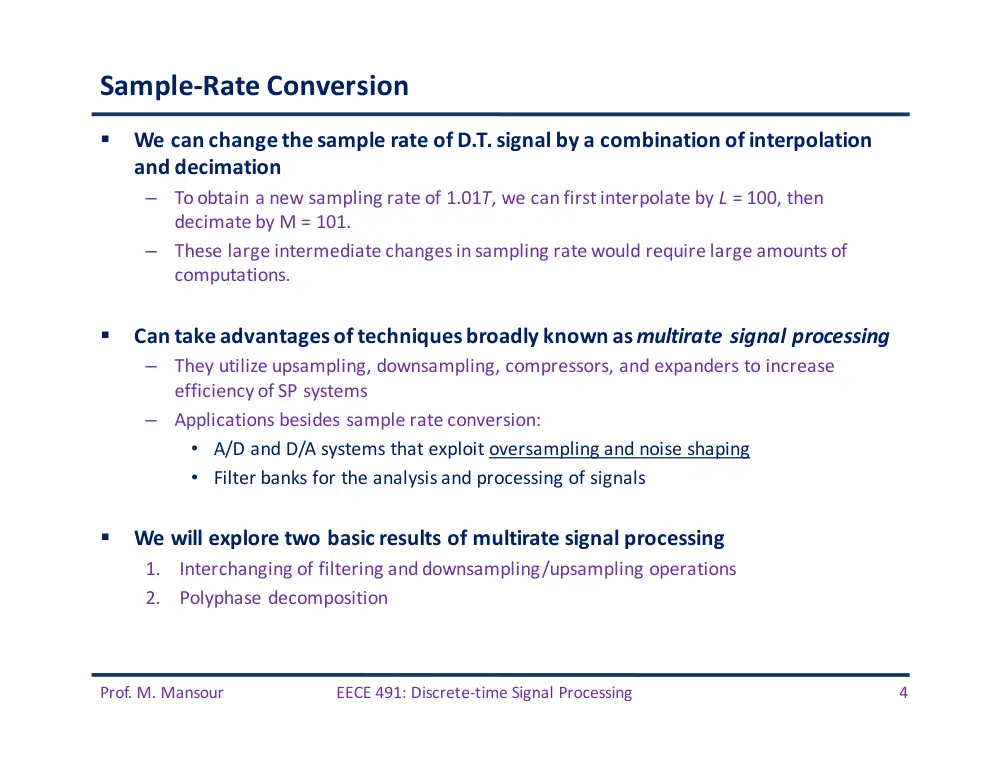
We
will
explore
two
basic
results
of
multirate
signal
processing
1.
Interchanging
of
filtering
and
downsampling/upsampling
operations
2.
Polyphase
decomposition
Prof.
M.
Mansour
EECE
491:
Discrete-‐time
Signal
Processing
5
Compressor/Expander
§
For
a
compressor-‐by-‐M with
input
x[n]
and
output
xd[n],
we
have
§
For
an
expander-‐by-‐L with
input
x[n]
and
output
xe[n],
we
have
(
)
(
)
(
)
1
2
/
0
1 M
j
i
M
j
d
i
X
e
X e
M
ω
π
ω
−
−
=
=
∑
(
)
(
)
j
j L
Xe
e
X e
ω
ω
=
Prof.
M.
Mansour
EECE
491:
Discrete-‐time
Signal
Processing
6
Example
§
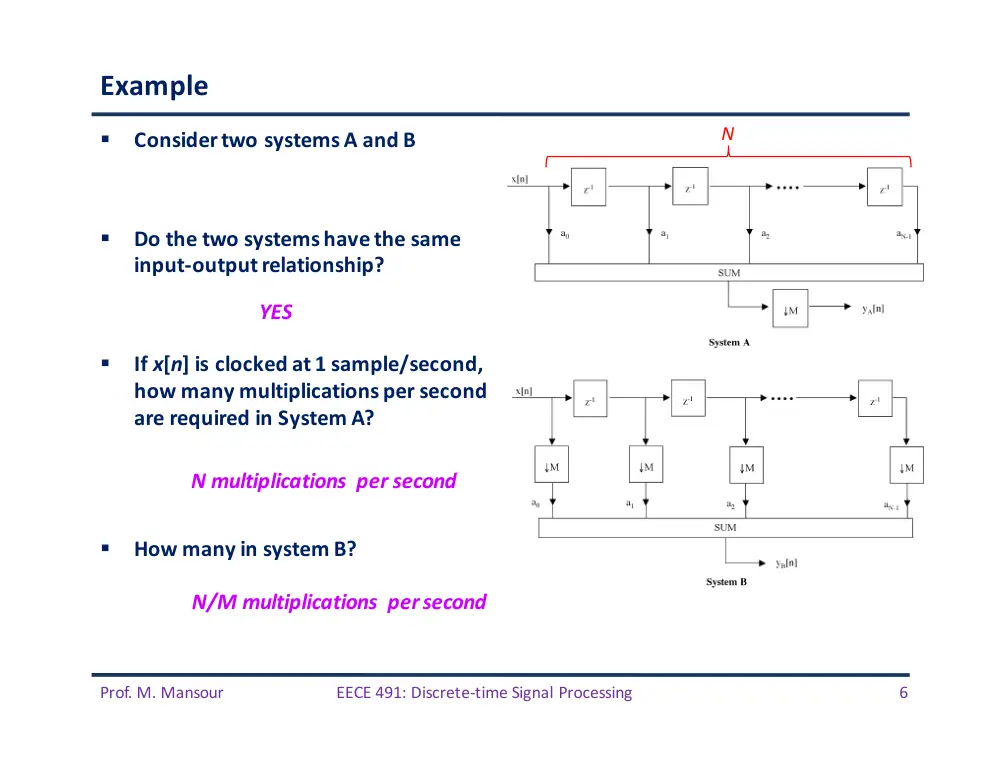
Consider
two
systems
A
and
B
§
Do
the
two
systems
have
the
same
input-‐output
relationship?
§
If
x[n]
is
clocked
at
1
sample/second,
how
many
multiplications
per
second
are
required
in
System
A?
§
How
many
in
system
B?
YES
N
multiplications
per
second
N/M
multiplications
per
second
N
Prof.
M.
Mansour
EECE
491:
Discrete-‐time
Signal
Processing
7
Noble
Identity
I:
Interchange
of
Filtering
with
Compressor
§
Prove
the
following
two
systems
are
equivalent
§
For
System
B,
we
have
(
)
(
)
(
)
(
)
(
)
(
)
(
)
(
)
(
)
(
)
(
)
(
)
1
2
/
0
1
2
2
/
0
1
2
/
0
1
1
1
M
j
i
M
j
b
i
M
j
i
j
i
M
i
M
j
i
M
j
i
j
j
a
Y e
X
e
M
H e
X e
M
H e
X e
M
H e
X
e
ω
π
ω
ω
π
ω
π
ω
π
ω
ω
ω
−
−
=
−
−
−
=
−
−
=
=
∑
=
∑
=
∑
=
(
)
(
) (
)
j
j M
j
Xb
e
H e
X e
ω
ω
ω
=
System
A
System
B
Prof.
M.
Mansour
EECE
491:
Discrete-‐time
Signal
Processing
8
Noble
Identity
I:
Interchange
of
Filtering
with
Compressor
§
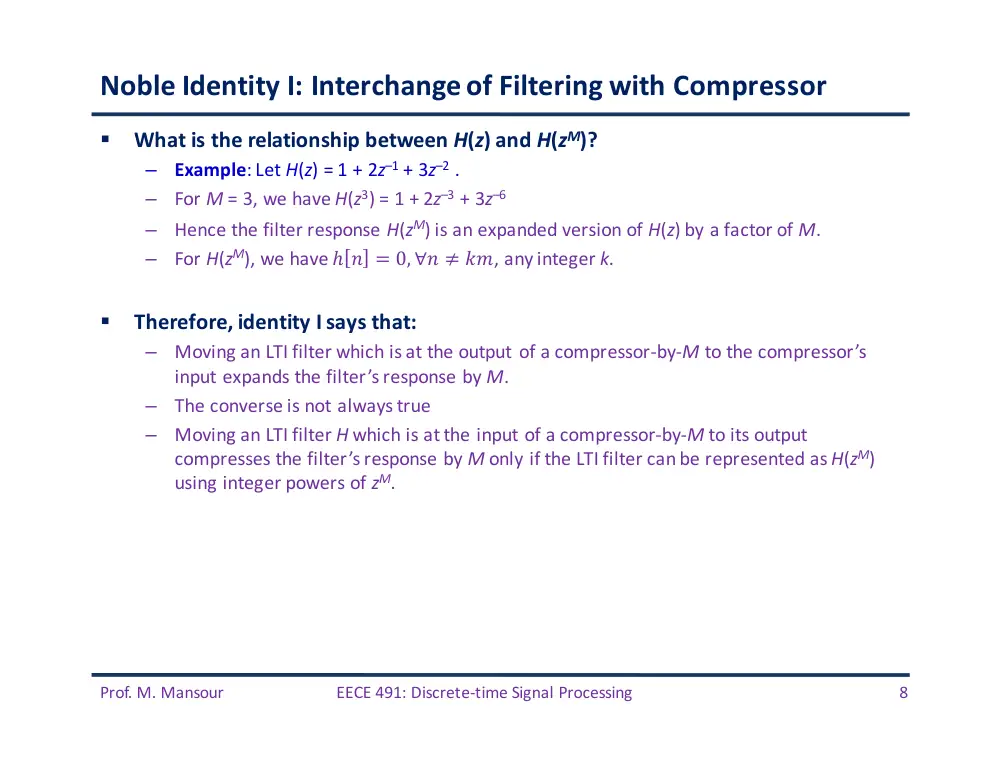
What
is
the
relationship
between
H(z)
and
H(zM)?
–
Example:
Let
H(z)
=
1
+
2z–1 +
3z–2 .
–
For
M =
3,
we
have
H(z3)
=
1
+
2z–3 +
3z–6
–
Hence
the
filter
response
H(zM)
is
an
expanded
version
of
H(z)
by
a
factor
of
M.
–
For
H(zM),
we
have
ℎ 𝑛 = 0, ∀𝑛 ≠ 𝑘𝑚,
any
integer
k.
§
Therefore,
identity
I
says
that:
–
Moving
an
LTI
filter
which
is
at
the
output
of
a
compressor-‐by-‐M to
the
compressor’s
input
expands
the
filter’s
response
by
M.
–
The
converse
is
not
always
true
–
Moving
an
LTI
filter
H which
is
at
the
input
of
a
compressor-‐by-‐M to
its
output
compresses
the
filter’s
response
by
M only
if
the
LTI
filter
can
be
represented
as
H(zM)
using
integer
powers
of
zM.
Prof.
M.
Mansour
EECE
491:
Discrete-‐time
Signal
Processing
9
Example:
Intuitive
Explanation
of
Identity
I
When
a
signal
x[n]
is
processed
by
filtering
with
some
H(zM)
(which
implies
ℎ 𝑛 = 0, ∀𝑛 ≠ 𝑘𝑚,
any
integer
k)
and
compressing
by
a
factor
of
M,
each
output
sample
y[n]
depends
only
on
every
Mth input
sample.
It
therefore
stands
to
reason
that
an
equivalent
input-‐output
relationship
can
be
achieved
by
first
compressing,
then
filtering.
Prof.
M.
Mansour
EECE
491:
Discrete-‐time
Signal
Processing
10
Noble
Identity
II:
Interchange
of
Filtering
with
Expander
§
Prove
the
following
two
systems
are
equivalent
§
For
System
A,
we
have
(
)
(
)
(
) (
)
j
j L
a
j L
j L
Y e
X
e
H e
X e
ω
ω
ω
ω
=
=
(
)
(
)
j L
j
b
H e
X
e
ω
ω
=
which
corresponds
to
system
B
System
A
System
B
Prof.
M.
Mansour
EECE
491:
Discrete-‐time
Signal
Processing
11
Multistage
Decimation
§
When
decimation
ratios
are
large,
need
to
use
long filters
to
achieve
adequate
approximations
to
the
required
lowpass
filters
–
Significant
reduction
in
computations
can
be
achieved
by
using
multistage
decimation
(a) 2-stage decimation
system with overall
decimation ratio M = M1M2.
LPF with
�𝜔+ = 𝜋/𝑀/
[ ]
[ ]
[ ] [
]
1
2
1
k
h n
h n
h
k
n
kM
δ
∞
=−∞
=
∗
−
∑
( )
( )
(
1 )
1
2
M
H z
H
z H
z
=
(b) Modification of (a) using
downsampling identity I
(c) Equivalent one-stage
decimation.
LPF with
�𝜔+ = 𝜋/𝑀0
Prof.
M.
Mansour
EECE
491:
Discrete-‐time
Signal
Processing
12
Multistage
Interpolation
§
Similar
concept
holds
for
interpolation
Prof.
M.
Mansour
EECE
491:
Discrete-‐time
Signal
Processing
13
Polyphase Decompositions
Prof.
M.
Mansour
EECE
491:
Discrete-‐time
Signal
Processing
14
Polyphase
Decompositions
§
Polyphase
decomposition
of
h[n]:
–
Represent
h[n]
as
a
superposition
of
M subsequences
–
Each
subsequence
consists
of
every
Mth value
of
successively
delayed
versions
of
h[n]
–
These
subsequences
ek[n]
are
called
the
kth polyphase
components
of
h[n]
§
Example
Q:
Given
the
polyphase
components
ek[n],
how
might
the
original
filter
h[n]
be
implemented?
[ ]
[
]
multiple of
0
otherwise
k
h n
k
n
M
h
n
⎧
+
= ⎨
⎩
h0 [ ]
n
[ ]
1h n
h2 [ ]
n
[ ]
[
]
1
0
M
k
k
h n
h
n
k
−
=
=
−
∑
Prof.
M.
Mansour
EECE
491:
Discrete-‐time
Signal
Processing
15
Generating
the
Polyphase
Components
of
h[n]
[ ]
[
]
[
]
k
k
e
n
h nM
k
h
nM
=
+
=
[ ]
[
]
multiple of
0
otherwise
k
h n
k
n
M
h
n
⎧
+
= ⎨
⎩
Prof.
M.
Mansour
EECE
491:
Discrete-‐time
Signal
Processing
16
Constructing
h[n]
from
its
Polyphase
Components
Prof.
M.
Mansour
EECE
491:
Discrete-‐time
Signal
Processing
17
Polyphase
Decomposition
of
h[n]
using
Polyphase
Components
E0 ( )
z
E1 ( )
z
E2 ( )
z
EM 1 ( )
− z
(
)
1
M
EM
z
−
(
)
2
M
E
z
(
)
1
M
E
z
(
)
0
M
E
z
( )
(
)
1
0
M
M
k
k
k
H z
E
z
z
−
−
=
= ∑
Prof.
M.
Mansour
EECE
491:
Discrete-‐time
Signal
Processing
18
Polyphase
Decomposition
of
h[n]
using
Chained
Delays
(cont’d)
E0 ( )
z
E1 ( )
z
E2 ( )
z
EM 1 ( )
z
−
(
)
0
M
E
z
(
)
1
M
E
z
(
)
2
M
E
z
(
)
1
M
EM
z
−
Prof.
M.
Mansour
EECE
491:
Discrete-‐time
Signal
Processing
19
Realization
Structure
Based
on
Polyphase
Decomposition
( )
(
)
1
0
M
M
k
k
k
H z
E
z
z
−
−
=
= ∑
Prof.
M.
Mansour
EECE
491:
Discrete-‐time
Signal
Processing
20
Polyphase
Implementation
of
Decimation
Filters
N-‐point
filter
N MULTs,
N
– 1 ADDs
1
sample
/
sec
( )
(
)
1
0
M
M
k
k
k
H z
E
z
z
−
−
=
= ∑
1
sample
/
sec
1
sample
/
M
sec
N/M-‐point
filters
Each
filter
requires:
•
1/M *
(N/M)
MULTs
•
1/M*(N/M
– 1)
ADDs
Total:
•
(N/M)
MULTs
•
(N/M
– 1)
+
M – 1
ADDs
Prof.
M.
Mansour
EECE
491:
Discrete-‐time
Signal
Processing
21
Polyphase
Implementation
of
Interpolation
Filters
Prof.
M.
Mansour
EECE
491:
Discrete-‐time
Signal
Processing
22
Polyphase
Implementation
of
Filters
§
For
both
decimation
and
interpolation
filters
–
Gains
in
computational
efficiency
result
from
rearranging
operations
so
that
filtering
is
done
at
the
low
sampling
rate
§
Combinations
of
interpolation
and
decimation
systems
for
non-‐integerrate
changes
lead
to
significant
savings
when
high
intermediate
rates
are
required
Prof.
M.
Mansour
EECE
491:
Discrete-‐time
Signal
Processing
23
Multirate
Filter
Banks
§
Polyphase
structures
for
decimation/interpolation
are
used
in
filter
banks
for
analysis/synthesis
of
audio
and
speech
signals
§
Two-‐channel
analysis
and
synthesis
filter
bank
LPF
�c=�/2
HPF,
�c=�/2
[ ]
[ ]
(
)
(
)
(
)
1
0
1
0
j n
j
j
h n
e
h
n
H
e
H
e
π
ω π
ω
−
=
=
LPF
�c=�/2
HPF,
�c=�/2
Prof.
M.
Mansour
EECE
491:
Discrete-‐time
Signal
Processing
24
Two-‐Channel
Analysis
and
Synthesis
Filter
Bank
§
Frequency
domain
relations:
(
)
(
) (
)
(
)
(
)
(
)
(
)
(
)
2
/2
2
/2
/2
/2
0
0
0
1
2
j
j
j
j
j
V
e
H
e
X e
H
e
X e
ω
π
ω
π
ω
ω
ω
−
−
=
+
(
)
(
) (
)
(
)
(
)
(
)
(
)
(
)
2
/2
2
/2
/2
/2
1
1
1
1
2
j
j
j
j
j
V e
H
e
X e
H
e
X e
ω
π
ω
π
ω
ω
ω
−
−
=
+
(
)
(
) (
)
2
0
0
0
j
j
j
Y
e
G
e
V
e
ω
ω
ω
=
(
)
(
) (
)
2
1
1
1
j
j
j
Y e
G e
V e
ω
ω
ω
=
(
)
(
)
(
)
(
) (
)
(
) (
)
(
)
(
) (
)
(
)
(
)
(
)
(
)
(
)
(
)
(
) (
)
(
)
(
)
(
)
(
)
(
)
0
1
2
2
0
0
1
1
0
0
0
1
1
1
1
2
1
2
j
j
j
j
j
j
j
j
j
j
j
j
j
j
j
j
j
Y e
Y
e
Y e
G
e
V
e
G e
V e
G
e
H
e
X e
H
e
X e
G e
H
e
X e
H
e
X e
ω
ω
ω
ω
ω
ω
ω
ω π
ω π
ω
ω
ω
ω π
ω π
ω
ω
ω
−
−
−
−
=
+
=
+
=
+
+
+
(
)
(
)
(
)
(
)
(
)
(
)
(
)
(
)
(
)
(
)
(
)
(
)
(
)
(
)
0
0
1
1
0
0
1
1
1
2
1
2
j
j
j
j
j
j
j
j
j
j
j
Y e
G
e
H
e
G e
H
e
X e
G
e
H
e
G e
H
e
X e
ω
ω
ω
ω
ω
ω
ω π
ω π
ω π
ω
ω
−
−
−
⎡
⎤
=
+
⎣
⎦
⎡
⎤
+
+
⎢
⎥
⎣
⎦
Prof.
M.
Mansour
EECE
491:
Discrete-‐time
Signal
Processing
25
Two-‐Channel
Analysis
and
Synthesis
Filter
Bank
§
If
analysis
and
synthesis
filters
are
ideal,
then
get
perfect
reconstruction:
§
If
filters
are
non-‐ideal,
can
still
obtain
perfect
or
near
perfect
reconstruction
if
§
This
condition
is
called
alias
cancellation
condition.
§
One
set
of
conditions
that
satisfy
the
above
equation
is:
(
)
(
)
(
)
(
)
(
)
(
)
(
)
(
)
(
)
(
)
(
)
(
)
(
)
(
)
0
0
1
1
0
0
1
1
1
2
1
2
j
j
j
j
j
j
j
j
j
j
j
Y e
G
e
H
e
G e
H
e
X e
G
e
H
e
G e
H
e
X e
ω
ω
ω
ω
ω
ω
ω π
ω π
ω π
ω
ω
−
−
−
⎡
⎤
=
+
⎣
⎦
⎡
⎤
+
+
⎢
⎥
⎣
⎦
(
)
(
)
j
j
Y e
X e
ω
ω
=
Can
potentially
introduce
aliasing
(
)
(
)
(
)
(
)
(
)
(
)
0
0
1
1
0
j
j
j
j
G
e
H
e
G e
H
e
ω π
ω π
ω
ω
−
−
+
=
[ ]
[ ]
(
)
(
)
(
)
[ ]
[ ]
(
)
(
)
[ ]
[ ]
(
)
(
)
(
)
1
0
1
0
0
0
0
0
1
0
1
0
2
2
2
2
j
j n
j
j
j
j
j
h n
e
h
n
H
e
H
e
g
n
h
n
G
e
H
e
g n
h
n
G e
H
e
ω π
π
ω
ω
ω
ω π
ω
−
−
=
⇒
=
=
⇒
=
= −
⇒
= −
h0[n]
and
h1[n]
are
Quadrature
Mirror
Filters
They
impose
symmetry
about
�=�/2
Prof.
M.
Mansour
EECE
491:
Discrete-‐time
Signal
Processing
26
Two-‐Channel
Analysis
and
Synthesis
Filter
Bank
§
Substituting
back,
we
obtain:
§
Perfect
reconstruction
è
§
It
can
be
shown
that
the
only
computationally
realizable
filters
satisfying
(**)
are:
§
Such
filters
cannot provide
sharp
frequency
selective
properties
needed
in
speech
and
audio
applications
§
But
to
illustrate
the
concept,
consider
2-‐point
moving
average
filter
§
Obtain:
(
)
(
)
(
)
(
)
(
)
(
)
2
2
0
0
j
j
j
j
Y e
H
e
H
e
X e
ω π
ω
ω
ω
−
⎡
⎤
=
−
∗∗
⎢
⎥
⎣
⎦
(
)
(
)
(
)
2
2
0
0
j
j
j M
H
e
H
e
e
ω π
ω
ω
−
−
−
=
(allow
a
phase
shift
of
M)
[ ]
[
]
[
]
0
0
0
1
1
0
1
0
1
0 1
2
2
1
,
arbitrary integers
1
,
satisfy
4
h
n
c
n
n
c
n
n
n n
c c
c c
δ
δ
=
−
+
−
−
=
[ ]
[ ]
[
]
(
)
(
)
(
)
/2
0
0
1
1
cos
/ 2
2
j
j
h
n
n
c
n
H
e
e
ω
ω
δ
δ
ω
−
=
+
−
=
(
)
(
)
j
j
j
Y e
e
X e
ω
ω
ω
= −
Prof.
M.
Mansour
EECE
491:
Discrete-‐time
Signal
Processing
27
Two-‐Channel
Analysis
and
Synthesis
Filter
Bank
§
Polyphase
techniques
can
be
used
to
save
computations
in
the
implementation
of
analysis/synthesis
filter
banks
[ ]
[
]
[ ]
[
]
[ ]
[
]
[
]
[ ]
[ ]
[
]
[
]
[ ]
00
0
01
0
2
10
1
0
00
2
11
0
0
01
2
2
1
2
2
2
1
2
1
j
n
j
n
j
e
n
h
n
e
n
h
n
e
n
h
n
e
h
n
e
n
e
n
h
n
e
e
h
n
e
n
π
π
π
=
=
+
=
=
=
=
+
=
+
= −