
MATH 218 Problems Solution Chapter 6.1, Spring 2012
American University of Beirut · Elementary Linear Algebra with Applications · 3 pages · with solution

More MATH 218 files
- Homework Chapter 8 · Fall 2012ChapterView
- Chapter Summary · Fall 2011ChapterView
- Problems Solution Manual Chapter 1.6 · Fall 2011Chapter · with solutionView
- Problems Solution Manual Chapter 1.3 · Fall 2011Chapter · with solutionView
- Problems Solution Manual Chapter 1.5 · Fall 2011Chapter · with solutionView
- Problems Solution Manual Chapter 1.2 · Fall 2011Chapter · with solutionView
- Problems Solution Manual Chapter 1.1 · Fall 2011Chapter · with solutionView
- Problems Solution Manual Chapter 1.4 · Fall 2011Chapter · with solutionView
Show the text of this chapter
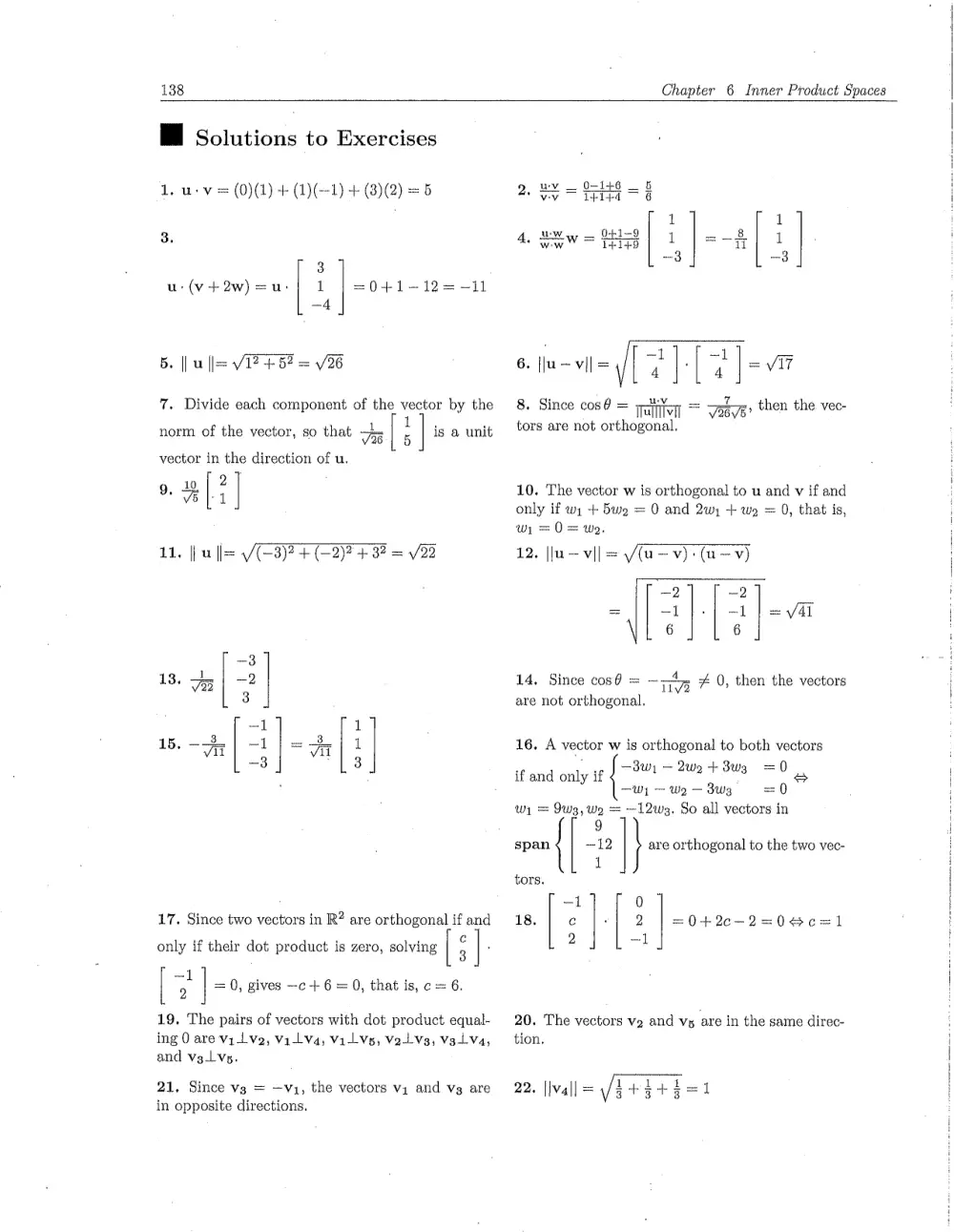
138
Chapter 6 Inner Product Spaces
WM Solutions to Exercises
L. we v = (0)(1) + (1)(—1) + (8)(2) = 5
3.
3
ortaman| Lo | =0+1-12=-11
-4
5. || u l= V1? +5? = V26
7. Divide each component of the vector by the
1
. . 1 is '
norm of the vector, so that Te 5 is a unit
vector in the direction of u.
wo | 2 |
0. |
LL. | a = (3)? + (2)? +8 = 29
17. Since two vectors in R? are orthogonal if and
8
1 = 0, gives -c+6 = 0, that is, c= 6.
only if their dot product is zero, solving e ‘
2
19. The pairs of vectors with dot product equal-
ing 0 are vz-Lv2, Vilva, Vi-LVs, V2-Lv3, Vsiva,
and vglvs5.
21, Since vg = —vj1, the vectors vy and vg are
in opposite directions.
Q, wy — O-146
=&
vv [+1+4 ~~ 6
1 1
. — O+1-9 — 8
4. aw = Theo 1 |=-i| 1
3 —3
-1 ~1 :
vm-n-lfa lal
8. Since cosé = pHing = Jae then the vec-
tors are not orthogonal,
10. The vector w is orthogonal to u and v if and
only if w+ 5we = 0 and 2w, + we = 0, that is,
wy =0= wa.
12.
ju ~v|| = /(u—v)+(u—v)
14, Since cos@ = ~aive # 0, then the vectors
are not orthogonal.
16. A vector w is orthogonal to both vectors
if and only if Sur = 2u2 + 3g = 0
—W1 — We — 8s = 0
wy = 9w3, We = —12ws. So all vectors in
9
span —12 are orthogonal to the two vec-
1
tors.
-1 0
18. e : 2 =0+2c-2=0e6c=1
2 -1
20. The vectors v2 and vy are in the same direc-
tion.
1
i
22. |Ivall = (4 +44 4
i
i
i
1
i
|
6.1 The Dot Product on IR" 139
26. w =
u.
v
29. Let u be a vector in
span{u1,Ug,**+ ,Un}. Then there exist scalars ¢1,c2,-++ ,¢p such that
u = CU + CQUg +11 + Cnn.
Using the distributive property of the dot product gives
veu=v-(cyuy + cola +... + Cnn)
= e1(v- uz) + ¢o(v+ ua) + +++ + en(v + Un)
= ¢1(0)+ €2(0) Foe + Cn (0) = 0,
30. If u and w are in 9 and cis a scalar, then
(utew):v=uivtc(w:v)=0+0=0
and hence, S is a subspace.
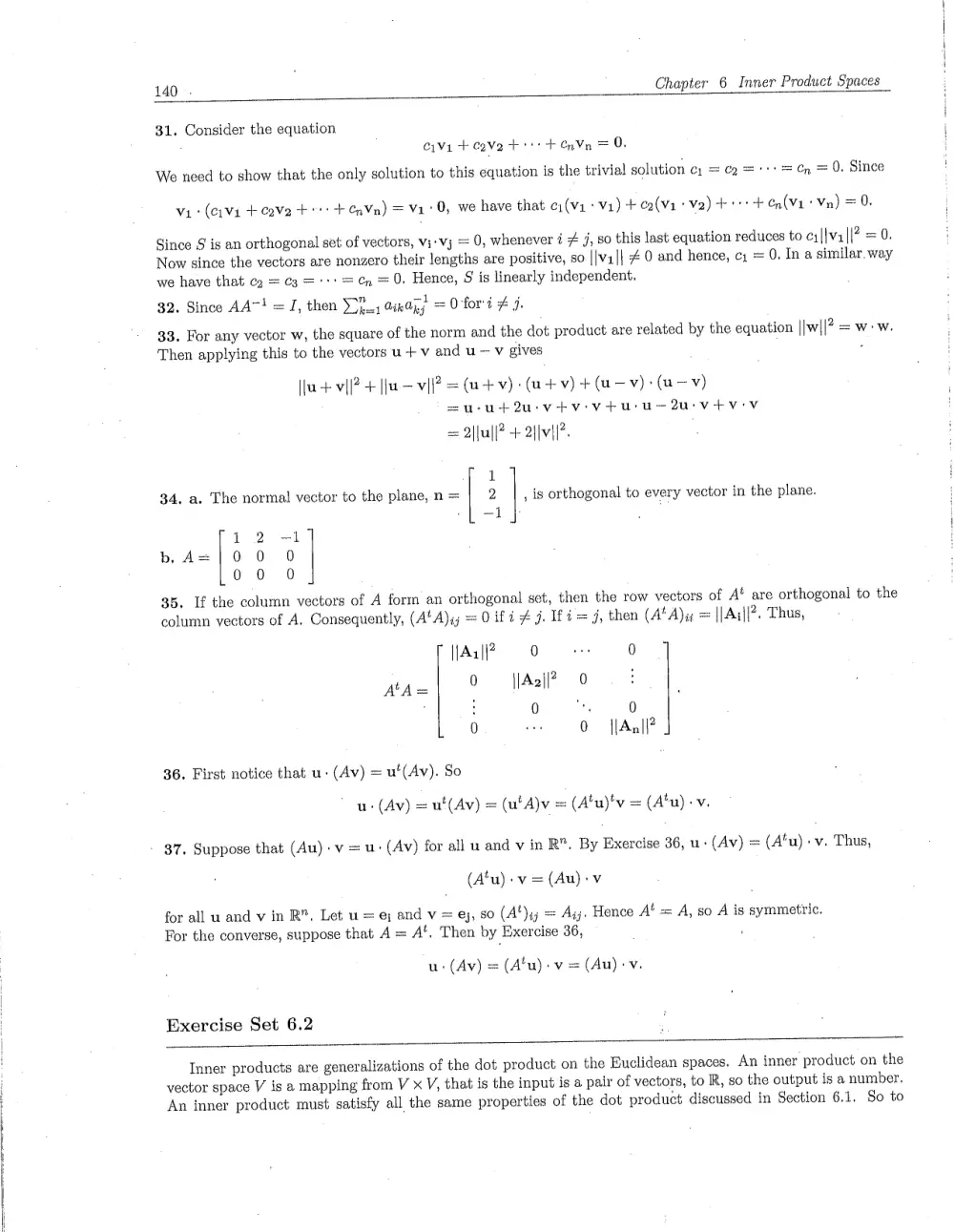
140 . Chapter 6 Inner Product Spaces
31. Consider the equation
e1vi + cava tet + enVa = 0.
We need to show that the only solution to this equation is the trivial solution 0) = Cg = 1+ = Cn = 0, Since
vi (civ + c2v2 + +++ + CnVn) = v2 ‘0, we have that er(va V1) + ¢2(va V2) to0 + env 'Vn) = 0.
Since § is an orthogonal set of vectors, vi-vj = 0, whenever # # j, so this last equation reduces to ex||val|? = 0.
Now since the vectors are nonzero their lengths are positive, so ||v1|| #0 and hence, ¢, = 0, In a similar. way
we have that co = cg = +++ = Cn = 0. Hence, S is linearly independent,
32. Since AA7! = I, then hy AKO, =O fort # j.
33. For any vector w, the square of the norm and the dot product are related by the equation ||w||? = wew.
Then applying this to the vectors u + v and u — v gives :
\lu-+ vil? + Ila — vi? = (atv) - (atv) + (uv) (av)
=u-ut2u:v+vivturu-2u:vtvev
= 2|[ul|? + 2I[v|)?.
1
34, a. The normal vector to the plane, n = 2 | , is orthogonal to every vector in the plane.
-1
12 -1
bA=|0 0 0
00 0
35, If the column vectors of A form an orthogonal set, then the row vectors of A’ are orthogonal to the
column vectors of A. Consequently, (A‘A)ij = 0 if i 4 j. If i= 7, then (AtA)iy = || Au]|?. Thus,
Aa? 0 oe 0
AtA = 0 |jAai[?_ 0
; : 0 a 0
0 a 0 Anil?
36. First. notice that u: (Av) = u'(Av). So
u: (Av) = u'(Av) = (u'A)v = (Abu)*v = (Atu) -v.
- 87. Suppose that (Au): v = u- (Av) for all u and v in R”. By Exercise 36, u+ (Av) = (A’u) -v. Thus,
(Atu) -v = (Au) +v
for all u and v in R®, Let u =e and v = ej, so (A*);; = Ajj. Hence A! == A, so A is symmetric.
For the converse, suppose that A = A’, Then by Exercise 36,
u: (Ay) = (A‘u)-v = (Au) -v.
Exercise Set 6.2
Inner products are generalizations of the dot product on the Euclidean spaces. An inner product on the
vector space V is a mapping from V x V, that is the input is a pair of vectors, to R, so the output is a number.
An inner product must satisfy all the same properties of the dot product discussed in Section 6.1. So to