
MATH 218 Problems Solution Manual Chapter 1.6, Fall 2011
American University of Beirut · Elementary Linear Algebra with Applications · 5 pages · with solution
More MATH 218 files
- Problems Solution Chapter 6.1 · Spring 2012Chapter · with solutionView
- Homework Chapter 8 · Fall 2012ChapterView
- Chapter Summary · Fall 2011ChapterView
- Problems Solution Manual Chapter 1.5 · Fall 2011Chapter · with solutionView
- Problems Solution Manual Chapter 1.2 · Fall 2011Chapter · with solutionView
- Problems Solution Manual Chapter 1.4 · Fall 2011Chapter · with solutionView
- Problems Solution Manual Chapter 1.1 · Fall 2011Chapter · with solutionView
- Problems Solution Manual Chapter 1.3 · Fall 2011Chapter · with solutionView
Show the text of this chapter
1.6 Determinants 23
A is invertible < det(A) 4 0 Ax = b has a unique solution
«> Ax = 0 has only the trivial solution
<> A is row equivalent to J.
One useful observation that follows is that if the determinant of the coefficient matrix is 0, then the linear
system is inconsistent or has infinitely many solutions.
W Solutions to Exercises
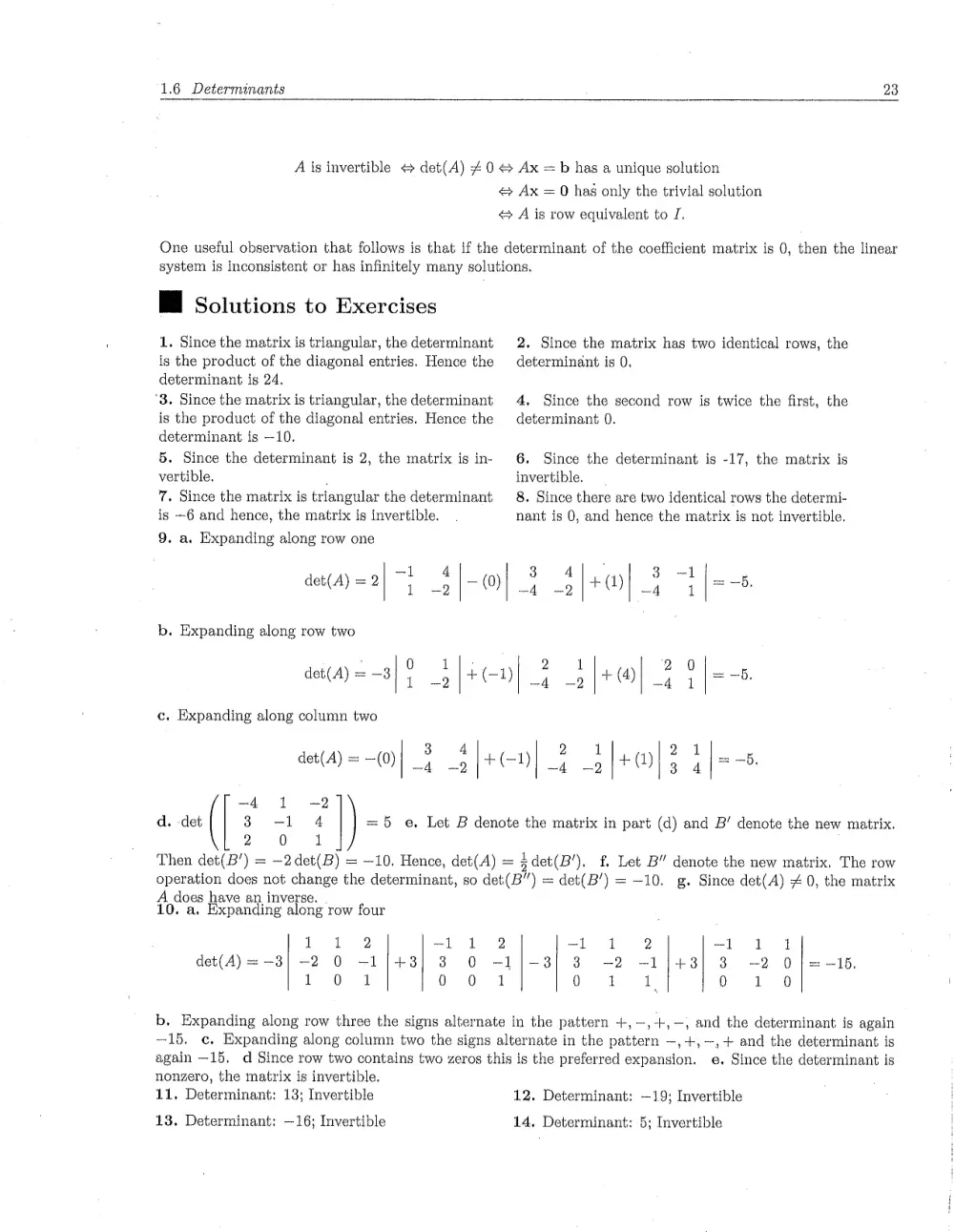
1. Since the matrix is triangular, the determinant
is the product of the diagonal entries. Hence the
determinant is 24,
‘3. Since the matrix is triangular, the determinant
is the product of the diagonal entries, Hence the
determinant is —10,
5. Since the determinant is 2, the matrix is in-
vertible. :
7. Since the matrix is triangular the determinant
is -6 and hence, the matrix is invertible.
9. a. Expanding along row one
2. Since the matrix has two identical rows, the
determinant is 0,
4, Since the second row is twice the first, the
determinant 0.
6. Since the determinant is -17, the matrix is
invertible.
8. Since there are two identical rows the determi-
nant is 0, and hence the matrix is not invertible.
-l1 4 3 4), 3-1
aer(a) =2| 1 -2 |- | 4-2 }+ | 404 | —5.
b. Expanding along row two
‘ 0 1 2 1 2 0
det(A) = —3 1 2f Een] 3 3 [+o i [=-5
c. Expanding along column two
_ 3 4 2 1 21|_,
eaia)=-0| 8 £]ecn] 2 Afew|2 tens
-4 1 ~2
d. -det 3 -1 4 =5 e, Let B denote the matrix in part (d) and B’ denote the new matrix.
2 0 1
Then det(B’) = —2det(B) = —10, Hence, det(A) = $det(B’), f Let B” denote the new matrix. The row
operation does not change the determinant, so det(B”) = det(B’) = —10. g. Since det(A) 4 0, the matrix
A does have an inverse.
10. a. Expanding along row four
1 1 2 -1 1 -1 1 2 -l 1 21
det(A)=-3} -2 0 -1/+3]/ 8 0 —3) 3 ~2 -1]+3}) 3 ~2 0 | =—165.
1 0 1 0 0 0 1 1 0 1 0
b, Expanding along row three the signs alternate in the pattern +,—,-+,—, and the determinant is again
—15. ¢, Expanding along column two the signs alternate in the pattern —,+,—~,+ and the determinant is
again —15, d Since row two contains two zeros this is the preferred expansion.
nonzero, the matrix is invertible.
11. Determinant: 13; Invertible
13. Determinant: —16; Invertible
12, Determinant: ~19; Invertible
14, Determinant: 5; Invertible
e. Since the determinant is
24 , : Chapter 1 Systems of Linear Equations and Matrices
15. Determinant: 0; Not invertible 16, Determinant: 0; Not invertible
17. Determinant: 30; Invertible 18. Determinant: -76; Invertible
19, Determinant: —90; Invertible 20. Determinant: 8; {nvertible
21. Determinant: 0; Not invertible 22. Determinant: 0; Not invertible
23. Determinant: —32; Invertible 24, Determinant: 59; Invertible
25. Determinant: 0; Not invertible , 26. Determinant: 5; Invertible
i
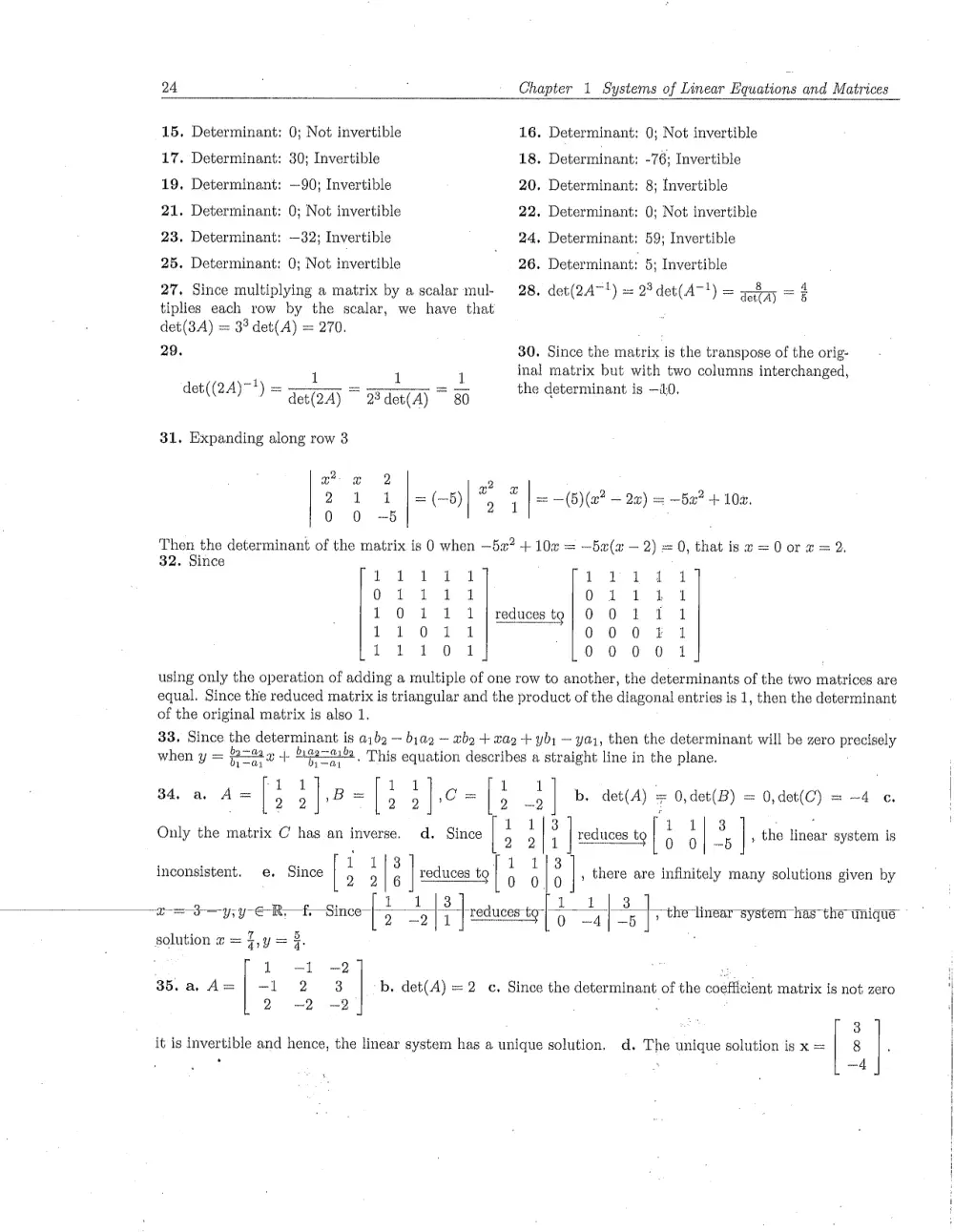
27. Since multiplying a matrix by a scalar mul- 28, det(2A~') = 2 det(A!) = agftay = ¢
tiplies each row by the scalar, we have that
det(3.A) = 39 det(A) = 270.
29. 30. Since the matrix is the transpose of the orig
1 1 1 inal matrix but with two columns interchanged,
det, “lh. = = he determinant is —i.0.
det((2A)~*) det(DA) ~ Waoi(A) * BO the determinant is -10
31. Expanding along row 3
a 2 2 2 2
2 1 1 |= (-5))", | | =—-(@)@? — 22) = 5a? + 102,
0 0 -5
Then the determinant of the matrix is 0 when —5a? + 10a = —5a(a — 2) = 0, that is@=0ora=2
32. Since
1 111i 111i ii
0o1i1d1i Ooi11%241
10 1 1 1 |]reducestg}]0 0 1 1 1
110141 000 81
11101 000 01
using only the operation of adding a multiple of one row to another, the determinants of the two matrices are
equal. Since the reduced matrix is triangular and the product of the diagonal entries is 1, then the determinant
of the original matrix is also 1.
33, Since the determinant { is a1b9 — b1a2 — bg + vag + yb — yar, then the determinant will be zero precisely
when y = pan0a w+ bigamaiba This equation describes a straight line in the plane.
41 11 14
34, a. A= [: 2 | 2 = [: 2 | c= E 2 | b, det(A) # 0,det(B) = 0,det(C) = ~4
. . “4 3 1 1] 3 oe .
Only the matrix C has an inverse. d. Since | hp reduces tg 0 0 | 5 , the linear system is
1 1
2 2/1
1 1738
0
inconsistent. e. Since E 3 p ts reduces to |. there are infinitely many solutions given by
1
2 0
w= 3— ys ye Rf Since— [a 1 tt | seus: ti ce
, 2 S10 4] -
ior
solution @ =
aN
ll
WY
1-1 -2
-1 2 8 b, det(A) = 2 c, Since the determinant of the coefficient matrix is not zero
2 -—2 —2
35.a, A=
8
it is invertible and hence, the linear system has a unique solution. d. The unique solution is x = 8
. : —4
| tne tnear system has the unique ~
1.6 Determinants . 25
3-2
1
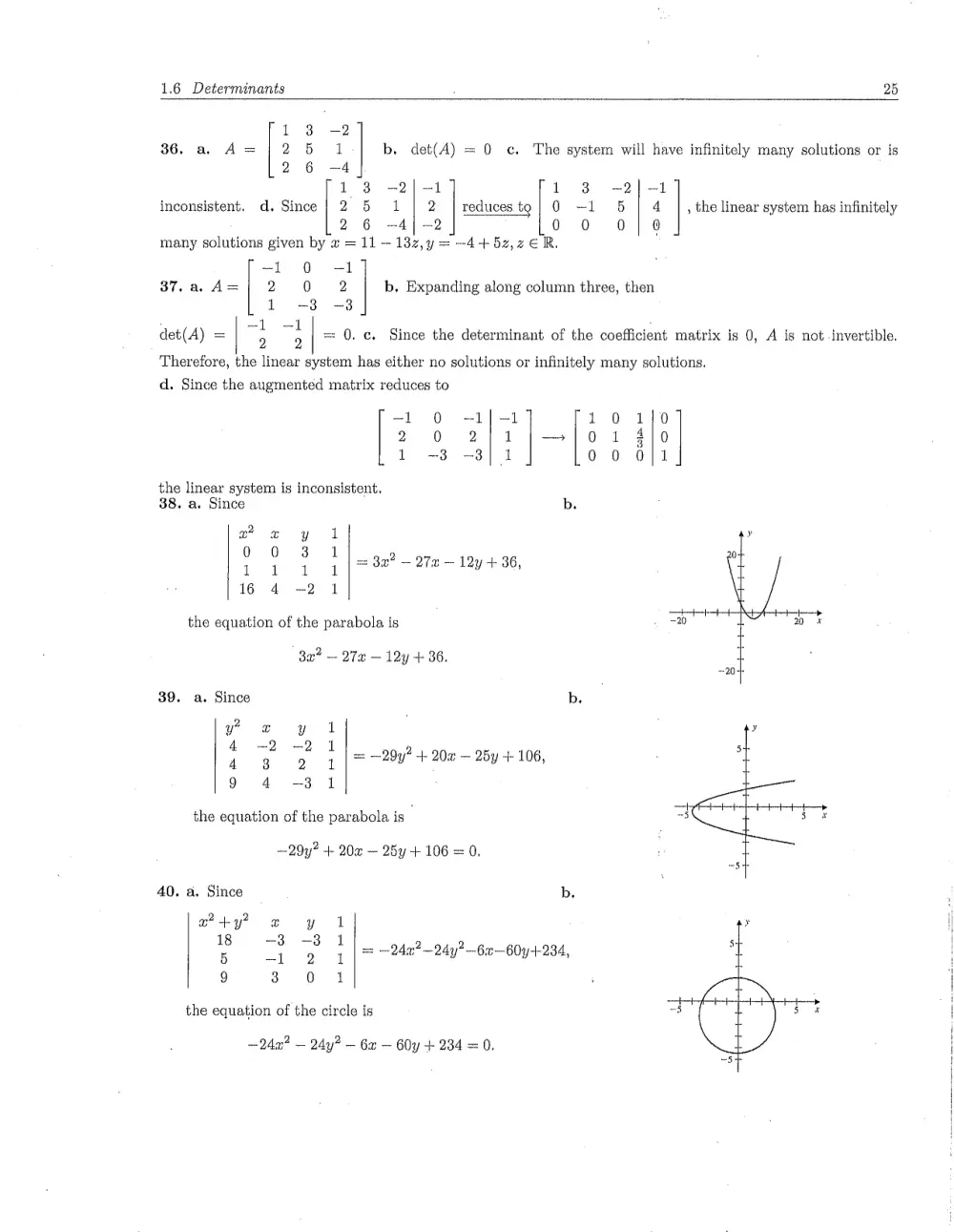
36, a A= jj} 2 5 1 b, det(A) = 0 c. The system will have infinitely many solutions or is
26 —4
1 38 -2|-—1 1 38 -2)-1
inconsistent. d. Since | 2 5 1 | 2 | reducestg| 0 ~1 5 | 4 |, the linear system has infinitely
2 6 —4|~-2 0 0 0] @
many solutions given by # = 11 — 18z,y= —-4+5z2,zER.
-l1 0 -1
87,.a,A=| 2 0 2 b, Expanding along column three, then
1 -3 ~3
1-1
= 0. c, Since the determinant of the coefficient matrix is 0, A is not invertible.
det(A) = | D8
Therefore, the linear system has either no solutions or infinitely many solutions.
|
d. Since the augmented matrix reduces to
-1 0 -1/-1 1 0
2 0 2/1 }—-]o1
1 -3 -3| 1 0 0
Owns te
no!
the linear system is inconsistent.
38. a, Since b.
woe y il
00 3 1/9
LoL Lp | 282? = 27m = 12y + 36,
164 -2 1
the equation of the parabola is
8a? — 27a — 12y + 36.
39. a. Since b.
yow yl .
4 -2 -2 1] _ 2 OV . ane
4 3 2 1/= —29y* 4 20x — 25y + 106,
9 4 -—3 1
the equation of the parabola is
~29y? + 20a — 2y + 106 = 0.
40. a. Since b.
ety «2 y i ay
18 -3 -3 1] 2 94,2 5
5 12 11% —240°—24y*—6a—60y+234, |
9 3.0 «42
the equation of the circle is
24m? — 24y? — 6x ~ 6Oy + 234 = 0.
26 ‘ Chapter 1 Systems of Linear Equations and Matrices
41. a, Since b.
we ya oy dl
0 140 —4 1
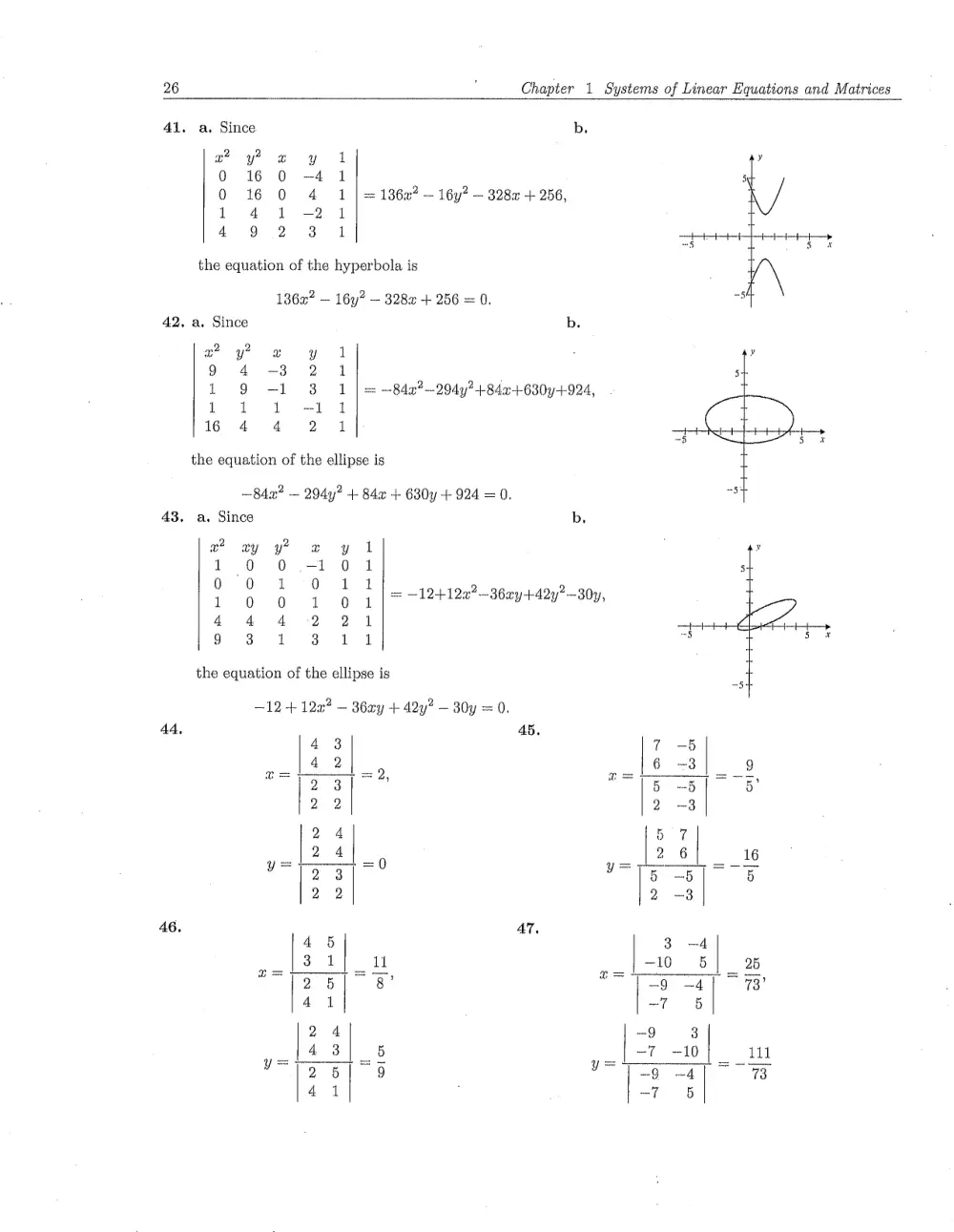
0 16 0 4 1 | = 1360? —16y? ~ 328a + 256,
14 1-2 1
4 9 2 3 1
the equation of the hyperbola is
186a? — 16y? ~ 3282 + 256 = 0.
42, a. Since b.
we yr oew yl ay
9 4 -3 2 1 s+
1 9 -1 8 1 | =—84n?~294y?+840-+630y+924,
1 ot i 1 1 4 >
164 4 2 1 |
-5 5 oY
the equation of the ellipse is [
84x? — 294y? + 84a + 630y + 924 = 0,
43, a. Since b,
vw ey yy we y l ay
1 0 0 .-1 0 1 s+
0 0 1 0 1 2f_ 2 an, 2 ]
100 1 01; —124+122°—36xy+42y°—30y,
4 4 4 2 2 1 HH z >
9 38 1 8 11 ° > *
the equation of the ellipse is _s]
~12 + 12x — 36xy + 42y? — 30y = 0.
44, 45.
43 7-5
w-l42_, _|6 -3}] 9
“To 3] ° e=15 oa 8?
2 2 Q
24 507
»a 2 4l_, [26] 16
YS la 3|~ vS)5 5] 8
2 2 2 -3
46. ar.
45 3-4
aoe _|-10 5] 25
“To 5| 8° e= 7) -9 4] > 73°
41 75
2 4 -9 8
Wa 4 3] 5 i -7 -10} 1
yl? 6] 9 ye) -9 4]
41 ~7 5
1.7 Elementary Matrices and LU Factorization 27:
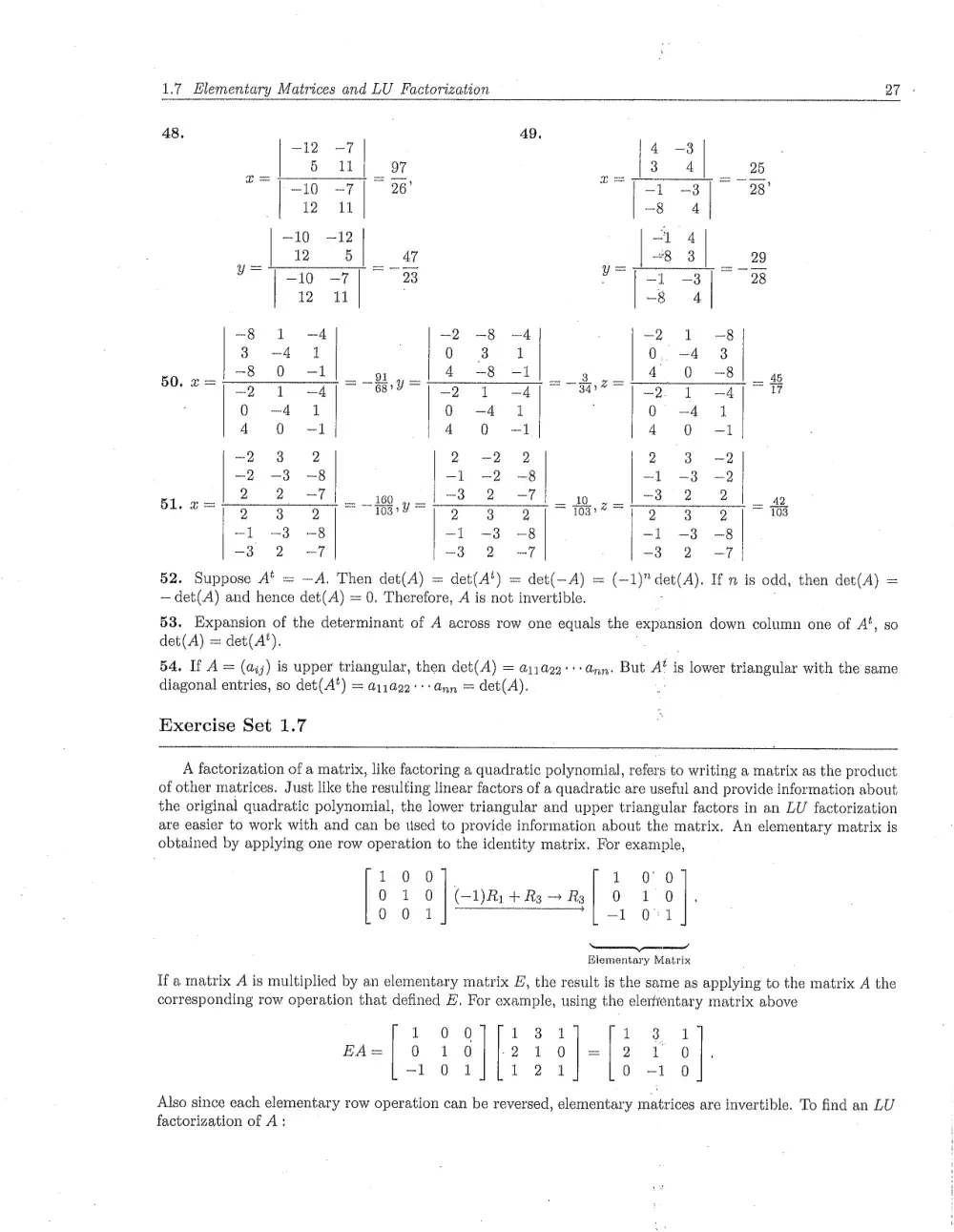
48, , 49.
-12 -7 4-3
5 ll 97 3 4 25
c= io Us poo =o,
-10 ~7 26 —-1 —8 28
: 12 11 —~8 4
-10 ~12 14
_ 12 5 _ 47 ye ~8 83 _ 29
ye) -i0 -7] > 38 ye TIT 23 28
12 il -8 4
-§ 1 —-4 -2 -8 -4 —-2 1 —8
3-4 «1 0 3 1 0. -4 8
-8 0 -1 1 4-8 -l 3 4 0 -8| 45
50, B= 5 = ae = 3,2 = = =
0 -4 1 0 -4 1 0 -4 1
4 0 =-l 4 0 -1 4 0 -1
-2 3 2 2 -2 2 2 3 -2
—2 -3 -8 -1 -2 ~8 -1 -3 ~2]
2 2 -7 -3 2 -7 -3 2 2 |
a a) = Top = 2 3 2] 02 = 37 a] = its
j; -1 -3 -8 -1 -3 -8 -1 -3 -8
-3 2 -7 -3 2 —7 -3 2 —-7
52. Suppose At = —A, Then det(A) = det(A*) = det(—A) = (—1)"det(A). If n is odd, then det(A) =
~—det(A) and hence det(A) = 0. Therefore, A is not invertible. :
53. Expansion of the determinant of A across row one equals the expansion down column one of A’, so
det(A) = det(A‘). .
54, If A = (a,j) is upper triangular, then det(A) = a11429:++@nn. But A® is lower triangular with the same
diagonal entries, so det(A) = a11422+++dnn = det(A).
Exercise Set 1.7
A factorization of a matrix, like factoring a quadratic polynomial, refers to writing a matrix as the product
of other matrices. Just like the resulting linear factors of a quadratic are useful and provide information about
the original quadratic polynomial, the lower triangular and upper triangular factors in an LU factorization
are easier to work with and can be used to provide information about the matrix, An elementary matrix is
obtained by applying one row operation to the identity matrix. For example,
10 07. 1 00
0 1 0 | (-1)Ri+Rs3 > Rs] 0 1 °0
0014)0>0—7 J] +1 081
Nn ee
Elementary Matrix
Ifa matrix A is multiplied by an elementary matrix E, the result is the same as applying to the matrix A the
corresponding row operation that defined E. For example, using the elerfientary matrix above
1 0 0 13 1 1 3 41
EFA=/] 0 1 0 21 0;/=]2 1 0),
-l1 01 121 0 -1 0
Also since each elementary row operation can be reversed, elementary matrices are invertible. To find an LU
factorization of A: