
MATH 218 Problems Solution Manual Chapter 1.5, Fall 2011
American University of Beirut · Elementary Linear Algebra with Applications · 3 pages · with solution
More MATH 218 files
- Problems Solution Chapter 6.1 · Spring 2012Chapter · with solutionView
- Homework Chapter 8 · Fall 2012ChapterView
- Chapter Summary · Fall 2011ChapterView
- Problems Solution Manual Chapter 1.6 · Fall 2011Chapter · with solutionView
- Problems Solution Manual Chapter 1.2 · Fall 2011Chapter · with solutionView
- Problems Solution Manual Chapter 1.4 · Fall 2011Chapter · with solutionView
- Problems Solution Manual Chapter 1.1 · Fall 2011Chapter · with solutionView
- Problems Solution Manual Chapter 1.3 · Fall 2011Chapter · with solutionView
Show the text of this chapter
12 Chapter 1 Systems of Linear Equations and Matrices
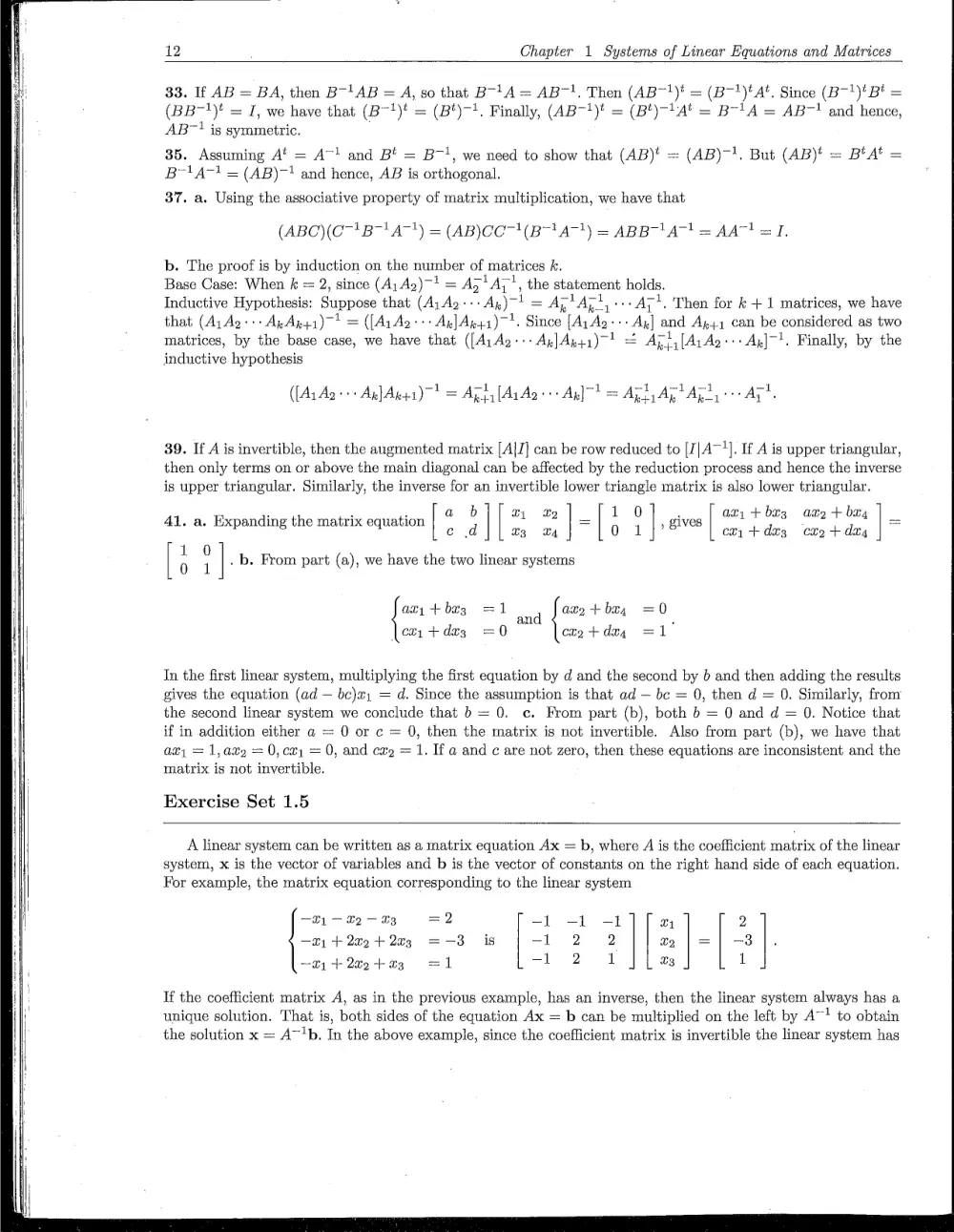
33. If AB = BA, then B-'AB = A, so that B-1A = AB~!. Then (AB™)* = (B-")¢ A". Since (B~1)' Bt =
(BB~')! = I, we have that (B~')' = (Bt)~. Finally, (AB~!)' = (B')-1.At = B-1A = AB and hence,
AB~ is symmetric.
35. Assuming A’ = A~! and B’ = B~!, we need to show that (AB)’ = (AB)~!. But (AB)' = BYAt =
B-1A-1! = (AB)~! and hence, AB is orthogonal.
37. a. Using the associative property of matrix multiplication, we have that
(ABC)(C1B A7!) = (AB)CC71(B"1 4“) = ABB“'A71 = AAT =I,
b. The proof is by induction on the number of matrices k.
Base Case: When k = 2, since (A; A2)~! = Az! Aj?, the statement holds.
Inductive Hypothesis: Suppose that (Aj A2---A,)~! = A,;'A,z*, +: Ay}. Then for k +1 matrices, we have
that (AyAg+++ Ag Agei)7? = ([A1 Ag +++ AglAgyi)7*. Since [A1 A+++ Ap] and Agy1 can be considered as two
matrices, by the base case, we have that ([A1Ag-+:Ag|Angi)7? = Agj [A142 Ago}. Finally, by the
inductive hypothesis
([A1 Ag see AglAnyi) 7! = Agia [Ay Ag see Ay} = Agi Ag Ag, tee Ay’.
39. If A is invertible, then the augmented matrix [A|J] can be row reduced to [I|A~“]. If A is upper triangular,
then only terms on or above the main diagonal can be affected by the reduction process and hence the inverse
is upper triangular. Similarly, the inverse for an invertible lower triangle matrix is also lower triangular.
a Ale = l=[4 1 | vives [Cat te axe + brs
41. a. Expanding the matrix equation | cd ta 4 01 cay + day cty+de4 | >
; : . b. From part (a), we have the two linear systems
azy+br3 =1 ate +ba4 =0
and :
ca, +daz3 =0 cag +dt4 =1
In the first linear system, multiplying the first equation by d and the second by b and then adding the results
gives the equation (ad — be)x, = d. Since the assumption is that ad — be = 0, then d = 0. Similarly, from
the second linear system we conclude that b = 0. c. From part (b), both b = 0 and d = 0. Notice that
if in addition either a = 0 or c = 0, then the matrix is not invertible. Also from part (b), we have that
av, = 1,ax_ = 0,cx1 = 0, and cp = 1. If a and © are not. zero, then these equations.are inconsistent and the
matrix is not invertible.
Exercise Set 1.5
A linear system can be written as a matrix equation Ax = b, where A is the coefficient matrix of the linear
system, x is the vector of variables and b is the vector of constants on the right hand side of each equation.
For example, the matrix equation corresponding to the linear system
21 — @2 — &3 =2 -1 -1 -1 24 2
—2,4+2%+2%3 =-3 is -1 2 2 x2 = -3
+ 2%2+4%3 =1 -1 2 1 v3 1
If the coefficient matrix A, as in the previous example, has an inverse, then the linear system always has a
unique solution. That is, both sides of the equation Ax = b can be multiplied on the left by A~! to obtain
the solution x = A~"b. In the above example, since the coefficient matrix is invertible the linear system has
1.5 Matric Equations 13
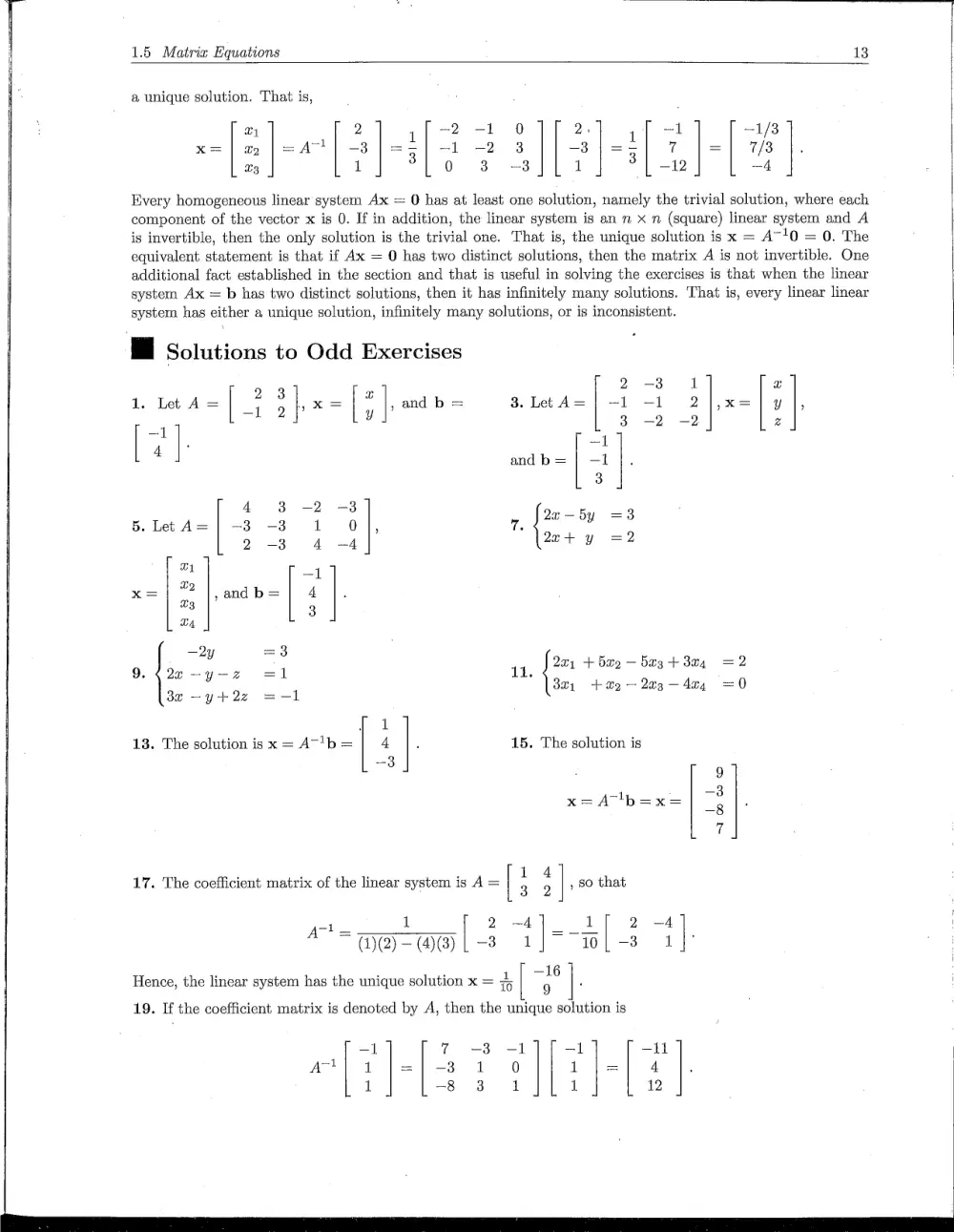
a unique solution. That is,
a4 2 ,[-2 -1 0 2. —I ~1/3
x= | a |=A?t} -3 =g|-1 2 3 -3/=1| 7 |= 7/3
as 1 0 3 -3 1 3} 12 —4
Every homogeneous linear system Ax = 0 has at least one solution, namely the trivial solution, where each
component of the vector x is 0. If in addition, the linear system is an n x n (square) linear system and A
is invertible, then the only solution is the trivial one. That is, the unique solution is x = A~'0 = 0. The
equivalent statement is that if Ax = 0 has two distinct solutions, then the matrix A is not invertible. One
additional fact established in the section and that is useful in solving the exercises is that when the linear
system Ax = b has two distinct solutions, then it has infinitely many solutions. That is, every linear linear
system has either a unique solution, infinitely many solutions, or is inconsistent.
Mi Solutions to Odd Exercises
2 3 2 2 -38 1 xz
1. Let A = x= , and b = 8. Let A=] -1 -1 2],x=] y |,
—-1 2 y
; 3-2 -2 z
-1
4 -1
andb= | —l
3
4 3 -2 -38 _
5B. Let A=|-3 -3 1 0 |, 7. {e by = 3
2-3 4 -4 ety =2
wy 1
x= |” , and b= 4
v3
3
v4
-2 =3
y 2a, +529 —5ag+3a4 =2
9. 42a —-y-z =1 11. 3 ; 2 4 =0
8a -y+2z2 =-1 te 2 ang ea
J ot
13. The solution is x = A7'b = Al. 15. The solution is
-3
9
x=Atb=x= 3
7
17. The coefficient matrix of the linear system is A = ; ; , so that
Ada—_1 2 -4 _ ti 2 -4 ;
(1)(2)- (4)(3) | -8 1 10, -3 1
Hence, the linear system has the unique solution x = 4 5 .
19. If the coefficient matrix is denoted by A, then the unique solution is
-1 7 -3 -1 —1 11
At] 1 |=|]-3 1 0 1
1 -§ 3 1 1 12
Hl
~
14 Chapter 1 Systems of Linear Equations and Matrices
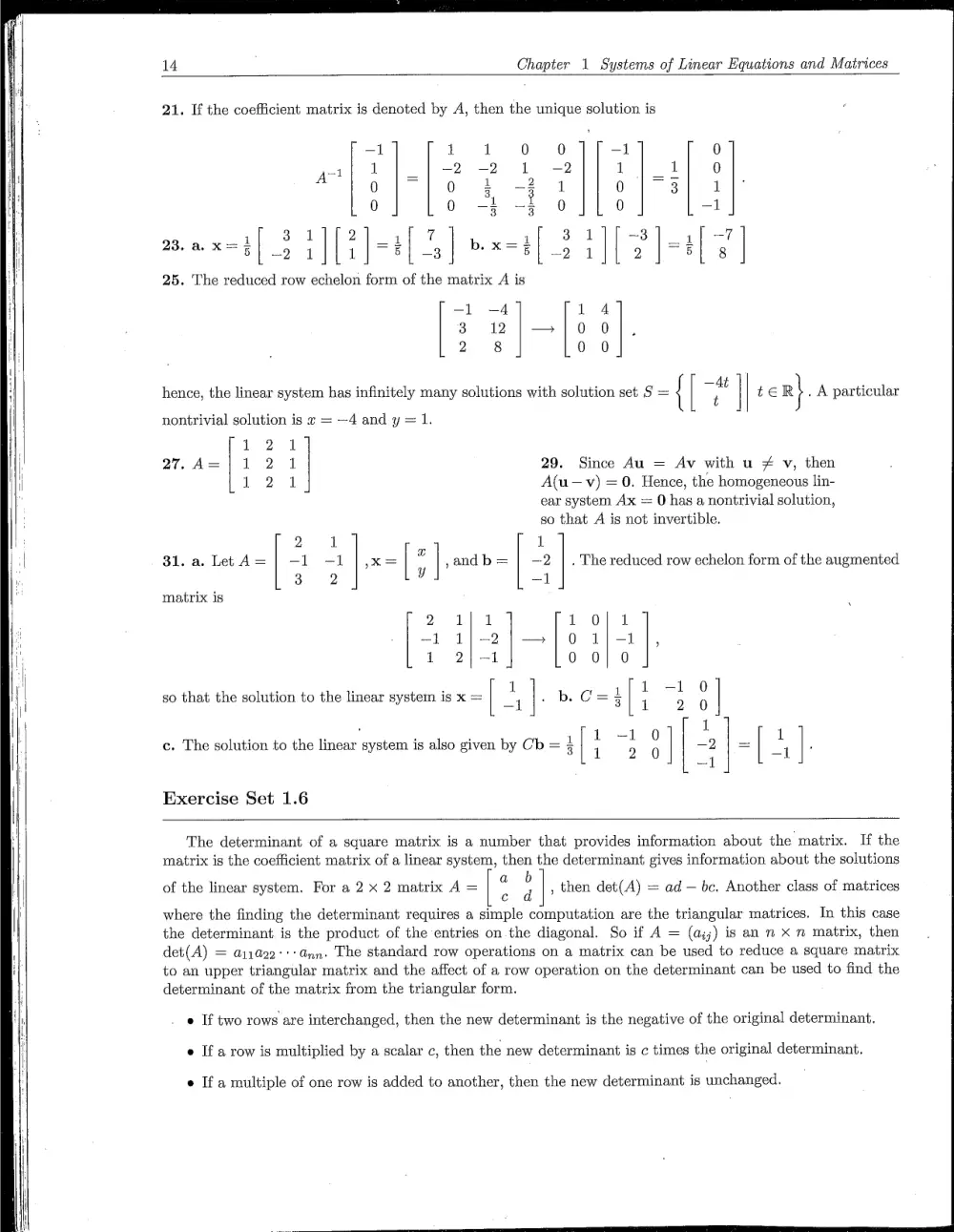
21. If the coefficient matrix is denoted by A, then the unique solution is
-1 1 1 0 0 -1 0
ao| } fo} -2 -2 1 -2 1 ]}_1}] 0
0 0 4 3 1 0 | 7 1°
0 0 -i -% 0 0 -1
3 1)f2 7 3.1)/-3 -7
meenif S|] S] eal LHe]
25. The reduced row echelon form of the matrix A is
-1 -4 1 4
3 «12 —|0 0
2 8 0 0
hence, the linear system has infinitely many solutions with solution set S = { m | te | . A particular
nontrivial solution is ¢ = —4 and y = 1.
12 1
27, A= 29. Since Au = Av with u # v, then
121
12 1 A(u—v) =0. Hence, the homogeneous lin-
ear system Ax = 0 has a nontrivial solution,
so that A is not invertible.
1
81.a. Let A=] —-1 —-1 |] ,x= ) ,andb = | —2 | . The reduced row echelon form of the augmented
3 2 —1
matrix is
2 1) 1 1 0} L
-1 1/-2/—]o0 1}-1],
1 2)-1 0 0; 0
. . ; 1 er)
so that the solution to the linear system is x = 1]: b C= 3 1 2 0
‘ 1 -1 0 1 1
c. The solution to the linear system is also given by Cb = 4 1 20 —2)= 4 :
-1
Exercise Set 1.6
The determinant of a square matrix is a number that provides information about the matrix. If the
matrix is the coefficient matrix of a linear system, then the determinant gives information about the solutions
of the linear system. For a 2 x 2 matrix A = ab , then det(A) = ad — 6c, Another class of matrices
cd
where the finding the determinant requires a simple computation are the triangular matrices. In this case
the determinant. is the product of the entries on the diagonal. So if A = (aij) is an n x m matrix, then
det(A) = @11422°+-Gnn. The standard row operations on a matrix can be used to reduce a square matrix
to an upper triangular matrix and the affect of a row operation on the determinant can be used to find the
determinant of the matrix from the triangular form.
e If two rows are interchanged, then the new determinant is the negative of the original determinant.
e If a row is multiplied by a scalar c, then the new determinant is c times the original determinant.
e If a multiple of one row is added to another, then the new determinant is unchanged.