
MATH 218 Problems Solution Manual Chapter 1.4, Fall 2011
American University of Beirut · Elementary Linear Algebra with Applications · 3 pages · with solution
More MATH 218 files
- Problems Solution Chapter 6.1 · Spring 2012Chapter · with solutionView
- Homework Chapter 8 · Fall 2012ChapterView
- Chapter Summary · Fall 2011ChapterView
- Problems Solution Manual Chapter 1.6 · Fall 2011Chapter · with solutionView
- Problems Solution Manual Chapter 1.2 · Fall 2011Chapter · with solutionView
- Problems Solution Manual Chapter 1.5 · Fall 2011Chapter · with solutionView
- Problems Solution Manual Chapter 1.1 · Fall 2011Chapter · with solutionView
- Problems Solution Manual Chapter 1.3 · Fall 2011Chapter · with solutionView
Show the text of this chapter
10 Chapter 1 Systems of Linear Equations and Matrices
Exercise Set 1.4
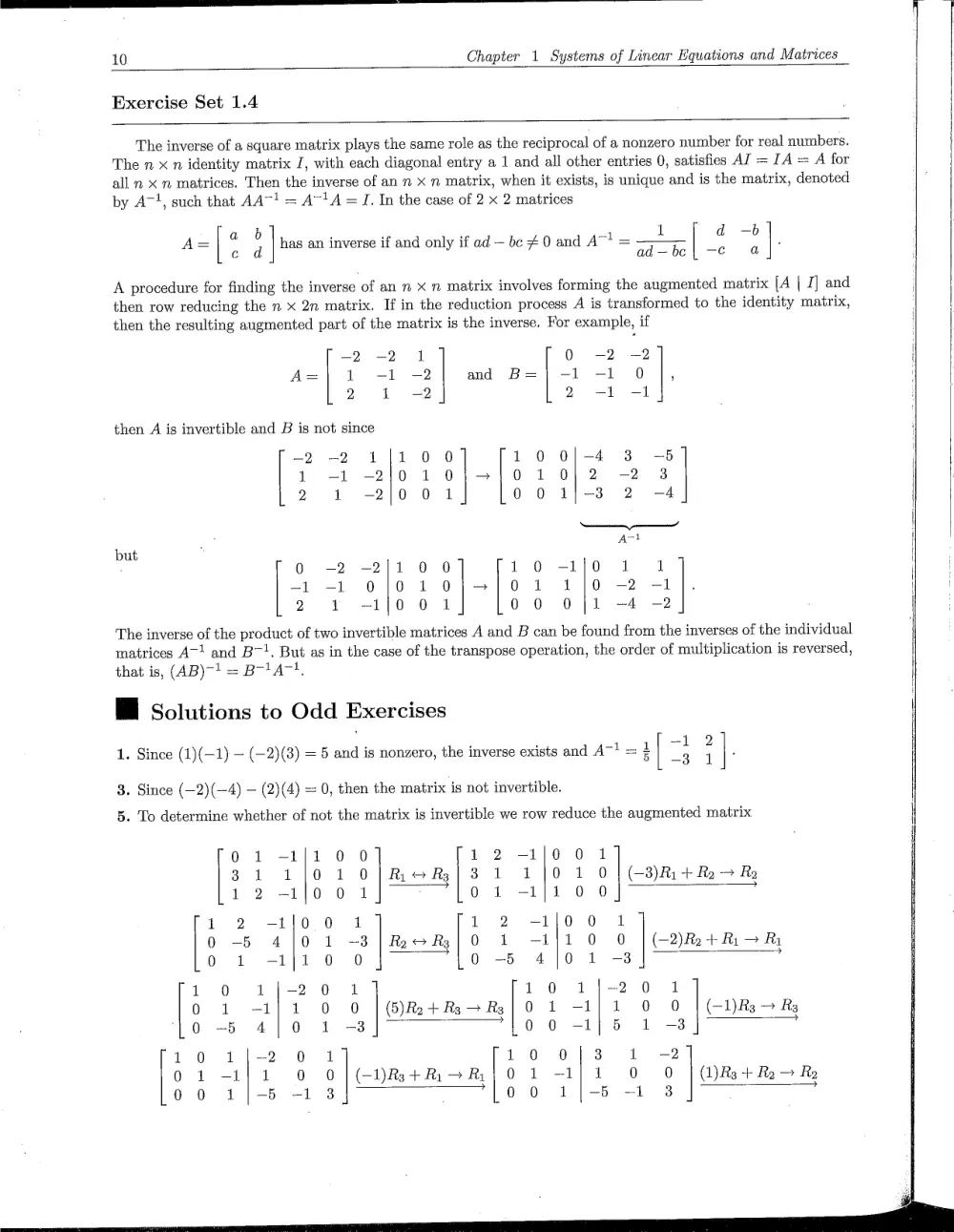
The inverse of a square matrix plays the same role as the reciprocal of a nonzero number for real numbers.
The n x n identity matrix J, with each diagonal entry a 1 and all other entries 0, satisfies AT = [A = A for
all n x n matrices. Then the inverse of an n x n matrix, when it exists, is unique and is the matrix, denoted
by A~}, such that AA~! = A~1A = J. In the case of 2 x 2 matrices
_fa bj, . . . 1.1 d —b
a=|¢ 2 | bas an inverse if and only if ad ~ be #0 and -az| 2 |.
A procedure for finding the inverse of an n x n matrix involves forming the augmented matrix [A | J] and
then row reducing the n x 2n matrix. If in the reduction process A is transformed to the identity matrix,
then the resulting augmented part of the matrix is the inverse. For example, if
2 -2 1 0 -2 -2
A=} 1 -1 -2| and B=] -1 -1 0 |,
2 1 -2 2 -1 -1
then A is invertible and B is not since
—2 -2 1i{1 0 0 10 0}-4 3 -5
1 -1 -210 1 OJ] +] 0 1 0) 2 -2 38
2 1 -2/0 0 1 00 1)-3 2 -4
or
but
‘ 0 -2 -2]1 0 0 10 -1)0 1 #1
-1 -1 0/0 1 0;>]0 1 1/0 -2 -1).
2 2 -1/0 01 00 Oj1 -4 -2
The inverse of the product of two invertible matrices A and B can be found from the inverses of the individual
matrices A-! and B~!. But as in the case of the transpose operation, the order of multiplication is reversed,
that is, (AB)-1 = B-1A7},
@ Solutions to Odd Exercises
1. Since (1)(—1) — (—2)(3) = 5 and is nonzero, the inverse exists and Al:
i
oe
—
Ii
we
Hw
a
3. Since (—2)(—4) — (2)(4) = 0, then the matrix is not invertible.
5. To determine whether of not the matrix is invertible we row reduce the augmented matrix
0 1-1/1 0 0 12 -1/0 01
31 1/01 0/R,¢6R3] 3 1 14/0 1 0 | (-3)Ri+Re- Ro
12 -1/0 01 ° 0 1-1/1 0 0)7.
1 2 -1/0 0 1 1 2 -1/0 0 1
0-5 4/01 -3 | Ree Rz3/0 1 -1)1 0 O | (-2)Re+Ri > Ry
0 1 -1}/1 0 0 "1 Qo -5 4/0 1 -8 ; —_
1 0 2 |-2 0 1 10 1 {-2 0 1
0 1 -1) 1 0 0 | ()Ro+Rg>R3]/ 0 1 -1) 1 0 O | (-D)Rs > Rs
0-5 4/0 141 -3|77—~1I0 0 -1)5 1-3 |
10 1{/-2 0 1 10 0/38 1 -2
0 1-1/1 0 Of (-D)Rg+ Ri 7k] 0 1 -1) 1 0 0 | ()R3+Re— Re
00 4/-5 -1.3)77 oO J] 00 00 1 fk
|
1.4 The Inverse of a Matrix it
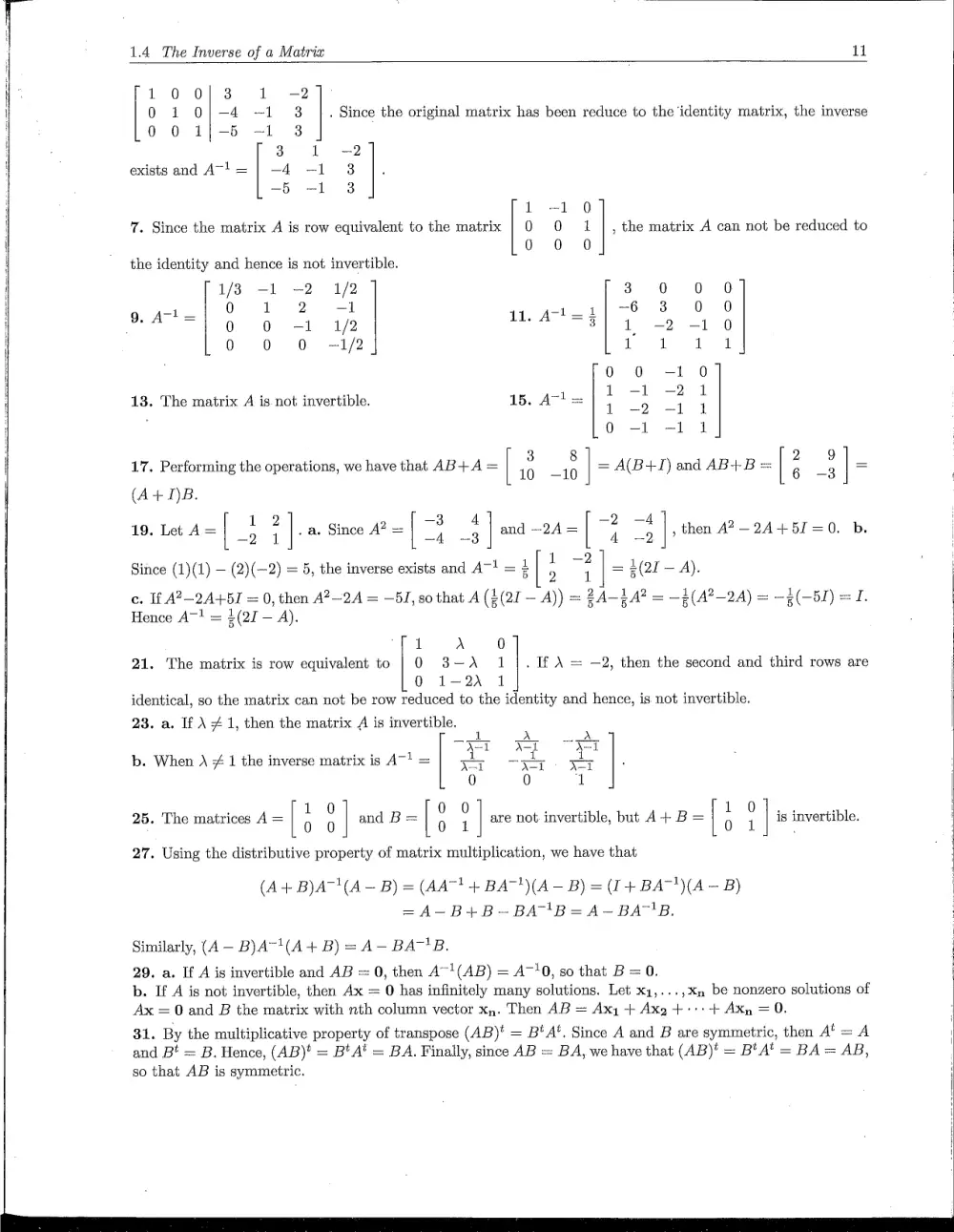
10 0 a 1 -2
010 ~1 8 |. Since the original matrix has been reduce to the ‘identity matrix, the inverse
001 - -1 3
3 1 -2
exists and ATt= | -4 -1 3 |.
—-5 -l 3
1 -1 0
7. Since the matrix A is row equivalent to the matrix | 0 0 1 | , the matrix A can not be reduced to
0 0 0
the identity and hence is not invertible.
1/8 -1 ~-2 1/2 3 0 0 0
0 1 2 -1 -6 3 0 0
“1 -1L1
9 A=) 0 0 -1 1/2 WAY =3) 1 -2 -1 0
0 0 0 1/2 1 1 1 so.
0 0 -1 0
. . . . 1 1-1 -2 1
13. The matrix A is not invertible. 15. Avt = 1-2 -1 4
0 -1 -1 1
3 8 2 9
17. Performing the operations, we have that AB+A = 10 -10 |= A(B+J) and AB+B = 6 -3 |=
(A+])B
_f 12 4g f[-3 4 _f-2 -4 4 _
19. tet A=|_ 1 | a. Since a? = | 5 [ad -24=| 4 |: then A? —-2A+5l=0. b
2
1
Since (1)(1) — (2)(—2) = 5, the inverse exists and A~! = }
c. If A? 2A+5I = 0, then A?—2A = —5I,so that A (#(2l — A)) = 2A—} A? = —}(A?—-2A) = —§(-5I) =
Hence A~! = }(27 — A).
1 on 0
21. The matrix is row equivalent to | 0 3—-A 1 |. If A = —2, then the second and third rows are
0 1-2 1
identical, so the matrix can not be row reduced to the identity and hence, is. not invertible.
23. a. If \ #1, then the matrix A is invertible.
dt d yy
=I W-t \-
Ant co pate tg fod — A
b. When \ # 1 the inverse matrix is AT*= | 34; —x4y a
0 0 1
. 1 0 0 0 : . 10],. .
25. The matrices A = 00 and B= o 1 | ae not invertible, but A+ B= 0 1/|%8 invertible.
27. Using the distributive property of matrix multiplication, we have that
(A+ B)A71(A— B) = (AA7! + BA™')(A— B) = (I+ BA7!)(A - B)
=A-B+B-—BA'B=A-BA™"B.
Similarly, (A — B)A7!(A+ B) = A— BA“"B.
29. a. If A is invertible and AB = 0, then A~+(AB) = A7'0, so that B =0.
b. If A is not invertible, then Ax = 0 has infinitely many solutions. Let x1,...,Xn be nonzero solutions of
Ax = 0 and B the matrix with nth column vector xn. Then AB = Ax1 + Axg +++: + Axy =0.
31. By the multiplicative property of transpose (AB)! = B' A’, Since A and B are symmetric, then Ab=A
and B* = B. Hence, (AB)* = Bt A‘ = BA. Finally, since AB = BA, we have that (AB)' = B'A' = BA = AB,
so that AB is symmetric.
12 Chapter 1 Systems of Linear Equations and Matrices
33. If AB = BA, then B~1AB = A, so that B-14 = AB~!, Then (AB-1)* = (B-)tAt, Since (Bt) Bt =
(BB~')' = I, we have that (B-')’ = (B*)~1, Finally, (AB~1)* = (B')"1 4 = BLA = AB! and hence,
AB" is symmetric. :
35. Assuming A‘ = A”! and Bt = B-!, we need to show that (AB) = (AB)~!. But (AB)! = BtAt =
B-A~! = (AB)! and hence, AB is orthogonal.
37. a. Using the associative property of matrix multiplication, we have that
(ABC)(C1 B71 47) = (AB)CC™1(B-1 47) =ABB'AT=AA =I.
b. The proof is by induction on the number of matrices k.
Base Case: When k = 2, since (A, Ag)~1 = A;'Azt, the statement holds.
Inductive Hypothesis: Suppose that (A; Ag+-+A,)~! = Ay Ag, se Art Then for k +1 matrices, we have
that (Ay Ag:++ Ay Agy1)7! = ([A1 Ag+ ++ Ag]Apsi)~*. Since [Ay Ag: ++ A,] and Az41 can be considered as two
matrices, by the base case, we have that ([AyAg-++AxJAgyi)7! = Aji [ArAe --+A,]~+. Finally, by the
inductive hypothesis
((Ar Ag+ AglAgyi)! = Apt [Arda-+Agh t= Ag Aptagh ATE
39. If A is invertible, then the augmented matrix [A|J] can be row reduced to [J|A~1]. If A is upper triangular,
then only terms on or above the main diagonal can be affected by the reduction process and hence the inverse
is upper triangular. Similarly, the inverse for an invertible lower triangle matrix is also lower triangular.
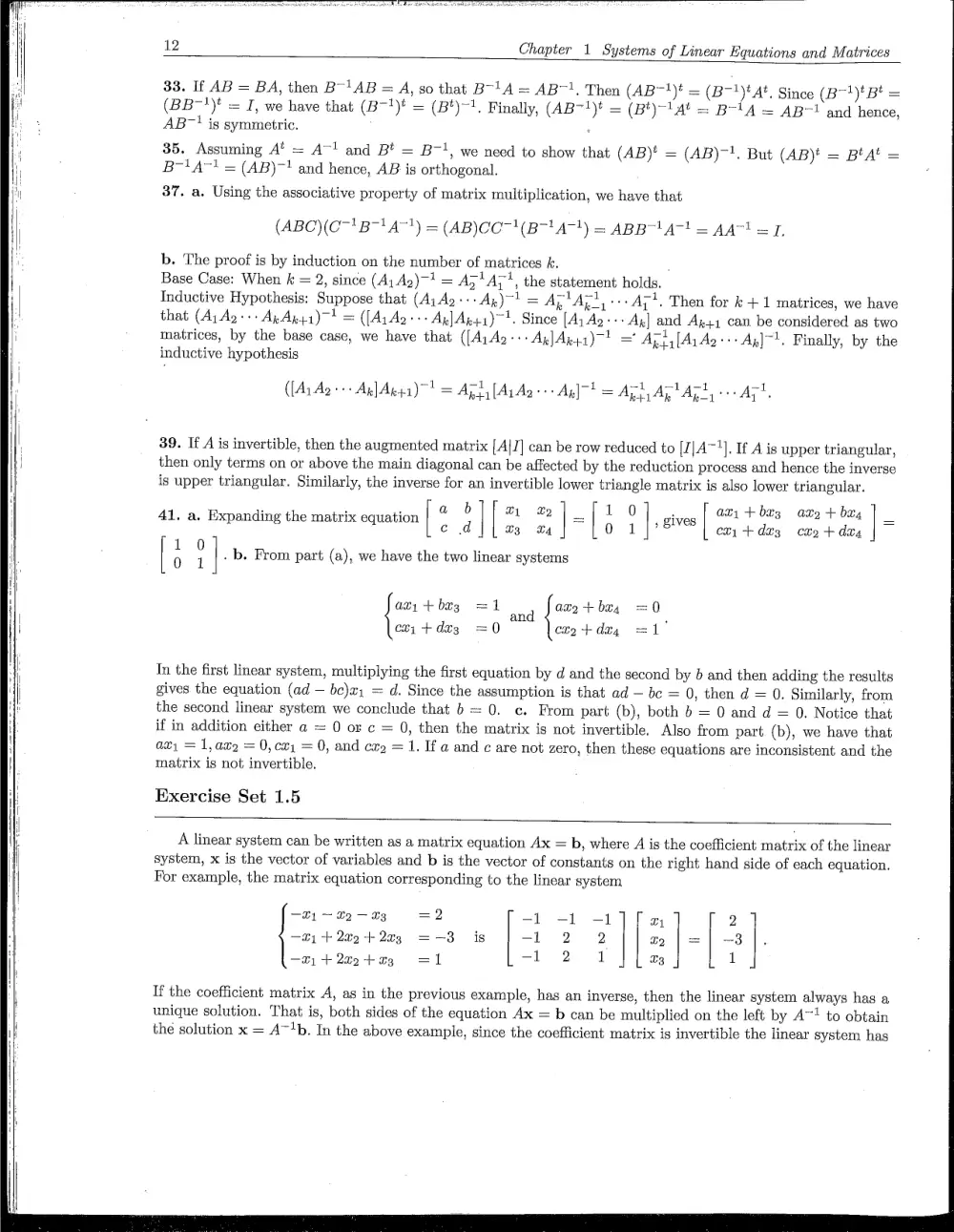
4 . iat . a b a a | [1 0 . at, +brz axg+ba, | _
Al. a. Expanding the matrix equation c d os 4 = 01 , gives ct + dag ct, +de4 | =
4 1 . b. From part (a), we have the two linear systems
ati +br3 =1 and axg+br4 =0
ct; +dzz3 =0 cag -+dtq =1°
In the first linear system, multiplying the first equation by d and the second by 6 and then adding the results
gives the equation (ad — be)x; = d. Since the assumption is that ad — be = 0, then d = 0, Similarly, from
the second linear system we conclude that 6 = 0. c. From part (b), both 6 = 0 and d = 0. Notice that
if in addition either a = 0 or c = 0, then the matrix is not invertible, Also from part (b), we have that
aa, = 1,ax2 = 0,cx, = 0, and ca = 1. If a and c are not zero, then these equations are inconsistent and the
matrix is not invertible.
Exercise Set 1.5
A linear system can be written as a matrix equation Ax = b, where A is the coefficient matrix of the linear
system, x is the vector of variables and b is the vector of constants on the right hand side of each equation.
For example, the matrix equation corresponding to the linear system
21 — €2 — 23 =2 -1 -1 -1 fan 2
—21-+2x2-+-2a3, =—3 is -1 2 2 ta | =| -3
—@+22+a3, =1 “roa 4 3 1
If the coefficient matrix A, as in the previous example, has an inverse, then the linear system always has a
unique solution. That is, both sides of the equation Ax = b can be multiplied on the left by A~! to obtain
the solution x = A~*b. In the above example, since the coefficient matrix is invertible the linear system has