
MATH 218 Problems Solution Manual Chapter 1.3, Fall 2011
American University of Beirut · Elementary Linear Algebra with Applications · 2 pages · with solution

More MATH 218 files
- Problems Solution Chapter 6.1 · Spring 2012Chapter · with solutionView
- Homework Chapter 8 · Fall 2012ChapterView
- Chapter Summary · Fall 2011ChapterView
- Problems Solution Manual Chapter 1.6 · Fall 2011Chapter · with solutionView
- Problems Solution Manual Chapter 1.2 · Fall 2011Chapter · with solutionView
- Problems Solution Manual Chapter 1.5 · Fall 2011Chapter · with solutionView
- Problems Solution Manual Chapter 1.1 · Fall 2011Chapter · with solutionView
- Problems Solution Manual Chapter 1.4 · Fall 2011Chapter · with solutionView
Show the text of this chapter
8 Chapter 1 Systems of Linear Equations and Matrices
Here we used that two matrices are equal if and only if corresponding components are equal. Some of the
exercises involve showing some matrix or combination of matrices is symmetric. For example, to show that
the product of two matrices AB is symmetric, requires showing that (AB) = AB.
Wi Solutions to Odd Exercises
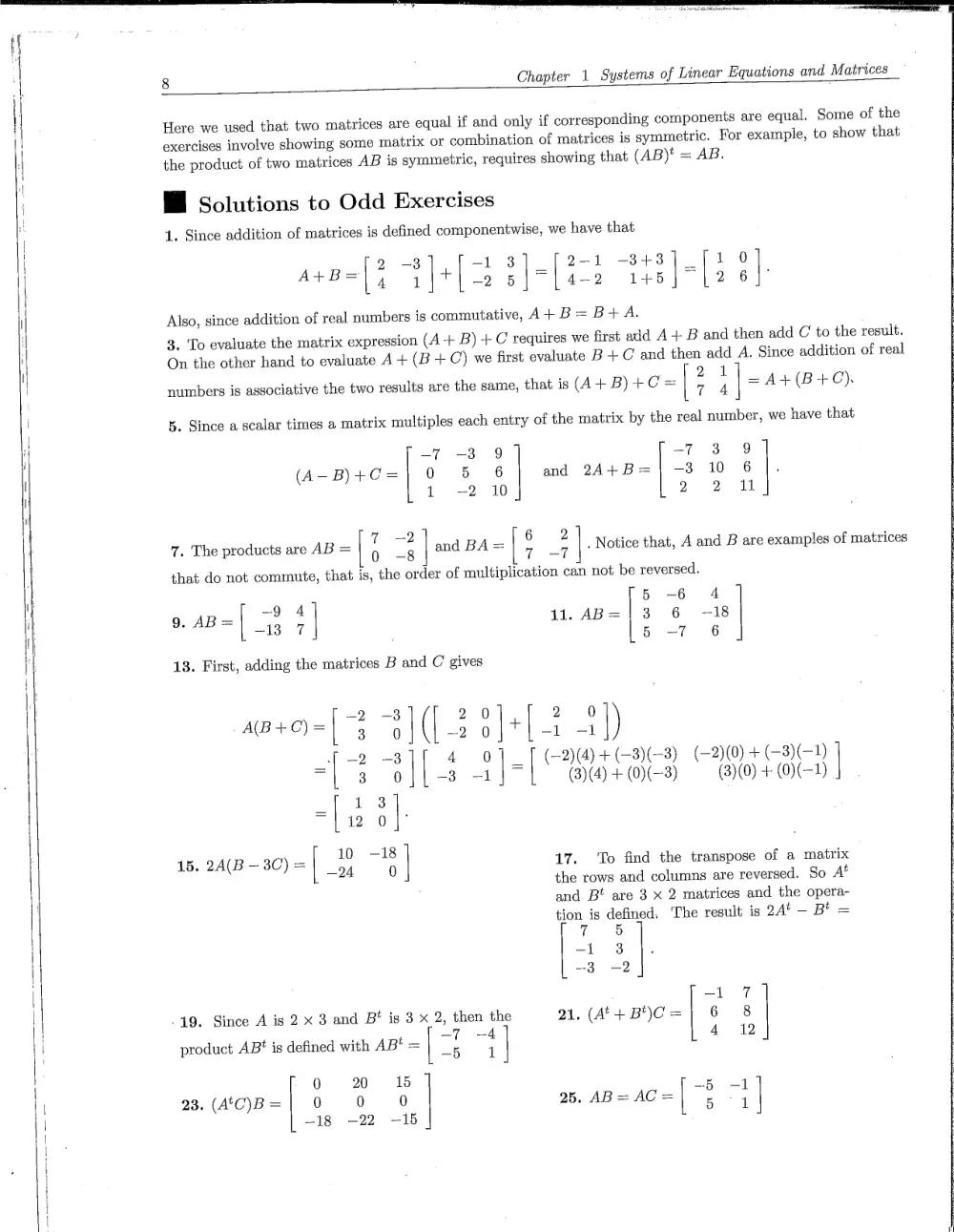
1. Since addition of matrices is defined componentwise, we have that
_f2 -3 -1 3] [2-1 -3+3]_[1 0
asB=| 4 t}+[ a e]=[ ic: eel: 3 |:
Also, since addition of real numbers is commutative, A+ B= B+ A.
3. 'To evaluate the matrix expression (A + B) + C' requires we first add A+B and then add C to the result.
On the other hand to evaluate A+ (B+ C) we first evaluate B+ C and then add A. Since addition of real
numbers is associative the two results are the same, that is (A+ B)+C= | ; I =A+(B+C).
5. Since a scalar times a matrix multiples each entry of the matrix by the real number, we have that
-7 -3 9 -7 3 9
(A-B)+C=] 0 5 6 and 24+B=|-3 10 6 |.
1 -2 10 2 2 It
7. The products are AB = i i" and BA = ; 3 . Notice that, A and B are examples of matrices
that do not commute, that is, the order of multiplication can not be reversed.
9 4 5 -6 4
9. AB= 3 7 41. AB=|3 6 -18
. 5 —-7 6
13. First, adding the matrices B and C’ gives
woro=[ 0) (4 0]+[4 4)
3 0] =| ane cars (-2)0)+ CD]
1 (C4) + (0-8) (8)(0) + (O(-1)
3 0
[13
~} 42 0/7
10 —18 a
15. 2A(B-—3C) = _94 0 17. To find the transpose of a matrix
the rows and columns are reversed. So At
and Bt are 3 x 2 matrices and the opera-
tion is defined. ‘The result is 2A’ — BY =
7 5
-1 3
—3 -2
-1 7
19. Since A is 2 x 3 and Bt is 3 x 2, then the 21. (A+ B)C=) 6 8
product AB? is defined with ABY = | _ - 4 22
0 20 15 5-1
23. (A'C)B=| 0 0 0 25. AB= AC = | 5 1
—18 —22 —15
1.4 The Inverse of a Matrix 9
2 4, ]) ab ab] _[@ abt+be]_[1°0
A= AA=| § ak °)=[% et} 10 1
if and only if a? = 1,c? = 1, and ab+ bc = (a+) =0. That is, a= +1,c = +1, and b(a+c) = 0, so that A
; 10 1 6b -1 0b -l 0]
has one of the forms 0 1 , 0 -1 , 01 , or 0-1 .
11
29. et A=| 4 0) eae=| 7 “| Then AB = ;
zero matrix. Notice that, this can not happen with real numbers. ‘That is, if the product of two real numbers
is zero, then at least one of the numbers must be zero.
31. The product
1 2 3 b]_[-5 b+2)°
a 0 -4 1|] {| 3a ab
if and only b+ 2 = 6, 3a = 12, and ab = 16. That is,a=b=4.
27. The product
, and neither of the matrices are the
-5 6
12 16
33. Several powers of the matrix A are given by
will equal
1 0 0 1 0 0 100 1 0 0
A=}]010)],42=]0 -1 0],44=]0 1 0], amd A5=] 0 -1 0].
0 0 1 0 0 1 00 1 0 Oo 1
1 0 0
We can see that if n is even, then A” is the identity matrix, so in particular A7? = | 0 1 0 | . Notice also
00 1
1 0 0
that, ifn is odd, then AX” = | 0 —-1 01.
0 0 1
35. We can first rewrite the expression A?B as A2B = AAB., Since AB = BA, then A?B = AAB = ABA=
BAA = BA?.
1
0
37. Multiplication of A times the vector x = | , | gives the first column vector of the matrix A. Then
0.
0
1
Ax = 0 forces the first column vector of A to be the zero vector. Then let x = | . | and so on, to show
0
that each column vector of A is the zero vector. Hence, A is the zero matrix.
_|a b 4 | @_e
39. Let A= ° 2 | 30 that A = b g | Then
Aatal@ > a c]_|[ a+b? ac+bd]_ [0 0
“ted b d| | actbd +d} | 0 0
if and only if a?-++b? = 0, c? +d? = 0, and ac+bd = 0. The only solution to these equations is a= b=c=d=0,
so the only matrix that satisfies AA’ = 0 is the 2 x 2 zero matrix.
41. If A is an mx n matrix, then A® is an n x m matrix, so that AA* and A‘A are both defined with AA’
being an m x m matrix and A‘A an n x n matrix. Since (AA')! = (A')!At = AA’, then the matrix AA! is
symmetric. Similarly, (A*A)* = A‘(A’)' = A*A, so that AA is also symmetric.
43. Let A = (aj) be an n x n matrix. If At = —A, then the diagonal entries satisfy aj, = —a; and hence
ay = 0 for each i, :