
MATH 218 Problems Solution Manual Chapter 1.1, Fall 2011
American University of Beirut · Elementary Linear Algebra with Applications · 4 pages · with solution


More MATH 218 files
- Problems Solution Chapter 6.1 · Spring 2012Chapter · with solutionView
- Homework Chapter 8 · Fall 2012ChapterView
- Chapter Summary · Fall 2011ChapterView
- Problems Solution Manual Chapter 1.6 · Fall 2011Chapter · with solutionView
- Problems Solution Manual Chapter 1.3 · Fall 2011Chapter · with solutionView
- Problems Solution Manual Chapter 1.5 · Fall 2011Chapter · with solutionView
- Problems Solution Manual Chapter 1.2 · Fall 2011Chapter · with solutionView
- Problems Solution Manual Chapter 1.4 · Fall 2011Chapter · with solutionView
Show the text of this chapter
1.1 Systems of Linear Equations 1
Solutions to All Odd—Numbered Exercises
Systems of Linear Equations and
l Matrices
Exercise Set 1.1
In Section 1.1 of the text, Gaussian Elimination is used to solve a linear system. This procedure utilizes
three operations that when applied to a linear system result in a new system that is equivalent to the original.
Equivalent means that the linear systems have the same solutions. 'The three operations are:
e Interchange two equations.
e Multiply any equation by a nonzero constant.
e Add a multiple of one equation to another.
When used judiciously these three operations allow us to reduce a linear system to a triangular linear system,
which can be solved. A linear system is consistent if there is at least one solution and is inconsistent if there
are no solutions. Every linear system has either a unique solution, infinitely many solutions or no solutions.
For example, the triangular linear systems
@—tg+a3 =2 ‘| &1 — 2x2 + &3 =2 204 +a3 =1
@—-2%3 =-1, —to+2%3 =-3, Ze —%3 =2
wg =2 0 =4
have a unique solution, infinitely many solutions, and no solutions, respectively. In the second linear system,
the variable x3 is a free variable, and once assigned any real number the values of #; and x2 are determined.
In this way the linear system has infinitely many solutions. If a linear system has the same form as the second
system, but also has the additional equation 0 = 0, then the linear system will still have free variables. ‘The
third system is inconsistent since the last equation 0 = 4 is impossible. In some cases, the conditions on the
right hand side of a linear system are not specified. Consider for example, the linear system
£1 — £2 =a 21 — 2 =a
2a, +222 +23 =b which is equivalent to a3 =b+2a
——_—_—E—Ererrreeveveesss
203 =Cc 0 =c-2b-4a
This linear system is consistent only for values a,b and c such that c — 2b — 4a = 0.
Solutions to Odd Exercises
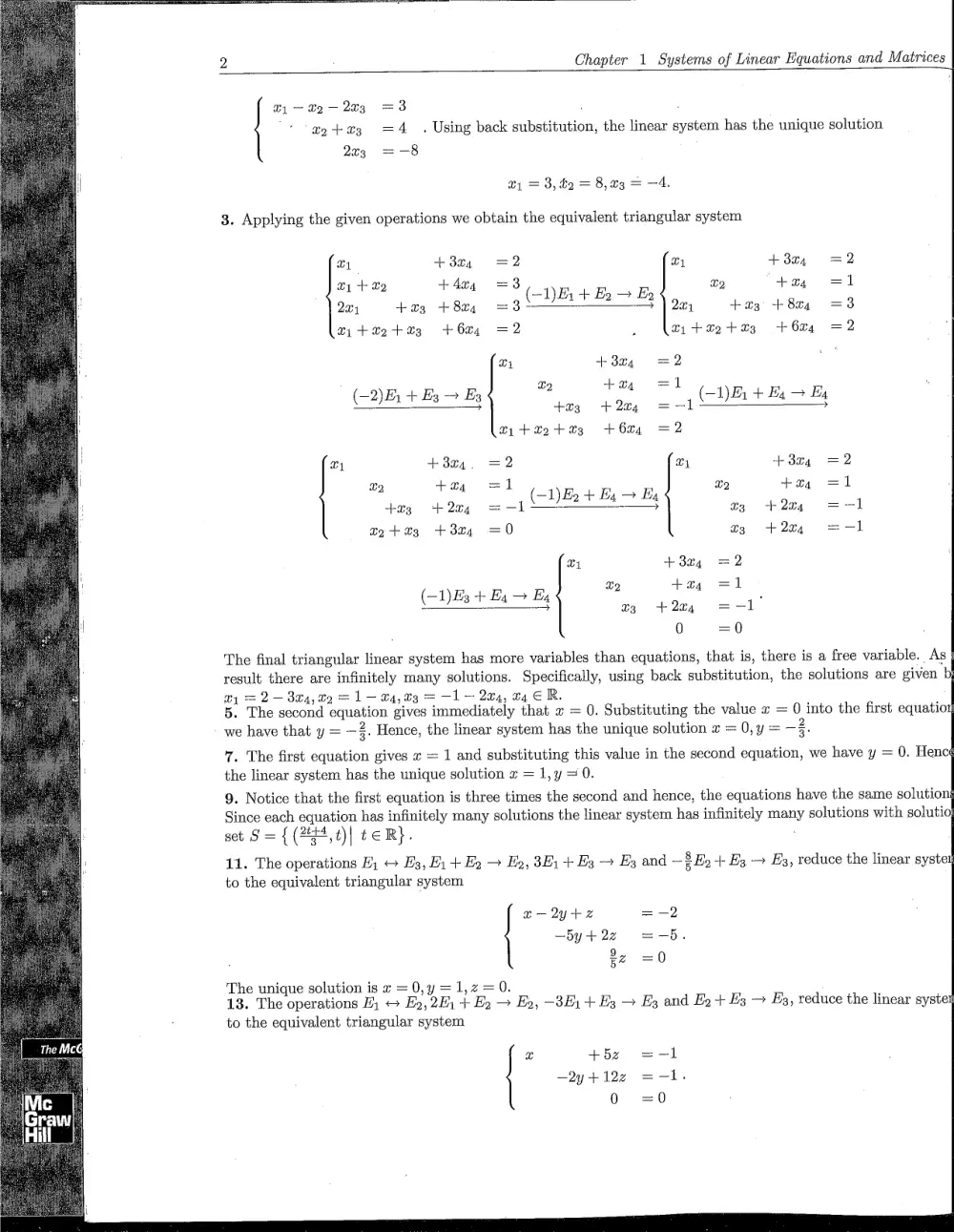
1. Applying the given operations we obtain the equivalent triangular system
@1— Lo — 2xg =3 @—%—-243 =3
a, +2%2.+8273 =1 By +in > Ey fo + 23 =4 (-2)E, + E3 > E3
—————_—_—_
221 —2ag-2a3 =-2 201 — 22-243 = —2
Chapter 1 Systems of Linear Equations and Matrices
v1 —-22-24%3 =3 .
zo+a3 =4 _ . Using back substitution, the linear system has the unique solution.
203 = -8
21 = 3,9 = 8,43 = —4.
3. Applying the given operations we obtain the equivalent triangular system
eal +3¢, =2 Ly +324, =2
4a, =3 , =1
v1 + & + 4x4 (-1) Ei + By Es Lp) + 24
221 +203 +824 = 3 —— | 221 +23 +804 =3
aj+22+%3 +64, =2 . aptag+a23 +604 =2
xy + 344 =2 ,
@2 +a, =1
(-2)F, + Bs > Es (-1)E. + 4 > By
+3 +2¢a4 =-1l
aj+%.+%3 +62, =2
wy +824. =2 Ly +324 =2
xe + 2 =l1 , © ty, =1
? 4 (-1) Ey + Ey > Fa 2 +4
+03 +2¢4 = —1 ————> wg +2% =-1
agta23 +324 =0 wg +2%4 = 1
+844 =2
re +a, =1
—-1)E3 + E. EB.
(<D)Es + Ea > Ey tn +20, = -1
0 =0
The final triangular linear system has more variables than equations, that is, there is a free variable. As
result there are infinitely many solutions. Specifically, using back substitution, the solutions are given bj
wy = 2—3a4, 29 = 1— 24,03 = —1— 204, a4 ER.
5. The second equation gives immediately that « = 0. Substituting the value « = 0 into the first equatio:
we have that y = —2. Hence, the linear system has the unique solution 7 = 0,y = -2,
7. The first equation gives z = 1 and substituting this value in the second equation, we have y = 0. Hence
the linear system has the unique solution # = 1, y = 0.
9. Notice that the first equation is three times the second and hence, the equations have the same solutions
Since each equation has infinitely many solutions the linear system has infinitely many solutions with solutio,
set 5 = { (*4,4)| te R}.
11. The operations Ey @ E3, EH, +E, > Ee, 3E, + E3 > Es and 3B, ++ E3 — Es, reduce the linear syste
to the equivalent triangular system
ev Qy +z =-2
—Sy+2z =-5.
az =0
The unique solution is 7 =0,y = 1,2 =0.
13. The operations E, @ Ey, 2E, +E, > Ey, -3£, + Es > Es and E2 + E3 — E3, reduce the linear systes
to the equivalent triangular system
+52 =-1
+122 =-1.
0 =0
1.1 Systems of Linear Equations
wo
The linear system has infinitely many solutions with solution set S = { (—1 —5¢,6t+ 3,¢)| te R}.
15. Adding the two equations yields 62; + 63 = 4, so that x, = 2 ~ 3. Substituting this value
in the first equation gives tg = —}. The linear system has infinitely many solutions with solution set
S={(-14+3,-4,0)| teR}. |
17. The operation 2E) +2 — Ep gives the equation —3x9—323 ~—4a4 = —9, Hence, the linear system has two
free variables, x3 and a4. The two parameter set of solutions is 5 = { (3 = Bt, —s— $t +3, s,t)| ste R} .
19. The operation —2E, + Ey > Eo gives z = b — 2a. Then y = a+ 22 = a+ 2(b~ 2a) = 2b ~ 38a, so that
the unique solution is 7 = —2a + b, y = —3a + 2b.
21. The linear system is equivalent to the triangular linear system
~£ —z =b
y =a+3b ;
z =c—Tb-2a
which has the unique solution 7 = 2a + 6b — c,y = a+ 3b, z= —2a—7b+e.
23. Since the operation 2E, + EH, — Ey gives the equation 0 = 2a + 2, then the linear system is consistent
fora =—1.
25. Since the operation 2H, + Ey — Ey gives the equation 0 = a+ b, then the linear system is consistent for
b=—a. .
27. The linear system is equivalent to the triangular linear system
w—2’y+4z2 =a
5y—-9z =-2a+b
0 =c-a-—b
and hence, is consistent for all a,b, and c such that c—-a—b=0.
29. The operation —2F; + EB, — HE gives the equivalent linear system
e+y =-2
(a-2)yy =7 °
Hence, if a = 2, the linear system is inconsistent.
31. The operation —3E, + Ey — Ey gives the equivalent linear system
a-y =2
0 =a-6'
Hence, the linear system is inconsistent for all a 4 6.
33. To find the parabola y = az? + ba +c that passes through the specified points we solve the linear system
ce =0.25
at+b+e =~-1,75.
a-b+ce =4.25
The unique solution is a = 1,6 = —3, and c = +; so the parabola is y = a? — 3a + + = (x - 3)? — 2. The
vertex of the parabola is the point (3, —2) .
4 Chapter 1 Systems of Linear Equations and Matrices
35. To find the parabola y = az? + be +c that passes through the specified points we solve the linear system
(-0.5)?a — (0.5)b+e¢ = —3.25
a + b+te =2
(2.3)?a +(23)b+e =2.91
The unique solution is a = —1,b = —4, and c = —1, so the parabola is y = ~2? + 4a —-1 = —(a — 2)? +3.
The vertex of the parabola is the point (2,3).
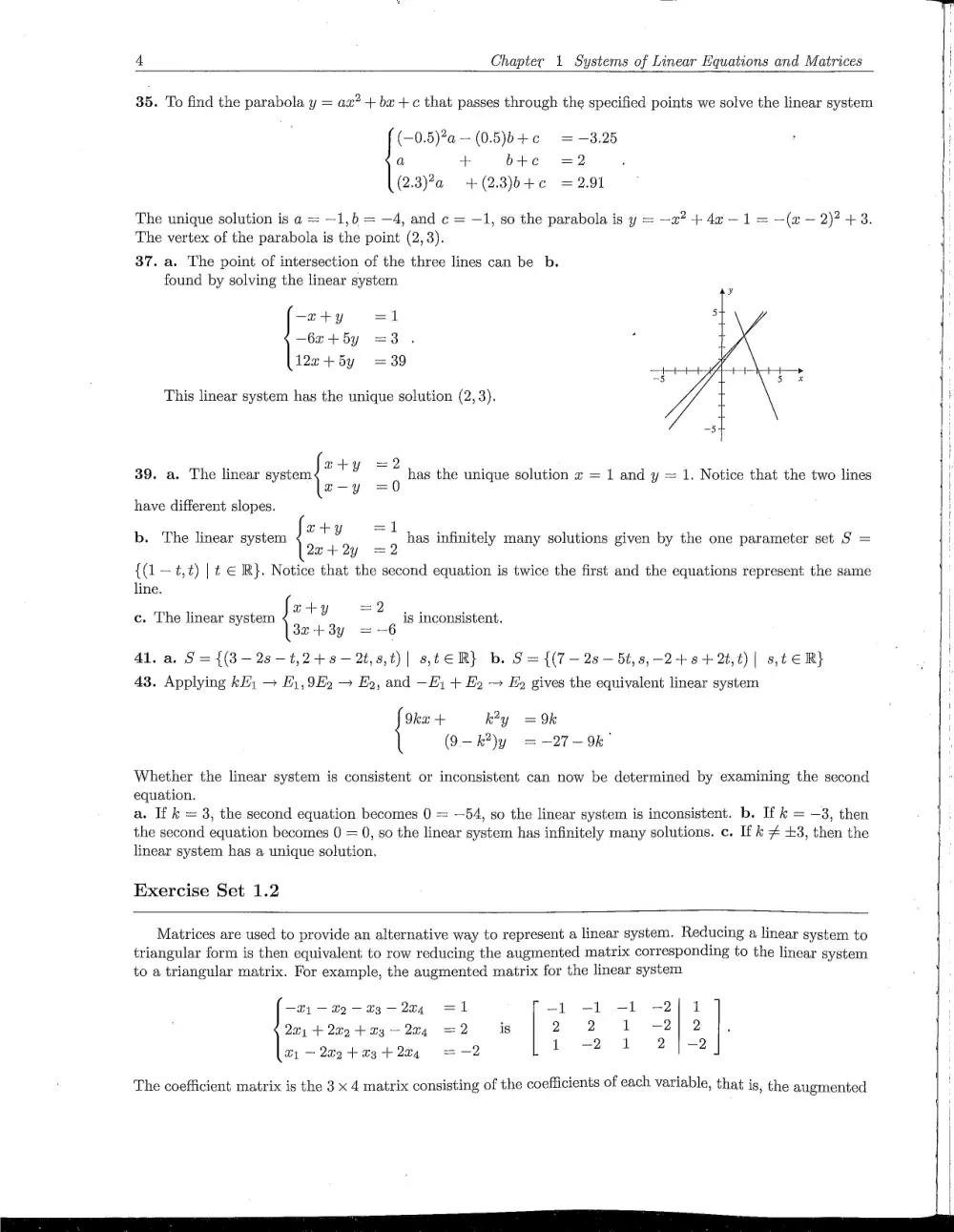
37. a. The point of intersection of the three lines can be b.
found by solving the linear system
—a+y =1
—62+5y =3
LQe+5y =39
This linear system has the unique solution (2,3).
@ =2
39. a. The linear erie ty 0 has the unique solution = 1 and y = 1. Notice that the two lines
e-y =
have different slopes.
ety =1 wae . .
has infinitely many solutions given by the one parameter set 9 =
Qn + 2y = 2
{(1~ t,t) | t € R}. Notice that the second equation is twice the first and the equations represent the same
line.
b. The linear system
a+y =2
3a+3y =-6
41. a, S={(3—2s—t,2+s8-—2t,s,t)| s,t€R} b. S={(7— 2s —5t,s,-2+48+4 2t,t)| s,t eR}
43. Applying ki, - E,,9E_ — E2, and —E; + Ey — KE» gives the equivalent linear system
ce. The linear system { is inconsistent.
9ka + k?y =9k
(9-—k*)y =-27-9k°
Whether the linear system is consistent or inconsistent can now be determined by examining the second
equation.
a. If k = 3, the second equation becomes 0 = —54, so the linear system is inconsistent. b. If k = —3, then
the second equation becomes 0 = 0, so the linear system has infinitely many solutions. c. If k ¢ +3, then the
linear system has a unique solution,
Exercise Set 1.2
Matrices are used to provide an alternative way to represent a linear system. Reducing a linear system to
triangular form is then equivalent to row reducing the augmented matrix corresponding to the linear system
to a triangular matrix. For example, the augmented matrix for the linear system
—a%1—a@2—-a%3—- 2a, =1 -1 -1 -1 -2] 1
20, 4+ 2x72 +23 —-204 =2 is 2 2 1 —2] 2
% — 2g +ag+2r4 =—2 1-2 1 2 |-2
The coefficient matrix is the 3 x 4 matrix consisting of the coefficients of each variable, that is, the augmented