
MATH 218 Problems Solution Manual Chapter 1.7, Fall 2011
American University of Beirut · Elementary Linear Algebra with Applications · 6 pages · with solution

More MATH 218 files
- Problems Solution Chapter 6.1 · Spring 2012Chapter · with solutionView
- Homework Chapter 8 · Fall 2012ChapterView
- Chapter Summary · Fall 2011ChapterView
- Problems Solution Manual Chapter 1.5 · Fall 2011Chapter · with solutionView
- Problems Solution Manual Chapter 1.2 · Fall 2011Chapter · with solutionView
- Problems Solution Manual Chapter 1.4 · Fall 2011Chapter · with solutionView
- Problems Solution Manual Chapter 1.1 · Fall 2011Chapter · with solutionView
- Problems Solution Manual Chapter 1.3 · Fall 2011Chapter · with solutionView
Show the text of this chapter
1.7 Elementary Matrices and LU Factorization 27
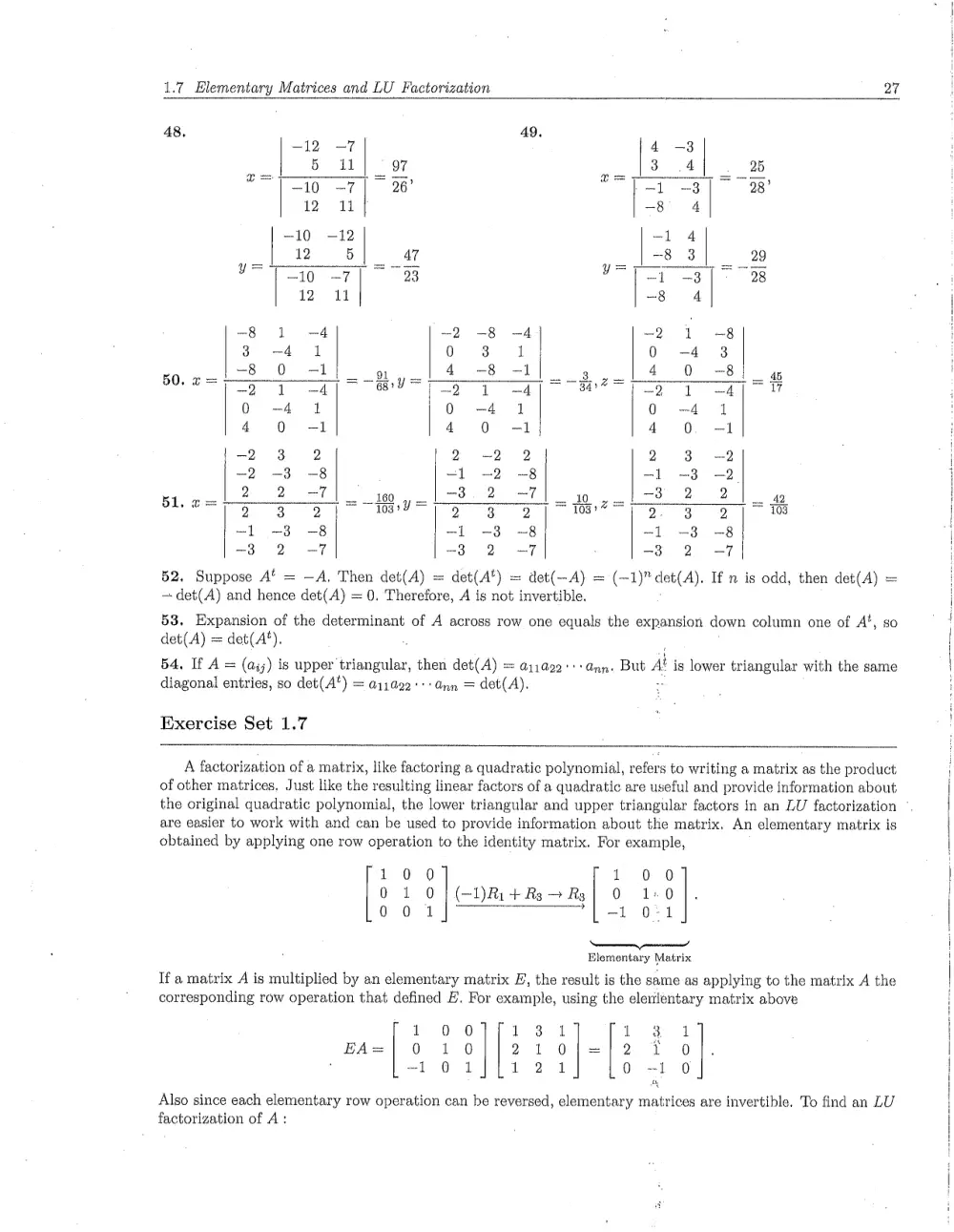
48. 49.
-12 -7 4-3
_ [8 i] 97 _ [38 4] _ 2%
7-10 —7 | ~ 36’ ey 1-3] 7 28°
12° 1l -§ 4
-10 -12 -1 4
[12 5] oar _ | -8 3| 29
= Tio 7] 8 Y= Toy os] 7 38
12 -§ 4
-8 1 -4 2 -§ 4 2 1 ~8
3-4 1 0 3 1 0 -4 3
_[-8 0 -1; 5 |4 -8 -1|. , |4 0 -8) 4
50. B= a ee a ep oe
0 -4 1 0 -4 1 0 -4 1
4 0 -1 4 0 -1 4 0 -1
2 3 2 2 -2 2 2 3 -2
2 -3 -8 =1 -2 ~8 ~1 -3 -2
2 2 -7 3.2 -7|_, -3 2 2
BL. = pg a = ye Se = | Te
-1 ~3 -8 -1 -3 ~8 -1 -3 -8
~3 2 ~7 ~3 2 ~7 -3 2 -7 4}
52, Suppose Ab = —A, Then det(A) = det(At) = det(—A) = (—1)" det(A). If n is odd, then det(A) =
~det(A) and hence det(A) = 0. Therefore, A is not invertible,
53, Expansion of the determinant of A across row one equals the expansion down column one of A’, so
det(A) = det(A*).
54, If A = (aij) is upper triangular, then det(A) = a11@29°++ Grn. But At is lower triangular with the same
diagonal entries, so det(A*) = a11422 +++ nn = det(A). :
Exercise Set 1.7
A factorization of a matrix, like factoring a quadratic polynomial, refers to writing a matrix as the product
of other matrices, Just like the resulting linear factors of a quadratic are useful and provide information about
the original quadratic polynomial, the lower triangular and upper triangular factors in an LU factorization
are easier to work with and can be used to provide information about the matrix. An elementary matrix is
obtained by applying one row operation to the identity matrix. For example,
oor
Ore
a)
1 0 0
(-1)Ry + Rg — Rg 0 1:07.
Fd
ee
Elementary Matrix
If a matrix A is multiplied by an elementary matrix E, the result is the same as applying to the matrix A the
corresponding row operation that defined E. For example, using the elerlentary matrix above
1 00 13 1 1 8 4
0 10 21 0/=/2 % 0
-1 041 121 0 -1 0
t
EA=
Also since each elementary row operation can be reversed, elementary matrices are invertible, To find an LU
factorization of A:
28 Chapter 1 Systems of Linear Equations and Matrices
e Row reduce the matrix A to an upper triangular matrix U.
e Use the corresponding elementary matrices to write U in the form Usa Ege EVA,
¢ If row interchanges are not required, then each of the elementary matrices is lower triangular, so that
A= ET 1, Ee yy is an LU factorization of A, If row interchanges are required, then a permutation
" matrix is also required. ,
When A = LU is an LU factorization of A, and A is invertible, then A = (LU)~' = U-!Z7', If the
determinant of A is required, then since L and U are triangular, their determinants are simply the product of
their diagonal entries and det(A) = det(LU) = det(L) det(U), An LU factorization can also be used to solve
a linear system, To solve the linear system :
2, — XQ + 2x = Q .
201+ %we+et, =O0 °
21 +29 = 1 :
the first step is to find an LU factorization of the coefficient matrix of the linear system, That is,
1 00 1-1 2
A= LU = 2 1 0 0 4 -3],
-101f,0 0 2
rEON
Next solve the linear system Ly = b = | using forward substitution, so that y; = 2,y2 = —2y, =
2
—4,y3 = 1+ y1 = 3. As the final step solve Ux = y = | —4 | using back substitution, so that 23 = $,&2 =
3
cont
q(—4 + 803) = $0, = 2+ a2 — ag = —
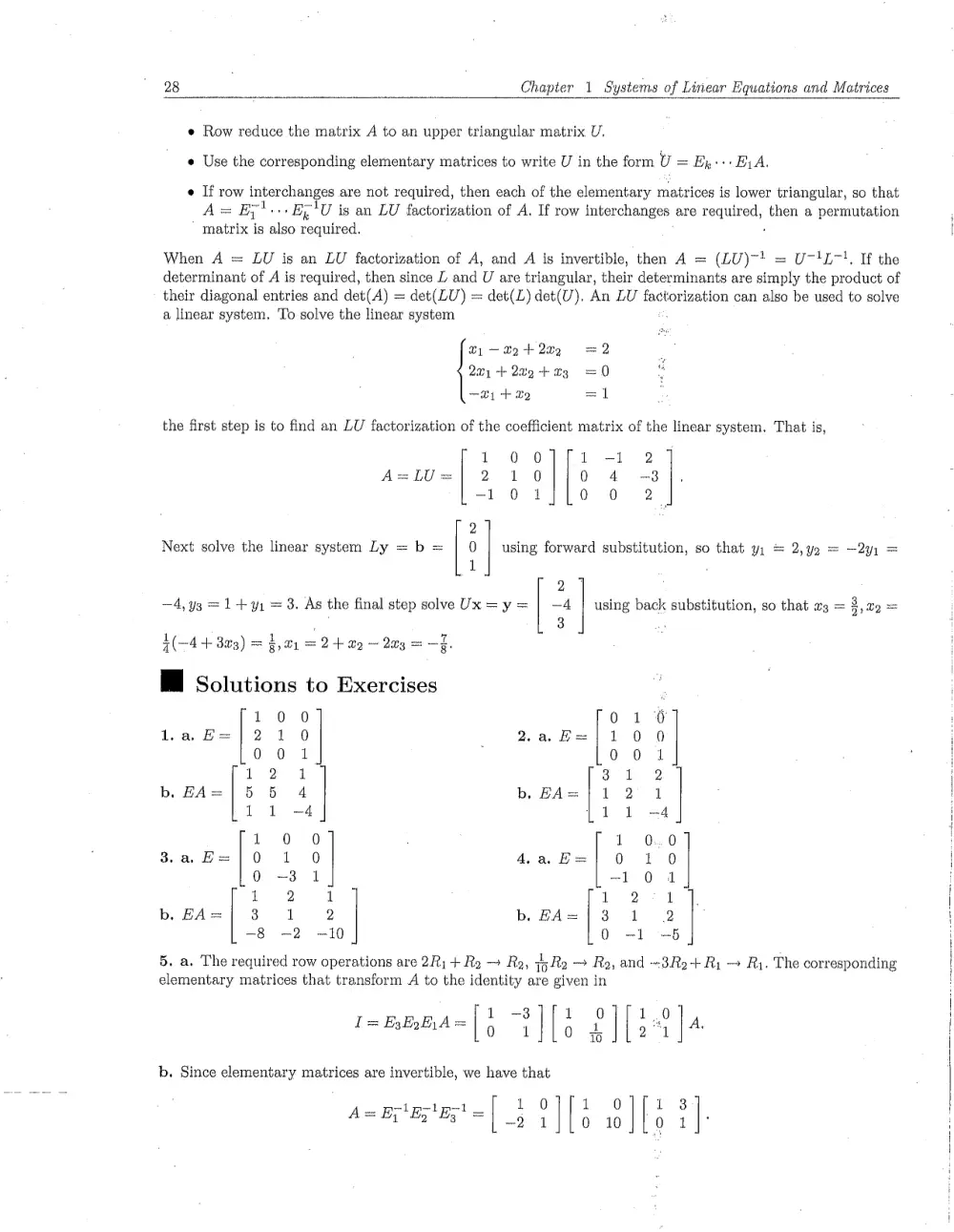
Ml Solutions to Exercises
f1 00 fo 1 6
lLaaE=|]2 1 0 2aB=]1 0 0
[9 0 1 Loo 4
pi 2 1 [3 1 2
b FA=]5 5 4 b, FA=}]1 2 1
fil 1 4 [1 1 ~4
fi 0 0 fy 1 0.0
3.a, B= |]0 1 0 4,aH=!] 0 1 0
[0 -3 1 [-1 0 4
Fio2 1 fr. 2 1 4,
b. FA=|] 3 1 2 b FA=]3 1 2 |”
| -8 -2 -10 LO -1 -5
5, a, The required row operations are 2R; +R —- Re, ple — Rg, and ~3R2+R, — R,. The corresponding
elementary matrices that transform A to the identity are given in
reonea-[} 4][3 £0]
b. Since elementary matrices are invertible, we have that
tpt pe 1 O0}f1 o]f1 3
Anzytey test =| ‘fo 0 | fo |:
LZ Elementary Matrices and LU Factorization 29
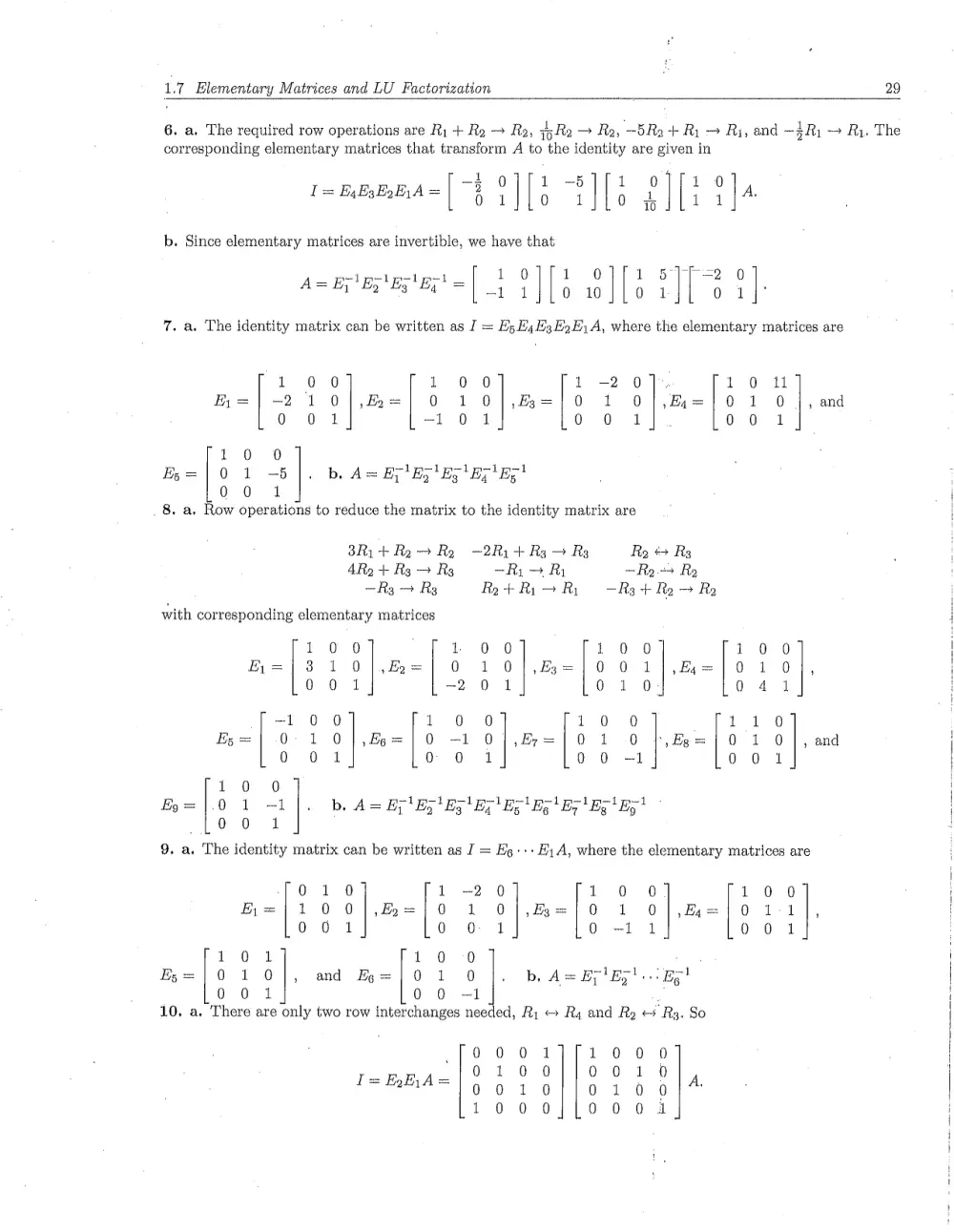
6. a. The required row operations are Ri + Ro > Ro, $Re — Ro, -5Rp+R, > Ry, and -3R, ~— Ry. The
corresponding elementary matrices that transform A to the identity are given in
-4.0 1 - 1 0 1 0
reewooa-[) 113 “E][8 S11 t+
b. Since elementary matrices are invertible, we have that
_petgetpetp-t_f 1 0]f1 O}f1 5 }f=2 0
a=e'es'e's'=[ 5 9 ][0 a 01 01"
7. a. The identity matrix can be written as I = Ey H4E3E,E,A, where the elementary matrices are
0 0
,Eg=| 0 10
-1 01
10 0
By=|0 1 -5 |. b. A= Eyl eye; ley ey!
00 1
8, a. Row operations to reduce the matrix to the identity matrix are
8Ri + Reg—- Ro -2R,+R3 > R3 Rg «> Rg
4Ro+R3 —- Rg —-R,- Ry —Rg-> Ry
—R3 — Rg Ro+ Ri > Rk, —Rg+Ry— Re
with corresponding elementary matrices
10 0 L 0 0
38 1 0),£o=] 0 10
001 -2 0 1
-1 00 1 0 0 1
Es=|{ 0 1 0/,f=|0 -1 0],H=]0
1
0 Oo 1
0 0
1
1
0 -1 . b A= Ey; By By By By By By By test
00 1
9. a. The identity matrix can be written as [ = Eg-++E,A, where the elementary matrices are
Ey =
|O 1.0 1 -2 0 1 0 0 1 0 0
By=j}1 0 0)],2=/]0 1 O0f],2=}]0 1 O],Bg=)0 1-14,
00 1 0 0 1 QO -1 1 00 1
101 10 0 .
Fy=|0 10], and B=]0 1 0 b, A= Ey By. Bg!
001 00 -1 .
10, a. There are only two row interchanges needed, R, > Rg and Rg + Rx. So
[000 1]f1000
_ _ {0 10 0 0010
T=FalhA=| 9 9 1 o| fo 1 0 0 A.
100 0 000 4
30 Chapter 1 Systems of Linear Equations and Matrices
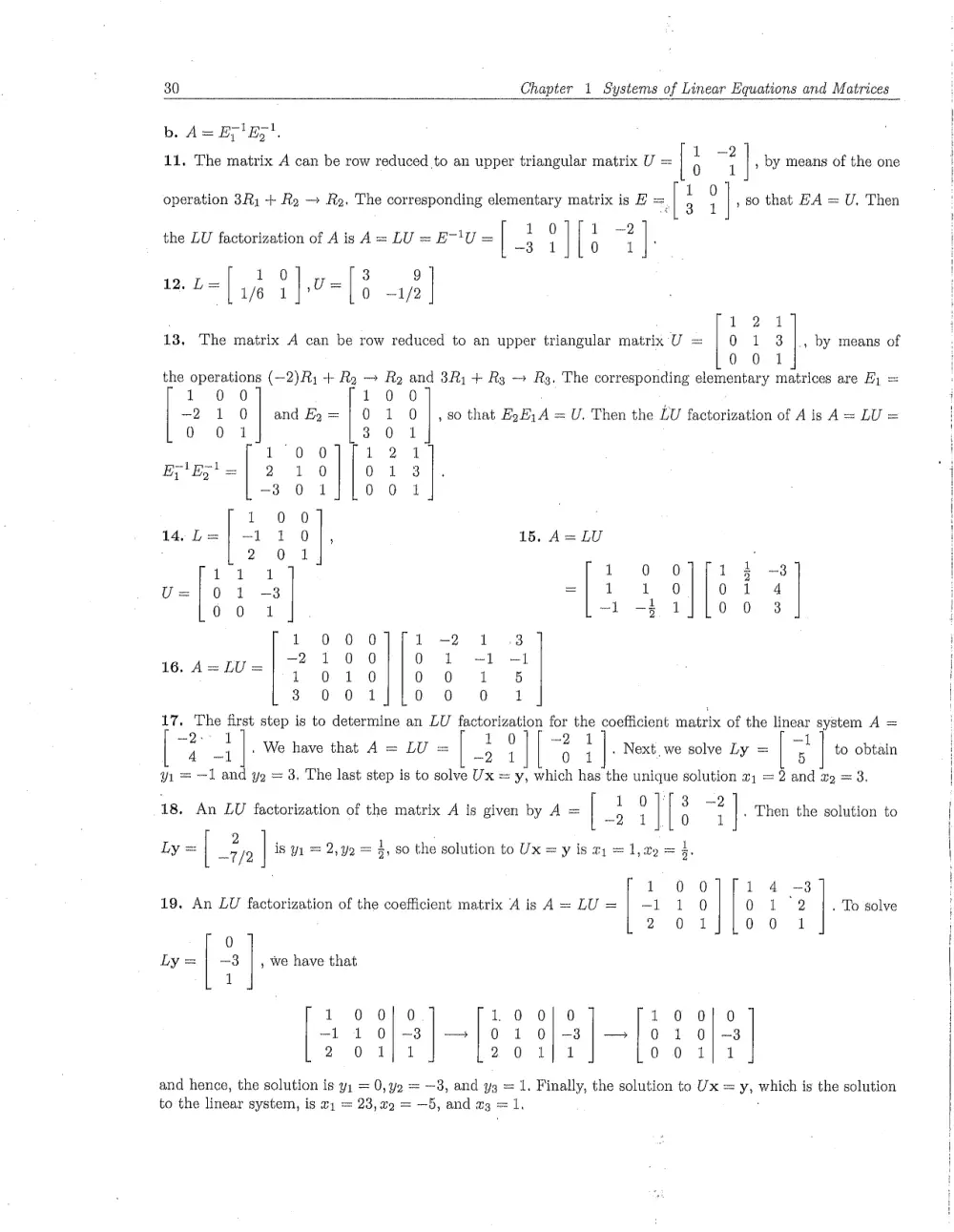
b. A= Ey! Ey}.
1
11, The matrix A can be row reduced to an upper triangular matrix U = 0 “ , by means of the one
operation 3R1 + Ry — Rz. The corresponding elementary matrix is E =. ; , , 80 that BA = U. Then
the LU factorization of Ais A= LU = EU = 10 1-2 .
-3 1 0 1
12. b= | 51 )%=(6 >|
1/6 1 0 -1/2
12 1
13, The matrix A can be row reduced to an upper triangular matrix U = | 0 1 3 |., by means of
00 1
the operations (~2)R, + Ry — Rez and 3R; + Rs — Rg. The corresponding elementary matrices are Ey =
1 0 0 100
-2 1 0] andE,=] 0 1 0 |,80 that Eyz,A =U. Then the LU factorization of Ais A= LU =
0 O01 301
1°00 121
EylEy'=| 2 1 0 01.3
-3 0 1 001
0 0
14, -|2 1 0}, 15, A= LU
2 01
144 1 0 0 1 4 -3
U=/01 -3 = 1 1 0 Oo 1 4
fo: 3 | a ayfed |
1000 1-2 1 8
—2 100 0 1. -1 =
1% A=IU=|) 7 oi o]]o 0 1 5
3 001 00 0 1
17. The first step is to determine an LU factorization for the coefficient matrix of the linear system A =
~ at |. We have that A = LU = 3 : - H |. Next we solve Ly = 5 | to obtain
yi = —1 and ye = 3, The last step is to solve Ux = y, which has the unique solution a; = 2 and x = 3.
18. An LU factorization of the matrix A is given by A = - : ; 7 . Then the solution to
2 + Lon the enlation te 7 1
Ly = ~7/2 is y1 = 2,2 = 3, so the solution to Ux = y is 71 = 1, x = 5.
1
0 0 1
-l1 10 0
2 0 1 0
0 1 0 0} 0 1 0 0} 0
~3 |---|] 0 1 0|-38 | —/} 0 1 0|-3
1 2 0 1) 1 0 0 1) 1
and hence, the solution is y1 = 0, ye = —38, and y3 = 1. Finally, the solution to Ux = y, which is the solution
to the linear system, is 7 = 23,2 = —5, and wg = 1. :
4 -3
1 2 . To solve
0 1
19, An LU factorization of the coefficient matrix A is A= LU =
0
ly = | —3 | , we have that
1
1 0 0
-l1 10
2 01
1.7 Elementary Matrices and LU Factorization
31
1 0 0
20. An LU factorization of the matrix A is given by A = 2 1
-2 0
1 -2
0 0 ol
1 0 0
1
4 | . Then the solution
1
-1
to Ly = | 8 | is y1 = —1, yo = 10, y3 = 2, so the solution to Ux = y is a, = 1,49 = 2,03 = 2.
4
21. LU Factorization of the coefficient matrix:
1 0 0 0 1-2 3 1
1 1 00 Oo 1 2 2
. A=lU=| 5 9 1o0o}llo 011
-1 -1 0 1 0 0 0 1
5
Solution to Ly = QL 141 = 5, yo = 1,y3 = 4, y4 = -2
-8
Solution to Ux = y: #1 = ~25,29 = —7, a3 = 6,24 = —2
1 0 00 12 2 -1
vs + te Ate st _}| 0 tt 00 Oo 11-1] ,,
22. An LU factorization of the matrix A is given by A = -1 0 1.0 001 3 4° Then the
2 -2 0 1 0:0 0 2
5 ‘
solution to Ly = 7? is y1 = 5, yo = —2,y3 = 6,44 = —18, so the solution to Ux = y is 2 = Bay =
1
~34,03 = Bay = — 1, 4
23, In order to row reduce the matrix A to an upper triangular matrix requires the operation of switching
rows, This is reflected in the matrix P in the factorization
0 0 10 0
A=PLU=| 0 25 0
1 0 1 -%
|
1
0
0
8 2
1-2],
m0) 1
24, In order to row reduce the matrix A to an upper triangular matrix requires the operation of switching
rows, This is reflected in the matrix P in the factorization
00 1]f71 00)
A=PLU=|10 0]{4 1 0
o10}lLoo01]
25. Using the LU factorization A = LU =
Ate=UOp =
26,
oles
nore
elie
nin
|
, we have that
|
1-4)
Hlat-l4 7)
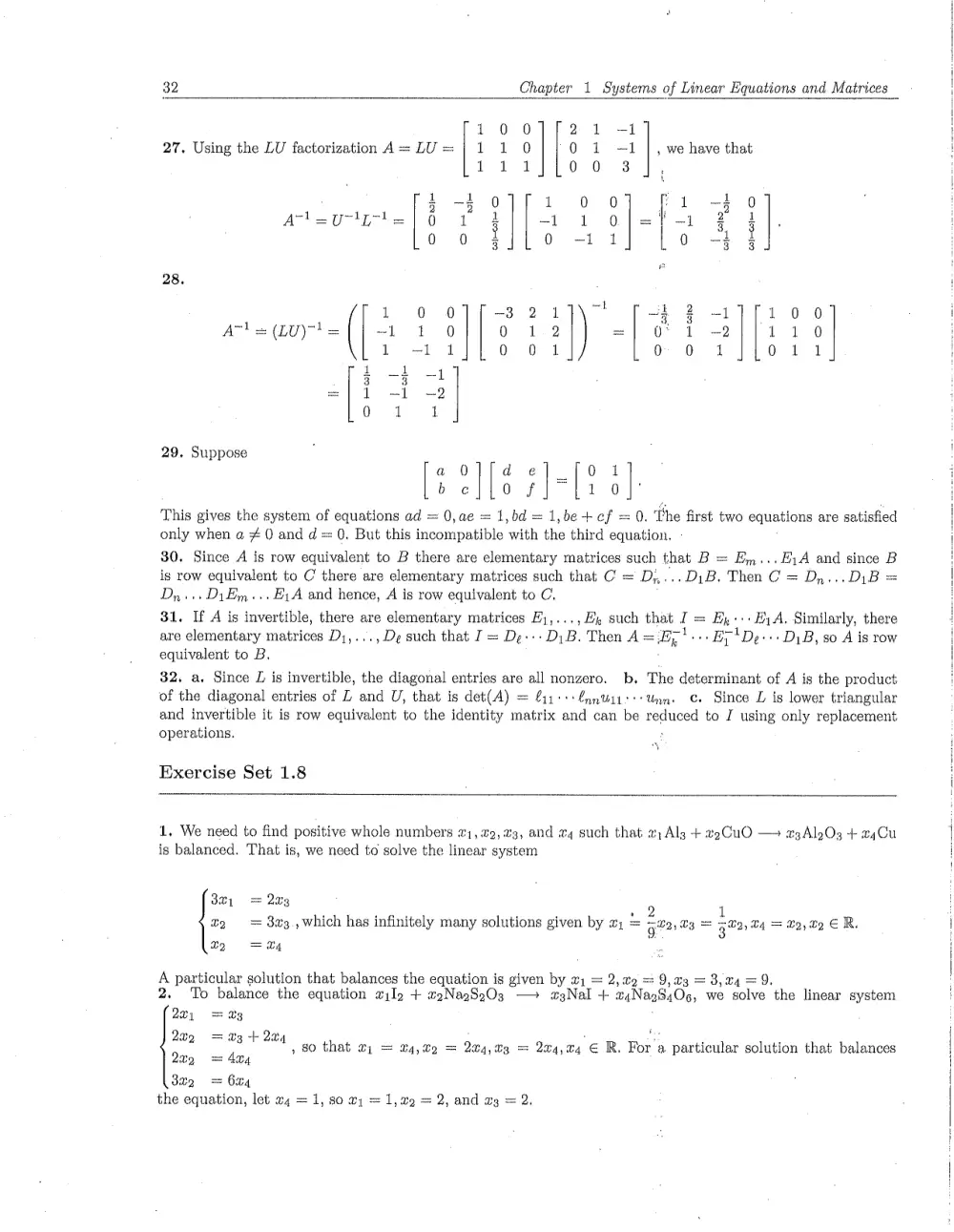
32 Chapter 1 Systems of Linear Equations and Matrices
10 0 21 -1
27. Using the LU factorization A= LU =} 1 1 0 0 1 —1 |, we have that
111 00 8 :
3 -% 0 1 0 0 PF 1 3% 0
AteutEt=|0 1 3 -1 1 O0;/=f-1 2 3
1
0 0 3 0 -1 it O 3 3
28,
1 0 O}f-38 2 4)\7! P-h 2 -17 7100
Aut (LU)"t = ~l 1 0 0 12 =| 0% 1 ~2 110
1 o-1 1 0 01 0 0 fF 011
1
ib -} -1
=/ 1 -1 -2
0 1 1
29. Suppose
a 0 de] _ /0 1
be Oo fi] t1 07f°
This gives the system of equations ad = 0,ae = 1,bd = 1,be+cf =0. ‘The first two equations are satisfied
only when a #0 and d= 0. But this incompatible with the third equation.
30. Since A is row equivalent to B there are elementary matrices such that B= E,... EA and since B
is row equivalent to C there are elementary matrices such that C = D,,...D,B. Then C = Dn... D,B =
Dn... Di Em...,A and hence, A is row equivalent to C. :
31, If A is invertible, there are elementary matrices Ey,...,£, such that J = E,-++: 1A. Similarly, there
are elementary matrices D;,...,.De such that J = Dy:-.D,B. Then A =iB,' tee Ey'De: + D,B, so A is row
equivalent to B, :
32. a, Since L is invertible, the diagonal entries are all nonzero. b. The determinant of A is the product
of the diagonal entries of L and U, that is det(A) = ¢11+++Cnntiis++Unn. ¢. Since L is lower triangular
and invertible it is row equivalent to the identity matrix and can be reduced to J using only replacement
operations.
Exercise Set 1.8
1, We need to find positive whole numbers 71, #2, 23, and «4 such that a@,Al3 + vgCuO —» xgAleO3 + wqCu
is balanced, That is, we need to solve the linear system
3a, = 2x3 9 1
xq = 3e3.,which has infinitely many solutions given by a, = gras = g@a ks = Layo ER.
tm = 04 9: Q
A particular solution that balances the equation is given by v1 = 2,02 == 9,03 = 3,24 =9,
2. To balance the equation x Ip + w2NagS203 —> a3Nal + z4Nag$40¢, we solve the linear system
224 = 3 .
202 = @3 + 2a4 . a . .
On 4 , 80 that 1 = 4,02 = 24,03 = 2x4,a4 € R. For a particular solution that balances
CQ == 404
8a = ba4
the equation, let v4 = 1, so v1 = 1, x2 = 2, and a3 = 2,