
MATH 218 Problems Solution Manual Chapter 1.8, Fall 2011
American University of Beirut · Elementary Linear Algebra with Applications · 3 pages · with solution
More MATH 218 files
- Problems Solution Chapter 6.1 · Spring 2012Chapter · with solutionView
- Homework Chapter 8 · Fall 2012ChapterView
- Chapter Summary · Fall 2011ChapterView
- Problems Solution Manual Chapter 1.5 · Fall 2011Chapter · with solutionView
- Problems Solution Manual Chapter 1.2 · Fall 2011Chapter · with solutionView
- Problems Solution Manual Chapter 1.4 · Fall 2011Chapter · with solutionView
- Problems Solution Manual Chapter 1.1 · Fall 2011Chapter · with solutionView
- Problems Solution Manual Chapter 1.3 · Fall 2011Chapter · with solutionView
Show the text of this chapter
32 Chapter 1 Systems of Linear Equations and Matrices
; 100 214 -1
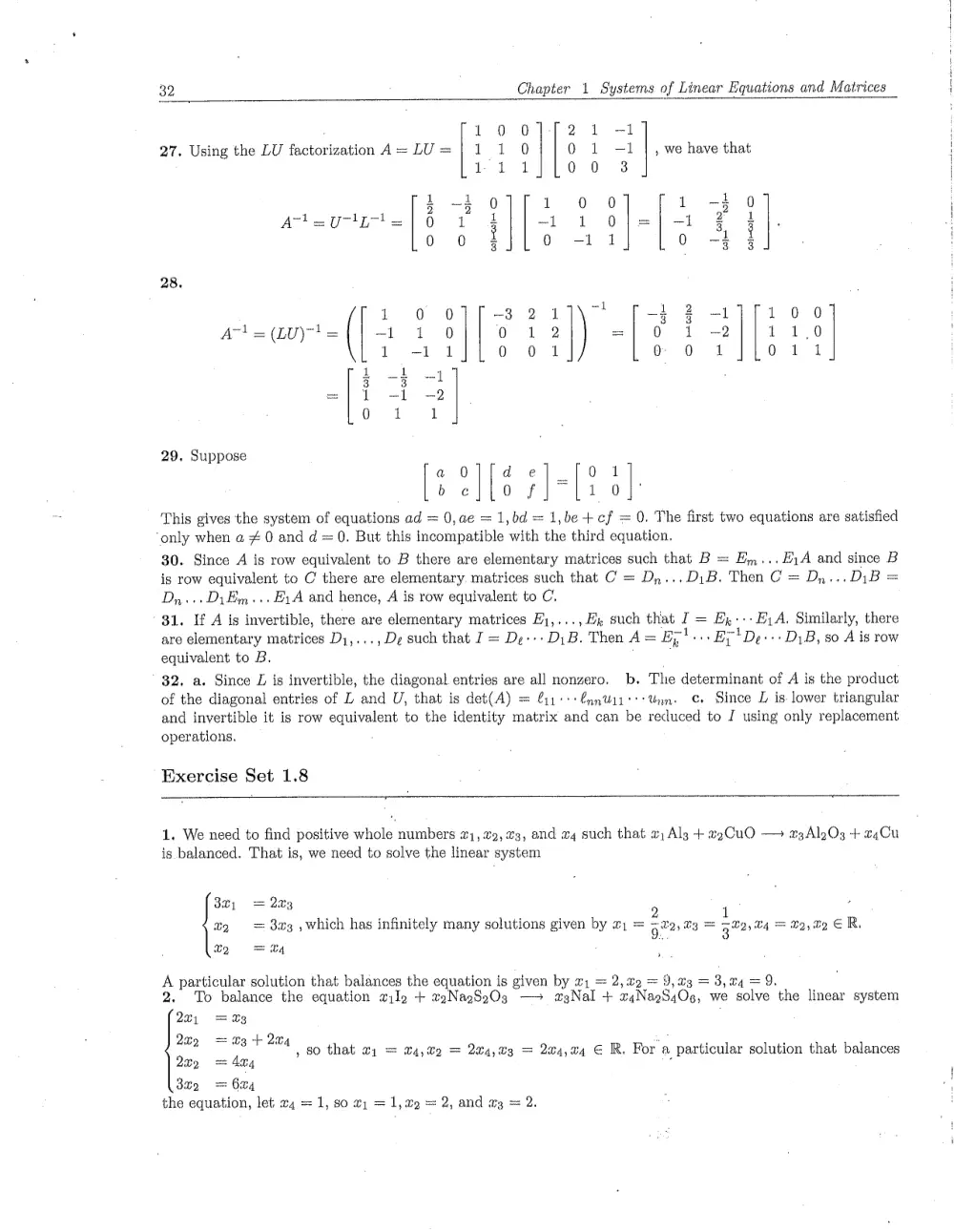
27. Using the LU factorization A= LU=j} 1 1 0 0 1 -1 |, we have that
oid 00 38
1 1 1
2 1 9 1 0 0 1 -4 0
2 2 2
Atsutpt=|]0 1 3 -1 1 Oj;=]-1 § 3
4 1 J
0 0 4 0 -1 1 | 0 -$ 3
28.
1 0 OJ [-3 2 47\7* F-d 2 -1]7 710 0
At =(LUy b= -1 1 0 0 12 =| 0 1 -2 1 1,0
1 -1 1 0 O01 0 0 1 011
i-}
=| 1 -1l -2
0 1 1
29, Suppose
(eel[s s]eLi al:
This gives the system of equations ad = 0,ae = 1,bd = 1,be + cf = 0. The first two equations are satisfied
‘only when a 4 0 and d = 0. But this incompatible with the third equation.
30. Since A is row equivalent to B there are elementary matrices such that B = E,...,A and since B
is row equivalent to C' there are elementary. matrices such that C = Dy...D,B. Then C = Dy... DiB =
Dn ....D Em... EA and hence, A is row equivalent to C.
31. If A is invertible, there are elementary matrices E1,...,#, such that I = E,-+-E,A. Similarly, there
are elementary matrices D,,...,.D¢ such that J = De---D,B. Then A= By! tee Ey" De «+ DB, so A is row
equivalent to B. :
32. a. Since L is invertible, the diagonal entries are all nonzero. b. The determinant of A is the product
of the diagonal entries of L and U, that is det(A) = @11+++€nntii''*Unn. ¢ Since L is. lower triangular
and invertible it is row equivalent to the identity matrix and can be reduced to J using only replacement
operations.
Exercise Set 1.8
1, We need to find positive whole numbers 21, v2, @3, and xq such that a, Al3 + v2CuO0 — agAlQ3 + eqCu
is. balanced, That is, we need to solve the linear system
8a, = ug 9 1
%q = 3x3 , which has infinitely many solutions given by #1 = ge 03 = ter = 02,02 ER,
BQ = 4 ; .
A particular solution that balances the equation is given by v1 = 2,%2 = 9,23 = 3,04 = 9.
2. To balance the equation vIg + vgNagSg03 —> asNal + xq4Na254O¢, we solve the linear system
20, = 23
Qu, = ug + 2x4 : : :
ow An , 80 that v1 = 24,@2 = 24,03 = 204,24 € R. For a particular solution that balances
2 = 4h4 ‘
8x2 = 624
the equation, let 24 = 1, so v1 = 1, aq = 2, and ay = 2,
1.8 Applications of Systems of Linear Equations 33
3. We need to find positive whole numbers 21, %2,%3,24 and zs such that
av1NaHCOs + aeCgHgO7 —> w3NagCgHsO7 + r4HeO + vgCOg.
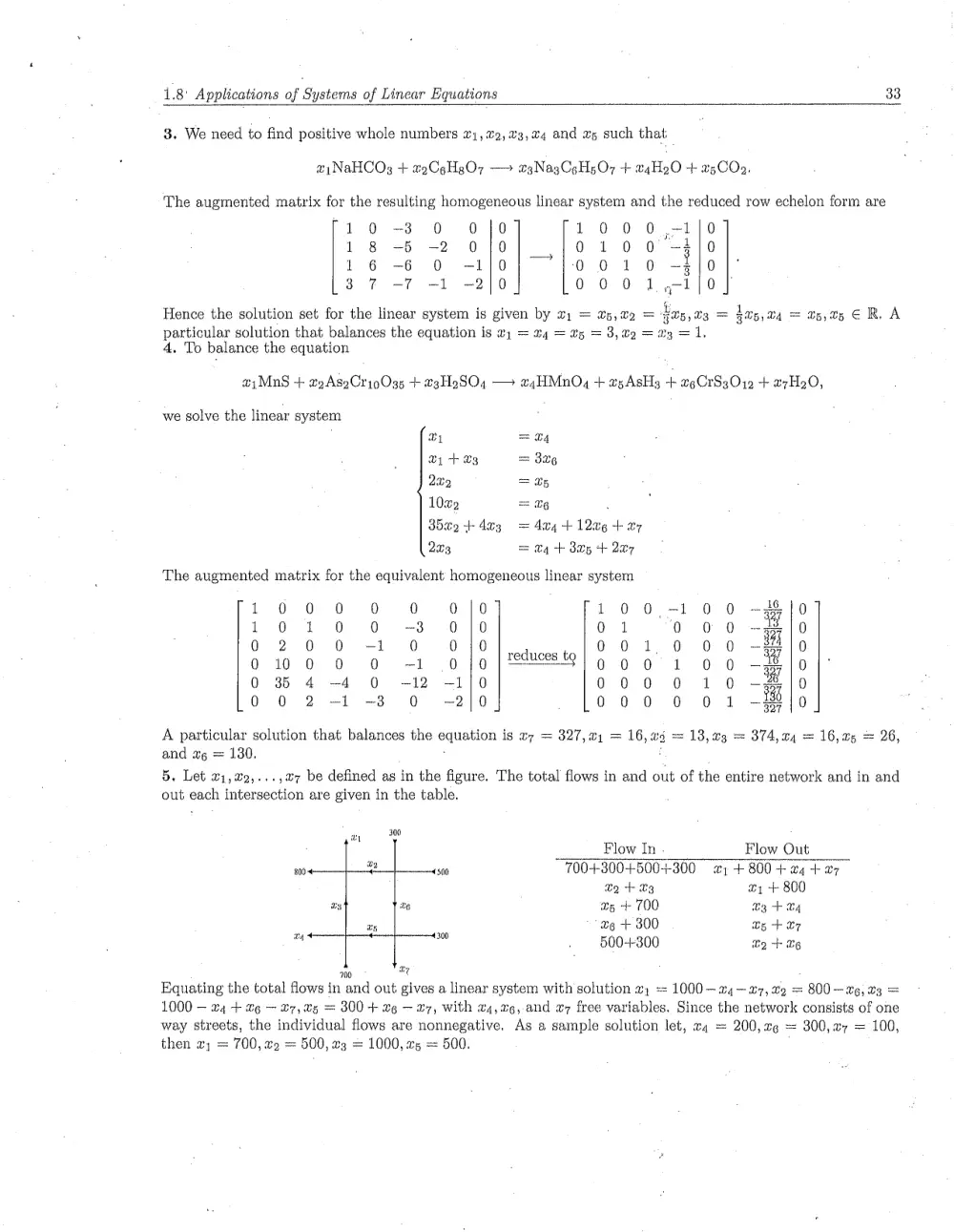
The augmented matrix for the resulting homogeneous linear system and the reduced row echelon form are
10-3 0 0 |0 10 0 0-1/0
18 -5 -2 0/0] ~/0 10 0 ~g/0
16 -6 0 -1]0 0 0 10 -t]0
37 -7 -1 ~-2]0 00 0 1,-1/0
particular solution that balances the equation is v1 = %q = vs = 3, a2 = 23 = |
4. To balance the equation
w,MnS + ag AsoCr19O35 + @3H,SO4 — awaHMnO4 + #5 AsH3 a aeCr$3012 + @7H20,
we solve the linear system
wy = 04
@1 + = 326
2x2, = 25
10x = %6 .
35aq +403 = 404 + 1206 + v7
223 = 04 + 8x5 + 2x7
The augmented matrix for the equivalent homogeneous linear system
1000 0 0 ofo 100 -1 0 0
1021 0 0 -38 0 jo 01 0 0 0
0200 -1 0 olfo]. 001.00 0
0 100 0 0 -1 0 Jo | etucests} oo 0 1 Oo 0
0 3 4 —4 0 -12 -1]0 00001 0
002-1 -3 0 2/0 000 00 0
A particular solution that balances the equation is v7 = 327,01 = 16,44 = 138,49 = 374,24 = 16,25 = 26,
and ag = 130. . 7 :
5. Let 21,%2,...,@7 be defined as in the figure. The total flows in and out of the entire network and in and
out each intersection are given in the table.
300
" | Flow In . Flow Out
800+ 2 4500 700+300+500+300 a1 + 800+ a4 + 27
tq + 2X3 21 + 800
ash Yt tp +700 U3 + u4
25 xe + 300 Ly +27
me ‘ “m . 500-800 Lg + 26
700 Vite
Equating the total flows in and out gives a linear system with solution x = 1000-—24—~27, 29 = 800~26, 23 =
1000 — a4 +g ~ &7, "5 = 800 + 4g — @7, with v4,26, and «7 free variables. Since the network consists of one
way streets, the individual flows are nonnegative. As a sample solution let, rq = 200,2¢ = 300,27 = 100,
then 7 = 700, v2 = 500, v3 = 1000, vs = 500.
34 Chapter 1 Systems of Linear Equations and Matrices
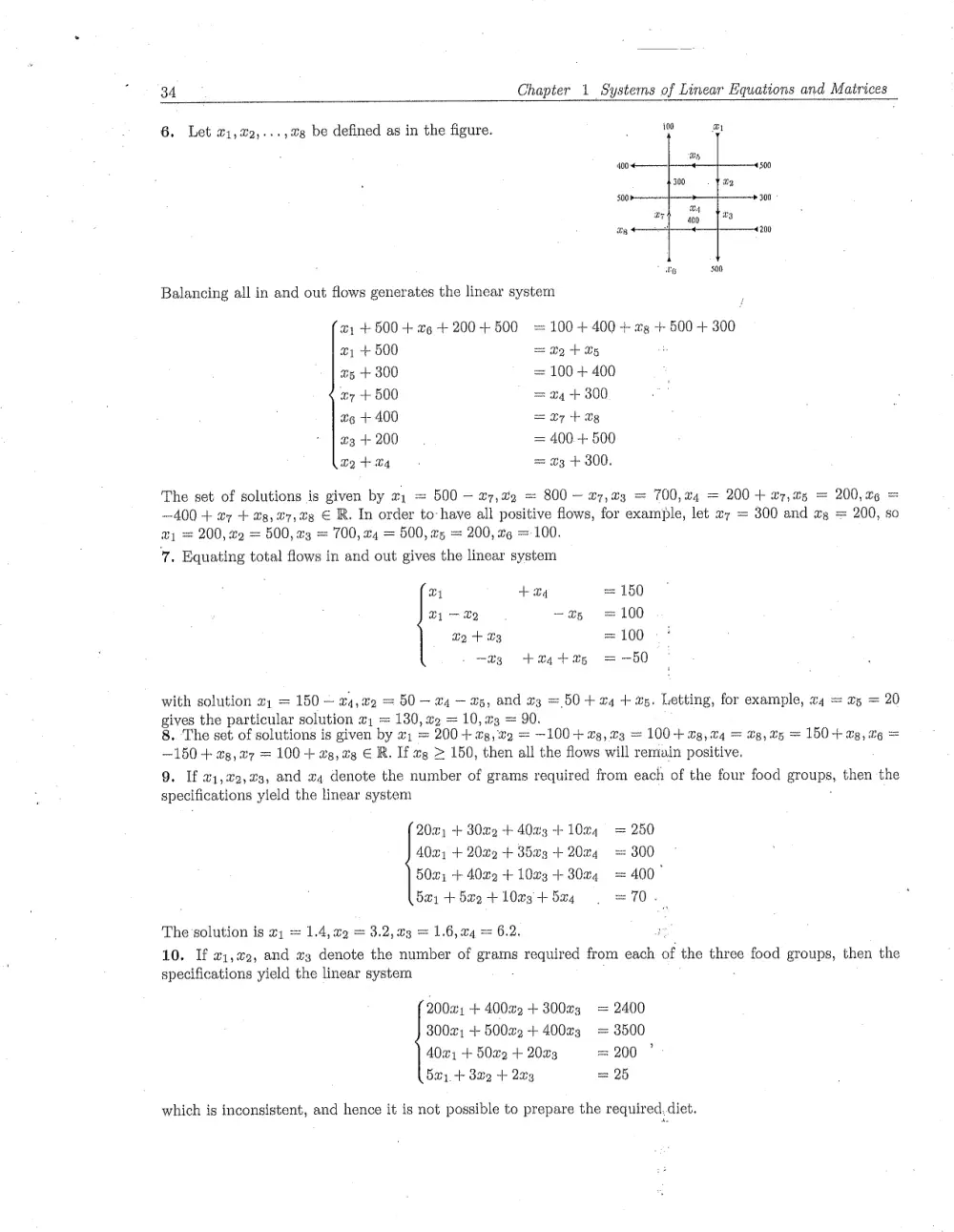
6, Let #1,%2,...,%8 be defined as in the figure. . ‘00 a
ts
400+ + 4500
4300 Yu
$00» > > 300
. C4 Vos
Lz 400 x
ug + 4 + 4200
ry +
“or 500
Balancing all in and out flows generates the linear system
21 +600 + ag + 200+ 500 = 100+ 400 + xg + 500 + 300
az + 500 = Do + Bs
as +300 = 100 + 400
a7 +500 = xq + 300
ae +400 = U7 + Xe
ag3+200 . = 400.+ 500
2+ @4 . = v3 +800.
The set of solutions is given by 21 = 500 — a7,a = 800 — 27,03 = 700,24 = 200+ 27,23 = 200,26 =
400 ++ 27 + ag, %7,2g € R. In order to-have all positive flows, for example, let x7 = 300 and xg = 200, so
a1 == 200, % = 500,23 = 700,24 = 500, vy = 200, 2g = 100.
7, Equating total flows in and out gives the linear system
xy +24 = 150
21 — 2g -2, =100
@2 +43 = 100
. —@3 +a4+a_ = —-50
with solution x1 = 150 ~ x4, 9 = 50 — a4 — a5, and 23 = 50+24 +45. Letting, for example, v4 = 5 = 20
gives the particular solution 7, = 130, %2 = 10,73 = 90.
8. The set, of solutions is given by v1 = 200+ %g, vq = —100+ 7g, 03 = 100+, 24 = %g, U5 = 150+ 08,26 =
—150 + vg, v7 = 100 + ag, 2g € R. If wg > 150, then all the flows will remain positive.
9. If 21,2,23, and xq denote the number of grams required from each of the four food groups, then the
specifications yleld the linear system
2021 + 802g + 40an3 +1004 = 250
4021 + 20a + 35a3-+20r4 = 300
50x + 40x29 + 1023+ 3024 = 400°
5a, +529+l0a3+524 | =70.
The solution is v1 = 1.4, 29 = 3.2, 03 = 1.6, 04 = 6.2,
10. If x1,%2, and vg denote the number of grams required from each of the three food groups, then the
specifications yield the linear system
20021 + 400a2 + 30023 = 2400
30021 + 500%2 + 400%3 = 3500
40a + 50ag + 2023 = 200
5ay.+ 38uq + 2x3 = 25
which is inconsistent, and hence it is not possible to prepare the required.diet.