
MATH 218 Problems Solution Manual Chapter 2.2, Fall 2011
American University of Beirut · Elementary Linear Algebra with Applications · 5 pages · with solution


More MATH 218 files
- Problems Solution Chapter 6.1 · Spring 2012Chapter · with solutionView
- Homework Chapter 8 · Fall 2012ChapterView
- Chapter Summary · Fall 2011ChapterView
- Problems Solution Manual Chapter 1.5 · Fall 2011Chapter · with solutionView
- Problems Solution Manual Chapter 1.2 · Fall 2011Chapter · with solutionView
- Problems Solution Manual Chapter 1.4 · Fall 2011Chapter · with solutionView
- Problems Solution Manual Chapter 1.1 · Fall 2011Chapter · with solutionView
- Problems Solution Manual Chapter 1.3 · Fall 2011Chapter · with solutionView
Show the text of this chapter
46 Chapter 2 Linear Combinations and Linear Independence
Uy V4
‘| Ue v2
36. Let u= . v= . , and c a scalar, Then
Un Un
Uy + V1 cu, + Cv, Cul cUy
U2 + U2 Cug + Cvg cug | v9
clu+v) =e . = = + =cu+ev,
Un + Un CUn + CUn, CUn CUn,
Uy
Ug
37, Letu= . and ¢ and d scalars, Then
Un,
(c+ d)ur “PT cur + duy cut duy
(e+ d)us Cug + duly Cu dug
(c+d)ju= =| . = J fet. =cu+ du.
(c+ d)un Clin + dun, CUn L dun
[ws | duy cduy
U2 dug cdug
38. Letu=| , and cand d scalars. Then c(du)=c}] , | = . = (ced)u.
L Un | dun Cdn,
[ts -] (1)tu
ue » (L)ug
39. Let u= . . Then (b)u = , =u.
Lun | (1)tn,
40. Suppose u+ 21 = u and u+22 =u. Then u+ 21 = u-+ Ze and hence, 21 = 29.
Exercise Set 2.2
The vectors in IR? and R', called the coordinate vectors, are the unit vectors that define the standard axes,
These vectors are
1 0 1 0 0
a=[5]e-[1] in R? andey=|0],e.=]| 1 |,eg= | 0 | in RS
0 0 . 1
with the obvious extension to R”. Every vector in the Euclidean spaces is a combination of the coordinate
vectors. For example,
V1 1 0 0
vg | =u] O | +ue] 1 | +23 | 0
U3 0 0 1
The coordinate vectors are special vectors but not in the sense of generating all the vectors in the space,
Many sets of vectors can generate all other vectors. The vector v is a linear combination of V1,Va,.0+,Vn if
there are scalars ¢1,¢2,...,, such that
V = CyVy + CQVQ + + CnVne
i
i
1
i
2.2 Linear Combinations 47
For specific vectors we have already seen that an equation of this form generates a linear system. If the linear
system has at least one solution, then v is’a linear combination of the others. Notice that the set of all linear
combinations of the vectors e, and eg in R® is the ay plane and hence, ‘not all of IR. Similarly, all linear
combinations of one nonzero vector in R? is a line, In the exercises when asked to determine whether or not
a vector is a linear combination of other vectors, first set up the equation ‘above and then solve the resulting
1 0
linear system. For example, to determine all vectors in R® that are a linear combination of | 1 },| 1 ;
1 -1
2 a
and 5 let v= | b |, be an arbitrary vector. Then form the augmented matrix
—1 c
‘10 24a 1 0 2} a
1 oi 5 | 6 | that row reducestg]| 0 1 3 —a+b
1 ~1 -lle 0 0 0] -2a+b-e
Hence, the components of any vector v that is a linear combination of the threé vectors must satisfy ~2a +
b-c=0. This is not all the vectors in R°. In this case notice that
2 1 0
5 | =2]/1)4+3] 1
-1 _ -1
M@ Solutions to Exercises
1, To determine whether or not a vector is a linear combination of other vectors we always set up a vector
equation of the form v = ¢ + v1 ++:+CnVn and then determine if the resulting linear system can be solved.
In matrix form the linear system is
1 -2|-4 1 0/2 . a. . aus _ _ ,
1 3 | ul that row reduces tg 01/3 , which has the unique solution cy = 2 and cg = 3. Hence,
the vector v is a linear combination of vz and ve.
. . —1 3) 18 1 0} -1 F .
2, Since the resulting linear system 2-9} —2 | to reduces ta oila)> which has the unique
solution ¢; = ~1, cz = 4, then the vector v is a linear combination of vz and v2.
3. Since the resulting linear system ? 3 i row reduces t 0 “Be 2 | , it is inconsistent, then
. v is not a linear combination of vz and ve. os
4, Since the resulting linear system 9 wa | ; row reduces to 4 a | , it is inconsistent, then v
is not a linear combination of vz and ve.
5, Since the resulting linear system
—-2 1|~-8 1 0;2
3 4] 10 | row reduces tg} 0 1] 1
4 2] 10 0 0/0
it is consistent with the unique solution c; = 2 and ce = 1, then v is a linear combination of v1 and vo.
6. Since the resulting linear system
38 2 ].-2 1 0} ~2
4 7] 6 | rowreducesto| 0 1] 2
—-1 3] 8 0 0} 0
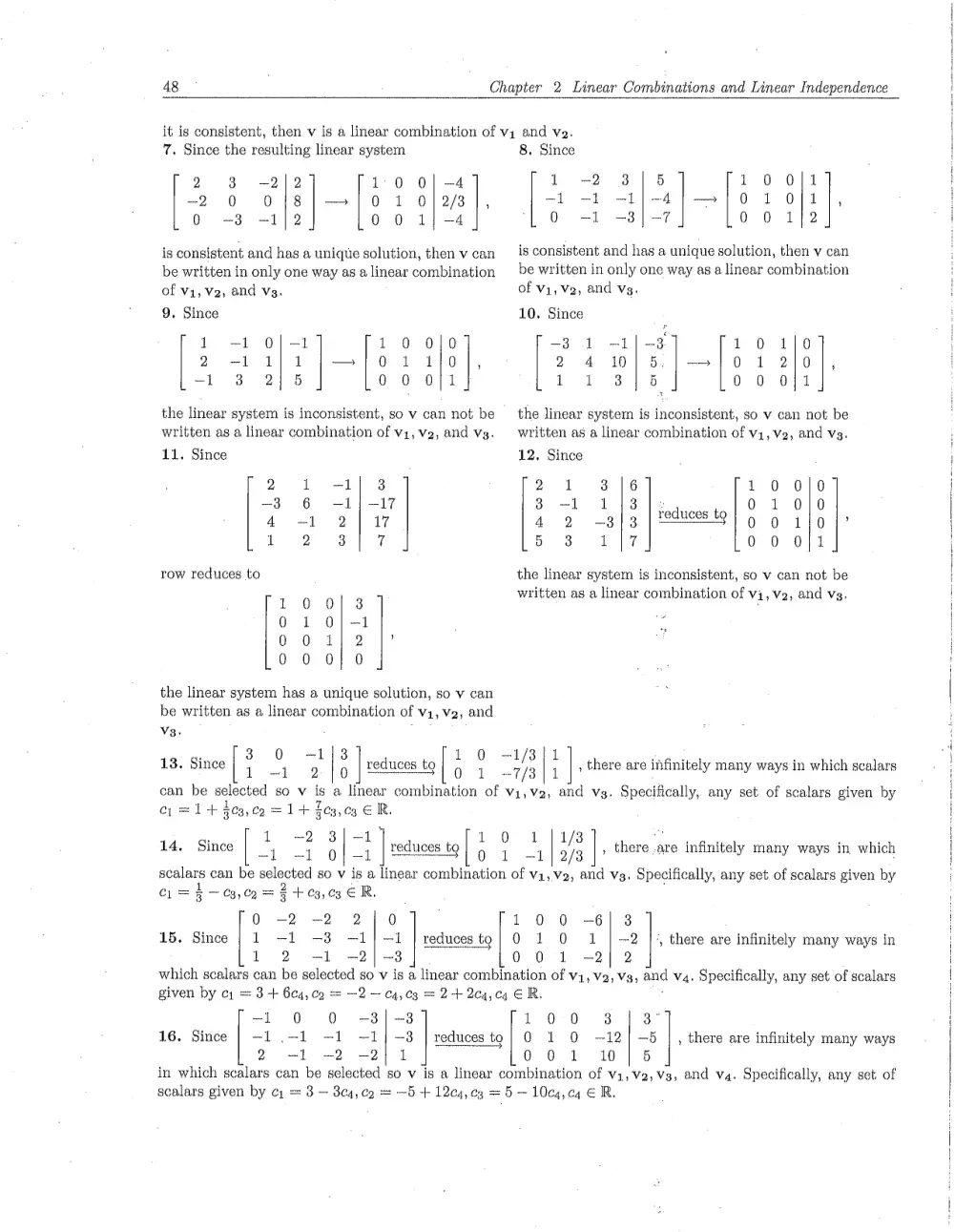
48 , Chapter 2 Linear Combinations and Linear Independence
it is consistent, then v is a linear combination of v1 and vg.
7, Since the resulting linear system
2 38 -2)2 1:0 0} -4
-2 0 O18 |—]0 1 0/2/3],
0 -38 +1) 2 0 0 1] -4
is consistent and has a unique solution, then v can
be written in only one way as a linear combination
of V1, V2, and v3.
9. Since
1 -1 0} -1 1 0 0/0
2 -1 1} il —};0 1 1/0],
-l 38 2) 5 0 0 0jf1
the linear system is inconsistent, so v can not be
written as a linear combination of v1, v2, and vg.
11. Since
2 1 -1) 3
-38 6 -1|-17
4 -1 2] 17
1 2 8 7
row reduces to
10 0} 3
0 ft 0}; -1
0 0 1/2 |?
0 0 0} 0
the linear system has a unique solution, so v can
be written as a linear combination of v1, v2, and
V3.
0 -1/3 1 0
; | 0 reduces tg 0 1
4: 3
13. Since 1-1 2
Cl = 1+ fos, ¢2 = 14+ 403,09 ER.
-2 3
-1 0
l
14. Since A - | sstuos to 0
scalars can be selected so v is a linear combination of v V1,,V2, and vg. Specifically, any set of scalars given by
C1 = = 03, Cg = 3 + 3,03 ER.
0 -2 -2 2] 0
15. Since | 1 -1 -—3 ~—1]} —1 | reduces t
1 2 -1 -2/]-3
—1/3
7/3
can be selected so v is a linear combination of v4, v:
0
8. Since
1 -2 385 1
-1 -1 -1)/-4 | — | 0
0-1 -3|=7 0
oO
HOO
nee
is consistent and has a unique solution, then v can
be written in only one way as a linear combination
of v1, V2, and vg.
10. Since
-3 1 -1/-3
1 0 1/0
2 4 10) 5 —|0 1 2/0],
1 1 3 5 0 0 Oj}!
the linear system is inconsistent, so v can not be
written ag a linear combination of vz, v2, and vg.
12, Since
2 1 3/16 1 0 0/0
8 -l 1)3 fe. 0 1 0/0
4 2 -313 reduces t 00 1lo}?
5 8 1/7 0 0 0f1
the linear system is inconsistent, so v can not be
written as a linear combination of vi, v2, and vg.
1} 1/3
1| 2/3
10 0 -6] 3
1 0 1 | -2 |; there are infinitely many ways in
00 1 ~-2) 2
, there are infinitely many ways in which scalars
2, and vg. Specifically, any set of scalars given by
iF there .are infinitely many ways in which
which scalars can be selected so v is a linear combination of v1, v2, Vs, a and v4. Specifically, any set of scalars
given by cy = 3 + 6c4, cg = ~2 ~ c4,¢3 = 24 2cy,c4 ER.
-1 0 O -3| 3 100 8 37
16. Since | —1 .—1 ~—1 ~—1]—-3 | reducesto| 0 1 0 -—12]—5 |, there are infinitely many ways
2 -1 -2 -2] 1 00 1 10] 5
in which scalars can be selected so v is a linear combination of v1, V2, Vs, and v4. Specifically, any set of
scalars given by cy == 3 — 8¢4,¢c2 = —5 + 12c4,c3 = 5 — 10cq4,c4 € R.
2.2 Linear Combinations 49
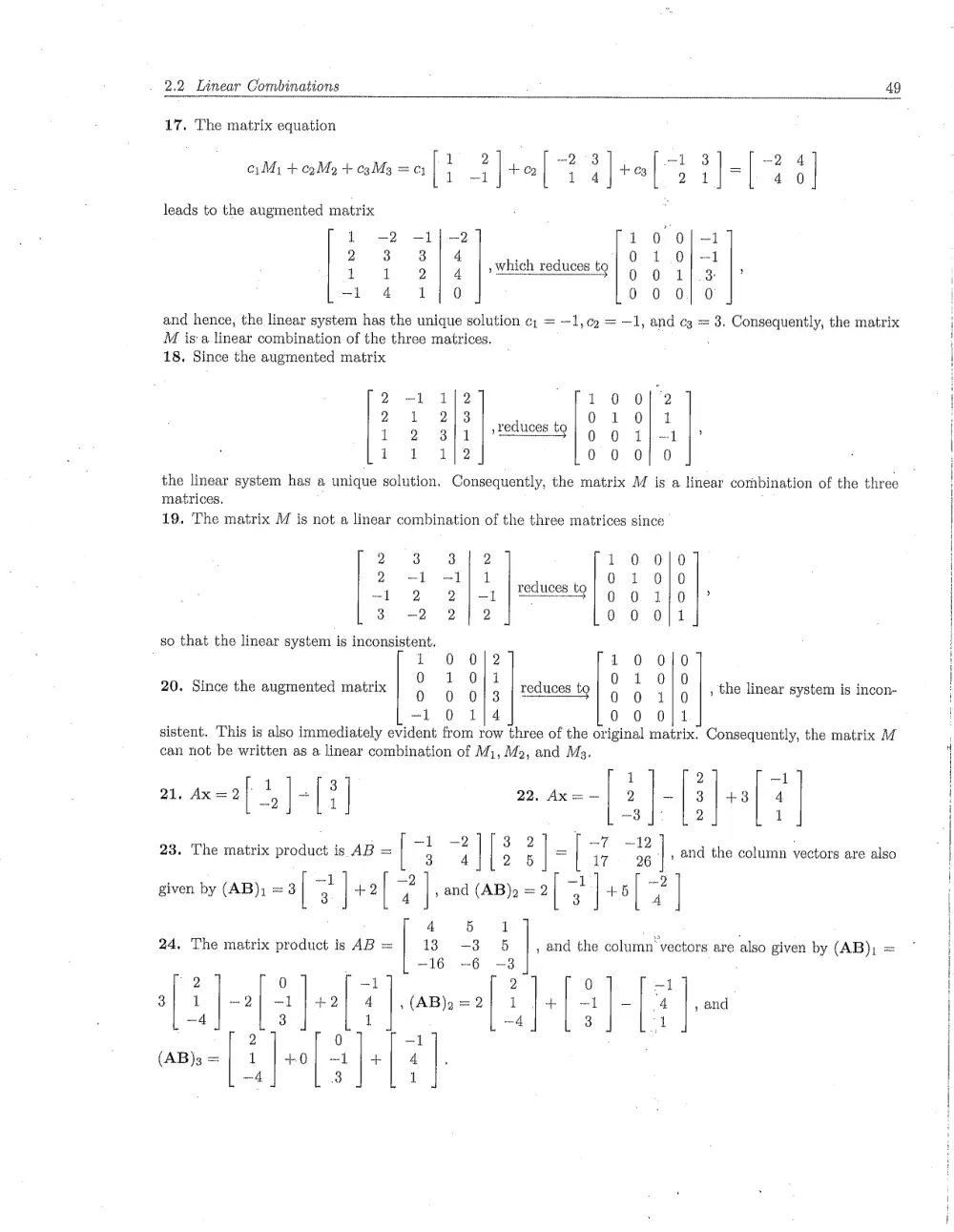
17, The matrix equation
1 2 —2 3 -1 3
cis + caMa + aM = es | i]+a| l i] tel 9 ‘]=| 40
leads to the augmented matrix
1-2 -1]-2 10
2 3 8/4 a | 0 1 .0f-1
1 1 9 4 , Which reduces to 00113 |?
-1 4 1/0 0 0 0) 0
and hence, the linear system has the unique solution c; = —1,cp = —1, and cg = 3. Consequently, the matrix
M is:a linear combination of the three matrices.
18. Since the augmented matrix
2-1 1/2 10 0} 2
2 1 213 reduces to O01 0) 1
162 87/1 |O—-->/0 0 Lf-1]?
1 1 142 0 0 0} 0
the linear system has a unique solution, Consequently, the matrix M is a linear combination of the three
matrices.
19, The matrix M is not a linear combination of the three matrices since
2 3 38 | 2 1 0 0}0
2-1 -1) 1 | aces to | 2 F 9] 0
-1 2 2 ]—1 | PEM Oo) 9 0 ilo}?
3-2 2 4} 2 00 0);1
so that the linear system is inconsistent.
1 0 0)2 10 0/0
‘ . . a) matrt 0 1 071 ae 0 1 0}0 ta lt cpakamy tat
20. Since the augmented matrix 0 0 013 reduces tg 00110 |? the linear system is incon-
-1 0 1/4 00 O}1
sistent. This is also immediately evident from row three of the original
can not be written as a linear combination of M), M2, and M3.
atrix. Consequently, the matrix M
5
1 3 1 2 —1
a. ax=2/ 1] =[ 9] 22, Ax=—| 2 |~|3]+43] 4
3B 2 1
23, The matrix product is AB = - i ; ; = u ie | , and the column vectors are also
~ ,and (AB)s = “I +6] “3
given by (AB), =3| 3 +2]
|
4
4 5 ot . :
24, The matrix product is AB = 3-3 5 |, and the column’ vectors are also given by (AB), =
-16 -6 -8
2 0 -1 2 0 -1
3] 1 |-2] -1 }+2]) 4 |,(AB)o=2}] 1 J+] -1]-—] 4 |, and
Ad dels fom] E STE]
2 0 -1
(AB)3 = 1 +0} —1 | + 4
-4 3 1
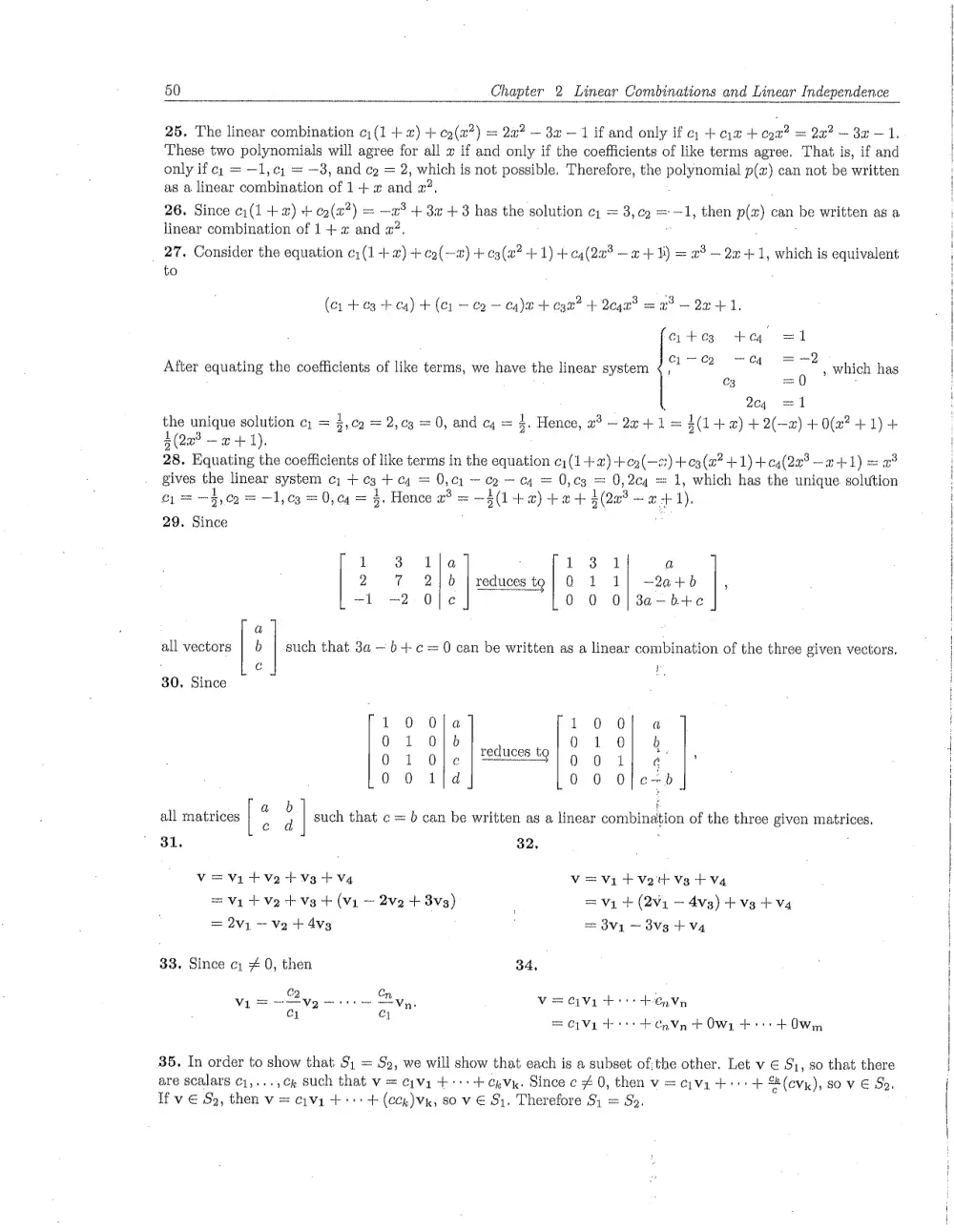
50 Chapter 2 Linear Combinations and Linear Independence
25, The linear combination ¢;(1 + 2) + c2(a?) = 2a? — 3x — 1 if and only if ce + cya + cpa? = Qa? ~ 8a — 1,
These two polynomials will agree for all x if and only if the coefficients of like terms agree. That is, if and
only if cy = —1,¢, = —8, and cz = 2, which is not possible. Therefore, the polynomial p(x) can not be written
as a linear combination of 1+ and «?,
26, Since ¢1(1 +a) + ¢p(a*) = —23 + 32 +3 has the solution cy = 3,¢, = —1, then p(x) can be written as a
linear combination of 1+ and z?,
27. Consider the equation ¢1(1- @) + ¢9(—x) + ¢3(a? +1) + c4(20° ~ a + 3) = o8 — 22 +1, which is equivalent
to
(er + 63 + ¢4) + (1 — cg — ca) + ca? + 2eqar?
After equating the coefficients of like terms, we have the linear system ¢ ~ 0°? which has
2c4 = 1
the unique solution c = 3,c2 = 2,c3 = 0, and cy = 4. Hence, a3 ~ 2@-+1 = $(1 +2) +2(—x) +0(a? +1) +
4 (20° —@ +1)
gan" — 6 : .
28. Equating the coefficients of like terms in the equation ¢(1-+2) +¢2(—s) +¢3 (a? +1) +¢4(223 —2 +1) = 28
gives the linear system ¢; + ¢3 + ¢4 = 0,¢1 — cz — cq = 0,3 = 0,2cq = 1, which has the unique solution
oO =~}, 02 = —1,c3 =0,c4 = $, Hence a3 = ~4(1 +2) +2 + 4(203 ~ 2 +1),
29, Since ,
1 3 lla 131 a
2 7 2/6 |reducestg| 0 1 1) —2a+b |,
-l -2 Ojfe 0 0 0] 38a-b+e
a
all vectors | 6 | such that 3a ~b+¢=0 can be written as a linear combination of the three given vectors.
c P
30, Since
1 0 O]a 10 0] a
QO 1 0}b -ecluces t 0 1 0} &
01 Ofc |RSS) 0 0 1] ef?
001 0 0 Ofe-b
all matrices ‘ ¥ such that ¢ = b can be written as a linear combination of the three given matrices,
31. 32, :
V=VitvVe+V3 + V4 V=VitvVatr Vs + v4
= V1 + ve + v3 + (v1 — Qve+ 3v3) : =Vy+ (2v1 _ 4vs) +V¥3 + V4
= 2v1 ~ vo + 4v3 == 38vy — 8v3 + v4
33, Since c; 40, then 34,
va = yg Byrn, V=C1V1 bi Henn
Cl Cl
= CrVa b+ CnVn + OW, +25: + OWm
35, In order to show that $1; = $2, we will show that each is a subset of;the other, Let v € $1, so that there
are scalars ¢1,...,¢, such that v = civa +:++ + cKVx. Since c 4 0, then v = @yva fee + £8 (evi); so Vv € Sp.
If v € Sg, then v = cyvy +++) + (Cex) VK, 80 V E S1, Therefore $1 = So.