
MATH 218 Problems Solution Manual Chapter 3.1, Fall 2011
American University of Beirut · Elementary Linear Algebra with Applications · 4 pages · with solution


More MATH 218 files
- Problems Solution Chapter 6.1 · Spring 2012Chapter · with solutionView
- Homework Chapter 8 · Fall 2012ChapterView
- Chapter Summary · Fall 2011ChapterView
- Problems Solution Manual Chapter 1.5 · Fall 2011Chapter · with solutionView
- Problems Solution Manual Chapter 1.2 · Fall 2011Chapter · with solutionView
- Problems Solution Manual Chapter 1.4 · Fall 2011Chapter · with solutionView
- Problems Solution Manual Chapter 1.1 · Fall 2011Chapter · with solutionView
- Problems Solution Manual Chapter 1.3 · Fall 2011Chapter · with solutionView
Show the text of this chapter
3.1 Definition of a Vector Space : 61
and since (21 +a) — (y1 + y2) + (41 + 22) = (wi — ya + 21) + (2 — yo + 2g) = O+0 = 0, the sum is also in V.
Similarly, cu is in V for all scalars c. These are the only properties that. need to be verified to show that V is
a vector space,
@ Solutions to Exercises
1. In order to show that a set V with an addition and scalar multiplication defined is a vector space all ten
properties in Definition 1 must be satisfied. To show that V is not a vector space it is sufficient to show any
one of the properties does not hold. Since
vy 22 Ly — to
yo} @}] yo |=} ww ye
zy 22 21 2Q
and .
Bip) By Bq —- 2
yo} OB) Mw | =] rw
22 BY 24 BY
do not agree for all pairs of vectors, the operation ® is not. commutative, so V is not a vector space.
2. Notice that since scalar multiplication is defined in the standard way the necessary properties hold for this
operation. Since the addition of two vectors is another vector, V is closed under ‘addition. Consider
vy Y wm +y1— 1 : cx, + cy1 ~e
co 22 1 @0] ye =c® wg+yo2-1 F{ c@g + cy2~-¢
&3 ys w3 + y3 ~ 1 ; cuz + cys —¢
but
ay YI | ct Cy cx, + ey ~ 1
CO] ®2 |} OcO] yo | = | ex. | © | cy | = | cagt+eyo—-1 |,
&3 Ys erg Cys x3 + Cyg — 1
so the expressions c@ (u @ v) and c®u@c@v do not agree for all pairs of vectors and scalars c. Therefore,
V is not a vector space. ,
3. The operation ® is not associative so V is not a vector space. That is,
wy ‘| ae 23 421 + dae + 2a
yi | ©} yy ®] ys | =|] 441 + 4ye + 2y3
2 2g |. £3 | 421 + 422 + 228
and -
vy XQ x3 221 + 4aq + 4arg
yw | ® y2 | @] ys =| 2y1+4y2+4y3 |,
can 22, 23 221 +429 + 42g
which do not agree for all vectors.
4, Since :
vy ZQ T+ yt try te
cO yi | @} yw =cO B+ Yo = ;
zy 42 t3 + Y3 .
but
By Yi wy + yi + 2c
CO] 2 | ©cO] yw | = wyry2e |,
x3 ya ®+Yg 2
soc@(u+v) and ecO@u@cOv do not always agree.
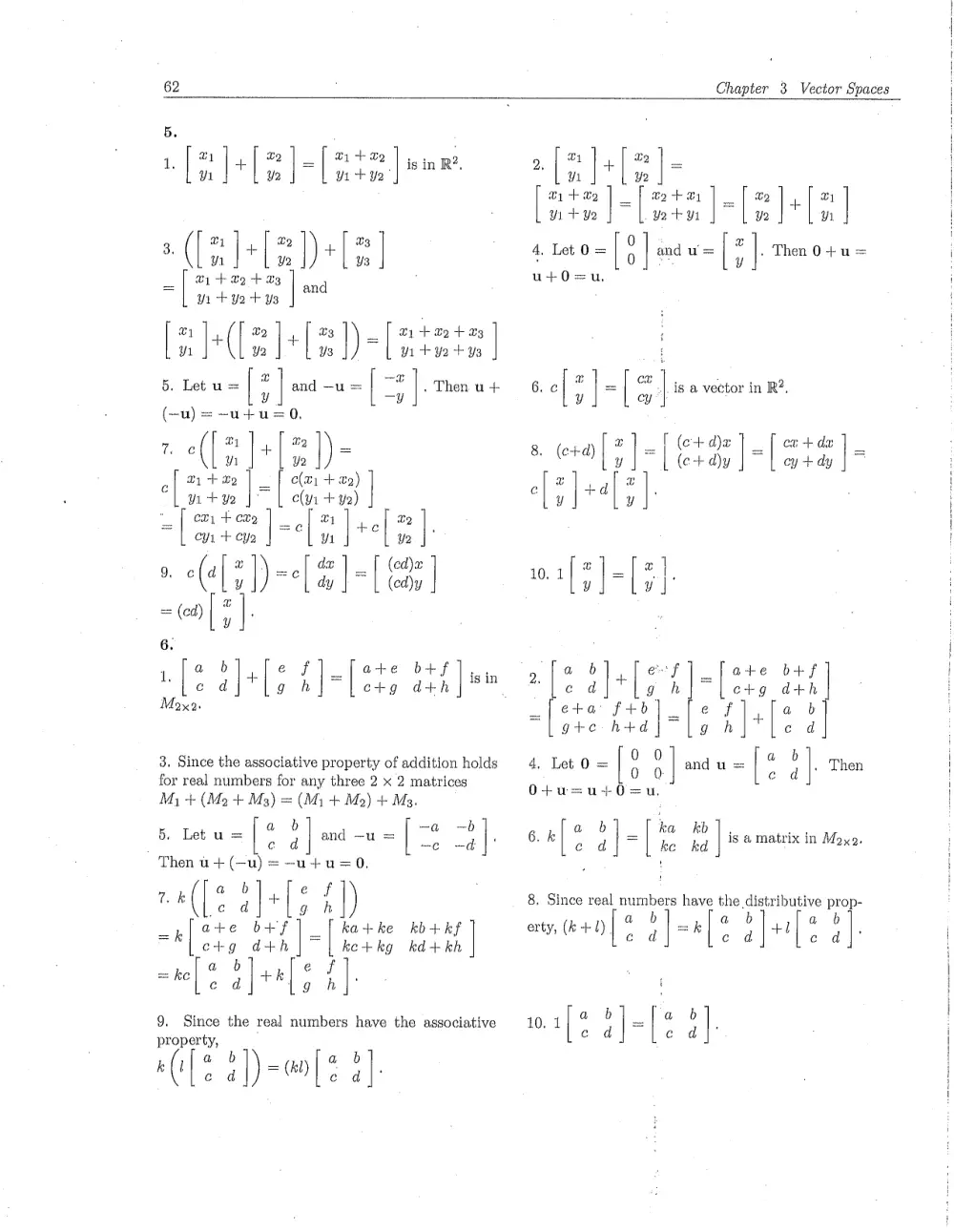
Chapter 3 Vector Spaces
Yi + 2
(h]+E D8]
@1 + LQ + 2&3
= and
y+ ye + Ys
ey x £3
le Le)
5. Let u = ° and —u = “* . Then u +
y —Y
(-u) = -u+u=0.
rele R])-
Yi Ye
21+ & o(a1 + te)
yi + Y2 e(y1 + y2)
= cay + cha =O "1 +e v2 .
cy + cya VA Ya
a e(a[2])=e[ &]=[ 2]
~eo
I
t+ 22 + 2g
y+ Yo + y3
Ml
6.
a b e f|_[ate b+f
| [é alts i ]= [2 ah] em
Moxa.
3, Since the associative property of addition holds
for real numbers for any three 2 x 2 matrices
My, + (Mo + M3) = (My + Mo) + M3.
5. Let u = [: i | and —u = |= - |:
"Then u + (=u) = =0,
. ab e f
male ale[s af)
=R| ore b+f |] _| kat+ke kb+kf
~ e+g d+h]|” | ke+kg kd+kh
_ a b e f
=e oo] eel e i].
9. Since the real numbers have the associative
property,
LS al) ols a].
[2](2]-
YL Yo
1+ BQ _ | % + ey _| % 4 Ly
Yt Yo Yar V1 Yo yi
4, tet o=[ 9 | ond u= [9]. Then 0+u =
0 y
u+0O=u,
6B.c ° = on | is a vector in R?,
«ool 5] [65a] [54 ]-
. a b ef | [ate b+f
22 ils Noles avn
_|eta f+
“| gte h+d 4 c
a
¢
4, tet 0 =| } ene |
i
‘|: Then
O+u=u+0=u,
6.6/8 i f= [i kb
cd ke kd is a matrix in Moxg.
8, Since real numbers have the distributive prop-
. abl a b a b
cen thed] eo gfe {eg ]ae[ sa.
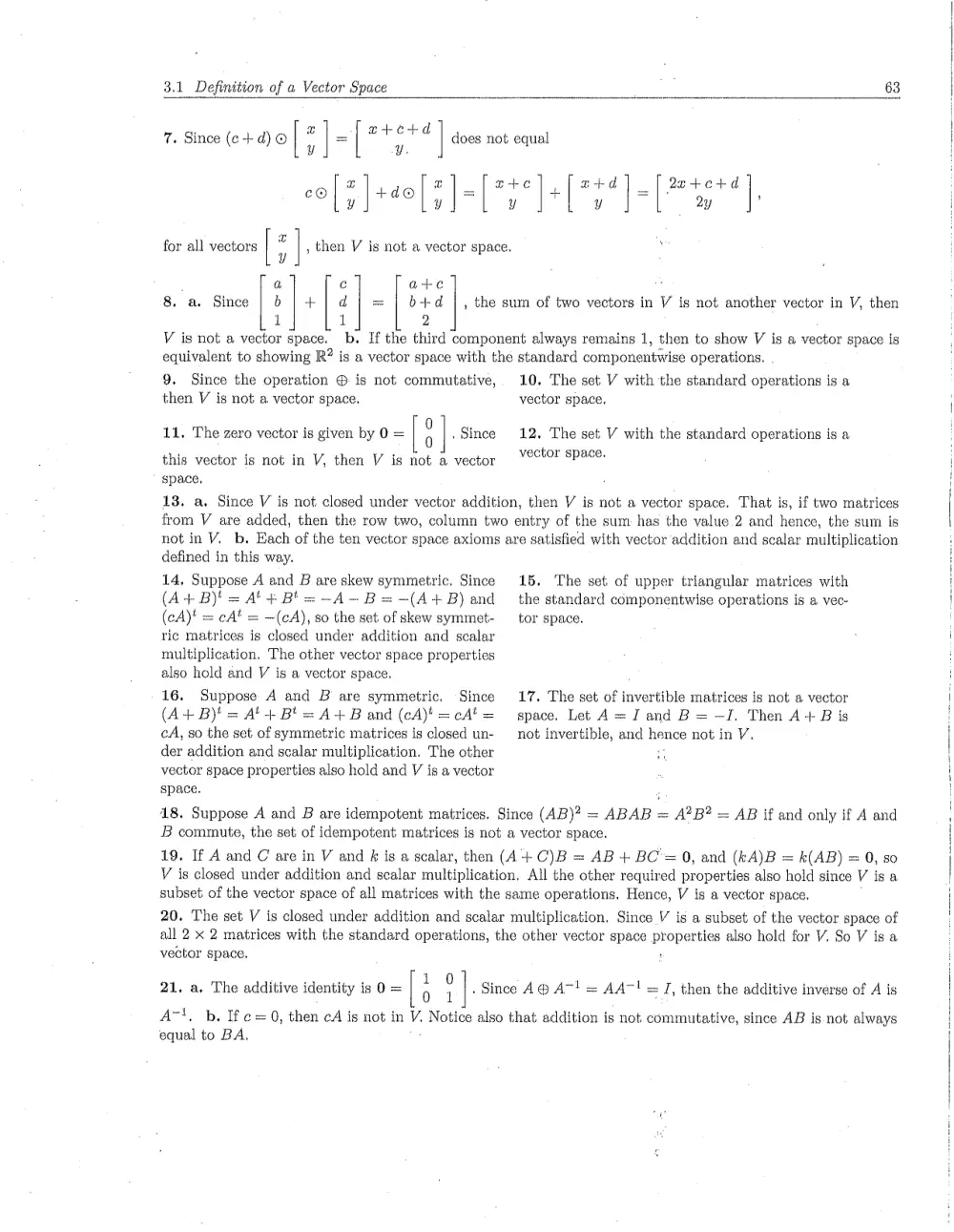
3.1 Definition of a Vector Space 63
7. Since (c+ d)@
na
Y
y
x z}| | @+e a+d |_| 2e+e+d
eo[ 5 J+eo[ 5] =| y J+| y | 2y i
|- [eter
= does not equal
Yy.
for all vectors ) , then V is not a vector space, .
. a c ate
8. a. Since | b | +] d | = | b+d |, the sum of two vectors in V is not another vector in V, then
1 1 2
V is not a vector space. b. If the third component always remains 1, then to show V is a vector space is
equivalent to showing R? is a vector space with the standard componentwise operations. .
10. The set V with the standard operations is a
vector space.
9, Since the operation @ is not commutative,
then V is not a vector space.
12, The set V with the standard operations is a
vector space,
11. The zero vector is given by 0 = ; . Since
this vector is not in V, then V is not a vector
space,
13. a. Since V is not closed under vector addition, then V is not a vector space. That is, if two matrices
from V are added, then the row two, column two entry of the sum has the value 2 and hence, the sum is
not in V, b. Each of the ten vector space axioms are satisfied with vector addition and scalar multiplication
defined in this way.
14, Suppose A and B are skew symmetric, Since
(A+B)! = Ab + Bl =—-A~B=-(A+B) and
(cA)! = cA’ = —(cA), so the set: of skew symmet-
ric matrices is closed under addition and scalar
multiplication, The other vector space properties
also hold and V is a vector space.
16. Suppose A and B are symmetric, ‘Since
(A+ B)' = Ab+ Bt = A+B and (cA)! = cA! =
cA, so the set of symmetric matrices is closed un-
der addition and scalar multiplication. The other
vector space properties also hold and V is a vector
space.
15. The set of upper triangular matrices with
the standard componentwise operations is a vec-
tor space.
17. The set of invertible matrices is not a vector
space. Let A= J and B = —I. Then A+ B is
not invertible, and hence not in V.
18. Suppose A and B are idempotent matrices, Since (AB)® = ABAB = A?B? = AB if and only if A and
B commute, the set of idempotent matrices is not a vector space.
19. If A and C are in V and k is a scalar, then (A+ C)B = AB + BC’= 0, and (kA)B = k(AB) = 0, so
V is closed under addition and scalar multiplication. All the other required properties also hold since V is a
subset of the vector space of all matrices with the same operations. Hence, V is a vector space.
20. The set V is closed under addition and scalar multiplication. Since V is a subset of the vector space of
all 2 x 2 matrices with the standard operations, the other vector space properties also hold for V. So V is a
vector space, :
1.0
0 1
A7!. b, If c= 0, then cA is not in V. Notice also that addition is not commutative, since AB is not always
equal to BA, :
21. a, The additive identity is 0 = . Since A@ Aw! = AA7! = J, then the additive inverse of A is
64 : Chapter 3 Vector Spaces
[otel=[ate)+ faze J= [setts Joero |
the additive identity is
22. a. Since
Oo
1 . b. Since the other nine vector space properties also hold, V is a vector space.
c. Since 0© f = o | ms , , and , is the additive identity, then 0@ v = 0.
1+¢ 1+ 0¢
1 l+a :
23. a, The additive identity isO = | 2]. Letu= 2—a |. Then the additive inverse is —u =
38 3+ 2a
l-a L+¢t 1+0t 1
2+a |. b. Each of the ten vector space axioms is satisfied. c.0©| 2-t | = 2—0t = | 2
3 - 2a 3+ 2¢ 3+2(0)t 3
24, Since S'is a subset of R? with the same stan- 25. Each of the ten vector space axioms is satis-
dard operations only vector space axioms (1) and fled.
(6) need to be verified since the others are inher-
ited from the vector space R°. If w1 and wg are in
S, then let wy = aut+bv and we = cu+dv. Then
Wi + We = (a+c)u+ (b+d)v and k(au+ by) =
(ka)u + (kb)v are also in S.
26. The set S is a plane through the origin in 27, Each of the ten vector space axioms is satis-
R, so the sum of vectors in S remains in S anda fied.
scalar times a vector in S remains in 9. Since the |
other vector space properties are inherited form
the vector space R°, then S$ is a vector space.
28. a. Since cos(0) = 1 and sin(0) = 0, the additive identity is 1
0
is cos(—ti) | _ | cost,
sin(—ti) | | sing,
. The additive inverse of cost
sin ty
. b, The ten required properties hold making V a vector space. c. The
additive identity in this case is ; . Since cost and sint are not both 0 for any value of ¢, then ; is
not in V, so V is not a vector space.
29. Since (f +g)(0) = f(0) +9(0) = 1+1 = 2, then V is not closed under-addition and hence is not a vector
space,
30. Since c@ (d@ f)(z) = ¢@ (f(a+d)) = f(w+e4+d) and (cd) @ f(z) = f(x + ed), do not agree for all
scalars, V is not a vector space,
t
31. a, The zero vector is given by f(z -+0) = #3 and —f(z +t) = f(a —t). b, Each of the ten vector space |
axioms is satisfied, i
Exercise Set 3.2
A subset W of a vector space V is a subspace of the vector space if vectors in W, using the same addition
and scalar multiplication of V, satisfy the ten vector space properties. That is, W is a vector space. Many of
the vector space properties are inherited by W from V. For example, if u and v are vectors in W, then they !
are also vectors in V, so that u@v = v © u. On the other hand, the additive identity may not be a vector
in W, which is a requirement for being a vector space. To show that a subset is a subspace it is sufficient to i
verify that
if u and v are in W and ¢ is a scalar, then u-+ ev is another vector in W,