
MATH 218 Problems Solution Manual Chapter 3.2, Fall 2011
American University of Beirut · Elementary Linear Algebra with Applications · 7 pages · with solution
More MATH 218 files
- Problems Solution Chapter 6.1 · Spring 2012Chapter · with solutionView
- Homework Chapter 8 · Fall 2012ChapterView
- Chapter Summary · Fall 2011ChapterView
- Problems Solution Manual Chapter 1.5 · Fall 2011Chapter · with solutionView
- Problems Solution Manual Chapter 1.2 · Fall 2011Chapter · with solutionView
- Problems Solution Manual Chapter 1.4 · Fall 2011Chapter · with solutionView
- Problems Solution Manual Chapter 1.1 · Fall 2011Chapter · with solutionView
- Problems Solution Manual Chapter 1.3 · Fall 2011Chapter · with solutionView
Show the text of this chapter
64 Chapter 3 Vector Spaces
[ited LabedeLtade[addta Jon
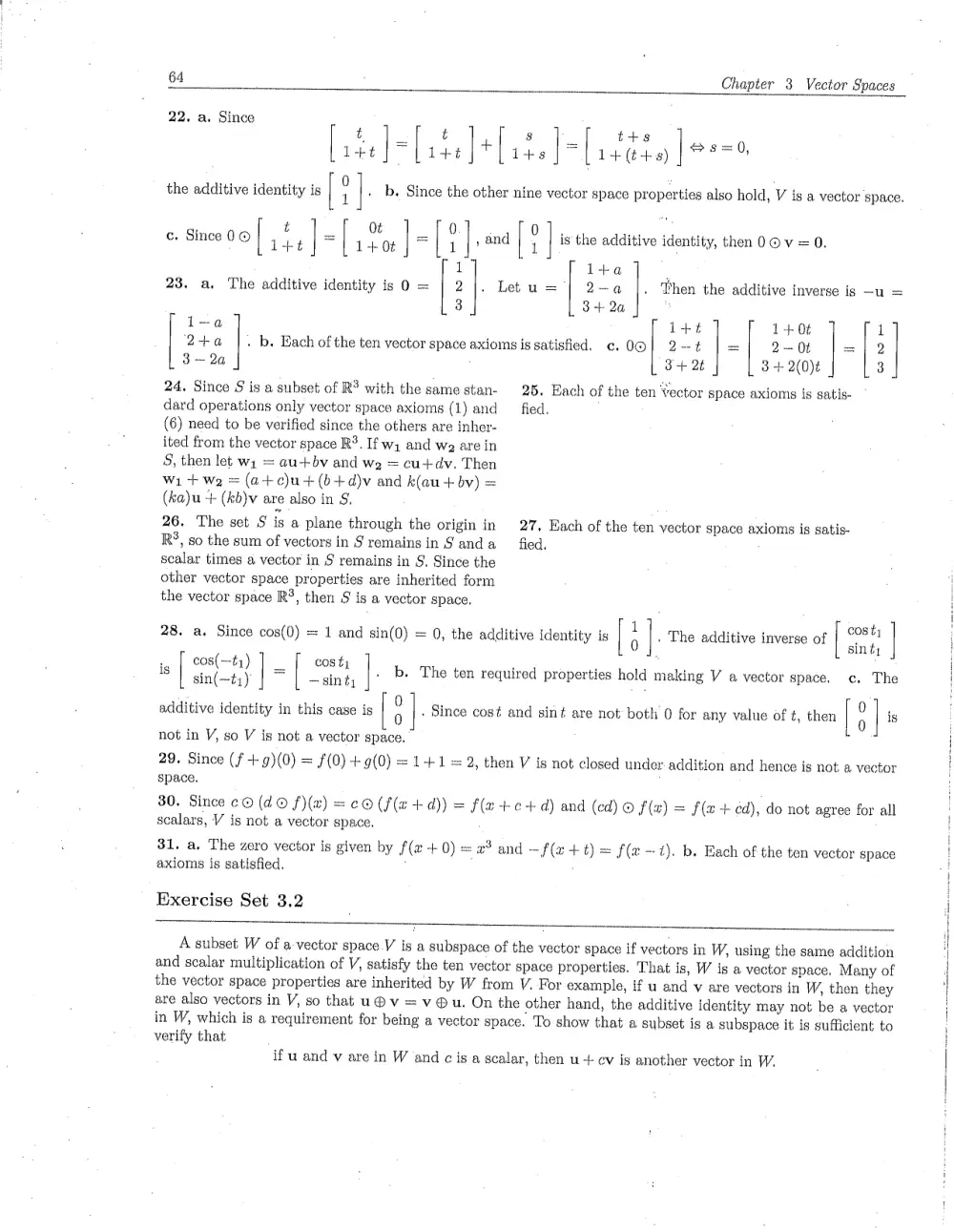
22. a. Since
the additive identity is : . b. Since the other nine vector space properties also hold, V is a vector space.
L+t 1+ 0¢ 1
1 l+a :
2 |. Letu= | 2—a |. Then the additive inverse ig —u =
3 3+ 2a
l-a I+¢ 1+ 0t
2+a |. b. Each of the ten vector space axioms is satisfied. ce. 0@| 2—t 2—0t
8-24 3+ 2t 3+ 2(O)t
24, Since S'is a subset of R? with the same stan- 25. Each of the ten Yector space axioms is satis-
dard operations only vector space axioms (1) and fied.
(6) need to be verified since the others are inher-
ited from the vector space R°. If wy and we are in
S, then let wi = au-+bv and wg = cu+dv, Then
Wi + Wa = (a+c)u+(b+d)v and k(au + by) =
(ka)u + (kb)v are also in S.
26. The set S is a plane through the origin in 27, Each of the ten vector space axioms is satis-
R°, so the sum of vectors in S remains in S and a fied.
scalar times a vector in S remains in S, Since the
other vector space properties are inherited form
the vector space R°, then $ is a vector space,
c. Since 0© é = Ot = 8 , and : is the additive identity, then 0@v = 0.
23. a. The additive identity is 0
i
i
il
wor
28, a. Since cos(0) = 1 and sin(0) = 0, the additive identity is A . The additive inverse of costa
sinty
. | cos(~ti) | _ [ cost; ; . conantic a Lon eran .
is sin(~t1) = ~sinty | b. The ten required properties hold making V a vector space. c, The
additive identity in this case is 0
not in V, so V is not a vector space.
29. Since (f +9)(0) = f(0) +9(0) = 1+1 = 2, then V is not closed under addition and hence is not a vector
space,
30. Since ¢@ (dO f)(w) = c@ (f(a +d)) = f(a -+e+d) and (ed) © f(a”) = f(e + ed), do not agree for all
scalars, V is not a vector space.
31, a, The zero vector is given by f(x +0) = a? and —f(@+t) = f(«@- 71). b. Each of the ten vector space
axioms is satisfied.
. Since cost and sint are not both 0 for any value of t, then , is
Exercise Set 3,2
A subset W of a vector space V is a subspace of the vector space if vectors in W, using the same addition
and scalar multiplication of V, satisfy the ten vector space properties. That is, W is a vector space, Many of
the vector space properties are inherited by W from V. For example, if u and v are vectors in W, then they
are also vectors in V, so that u@®v = v @ u. On the other hand, the additive identity may not be a vector
in W, which is a requirement for being a vector space. To show that a subset is a subspace it is sufficient to
verify that
if u and v are in W and cis a scalar, then u + cv is another vector in W.
3.2 Subspaces . 65
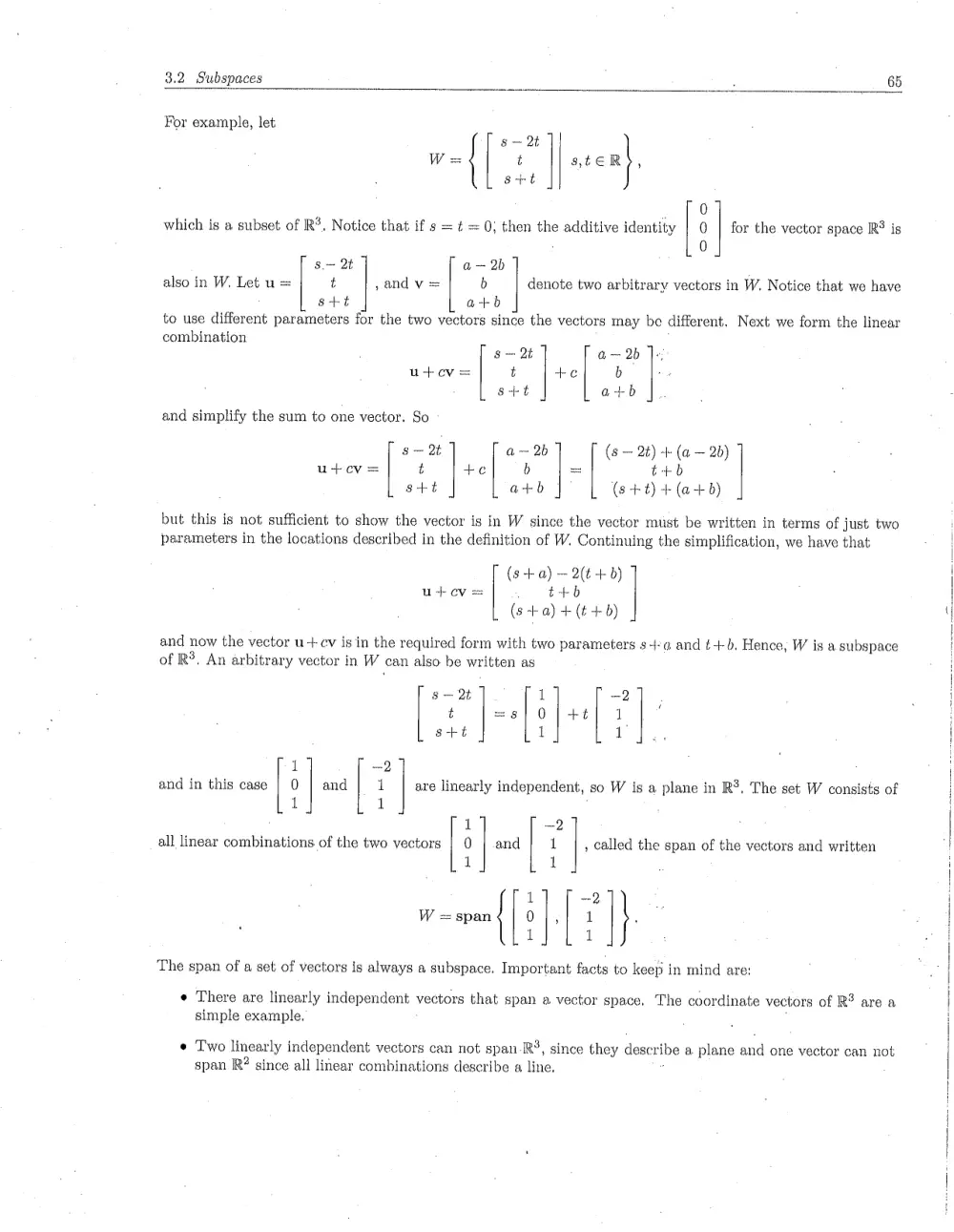
For example, let
g— at
Ws t s,tER>,
stt
. 0
which is a subset of R*, Notice that if s = ¢ = 0; then the additive identity | 0 | for the vector space R® is
0
8.— 2t a— 2b
also in W. Let u = t ,and v = b denote two arbitrary vectors in W. Notice that we have
s+t a+b
to use different parameters for the two vectors since the vectors may be different. Next we form the linear
combination
8 Qt a~2b
u-+cv = t +¢ b
s+t a+b
and simplify the sum to one vector. So
8 — 2t a— 2b (s — 2t) ++ (a —
u+cvs t +c b = t+b
s+t a+b (s +t) + (a+b)
but this is not sufficient to show the vector is in W since the vector must be written in terms of just two
parameters in the locations described in the definition of W. Continuing the simplification, we have that
(s +a) ~ 2(t +b)
u-+ev = . t+b
(s +a) + (t +b)
and now the vector u+ ev is in the required form with two parameters s--a and t+). Hence, W is a subspace
of IR°. An arbitrary vector in W can also be written as
s— Qt | 1 "= Q
t =e] 0] +t] 1
s+t | 1 1
1 [ —2
and in this case | 0 | and 1 are linearly independent, so W is a plane in R°, The set W consists of
1 1 :
1] -2
all linear combinations of the two vectors | 0 | and t , called the span of the vectors and written
1 1
1 ~2
W = span oO], 1
1 1
The span of a set of vectors is always a subspace. Important facts to keep in mind are:
¢ There are linearly independent vectors that span a vector space. The coordinate vectors of R3 are a
simple example. ,
¢ Two linearly independent vectors can not span-R°, since they describe a plane and one vector can not
span IR? since all linear combinations describe a line,
66 Chapter 3 Vector Spaces
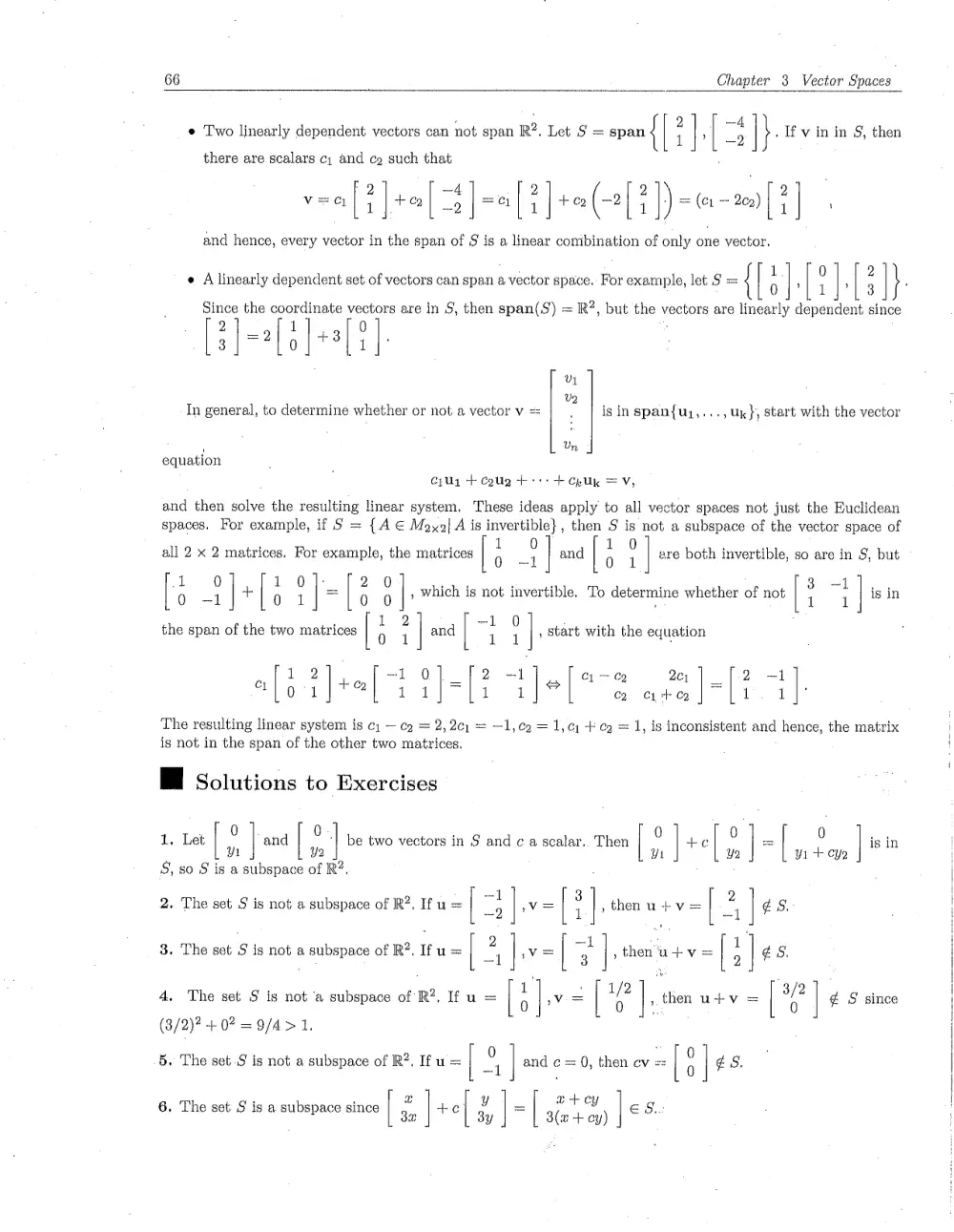
© Two linearly dependent vectors can not span R?. Let S$ = span { : , 3 } _ If v in in S, then
there are scalars c; and cg such that
veo[?]+a[ 3 ]=e[?]+0(-2[7]) -to-20[?]
and hence, every vector in the span of $ is a linear combination of only one vector.
2
e A linearly dependent set of vectors can span a vector space. For example, let $ = { 1 ; : ; |}:
0 3
Since the coordinate vectors are in S, then span(S) = R?, but the vectors are linearly dependent since
isJeelo]+9[t}
In general, to determine whether or not a vectorv = | , | is inspan{uy,..., ux}, start with the vector
, Un
equation
CyUy + CgUg + +++ + ChUK = V,
and then solve the resulting linear system. These ideas apply to all vector spaces not just the Euclidean
spaces. For example, if S = {A € Moxa| A is invertible}, then S is not a subspace of the vector space of
1 0]
0-1 |
[3 ’ + ; : |= 4 a ; which is not invertible, To determine whether of not ; 7 | is in
-1 0
12
0 1 | end | 11
fi 27, f -1 Of _ 7 2 -1 C1 — eg 2c, | | 2 ~1
alg 1 | +e 1 t}=[3 ‘| eg ate l=[i 1 |:
The resulting linear system is c) ~ cz = 2, 2c, = —1,c9 = 1,¢c1 + cg = 1, is inconsistent and hence, the matrix
is not in the span of the other two matrices,
all 2 x 2 matrices. For example, the matrices and ‘ : | are both invertible, so are in S$, but
the span of the two matrices , start with the equation
MF Solutions to Exercises
1, tet | 9 | ana | ?
Y Y2
| be two vectors in S and ca scalar. Then : +e 0 = 0 is in
Y2 Yt
S, so S is a subspace of R?
ye Yi + cya
(3/2)? +02 =9/4>1,
0
5, The set. is not a subspace of R?. If u= 1
2. The set $ is not a subspace of IR?, If u = many -( ; |. then u-+v = a ES.
3. The set $ is not a subspace of R*. If u = 2 v= ls y, thena+v = | , ES.
4, The set S is not ‘a subspace of R?. If u -|5 ] v= : , then u+v = 82 ¢ S since
and ¢ = 0, then ev = , ¢ 8.
set Sisas “i z y |_f tty Jog
6. The set S is a subspace since 30 + | ¢ 3y |- E 3(a + cy) és,
3.2 Subspaces ; 67
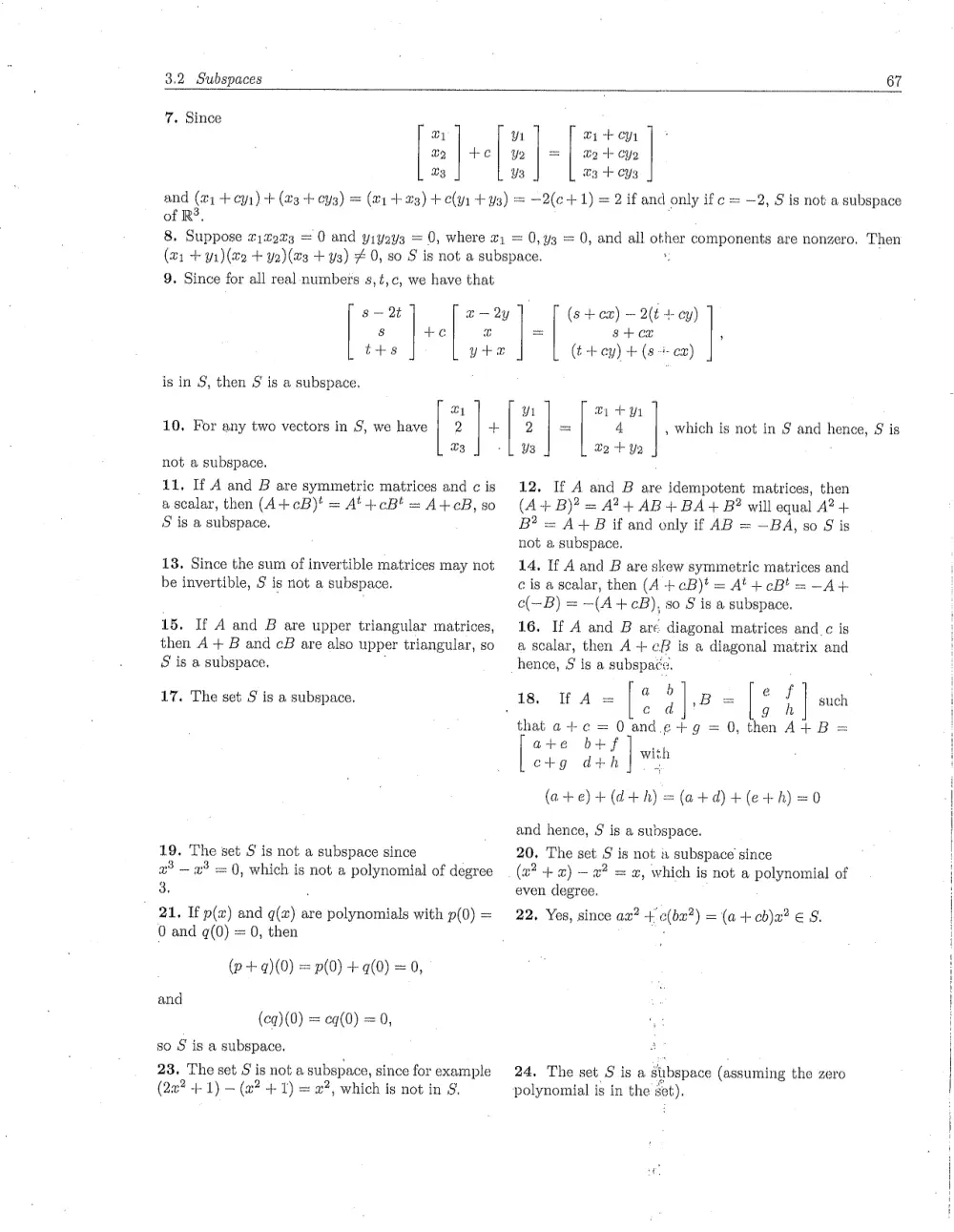
7. Since
Cea Yt v1 + Cyr
% | +e] yo | = | wo+ cya
x3 Ys 3 + CYy3
and (a1 + cy1) + (a3 + ey3) = (#1 +23) + c(y1 + y3) = -2(c+1) = 2 if and only if = —2, S is not a subspace
of R°,
8. Suppose 212223 = 0 and yiyays = 0, where 21 = 0, y3 = 0, and all other components are nonzero. Then
(x1 +41)(@2 + y2)(%3 + ys) 4 0, so S is not a subspace. y
9. Since for all real numbers s,t,c, we have that
3 — Qt a — Qy (8 + cx) ~ 2(¢ + cy)
8 +e wv = s+ cx ;
t+s ytau (t + ey) + (s+ ex)
is in S, then S' is a subspace.
x1 YL e+ yt
10, For any two vectors in S, we have | 2 | +] 2 |= 4 , which is not in S and hence, S is
3 ys 2+ Yy2
not a subspace.
11, If A and B are symmetric matrices and ¢ is
a scalar, then (A+cB)* = At+cBt = A+cB, so
S is a subspace.
13. Since the sum of invertible matrices may not
be invertible, $ is not a subspace.
15. If A and B are upper triangular matrices,
then A+ B and cB are also upper triangular, so
S is a subspace, :
17. The set S is a subspace,
19. The set S is not a subspace since
2° — x = 0, which is not a polynomial of degree
3, .
21. If p(w) and q(x) are polynomials with p(0) =
0 and q(0) = 0, then
(p + q)(0) = p(0) + 9(0) = 0,
and
(cq)(0) = eq(0) = 0,
so S' is a subspace.
23. The set S is nota subspace, since for example
(20 + 1) — (w? + 1) = 2”, which is not in S.
12. If A and B are idempotent matrices, then
(A+B)? = A? + AB + BA-+ B? will equal A? +
B? = A+B if and only if AB = —BA, so S is
not a subspace.
14. If A and B are skew symmetric matrices and
cis a scalar, then (A -+cB)' = A'+cBb=—A+
c(-B) = ~(A+ cB), so S$ is a subspace.
16. If A and B aré diagonal matrices and_c is
a scalar, then A + eB is a diagonal matrix and
hence, S' is a subspace.
18, If A = [: i |B = [¢ {| suet
cod gi ih
that a+c= 0 ande+g = 0, then A+ B=
ate b+f ih
c+g dt+h “
(a-+e)+(d+h) = (at+d)+(e+h) =0
and hence, S' is a subspace.
20, The set S' is not a subspace’ since
(a? + 2%) — 2? = a, which is not a polynomial of
even degree.
22, Yes, since ax? +/2(bx?) = (a + cb)a? € S.
24, The set S is a subspace (assuming the zero
polynomial is in the set),
68 Chapter 3 Vector Spaces
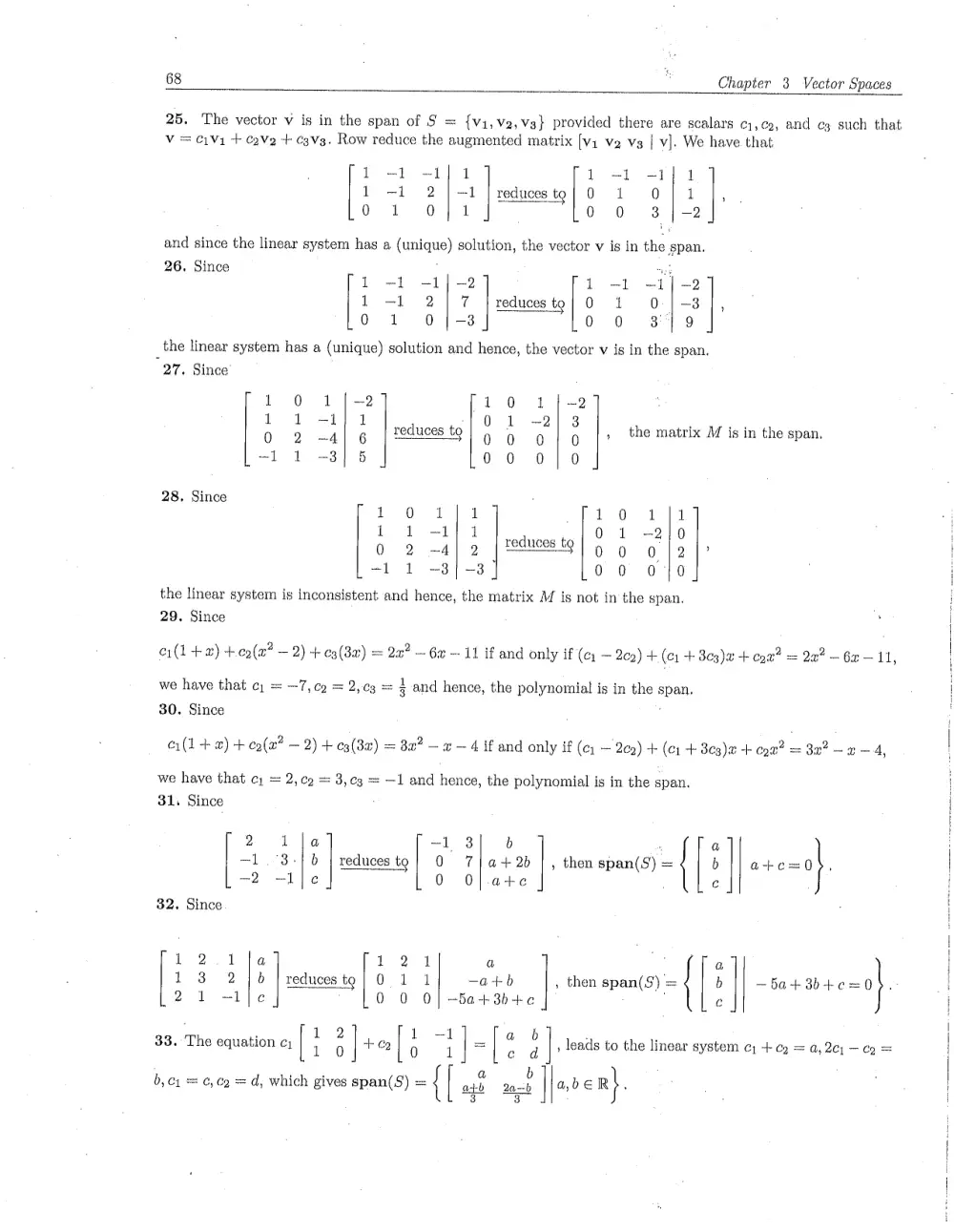
25. The vector v is in the span of $ = {v1,v2,v3} provided there are scalars ¢1,¢2, and cy such that
V = civi + C2V2 + c3vg. Row reduce the augmented matrix [v1 va vg | v]. We have that
1 -1 -1) 1 1 -1 -1) 1
1 -1 2 |—1 | reducestg| 0 1 0 1 ;
0 1 0 ]
1 0 0 3 ]-2
and since the linear system has a (unique) solution, the vector v is in the span.
26, Since
—2
-~3 |,
9
the linear system has a (unique) solution and hence, the vector v is in the span,
27. Since
1-1 -1|-2 1-1-1)
1-1 2) 7 | reducestg} 0 1 0)
0 it 0 | -38 0 0 3
1 0 1 |-2 10 1 |-2
1 1-1/1 01 -2) 3 “arcs ;
0 2 —4! 6 reduces tg 00 0fo |? the matrix M is in the span,
-l 1 -3] 5 00 0 0
28, Since
1 ou]. fio 4.44
1 1-1} 1 Jo sneos to | 2 2 72/0
0 2 -4] 2 | MEME To o oO fa]?
-l 1 ~3} -3 00 070
the linear system is inconsistent and hence, the matrix M is not in the span. i
29. Since ,
c1(1 +2) +.¢2(n? — 2) + 03(8x) = 2a? — 6x — 11 if and only if (1 — 2¢2) + (ce, + 8¢3)a + con” = 2a? — 62-11,
we have that c) = —7, cy = 2,¢3 = 3 and hence, the polynomial is in the span.
30. Since
ea(1 + @) + c2(2? — 2) + cg(3a) = 8x? — 2 ~ 4 if and only if (cr — 2e2) + (er + 3e9)@ + cpa? = 3a® ~ 2 —4,
we have that ce, = 2,c2 = 8,c3 = —1 and hence, the polynomial is in the span.
31. Since
2 1a -1 3 b + a
—1.°3-1 0 | reduces to] 0 7)a+2b |, then span(S) = b a+c=0>,
-2 —-lle 0 O}.ate c
32, Since .
12. 1a 12 1 a , a
1 3 2 | 6 | reducestg}] 0 1 1 —a+b , then span($) = b —5at3b+c=0>.
2 1 -1le 0 0 0] -Sa+3b+¢ ; e
|
|
: 1 2 1-1 b |
33. The equation c; 1 0 + CQ 0 “y = ‘ 2 , leads to the linear system ¢ +c, = a, 2c, — cy = |
b,c: = ¢,¢g = d, which gives span(S) = { ab oa? abe Rh.
+b 2o=b
3
3.2 Subspaces
69
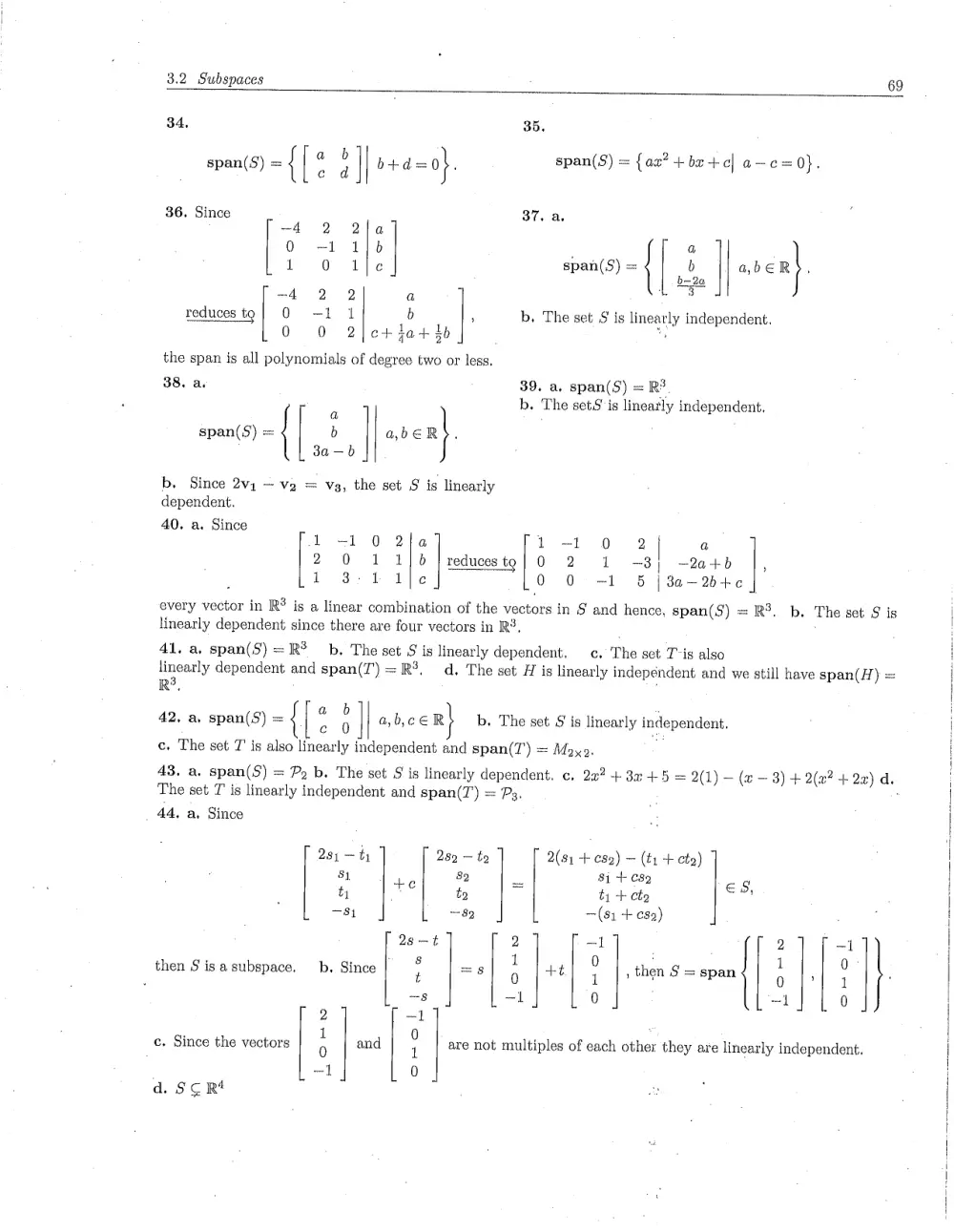
34,
span(S) = {
as
ac
ws
>
+
ia
fl
fo)
hanes
36. Since
-4 2 2i/a
0 ~-1 1/6
1 0 lie
-4 2 2 a
reduces to} O -1 1 b :
0 0 2le+ja+t 4d
the span is all polynomials of degree two or less.
38. a.
abe x}
a
span(S) = b |
3a—b
b, Since 2v1 — v2 = vg, the set S is linearly
dependent.
1 -1 0
2 0 1
1 3-1
40. a. Since
2
L
35.
span(S) = {ae* +be+¢e| a—c=0}.
37, a.
T a
span(S) = , b | a,be e} ;
b, The set 9 is linearly independent.
39. a, span($) = R?
b. The setS' is linearly independent.
a 1-1 0 2 | a
b | reducestoe| 0 2 1-3) ~-2a+b ;
¢c
0 0 -1 5 [8a~2b+e |
every vector in R® is a linear combination of the vectors in S and hence. span(S) = R°. b, The set $ is
linearly dependent since there are four vectors in R°,
41, a, span(S) = R°
linearly dependent and span(T’) = R°,
R’,
42, a, span(S) = { 3
b. The set S is linearly dependent,
d, The set H is linearly independent and we still have span(H) =
c, The set Tis also
a,d,c€ R} b. The set S' is lmearly independent,
c. The set T is also linearly independent and span(T’) = Moy.
43, a, span(S) = Pz b, The set S is linearly dependent. c, 222 +3245 = 2(1) — (w — 8) + 2(a? + 22) da
The set T is linearly independent and span(T’) = P3.
44, a, Since
2814 — ty 28 — te
$1 , 82
ti te te
Sy 82
28 —t
then S isa subspace. b. Since = 8
—s
2 —1
c. Since the vectors ;
d. S¢ Rt
2(81 + 82) — (t1 + ete)
_ 81 + C8
= ti + cla ۤ,
—(81 + 82)
2 ~1 2 -1
1 0 : 1 0
0 +t l , then S$ = span 0 ; 1
= 0 : ~1 0
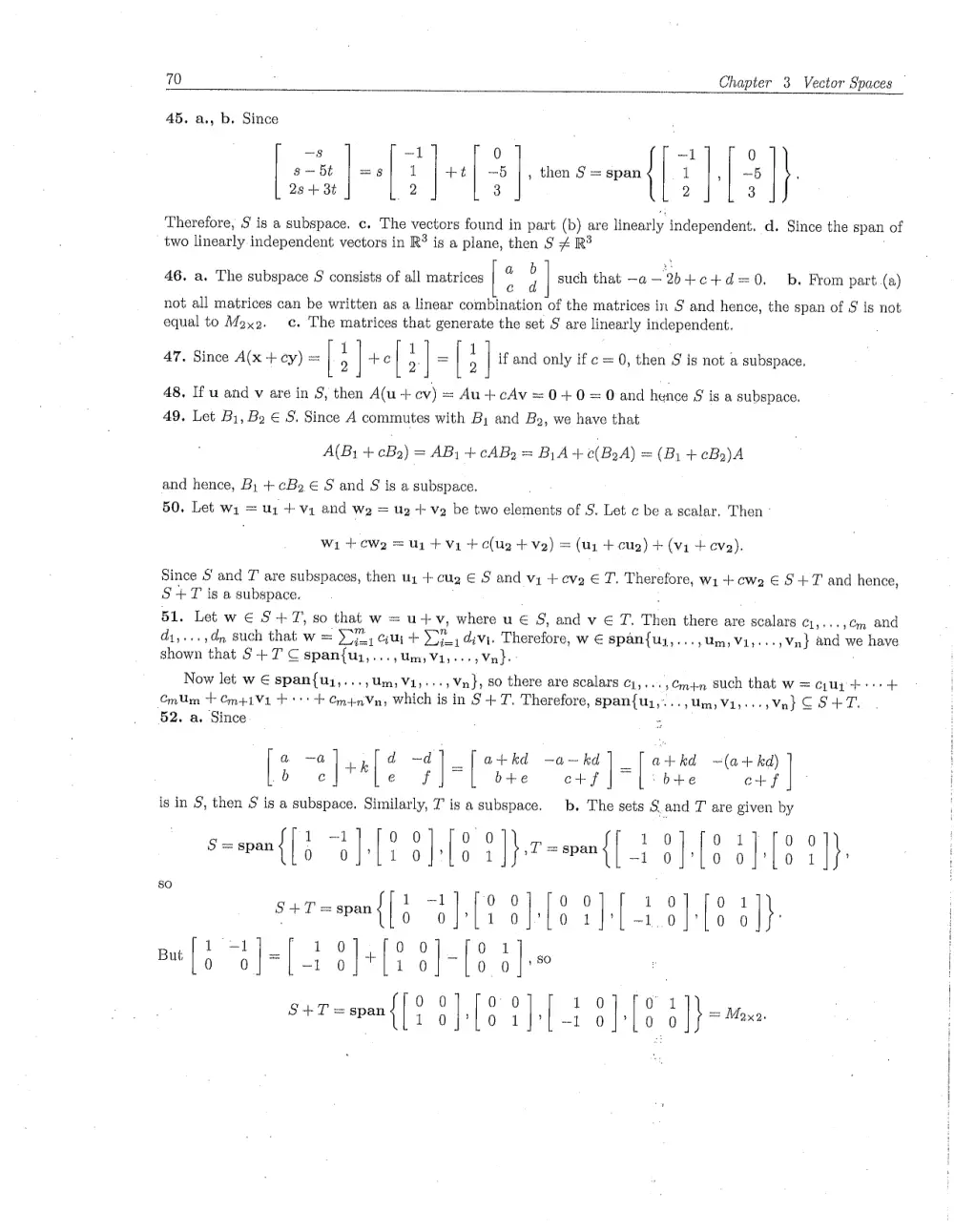
70 Chapter 3 Vector Spaces
45. a., b, Since
8 -1 0 "1 0
s~5é¢ | =s} 1 | +¢] -5 |, then S=span 1 },}] -5 :
28 + 3t 2 3 2 3
Therefore, S is a subspace. c, The vectors found in part (b) are linearly independent. d. Since the span of
two linearly independent vectors in R® is a plane, then $ 4 R®
46. a. The subspace S$ consists of all matrices ‘ such that ~a—2b+¢+d=0. b. From part (a)
not all matrices can be written as a linear combination of the matrices in S and hence, the span of S' is not
equal to Mzx2. _c. The matrices that generate the set S are linearly independent.
47. Since A(x + cy) = 1 +e 1 =|! if and only if c= 0, then S' is not a subspace,
2 2 2
48, If u and v are in S, then A(u+ cv) = Au+cAv =0+0=0 and hence $ is a subspace,
49. Let B,, Bg € S. Since A commutes with By and Bo, we have that
A(By + cB) = AB, +cABg = BjA+ ¢(B2A) = (By, + cBg)A
and hence, By + cB, € S and S is a subspace.
50. Let wi = ur + v1 and we = uz + v2 be two elements of S, Let c be a scalar. Then
Wi + cW2 = U1 + Vi + C(Ug + V2) = (uy + cug) + (vi + eva).
Since S'and T are subspaces, then uy +cug € S and v1 + eve ET. Therefore, wi + cwe € 9 +T and hence,
S+T is a subspace.
51. Let w ¢ $+ 7, so that w = u+v, where u € S, and v € T. Then there are scalars C1y+++yCm and
di,...,dy such that w = an Guy + YL, divi. Therefore, w € span{uy,...,Um,V1,...,Vn} and we have
shown that $+ 7 C span{uy,...,Um,Vi,...;Vn}-
Now let w € span{ui,...,Um,Vi,..., Vn}, 80 there are scalars c1,... +Cm4n such that w = cpuy +e +
CmUm + Cm41V1 + +++ + Cm4nVn, which is in $+. Therefore, span{ui,:..,Um,Vi,..- Vn CS+T.
52. a. Since
a aly d -d}_[a+kd -a~kd])_ [| a+kd -(a+kd)
b oe e ff bt+e ct+f | [i b+e c+f
is in S, then S' is a subspace, Similarly, T is a subspace. b. The sets $ and T are given by
_ 1-1 0 0 0 0 _ 1 0 0 1 0 0
sommn({ SELL a) [8 $]}e-omm(l s ShL8 8hL ED)
5+1=span{|
fi -1]_f 1 0],fo 0] _fo1].
But | j 5 |=[-1 otis o|-[o 5 |
0
1
so
on
|
or
ws
——
Bo
o°
uo
—
oo
Ko
os
—
i
en
oo
os
—s
oo
QOr
ws
a,