
MATH 218 Problems Solution Manual Chapter 3.3, Fall 2011
American University of Beirut · Elementary Linear Algebra with Applications · 6 pages · with solution
More MATH 218 files
- Problems Solution Chapter 6.1 · Spring 2012Chapter · with solutionView
- Homework Chapter 8 · Fall 2012ChapterView
- Chapter Summary · Fall 2011ChapterView
- Problems Solution Manual Chapter 1.5 · Fall 2011Chapter · with solutionView
- Problems Solution Manual Chapter 1.2 · Fall 2011Chapter · with solutionView
- Problems Solution Manual Chapter 1.4 · Fall 2011Chapter · with solutionView
- Problems Solution Manual Chapter 1.1 · Fall 2011Chapter · with solutionView
- Problems Solution Manual Chapter 1.3 · Fall 2011Chapter · with solutionView
Show the text of this chapter
3.3 Basis and Dimension ; 71
Exercise Set 3.3
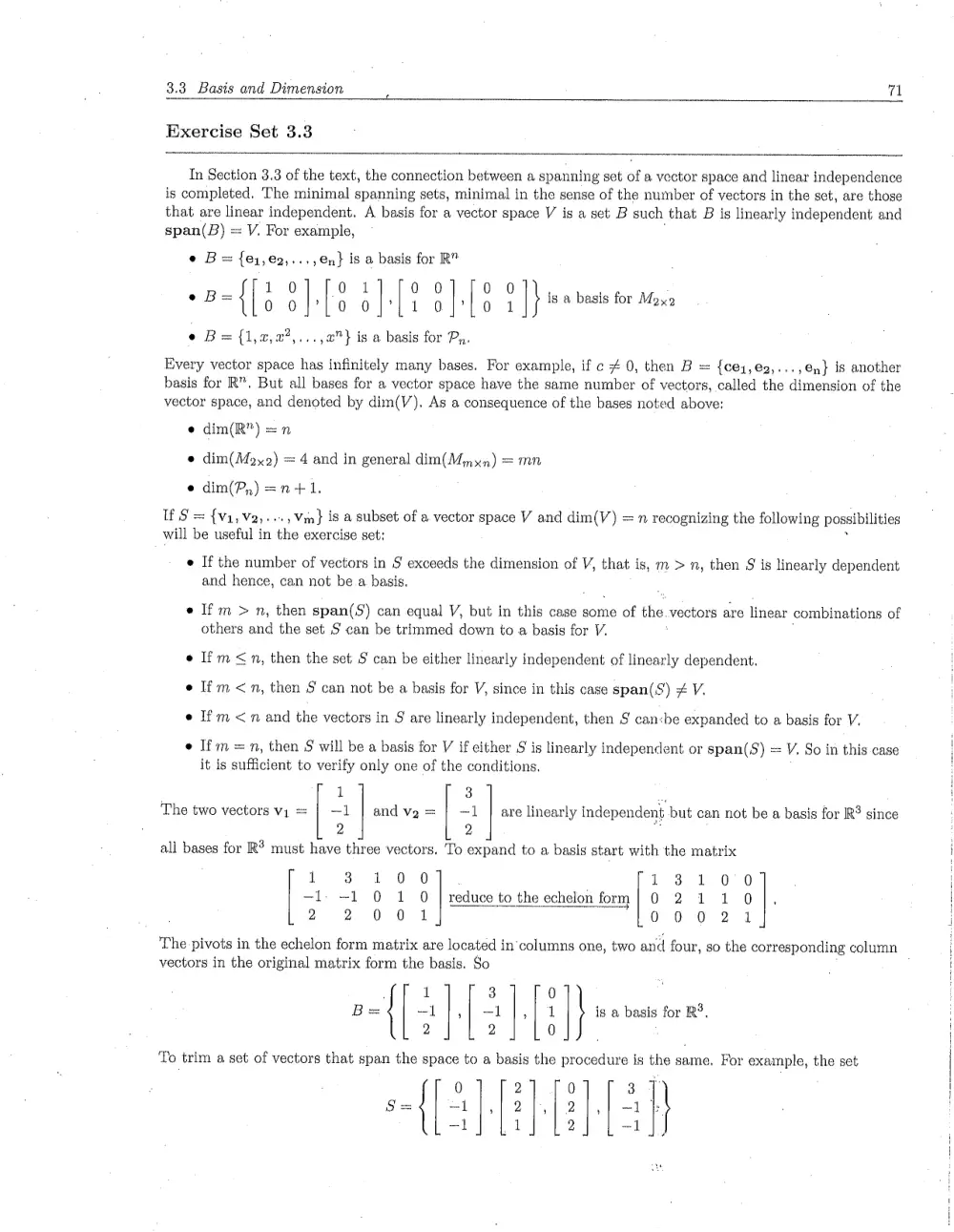
In Section 3.3 of the text, the connection between a spanning set of a vector space and linear independence
is completed. The minimal spanning sets, minimal in the sense of the number of vectors in the set, are those
that are linear independent, A basis for a vector space V is a set B such that B is linearly independent and
span(B) = V. For example, :
e B= {e1,€2,...,en} is a basis for R™
1 0 . ,
-B={\ 5 off of [! of le 1 | ts bosis for Mavs
¢ B= ({l,2,x",...,0"} is a basis for Py.
Every vector space has infinitely many bases. For example, if c #0, then B = {cey,eg,... ,©n} is another
basis for R”, But all bases for a vector space have the same number of vectors, called the dimension of the
vector space, and denoted by dim(V). As a consequence of the bases noted above:
e dim(R") =n
© dim(M2x2) = 4 and in general dim(Mmnxn) = mn
e dim(P,) =n+1,
If S = {v1,V2,..., Vin} is a subset of a vector space V and dim(V) = n recognizing the following possibilities
will be useful in the exercise set: .
e If the number of vectors in S exceeds the dimension of V, that is, m > n, then $ is linearly dependent
and hence, can not be.a basis,
e Ifm > n, then span(S) can equal V, but in this case some of the.vectors are linear combinations of
others and the set S can be trimmed down to a basis for V.
e Ifm <n, then the set S can be either linearly independent of linearly dependent.
e Ifm <n, then § can not be a basis for V, since in this case span(S) 4 V.
e Ifm <n and the vectors in $ are linearly independent, then S' canbe expanded to a basis for V.
e Ifm =n, then 9 will be a basis for V if either $ is linearly independent or span(S) = V. So in this case
it is sufficient to verity only one of the conditions,
1 3 :
The two vectors v1 = | —1 | andvg= | —1 | are linearly independent but can not be a basis for IR? since
2 2 ~
all bases for R? must have three vectors. To expand to a basis start with the matrix
1 3 10 07. 1 3 100
-l- -1 0 1 0 | reduce to the echelon form| 0 2 1 1 0
2 2 001 000 2 1
q
The pivots in the echelon form matrix are located in’columns one, two and four, so the corresponding column
vectors in the original matrix form the basis. So
. L 3 0
B= —-l],)/ -1 ],] 4 is a basis for R°,
2 2 0
To trim a set of vectors that span the space to a basis the procedure is the same. For example, the set
0 2 0 3 7
S= —-1},)2},}/2],] -1 4
-1 1 2 -1
72
Chapter 3 Vector Spaces
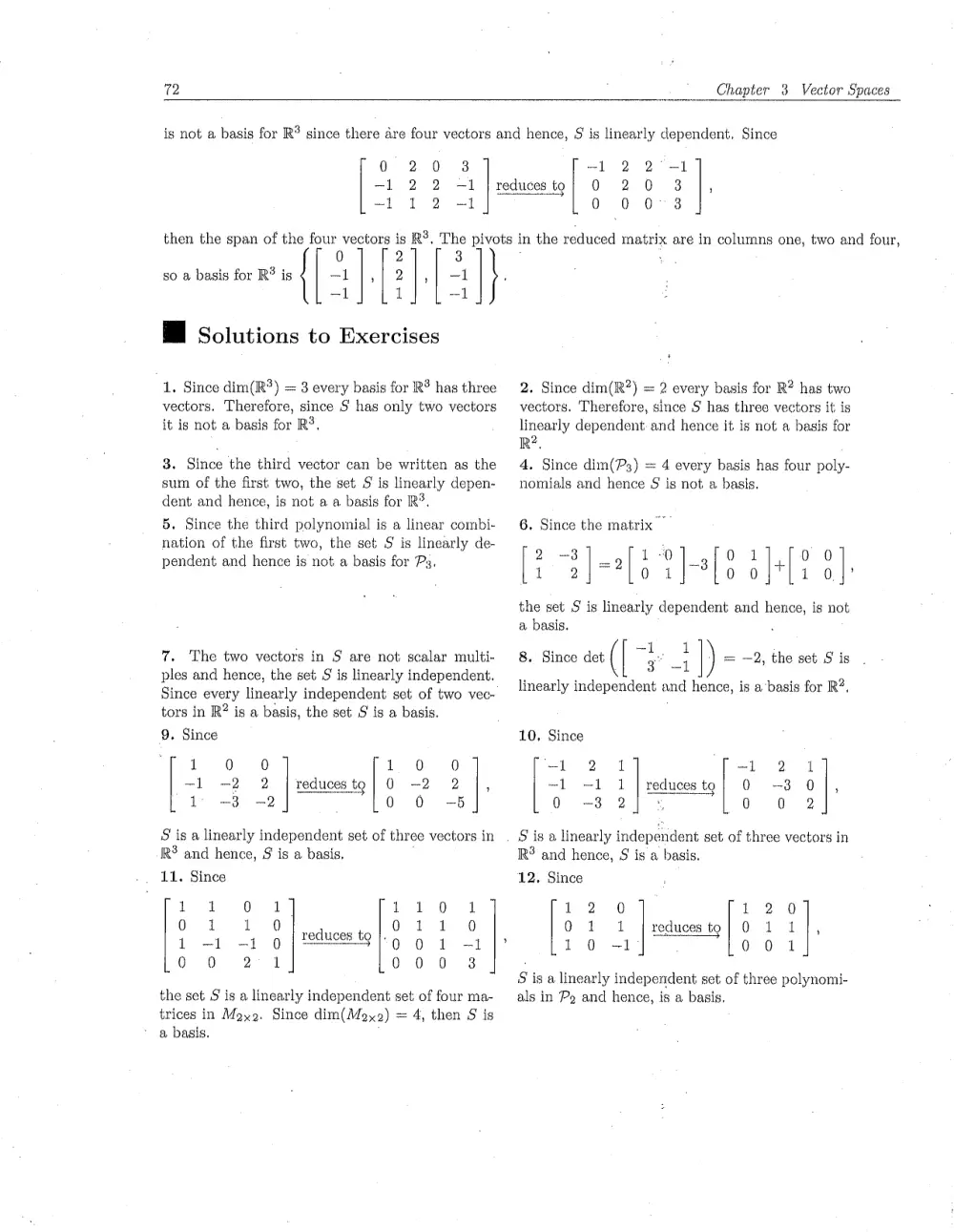
is not a basis for R® since there are four vectors and hence, S$ is linearly dependent. Since
2
reduces to | 0 ; , 3,
-1 2°-1
0 3
then the span of the four vectors is R°, The pivots in the reduced matrix are in columns one, two and four,
0 2 0 8
-1 2 2 -1
-1 12 -1
0 2 3
so a basis for R? is -1],/ 2 ],] -1
—1 1 —1
@ Solutions to Exercises
1. Since dim(IR*) = 3 every basis for IR® has three
vectors. Therefore, since S has only two vectors
it is not a basis for R®.
3. Since the third vector can be written as the
sum of the first two, the set S is linearly depen-
dent and hence, is not a a basis for R3.
5. Since the third polynomial is a linear combi-
nation of the first two, the set S is linearly de-
pendent and hence is not a basis for P3.
7. The two vectors in S$ are not scalar multi-
ples and hence, the set S is linearly independent.
Since every linearly independent set of two vec-
tors in R? is a basis, the set 9 is a basis,
9. Since
1 0 0 1 0 0
vl -2 2 reduces t 0 -2 2 ;
1 -3 -2 0 0 -5
S is a linearly independent set of three vectors in.
R3 and hence, $ is a basis.
11. Since
11 0 17 110 1
0 1 1 O07} cancer to! 2 : 1 0
1-1 -1 0 | SEP oo 1 Ht
00 2 1 000 8
the set S is a linearly independent set of four ma-
trices in Mgx2. Since dim(Me,y2) = 4, then S is
a basis.
‘
2. Since dim(R?) = 2 every basis for R? has two
vectors. Therefore, since S has three vectors it is
linearly dependent. and hence it is not a basis for
R?,
4, Since dim(P3) = 4 every basis has four poly-
nomials and hence S is not a basis.
6. Since the matrix —
2 -3 1-0 a} 0 1 0 0
[i a]=2[o a} e[o o][t ol]:
the set S is linearly dependent and hence, is not
a basis.
1.61
8. Since det (| 3° 4
}) = —2, the set S is
linearly independent and hence, is a’basis for IR,
10. Since
-1 2 1 ‘T-1 2 1
~Il -1 1 |reducesto}| 0 -3 0],
—— ——b
0 -3 2 y 0 0 2
S is a linearly independent set of three vectors in
R? and hence, S$ is a basis,
12, Since
1 2 0 1 2 0
01 41 reduces to} 0 1 1],
a
10 1° 0041
S is a linearly independent set of three polynomi-
als in Py and hence, is a basis.
3.3 Basis.and Dimension
73
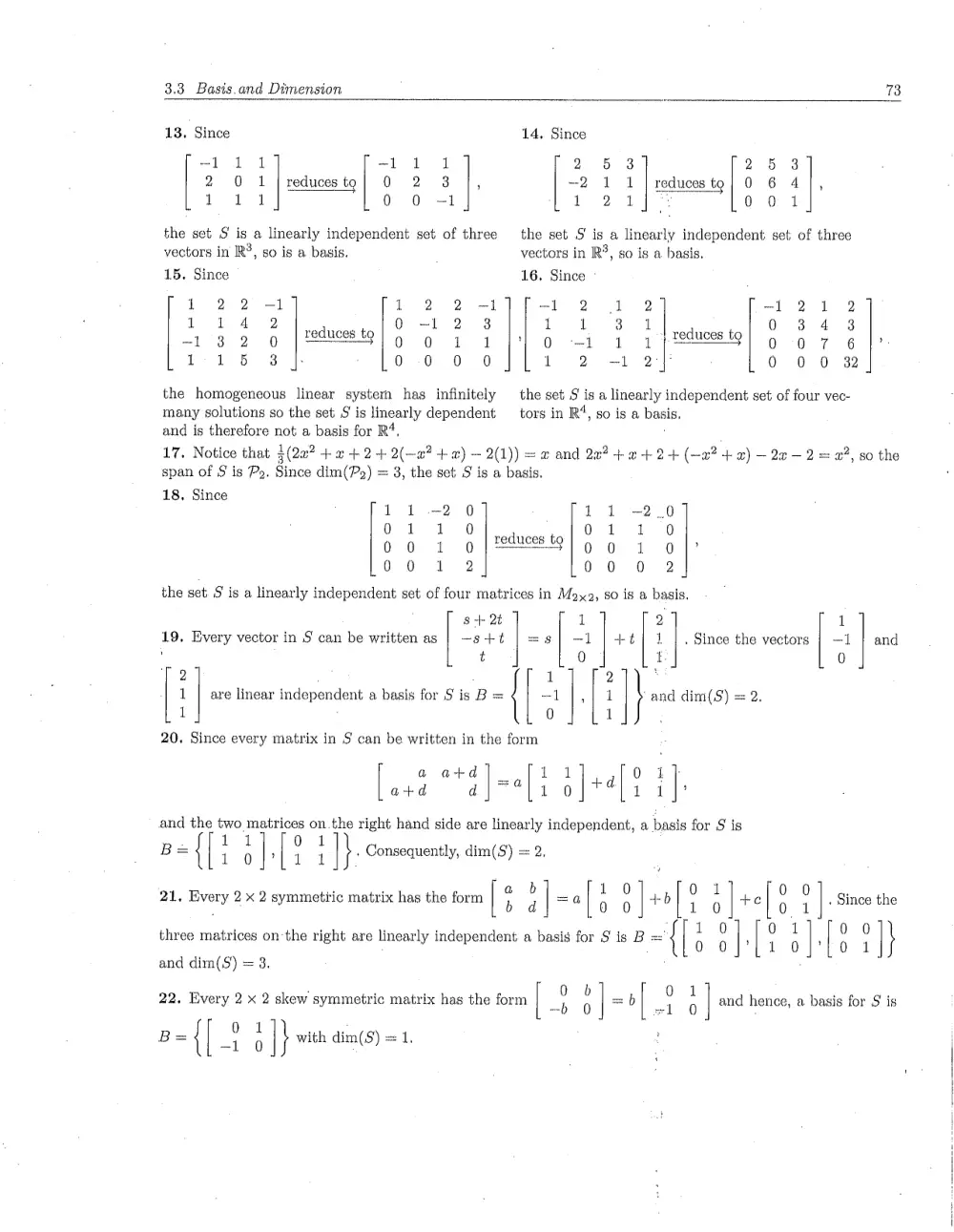
13, Since
-1 1 ii -l1 1 oi
2 0 1 reduces tg 0 2 8 ;
1 o1it 0 oOo -1
the set S' is a linearly independent set of three
vectors in R°, so is a basis.
15, Since
1 2 2 -1 1 2 2 -1
1 14 2 educes 0 -1 2 8
132 0 reduces ti 001 1
1-15 8 0 0 0 0
the homogeneous linear systern has infinitely
many solutions so the set S' is linearly dependent
and is therefore not a basis for R4.
14, Since
Dan
eR ow
|
the set 5 is a linearly independent set of three
vectors in R®, so is a basis,
16, Since
2 5 3 2
—2 1 1 | reduces tg | 0
121 - 0
-1 2 1 | -1 2 1 2
1 1 3 1 0 3 4 8
| go -1 1 1 pteduceste} 9 og 7 6 |
1 2 -1 2 | 0 0 0 32
the set $ is a linearly independent set of four vec-
tors in R4, so is a basis,
17, Notice that 4(2a° +2 + 2-+ 2(-a? + x) — 2(1)) =a and 2x? + @-+ 2+ (—a? + z) — 2a —2 = 2", so the
span of $ is Pz. Since dim(P2) = 3, the set S is a basis.
18, Since
11-2 0 1 1 -2.0
01 1 0} ances to} 2 2 1 9
oo 1 9 |Res too 1 0]?
00 1 2 090 0 2
the set. S is a linearly independent set of four matrices in Moy, so is a basis.
8+ 2t
—st+t
19, Every vector in S can be written as
' t
1 2 1
=s] —l | +t] 1 |. Since the vectors | —1 | and
0 ft. 0
2 1 2
1 | are linear independent a basis for S is B = -l | : 1 |
1 0 1
| and dim(S) = 2.
20, Since every matrix in S' can be written in the form
a+d d
cord).
11 01
al i 0) i]
and the two matrices on.the right hand side are linearly independent, a basis for S$ is
1 01 \
B= {| 10 , 11 |}: Consequently, dim(S')) = 2,
21, Every 2 x 2 symmetiic matrix has the form
and dim(S) = 3.
22. Every 2 x 2 skew symmetric matrix has the form
B= {| on \} with dim($) = 1.
a >}_ ft 0},,f9 1],,J0
b dl} ~*1o of F811 af tho
0
1
three matrices on-the right are linearly independent a basis for S is B =: { 1 , ,
antl
74
Chapter 3 Vector Spaces
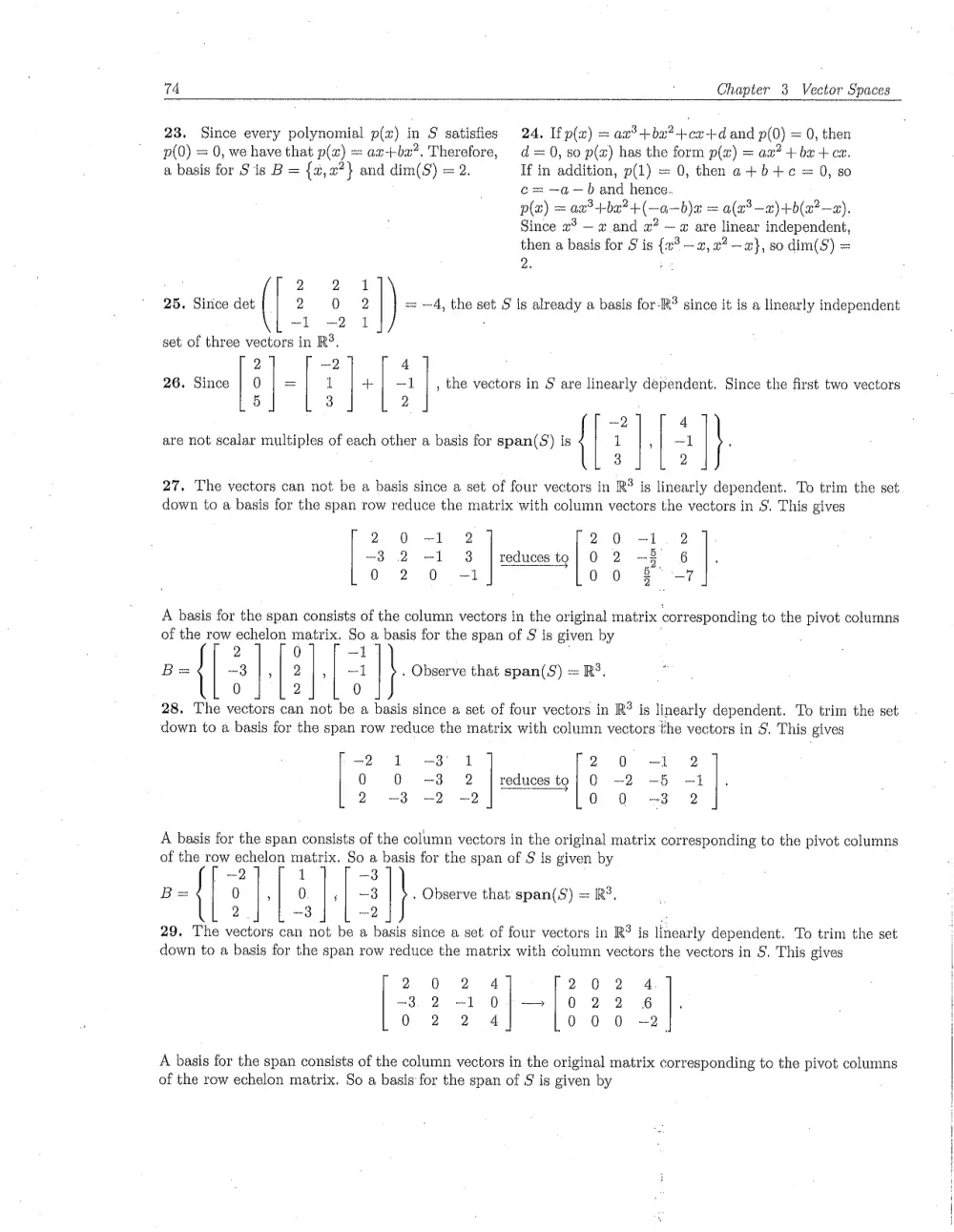
23. Since every polynomial p(x) in S satisfies
p(0) = 0, we have that p(x) = ax+ba?. Therefore,
a basis for Sis B = {%,2*} and dim(S) = 2.
24, If p(x) = av +ba?+cx+d and p(0) = 0, then
d = 0, so p(z) has the form p(x) = az? + ba + cx.
If in addition, p(1) = 0, then a+b+¢ = 0, so
¢= —a—b and hence.
p(t) = aa®+be?+(—a—b)x = a(e3—a)+b(a*—2),
Since 2° — a and x? — « are linear independent,
then a basis for S is {v3 ~ x, 2 —z}, so dim($) =
2.
2 2 1
25. Since det 2 0 2 = —4, the set $ is already a basis for-IR® since it is a linearly independent
~1 -2 1
set of three vectors in R%,
2 —2 4
26. Since | 0 | = L | +] —1 |, the vectors in S are linearly dependent. Since the first two vectors
5 3 2
—2 4 7
are not scalar multiples of each other a basis for span(S) is 1 },} -1
3 2
27, The vectors can not be a basis since a set, of four vectors in R® is linearly dependent, To trim the set
down to a basis for the span row reduce the matrix with column vectors the vectors in S. This gives
2 0 -1 2 20 -1 2
~3 2 -1 3 | reducestg| 0 2 — 8 6
0 2 0 =-1 00 2° -7 |
A basis for the span consists of the column vectors in the original matrix corresponding to the pivot columns
of the row echelon matrix. So a basis for the span of $' is given by :
2 0 —1
B= -31,/ 2],] -1 . Observe that span(.S) = R°.
0 2 0
28. The vectors can not be a basis since a set of four vectors in R® is linearly dependent. To trim the set
down to a basis for the span row reduce the matrix with column vectors the vectors in S$, This gives
—2 1 -3 1 2 0 -1 2
0 OO -3 2 | reduces to; 0 -2 -5 -1
2 -3 -2 -2 0 0 -8 2
A basis for the span consists of the column vectors in the original matrix corresponding to the pivot columns
of the row echelon matrix. So a basis for the span of $ is given by
—2 1 —3
B= Oo }|,] 0 |],} -8 . Observe that span(S) = R°,
2 —3 —2
29, The vectors can not be a basis since a set of four vectors in R? is linearly dependent. To trim the set
down to a basis for the span row reduce the matrix with column vectors the vectors in S$, This gives
20 2 4 202 4
-32 -1 0f/—]o022 6].
02 2 4 000 -2.
A basis for the span consists of the column vectors in the original matrix corresponding to the pivot columns
of the row echelon matrix. So a basis for the span of $' is given by
3.3 Basis and Dimension 75
2 0 4
B= -~3],/ 2],] 0 . Observe that span(S) = R°.
0 2 4
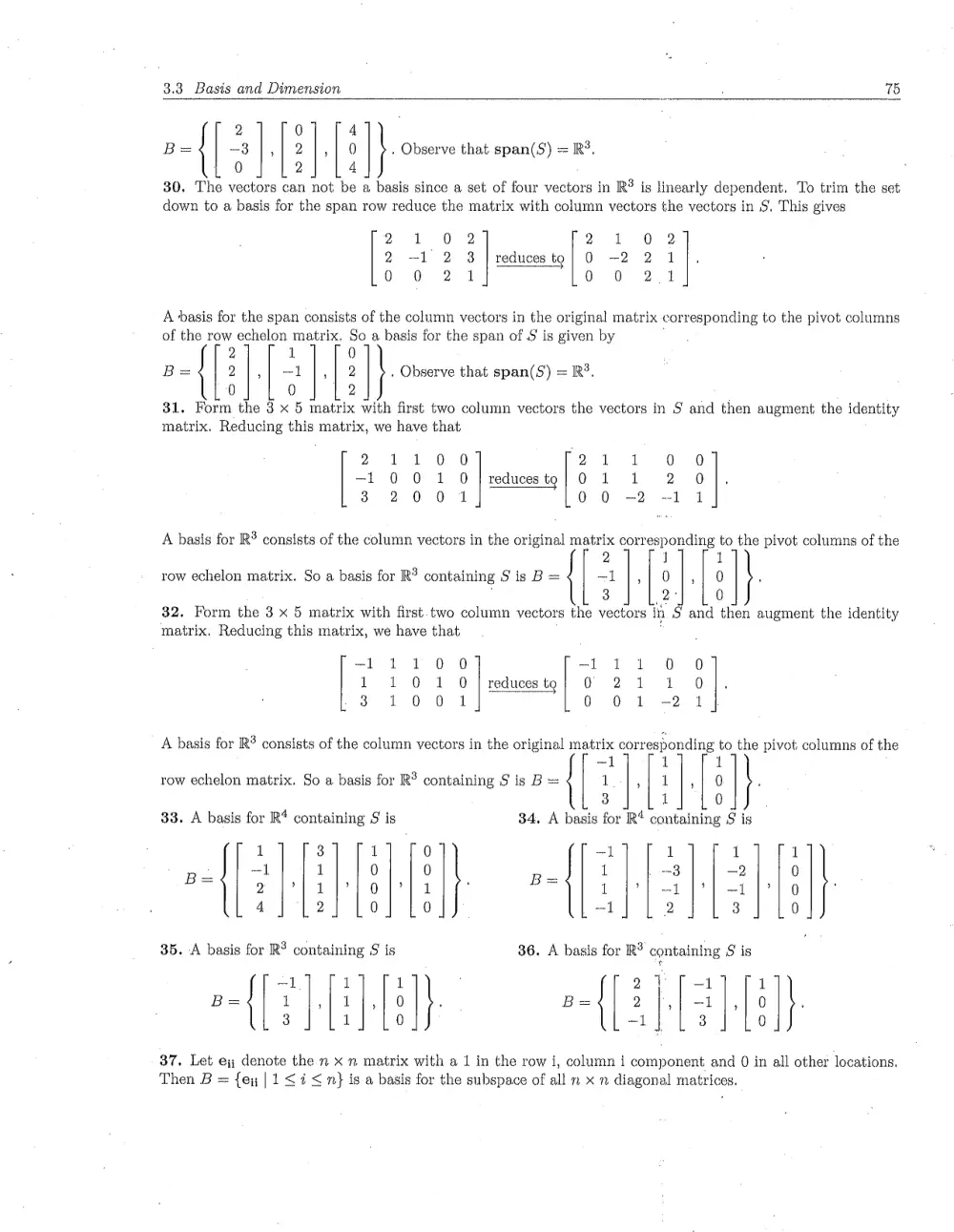
30. The vectors can not be a basis since a set of four vectors in R° is linearly dependent. To trim the set
down to a basis for the span row reduce the matrix with column vectors the vectors in S. This gives
2 1 £0 2 2 1 £0 2
2 ~1 2 38 | reduces tg 0 -2 2 1
0 0 21 0 0 2.1
A basis for the span consists of the column vectors in the original matrix corresponding to the pivot columns
of the row echelon matrix, So a basis for the span of S is given by
2 1 0
B= 2),/ -1],] 2 . Observe that span(S) = R°.
0 0 2
31, Form the 3 x 5 matrix with first two column vectors the vectors in S and then augment the identity
matrix. Reducing this matrix, we have that
21100 ‘21 1 0 0
—-1 0 0 1 O |} reducestg] 0 1 1 2 0
3.2001 00 -2 -1 1
A basis for R® consists of the column vectors in the original matrix corresponding to the pivot columns of the
2 ] 1
row echelon matrix. So a basis for IR® containing S$ is B = -~l},/ 07]7,] 0
: 3 2° 0
32. Form the 3 x 5 matrix with first.two column vectors the vectors ii S and then augment the identity
matrix. Reducing this matrix, we have that :
-l1 1 1°00 -1 11 0 0
1 1010 reduces tg 0 21 1 «0
3 1001 0 01 -2 1
A basis for R° consists of the column vectors in the original matrix corresponding to the pivot columns of the
—1 t 1
row echelon matrix. So a basis for R® containing S is B = 1 >| 1 ],} 0
3 1 0
33. A basis for R* containing 9 is 34, A basis for R4 containing 9 is
1 3 1 0 —1 1 1 fo
-J{-1 1 0 0 7 1 3 ~2 0
B=V) oo lela lelolela B=y) a jet ea fo] -1 fe] o
4 2 0 0 -1 2 3 L 0
35. -A basis for R® containing S is 36. A basis for R® containing 9 is
~1 1 1 ; 2 1 7 -1 1]
B= 1 },f1},fo 5. B= 2 },{ -1 },] 0
3 1 0 -1] [3 0 |
37, Let ey denote the n x n matrix with a 1 in the row i, column i component and 0 in all other locations.
Then B = {ey | 1 <4 <n} is a basis for the subspace of all n x n diagonal matrices.
76 Chapter 3 Vector Spaces
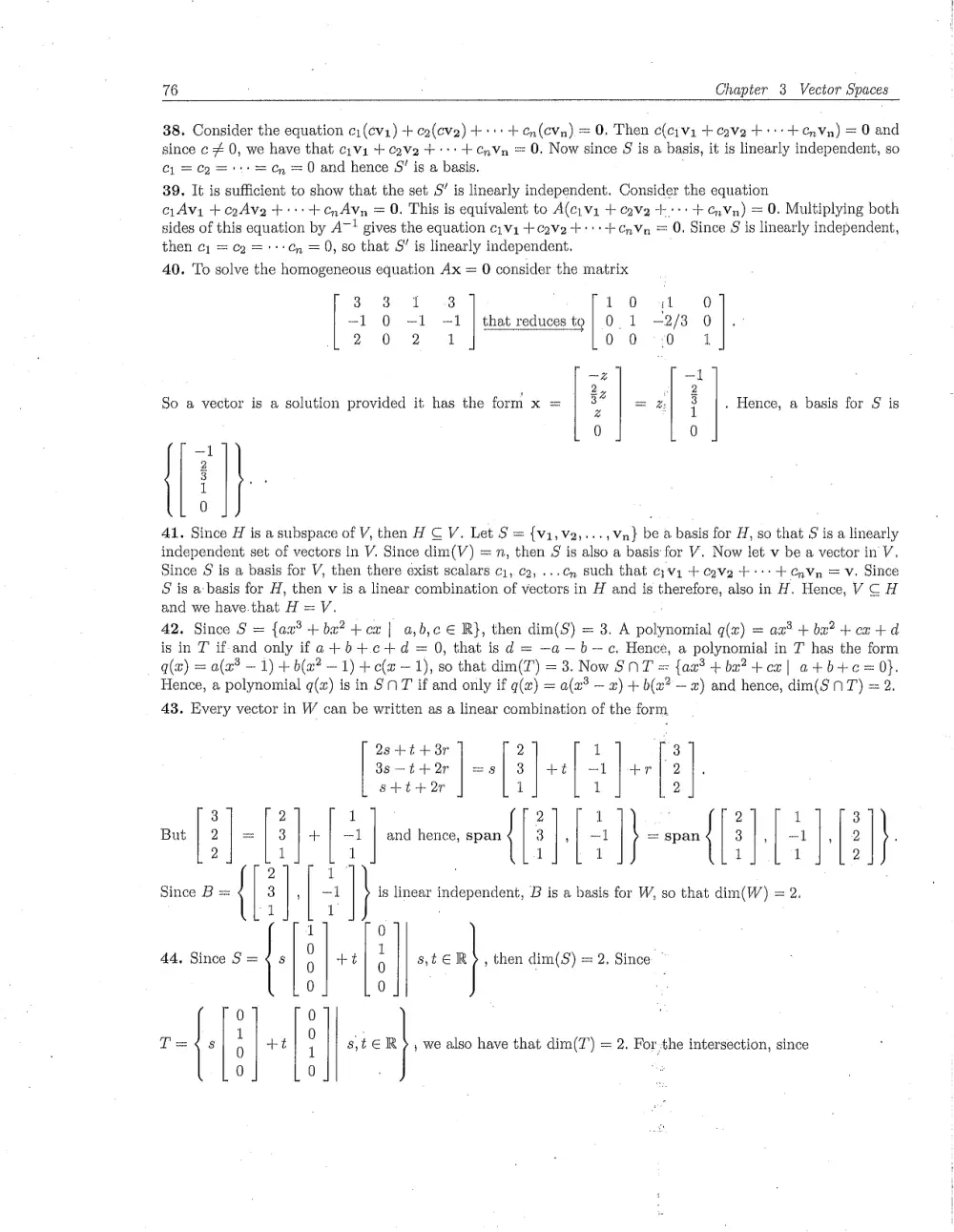
38, Consider the equation ¢1(¢v1) + ca(eva) ees + en(eVn) = 0. Then e(crvi + cove + +++ + CrVn) = 0 and
since c 4 0, we have that cyva + cove + +++ + Cnn = 0. Now since S is a basis, it is linearly independent, so
C1 = Cg = +++ = Cy, = 0 and hence S$" is a. basis.
39. It is sufficient to show that the set S” is linearly independent, Consider the equation
ca Avy + coAve +++) + CpAvn = 0. This is equivalent to A(crvi + c2V2 +e + + CnVn) = 0. Multiplying both
sides of this equation by A~ gives the equation civ1 +¢2v2+++++CnVn = 0. Since S is linearly independent,
then cy = C2 =+++C, = 0, so that 9" is linearly independent,
40. To solve the homogeneous equation Ax = 0 consider the matrix
38.3 ~=«S 3 1 0 il 0
-1 0 -1 1 | that reduces to} 0.1 2/3 0].
0 0
202 1 oO ot
~% -1
‘ 2 2
So a vector is a solution provided it has the form x = ° = 2: { . Hence, a basis for S$ is
0 0
-1
2
3
1
0
41. Since H is a subspace of V, then H CV. Let S = {vi,v2,..., Vn} be a basis for H, so that S' is a linearly
independent set of vectors in V. Since dim(V) = n, then S' is also a basis: for V. Now let v be a vector in'V,
Since $' is a basis for V, then there exist scalars cy, c2, ...Cy such that cyv_ + cove +++) + CnVn = V. Since
S is a-basis for H, then v is a linear combination of vectors in H and is therefore, also in H. Hence, V C H
and we have.that H = V.
42. Since S = {ax + ba? +cx | a,b,c € R}, then dim(S) = 3. A polynomial g(z) = ax* + ba? + ex +d
is in T if-and only ifa+b+e¢+d = 0, that isd = -a-—b—c. Hence, a polynomial in T has the form
q(x) = a(x® — 1) + b(a* — 1) + c(a — 1), so that dim(T) = 3. Now SNOT = {ax? + ba? +cx| a+b+c=0}.
Hence, a polynomial g(x) is in SMT if and only if q(x) = a(z3 — x) + b(a — x) and hence, dim($ MT) = 2.
43, Every vector in W can be written as a linear combination of the form
2s+t+3r 2 1 3
8s—t+2r | =s] 3 —lL ptr] 24.
1 | 2
+t
s+t+2r 1
3 ‘ 2 1 ‘ 2 1 3
But | 2 + and hence, span 3 1,] 1 = span 3 ],; -l ],] 2 .
2 1 1 1 1 2
u .
Since B = 3 is linear independent, B is a basis for W, so that dim(W) = 2.
° T
1 0
44, Since S$ = s|° +t 4 s,t ER >, then dim(S) = 2. Since
0 0
0 0
T= s , +t I s,t € R }, we also have that dim(TZ') = 2. For-the intersection, since
0 0