
MATH 218 Problems Solution Manual Chapter 3.4, Fall 2011
American University of Beirut · Elementary Linear Algebra with Applications · 5 pages · with solution
More MATH 218 files
- Problems Solution Chapter 6.1 · Spring 2012Chapter · with solutionView
- Homework Chapter 8 · Fall 2012ChapterView
- Chapter Summary · Fall 2011ChapterView
- Problems Solution Manual Chapter 1.5 · Fall 2011Chapter · with solutionView
- Problems Solution Manual Chapter 1.2 · Fall 2011Chapter · with solutionView
- Problems Solution Manual Chapter 1.4 · Fall 2011Chapter · with solutionView
- Problems Solution Manual Chapter 1.1 · Fall 2011Chapter · with solutionView
- Problems Solution Manual Chapter 1.3 · Fall 2011Chapter · with solutionView
Show the text of this chapter
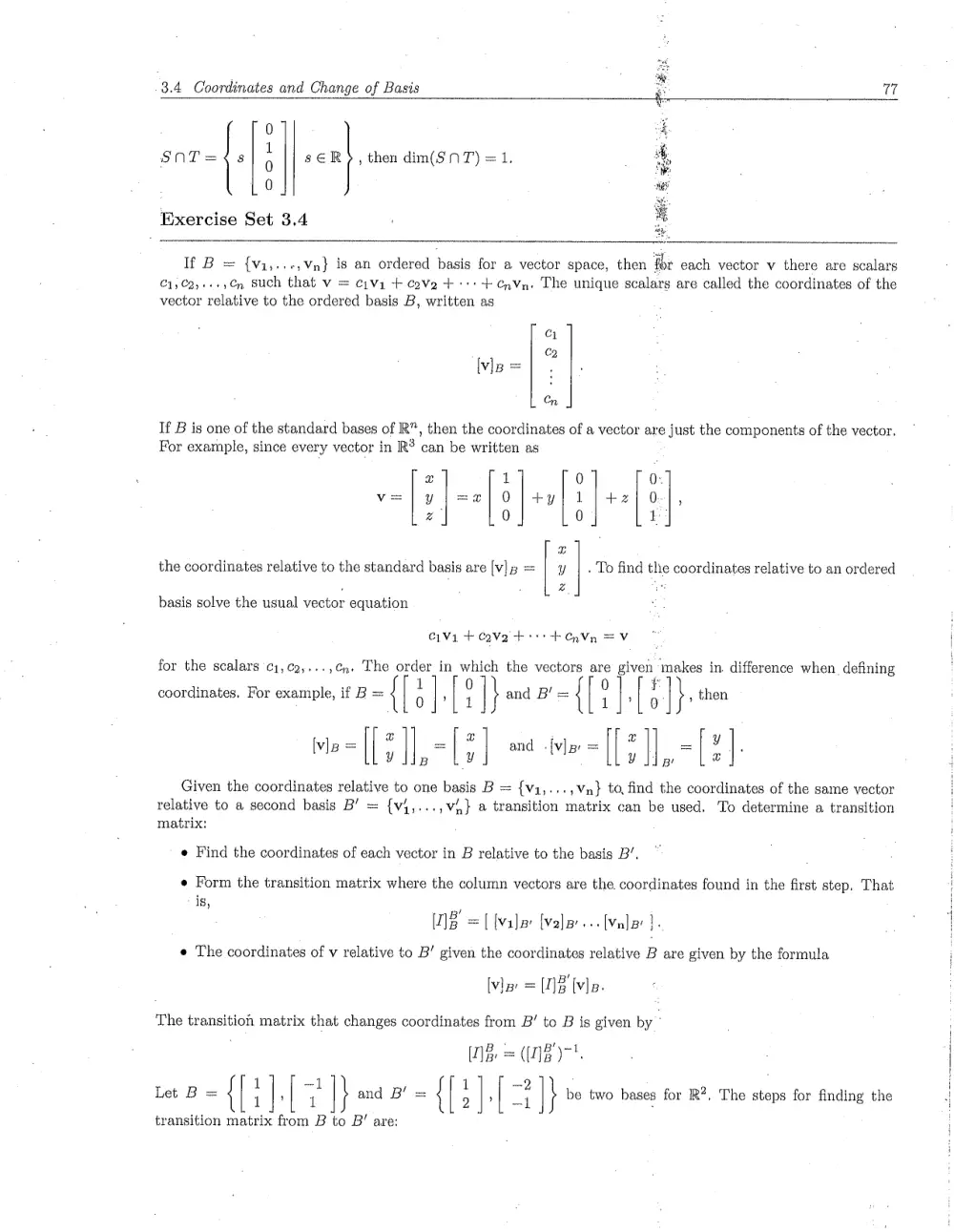
3.4 Coordinates and Change of Basis Pe 77
sé€R>, then dim(SNT) =1,
cooreo
Exercise Set 3.4
If B = {vi,..+,Vn} is an ordered basis for a vector space, then for each vector v there are scalars
€1,C2,+++,Cn Such that v = e1vi + cove +++++CnVn. The unique scalars are called the coordinates of the
vector relative to the ordered basis B, written as
If B is one of the standard bases of R”, then the coordinates of a vector are just the components of the vector.
For example, since every vector in R® can be written as
Fy 1 0 0:
v=|]y}=2}]O0]+y}] 1] +2] 0-],
zo 0 0 L
x
the coordinates relative to the standard basis are [v]z = | y | . To find the coordinates relative to an ordered
. z a
basis solve the usual vector equation
evi + cava te + CnVn = V
for the scalars cj, ¢2,...,@,. The order in which the vectors are given makes in. difference when defining
coordinates. For example, if B = {| 4 ) , |} and B! = { ’ ; I} , then
ne= (3 ]h [8] === [[s]le-L]
Given the coordinates relative to one basis B = {v1,...,Vn} to, find the coordinates of the same vector
relative to a second basis B’ = {v4,...,v,} a transition matrix can be used. To determine a transition
matrix:
e Find the coordinates of each vector in B relative to the basis B’,
¢ Form the transition matrix where the column vectors are the. coordinates found in the first step. That
is,
WB = [ (valor [vale [vn]ar }
¢ The coordinates of v relative to B’ given the coordinates relative B are given by the formula
vie = (18 ve.
The transition matrix that changes coordinates from B’ to B is given by .
(NB = (1B).
Let B= {| ; , 7 |} and B’ = {| ; a _ |} be two bases for R?, The steps for finding the
transition matrix from B to B’ are:
78 : Chapter .3 Vector Spaces
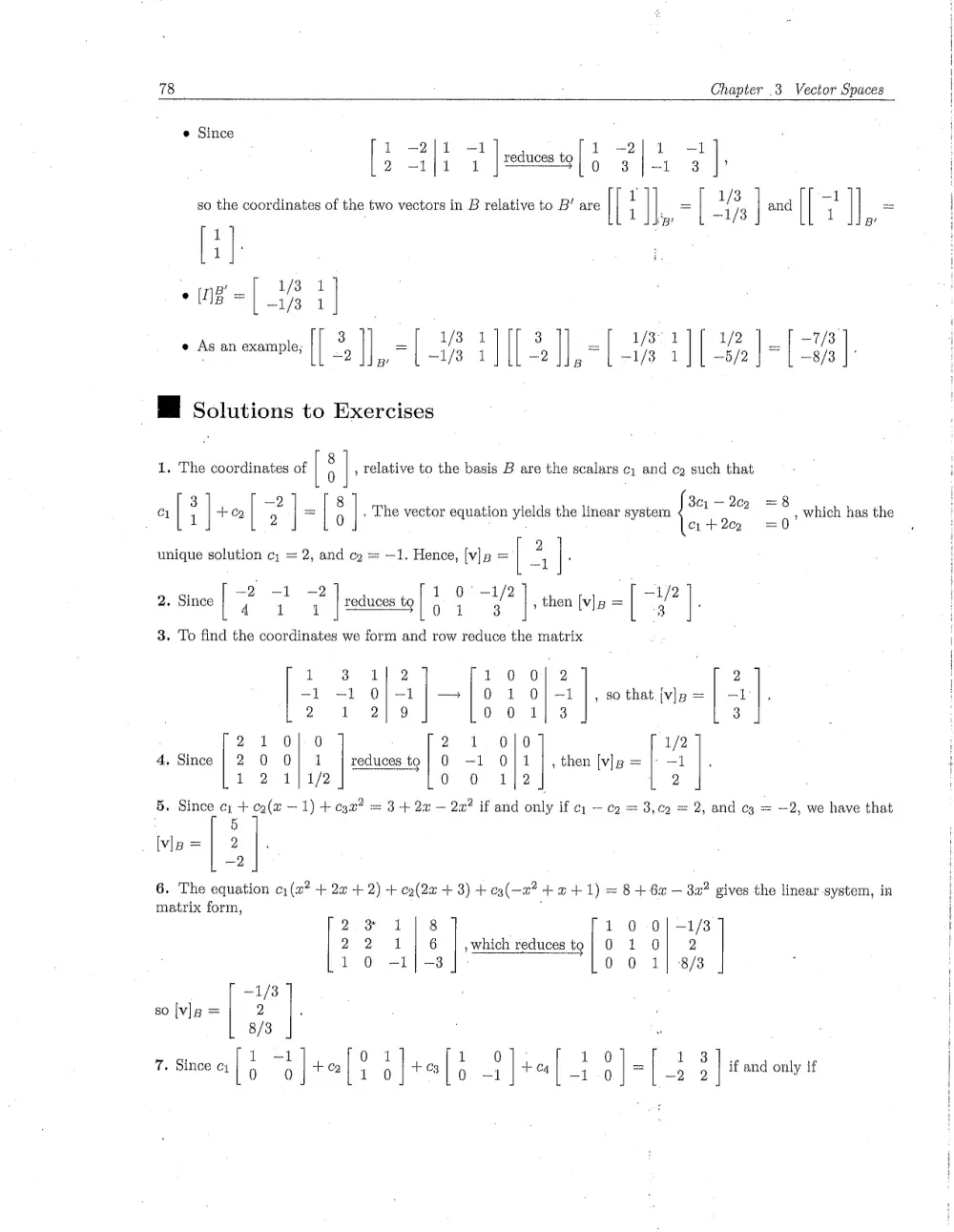
e Since
1-2/1 -1] sancestol 2 ~2/ 2 2
2 -t}1 1 [PME QO 3g fer 3?
so the coordinates of the two vectors in B relative to B’ are I = 1/3 and “t =
Lj ity —1/3 1 B
[7] :
vn'=| tis 3 |
stool D)= [28 HILT [48 TLR] E58]
Mi Solutions to Exercises
1. The coordinates of ; , Telative to the basis B are the scalars c; and cz such that
C1 3 + C2 ~ = 8 . The vector equation yields the linear system Ser 2en, = 8 , which has the
1 2 0 : c+2ce, =0
unique solution c; = 2, and cg = —1. Hence, [v]g = a .
. f -2 -l -2 apf 10° -1/2 : _f -1/2
2. Since 4 1 1 reduces tc 041 3 , then [v]z = 3 .
3. To find the coordinates we form and row reduce the matrix
1 38 1} 2 1 0 O} 2 2
-1 -1 0O;/-1}—]0 1 0]-1 |, sothat.jvjp= | -1 |].
2 1 2) 9 0 0 1) 3 3
2 1 0] 0 2 1 oo 1/2
4, Since | 2 0 0] 1 | reducesto] 0 -1 0/1 |, then [vJg=] —-1 |.
1 2 1); 1/2 001 | 2
5. Since cy + cg(@ — 1) + cgu* = 3 + 2a — Qu? if and only if cy — cg = 3,c2 = 2, and cg = —2, we have that
5
VJe= |} 2
2
6. The equation cy (a? + 2a + 2) + c2(2a + 8) + ¢3(—a? + a + 1) = 8+ 60 — 32? gives the linear system, in
matrix form, ‘
2 3 1 | 8 1 0.0] -1/3
22 1 6 | , which reduces tg] 0 1 0 2
1 0 ~1]-38 0 0 14} 8/3
[|
so [v]g = 2 :
8/3
. 1 -1 0 1 1 : 1 0 1 up vp
7. since «| 9 o|ta[t oftele frei a 0 |=[-2 2 | Hand only
3.4 Coordinates and Change of Basis 79
a +eg+eq =1
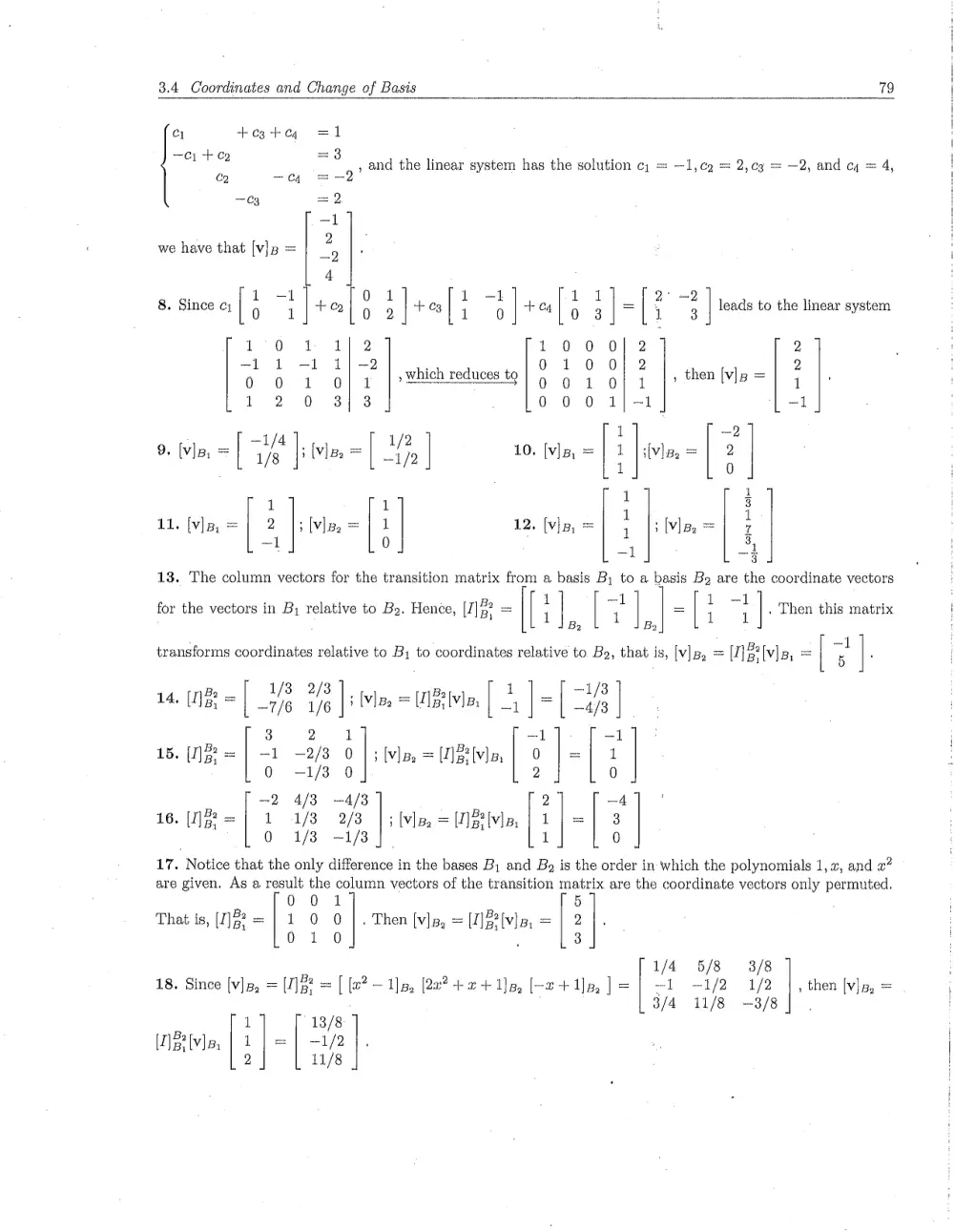
~e1 + ee =8 2? and the linear system has the solution c, = —1,cyg = 2,cz = —2, and cq = 4,
C2. —~Ch =o
C3 =
—14
2 .
we have that [v]p = _9 |:
4 ot
+ 1-1 fo 1 1-1], f14
8. since e1| 9 i}+e] 9 rita t a |te[o 3|- [i 5 | leds to the tinar system
1 0 4 1] 2 10 0 Of] 2 2
-1 1 -1 Ij -2 0 10 OF 2 2
0 0 1 ol4 , which reduces to 0010 7 , then [v]p = 1
1 2 0 3); 8 000 1)-— -1
9. [vy] U4 (vie 1/2 10. [v] ly
+ (VJB, 4 2] + |ViB, = lv
1/8 1/2 :
1 1 ; 7
11. [v]B, = 2 ; lv]. = 1 12, [va = 1 sv] B, = Z
—1 0 4 3,
13. The column vectors for the transition matrix from a basis By to a basis By are the coordinate vectors
for the vectors in By relative to Bg. Hence, WR = [ : 7 = ; ; ‘ . Then this matrix
Bz By
transforms coordinates relative to B; to coordinates relative to Bg, that is, [v]s, = [I] 2? BV], = =| ; .
14. n= [18 8 ] solos = nBeotes | 2, |= [ 48 |
3 2 1 ~1 -1
15, [12 = | -1 -2/3 | v= a | 0 |-| 1 |
0 -1/3 0 2 0
—2 4/3 —4/3 2° —4
16. [p= | 1 1/3 2/8 | i = tj=] 8
0 1/38 ~1/3 1 0
17. Notice that the only difference in the bases B, and Bo is the order in which the polynomials 1, a, and a?
are given, As a result the column vectors of the transition matrix are the coordinate vectors only permuted.
00 1 5
That is, [Ug = | 1 9 0 |. Then [vja, = [Z]p%Ivla, = | 2 | -
010 ; 3
18. Since [v]a, = [Z| 5) = [ (2? — 1a, (22? ++ 1]a [-2 +1] | =
1 13/8
(elvis, | 1 = | ~1/2 | ;
2 11/8
| 1/4 5/8 3/8 |
-1 ~-1/2 1/2 |, then [v}p, =
3/4 11/8 -3/8
80
Chapter 3 Vector Spaces
ee
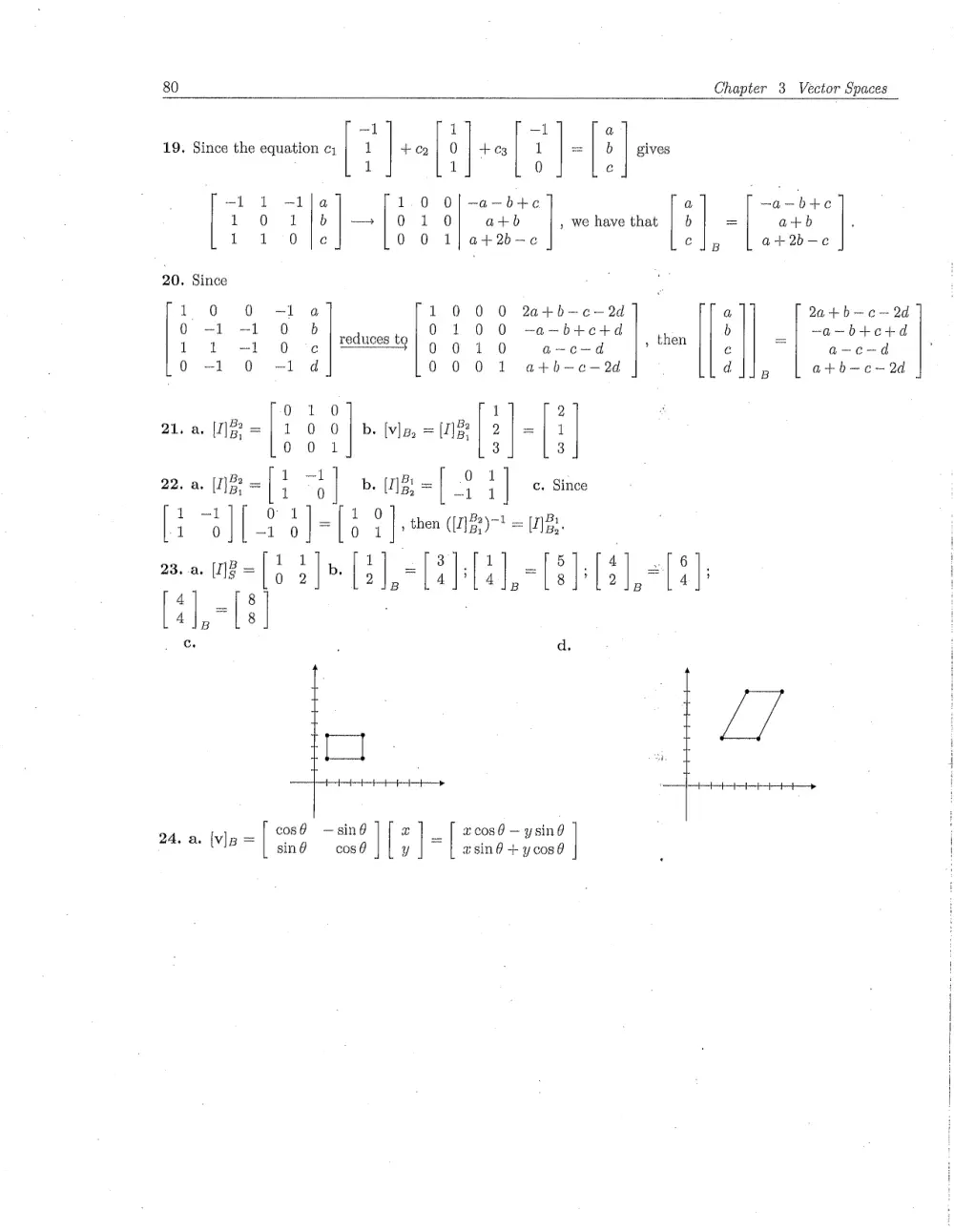
-1 1 -lia 1.0 O0|-a-—b+e a
1 0 t]/b}—}]0 1 0 a+b , we have that | b
1 1 Ofe 0 0 1) a+2b-c¢ e
20. Since
1 0 0 -1l a 100 0 2a+b-—c-2d
0 -1 -1 0 0b jl ‘ 0 10 0 -a-b+e+d the
11 -1 0c |S) 9 0 10 aed » en
0 -1 0 -1 ad 000 1 a+b-c-2d
0 0 1 2
ant [! 0 ° | ose 2] =[]
aaa. B=[1 ~o] > W=[_2 {| since
[i olf of=[o 2] me cng = ing.
oomt-(2 3 [],-EHEEL “Uh hel
elio[s!
c d,
—sind
cos 6
cos 6
24, a. [v]p = cos _ xcosd — ysin#@
asind + ycosé
Iti
—a-b+e
= a+b
B a+22%b—-—e
a 2a+b-—c—2d
b _ | -a-b+e+d
c ~ a-c-d
d at+b—c~2d
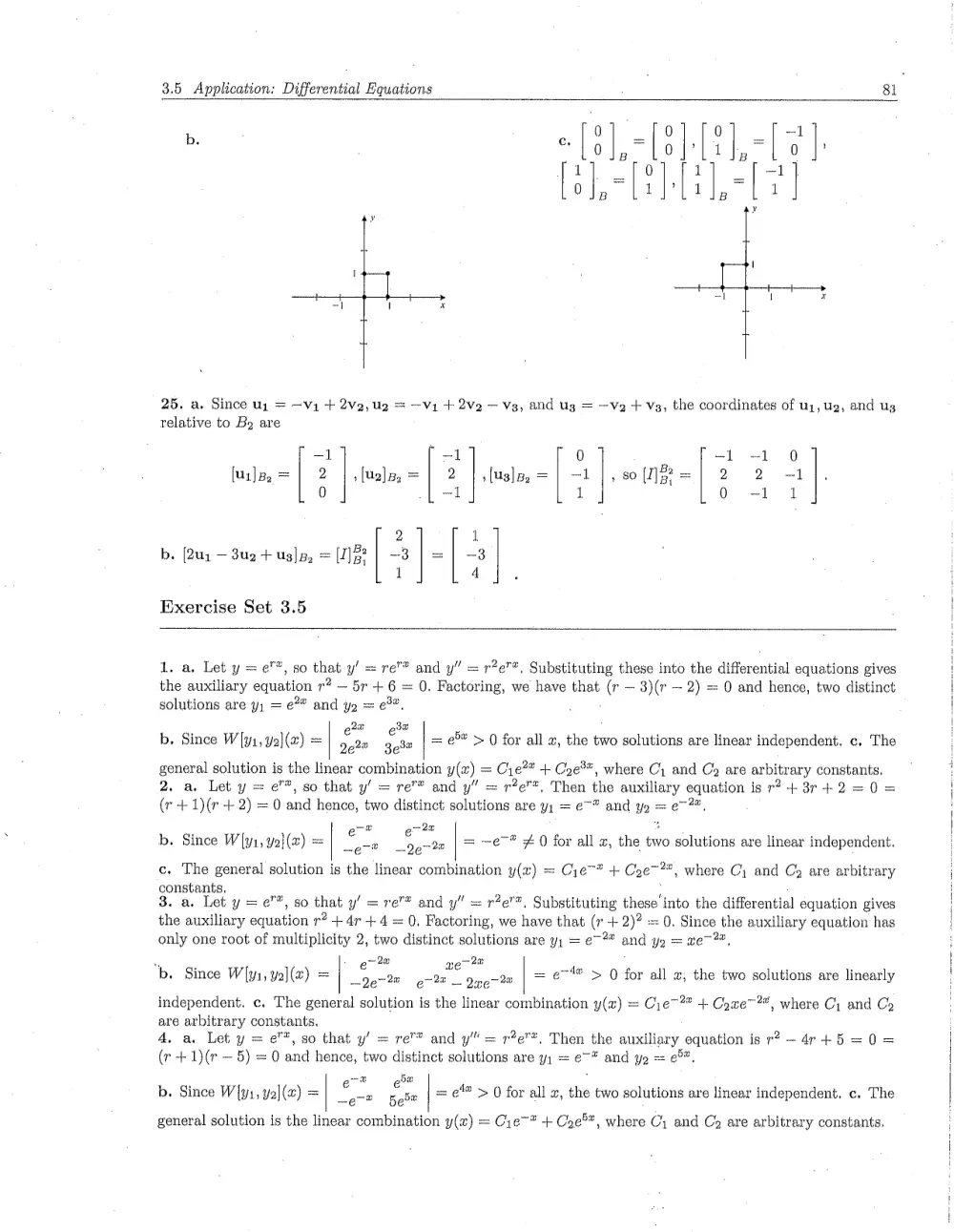
3.5 Application: Differential Equations . 81
25. a. Since uy = ~v4 + 2v2, Ug = ~v1 + 2v2 — vg, and ug = —v2 + vs, the coordinates of uz, ug, and ug
relative to Bg are
-1 f 1 0 -1 -1 0
luije,=| 2 | lula, =| 2 |,[usle =| -1 |, so (f= | 2 2 1
0 -1 1 0 -1 1
2 1
b, [Quy — 3ug+ ug] By = (3? -3 |=] -3
1 4
Exercise Set 3.5
1. a, Let y =e", so that y/ = re" and y” = r2e"®, Substituting these into the differential equations gives
the auxiliary equation r? — 5r + 6 = 0. Factoring, we have that (r — 3)(r — 2) = 0 and hence, two distinct
solutions are y; = e?” and yg = e°*,
ert et
b. Since W[y1, ye] (a) = get” Zee | = e®* > 0 for all x, the two solutions are linear independent. ¢. The
general solution is the linear combination y(x) = Cye?® + Cye**, where Cy and Co are arbitrary constants.
2. a. Let y = e"®, so that y! = re’ and y"” = r?e", Then the auxiliary equation is r? + 3r+2=0=
(r + 1)(r + 2) = 0 and hence, two distinct solutions are y, = e~* and yo = e7?",
en? en 2 3
—e7® = —Qe72#
c. The general solution is the linear combination y(x) = Cye™* + Cge7", where C; and Cy are arbitrary
constants, :
3. a. Let y = e”, so that y/ = re" and y” = re", Substituting these into the differential equation gives
the auxiliary equation r? + 4r +4 = 0, Factoring, we have that (7 +2)? = 0. Since the auxiliary equation has
only one root of multiplicity 2, two distinct solutions are y;, = e7?* and yo = we7?",
b. Since W[y1, yo} (a) = = ~e~* #0 for all x, the two solutions are linear independent.
. + ew de wen 2
b. Since Wly1, y2](2) = —2e72% er 28 _. Omen 2e
independent. c. The general solution is the linear combination y(a) = Ce7?" + Coxe7?", where Ci and C2
are arbitrary constants,
4. a. Let y = e", so that y’ = re" and y= re", Then the auxiliary equation is r? — 4r +5 = 0 =
(r +1)(r — 5) = 0 and hence, two distinct solutions are y, = e~* and yg =: e5*,
. ene edt
b. Since W[y1, ya](z) = —en® Bede
general solution is the linear combination y(z) = Cie~* + Ce", where C1 and C2 are arbitrary constants.
= e~4@ > 0 for all x; the two solutions are linearly
Mi
=e > 0 for all a, the two solutions are linear independent. c, The
|
|