
MATH 218 Problems Solution Manual Chapter 4.1, Fall 2011
American University of Beirut · Elementary Linear Algebra with Applications · 6 pages · with solution


More MATH 218 files
- Problems Solution Chapter 6.1 · Spring 2012Chapter · with solutionView
- Homework Chapter 8 · Fall 2012ChapterView
- Chapter Summary · Fall 2011ChapterView
- Problems Solution Manual Chapter 1.5 · Fall 2011Chapter · with solutionView
- Problems Solution Manual Chapter 1.2 · Fall 2011Chapter · with solutionView
- Problems Solution Manual Chapter 1.4 · Fall 2011Chapter · with solutionView
- Problems Solution Manual Chapter 1.1 · Fall 2011Chapter · with solutionView
- Problems Solution Manual Chapter 1.3 · Fall 2011Chapter · with solutionView
Show the text of this chapter
88 Chapter 4 Linear Transformations
4 Linear Transformations
Exercise Set 4.1
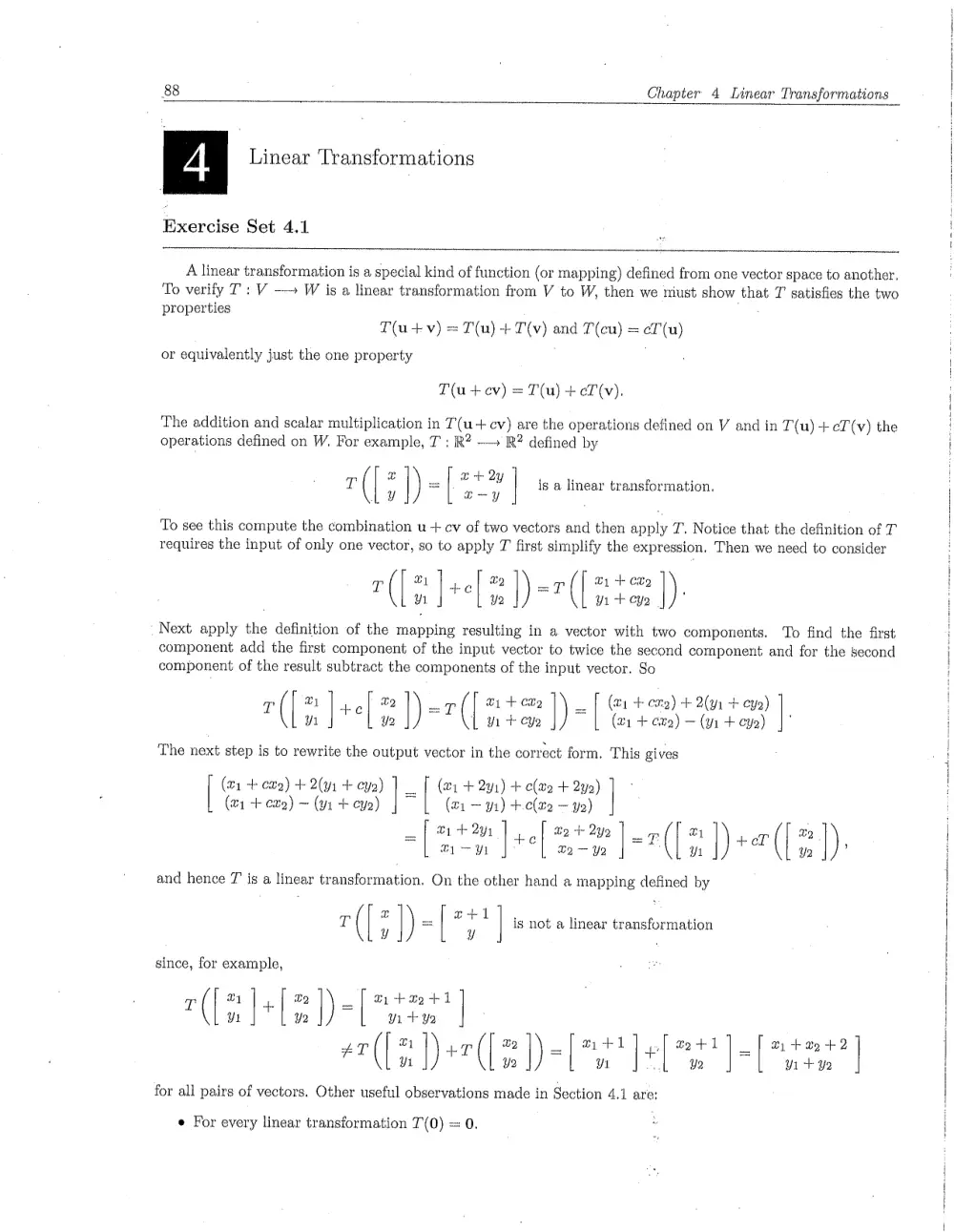
A linear transformation is a special kind of function (or mapping) defined from one vector space to another,
To verify T: V —» W is a linear transformation from V to W, then we miust show that T satisfies the two
properties :
T(ut+v) = T(u)+T(v) and T(cu) = eT (u)
or equivalently just the one property
T(u+ev) =T(u) +cT(v).
The addition and scalar multiplication in T(u+ cv) are the operations defined on V and in T(u) + cT(v) the
operations defined on W. For example, T : R? > R? defined by
T (| ° }) = wry | is a linear transformation,
Ly zy ;
To see this compute the combination u + ev of two vectors and then apply T. Notice that the definition of T
requires the input of only one vector, so to apply T first simplify the expression, Then we need to consider
(Ln }+ele ))-7([aae ).
Next apply the definition of the mapping resulting in a vector with two components, To find the first
component add the first component of the input vector to twice the second component and for the second
component of the result subtract the components of the input vector. So
r([3 Jee[ 2 J)=r([ te ])=[ ett ae tae |.
The next step is to rewrite the output vector in the correct form, This gives
(a1 + cae) + 2(y + cya) _ (v1 + 2y1) + ¢(a2 + 242)
(1 + e%2) — (yr + eye) | ~ | (#1 — 91) +.e(a2 — ye)
[2% ees] (3 )-e(a))
ty —Y © — Y2 Yn Ya
and hence T is a linear transformation. On the other hand a mapping defined by
T (| , }) = ° ; | is not a linear transformation
since, for example,
By x ay +ag+)
T =
(| Yi J+[ 2 \) yi + yo
wy Be a+ we+1 @ +2242
T T = ' =
# (| VA ))+ (| Yo }) YI Fal Ya Yi + Yo |
for all pairs of vectors, Other useful observations made in Section 4.1 are:
e For every linear transformation T(0) = 0.
|
|
|
1
4.1 Linear Transformations 89
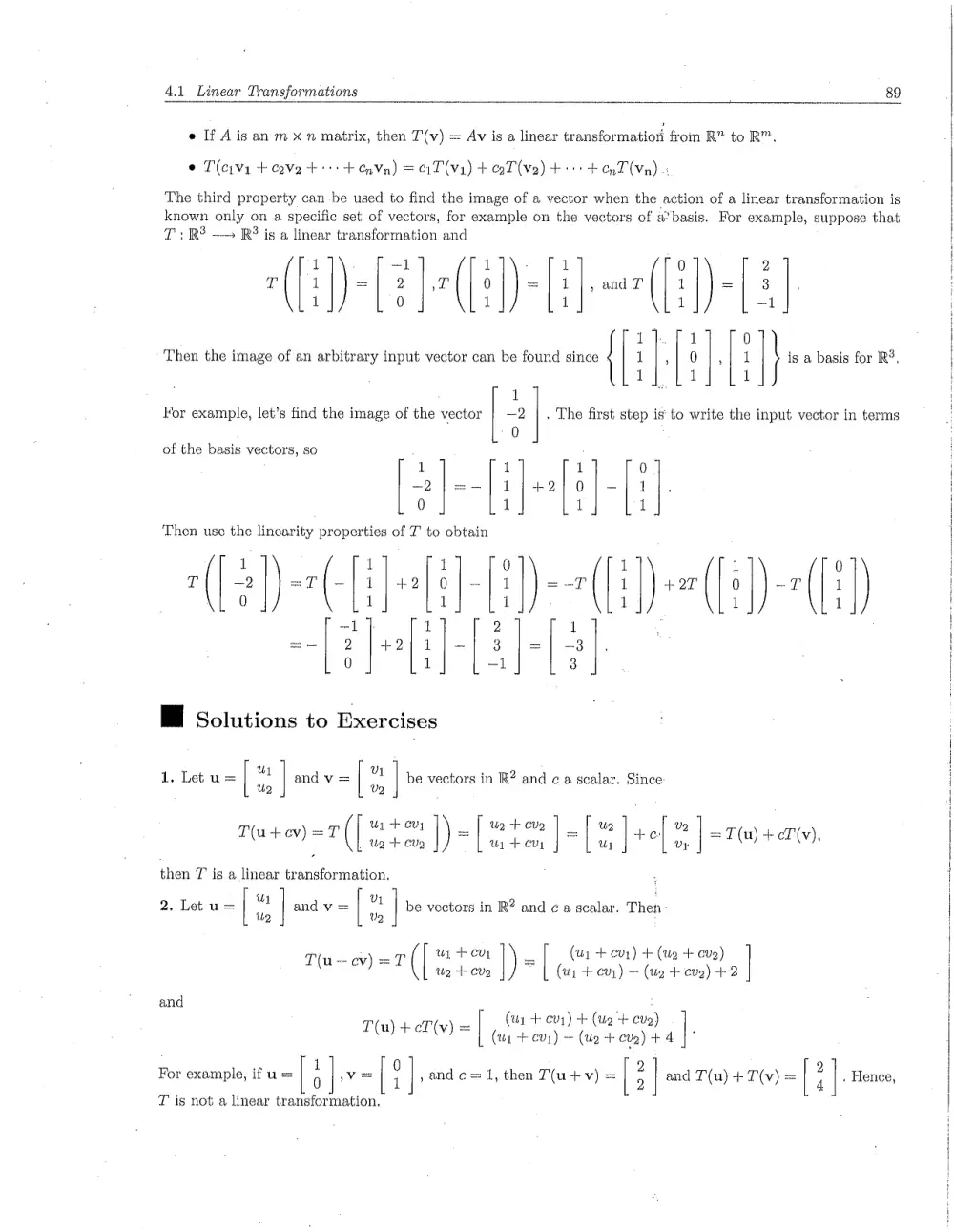
e If Ais an m x n matrix, then T'(v) = Av is a linear transformatiod from R” to R™.
© Teva + c2V9 +++) + eaVn) = rT (v1) + eT (v2) Fe + nT (Wn) +
The third property can be used to find the image of a vector when the action of a linear transformation is
known only on a specific set of vectors, for example on the vectors of «basis. For example, suppose that
T :R® — R? is a linear transformation and
1 : 1 0
0 1}, andT 1
1 1 1
0
1
1
i
(LN) -Lele(
1}. 7 i
Then the image of an arbitrary input vector can be found since | 1 | , | 0 | : . is a basis for R°.
1 1
,
For example, let’s find the image of the vector | — . The first step is to write the input vector in terms
lett
“EPC (l€
EEE}
MI Solutions to Exercises
| Us V1 b . 2 Hs
1. Let u= un and v = 9 be vectors in R* and ¢ a scalar. Since
_ ur + cry | Uatev, |_| ue |} ve | L
Murer) =7([ yor )-[ere]-[2] rel | =7(0); Pv),
then T is a linear transformation,
of the basis vectors, so
(
ow
2, Let u= a and v = be be vectors in R? and ca scalar. Then
7 uy + cur _ (uy + cv) + (u2 + cv)
Tu+ ev) =T (| ug + ev ) ~ (uy + cuz) — (ue + ev9) +2
and
(uy + ev) + (aug + cv)
wy + cul) ~ (ua + evg) +4 J
T(u) + cT(v) = (
©
For example, if u = i ve ; ,ande= 1, then T(u+v) = ; and T(u) + T(v) = ‘ . Hence,
T is not a linear transformation,
Chapter 4 Linear Transformations
90
U1 Uy . 2a
3. Let u= and v = be vectors in IR*, Since
U2 Cp)
_ Uy + U4 _ U1 + U4 Urb | _
Tutv)=T (| Ug + v2 ) ~ ud + 2ugve + v3 and ug +03 P(u) +T(v),
which do not agree for all vectors, T is not a linear transformation.
4, Since
_ U1 V1 —r{|™ + ev, uy + cv) — (ug + eve)
T(ut ev) =r(| ug te v9 )) = (| Un, + eve \)- (2 uy + cv4 + 3(ug + ev2)
and 2 :
T(u) + cL (v) = ut Sue +¢
then T is a linear transformation,
a Ul ,| U4 _ | Uy tev
5. since 2(| |e] 3 ]) =| 0
scalars c, T is a linear transformation.
6. Since
T(u+cv) =T tin + cv
then T is a linear transformation.
7. Since T(a+y) =
8. Since T describes a straight line passing
through the origin, then T defines a linear trans-
formation,
10. Since T is the identity mapping on the first
two coordinates, then T is a linear transforma-
tion.
Qu, — v2 2(w1 + v1) ~ (ue + cvg)
v1 + 8v2 1 + ev + 3(tu2 + eve) ,
r(| a }) +c ([¢: ae }) , for all pairs of vectors and
(ute })- | (uxkoun)-+(ue-tov2)
aus tev) t(ua-teve) | = T(u) + cT(v),
2
T(x) +T(y), if and only if at least one of z or y is zero, T is not a linear transformation.
9. Since T (| ; }) = (a? + y®) =
(7)
= e(u? + y?) if and only if ¢ = 1 or
; * |= 0 , is not a linear transformation.
y 0
11. Since T(0) # 0, T is not a linear transforma-
tion.
12, Since cos0 = 1, then T(0) 4 0 and hence, T is not a linear transformation,
‘
13, Since
T (p(x) + 4(2)) = 2(p"(a) +q"(2)) —
= (2p!"(a) ~ 8p'(x) + p(x)) 4
3(p'(x) + a'(
2)) + (p(x) + 4(2))
b (24!) ~ 3q'(w) + q(e)) = T(p(2)) + T(q(a))
and similarly, T(cpl2)) = cT'(p(«)) for all scalars c, T is a linear transformation.
14, Since T(p (2) +4(x)) = p(x) +9(x)+a and T(p(x))+T(q(x)) = p(x )+9(x) +22 these will not always agree
and hence, T is not a linear transformation. Also T(0) = x and hence thé zero polynomial is not mapped to
the zero polynomial.
15, If A is a 2 x 2 matrix, then det(cA) =
c? det(A), then for example, if = 2 and det t(A) 4 0, we have that
T(2A) = 4T(A) ¢ 2T(A) and hence, T is not a linear transformation.
16, Since T(A+ cB) =
transformation.
A+cB+(A+cB)! = A+cB+ Ab + cB =T(A)
) + cT(B), then T is a linear
17. a T(u) = a Tv) = [= b. Tury)=T( : ) = , =T(u) +7 (v)
c. The mapping T is a linear transformation,
¢
4.1 Linear Transformations 91
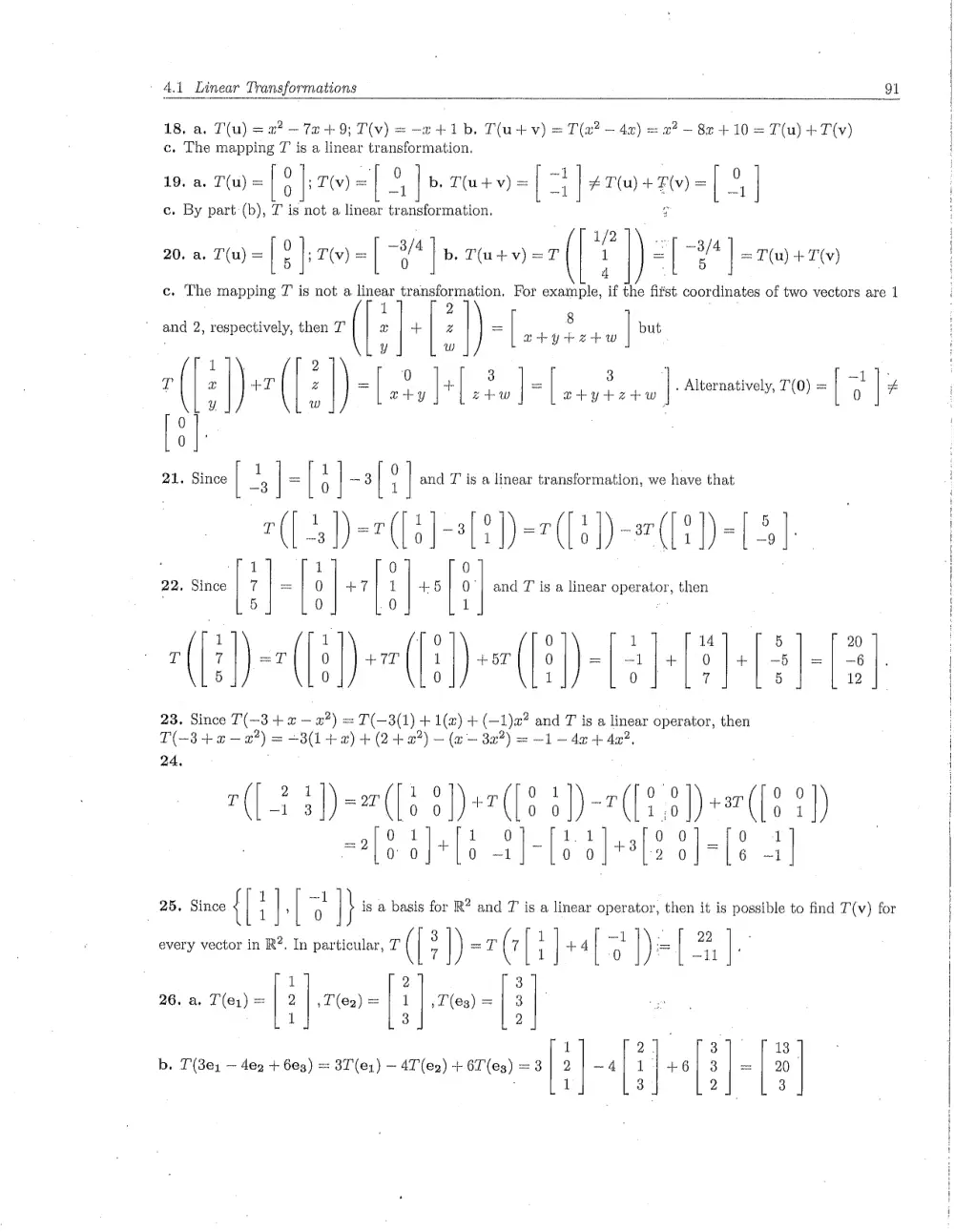
18, a, T(u) = 2? ~ 70+ 9; T(v) = —e+1b. T(ut+yv) = T (a? — 42) = x? — 82 +10 = T(u) + T(v)
c, The mapping T is a linear transformation.
19. a. T(u) = ° ir) =| o b. Tlu+v) = a | £T(u)+F(v) = 2]
c. By part (b), T is not a linear transformation.
1/2
20. a. T(u) = ° }t= “8/4 b. rorya 1 = “3/4 =T(u) +T(v)
c, The mapping T is not a linear transformation. For example, if the fist coordinates of two vectors are 1
1 2
, . _ 8
and 2, respectively, then T E + | z = atytztw but
y w
1 )\ 2 :
. _ 0 3 _ 3 Alhermative _f-1):
(| ; Jr(| 2 }) = oty J+| hw = [ty tetw |: Alteraaivels 7(0) =| 0 |#
0
0
and T is a linear transformation, we have that
ol-s[r)=([o (Li) =[ 4]
T
‘ fa 1 ]
22, Since | 7 | = | 0 | +7 +5 and T is a linear operator, then
5 0
“(LT -e(Li])em(ED ot) Lele] [2]: Ea}
23, Since T(—3 + @ — x”) = T(—3(1) + 1(a) + (—1)2? and T is a linear operator, then
T(-3 +a — 27) = =3(1 +2) + (24+?) — (@— 8x") = -1 — de + 42,
24,
. f i 1 ;
21, Since | s|=[o]-3
ROO
25, Since { : j 7 is a basis for R? and T is a linear operator, then it is possible to find T(v) for
svery vector in R® ‘ticular St) er(7)} The]
every vector in R*, In particular, T (| 7 =T(7 +4 0 =) lat |e
1 2 3
/T(e2)= | 1 | ,T(es) =] 3
3 2
26. a. T(e1) = | 2
1
1 2 3 13
b, T(8e1 — 4eg + 6e3) = 387'(e1) — 4T (eg) + 6T(es) = 3 | 2 -4 1 | +6 3 | = | 20 |
: 1 3
|
|
92 Chapter 4 Linear Transformations
27, a, Since the polynomial 2x? ~32+2 cannot be written as a linear combination of #2, —3a, and —a? +32,
from the given information the value of T'(2x? ~ 8x +2) can not be determined, That is, the equation
C12? + ¢2(—82x) + 03(—2? + 8a) = Qa? ~ 22 +1 is equivalent to (c1 + ¢3)a + (—3eg + 8c3)a = 207 — 3a +2,
which is not possible. b, T(30? — 42) = T (3a? + $(—82)) = 3T(a2) + 47 (-32) = $2? + 62 —
[thE EL
1
111 . 1
b, Since the | 0 1 3 | has a row of zeros its value is 0, so the vectors ‘ ,» and | 3 | are
0 0 0 .
linearly dependent, Therefore, it is not possible to determine T'(v) for every vec vo in a.
29, a. ra=| - J]. r([$])=4f 8 ]= [2], b. nea)-[ 2 a
0 |. Observe that these are the column vectors of A.
—1
1 -2 1 —2
30.a, Let A=] 3 1 . b. Ter) = | 3 | , Tee) = 1
0 2 0 2
° uty 0
31, A vector | y | in R?i ds mapped to the zero vector if and only if x ’ = 0 , that is, if and only
z : “
0
if a = y = 0, Consequently, T (|: 0 } = ; » forall z ER.
~-([)-
1 21
5 I reduces tg
—3y
=e zER.
Zz
33. a, Since
b+ Qy +z =0
if and only if wt ay + ( and
—a+by+z =0 .
2
7
coo
e
[3 , then all vectors that are mapped to the zero vector have the form
nw
1 -1 240 1-1 2/0
2 3 3 ’ 4 ’ ; > 0},
-1 2 0
the zero vector is the only vector in R° such that T ~f I 0 |:
b. Since
1-1 27 . 100 1 7
2 38 -1l;/-6]->];0 1 0 , then T -2 =| -6 |].
-1 2 -2)|~-9 001 2 -9
34. a, Since T(an? + ba +c) = (2ax +b) ~¢, then T(p(x)) = 0 if and only if 2a = 0 and b—a = 0. Hence,
T(p(x)) = 0 if and only if p(x) = ba + = b(a +1) for any real number b, b. Let p(x) = 3x? — 32, then
T(p(x)) = 6x — 3. As a second choice let g(x) = 3a? — 5a — 2, so q(0) = —2 and T(q(x)) = q(x) — q(0) =
62 -5+2=62-3, c. The mapping T is a linear operator,
35. Since T(cv + w) = Thy) ny = o| Ths + nit |- cI'(v) + T(w), then T is a linear
transformation,
|
|
|
|
|
|
'
H
4,2 The Null Space and Range ; 93
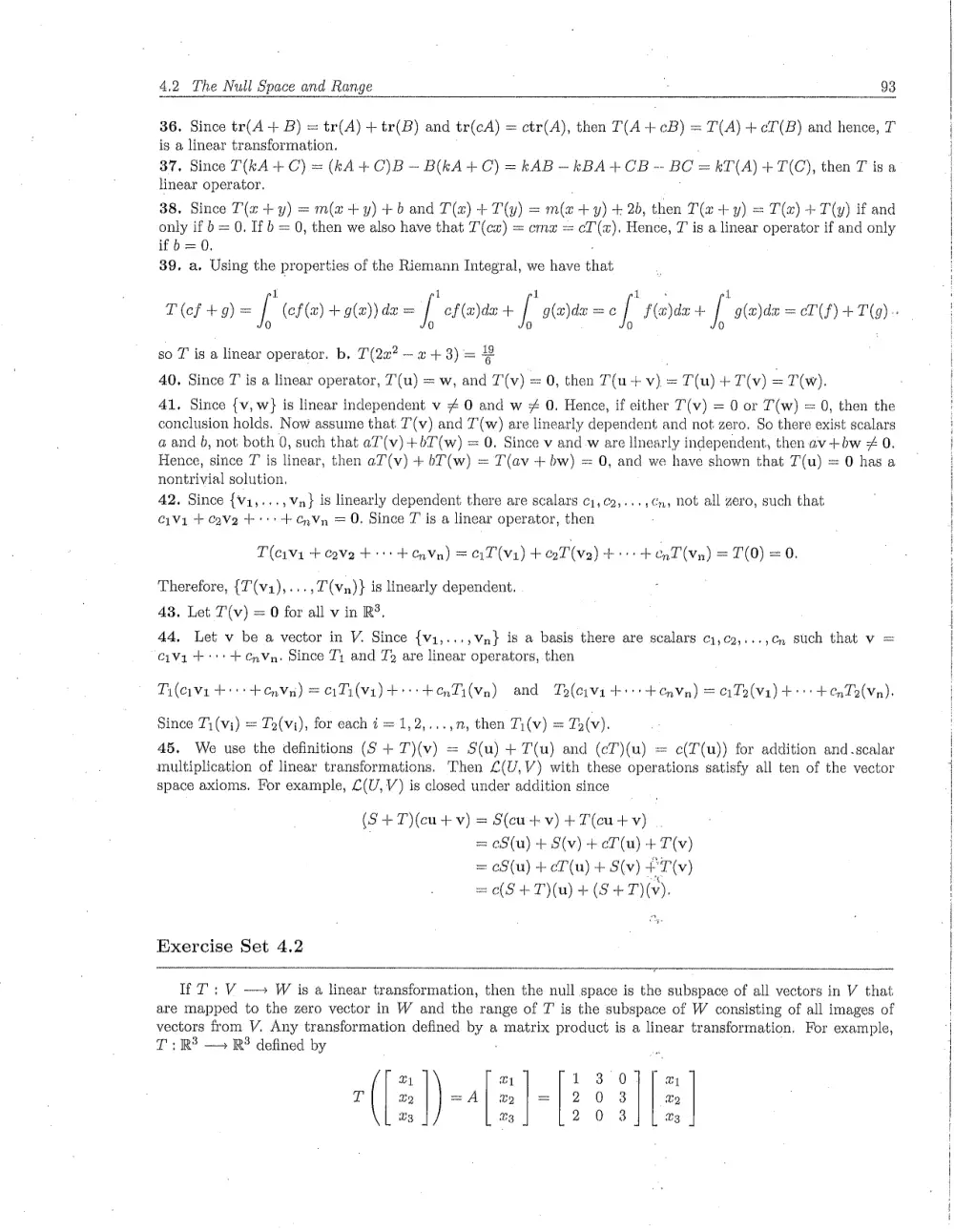
36, Since tr(A +B) = tr(A) + tr(B) and tr(cA) = ctr(A), then T(A+c¢B) = T'(A) + cT(B) and hence, T
is a linear transformation,
37, Since T(kA+C) = (kA+C)B-B(kKA+C) =kAB-kBA+CB-- BC =kT(A)+T(C), then T isa
linear operator.
38, Since T(m +y) = m(a+y) +6 and T(z) + T(y) = m(a+y) + 2b, then T(z + y) = T(x) + T(y) if and
only if b = 0, If b = 0, then we also have that T'(cx) = ema = cI'(x). Hence, T' is a linear operator if and only
ifb=0. .
39, a. Using the properties of the Riemann Integral, we have that
1
1 1
T lef +9) = | (cf (@) + g(a)) da = [ of (a)da +f
so T is a linear operator. b, T(20? ~u +3) = 2 ;
40, Since T is a linear operator, T(u) = w, and T'(v) = 0, then T(u+v) = T(u) + T(v) = T(w).
41. Since {v, w} is linear independent v 4 0 and w # 0. Henee, if either T(v) = 0 or T(w) = 0, then the
conclusion holds. Now assume that T(v) and T'(w) are linearly dependent and not zero. So there exist scalars
a and 6, not both 0, such that aT (v)+bT(w) = 0. Since v and w are linearly independent, then av-+bw # 0.
Hence, since T is linear, then aT(v) + bT(w) = T(av + bw) = 0, and we have shown that T(u) = 0 has a
nontrivial solution,
42, Since {v1,...,Vn} is linearly dependent there are scalars c1,¢2,...,¢n, not all zero, such that
C1V1 + Cova +++ CnVn = 0. Since T is a linear operator, then
T(erva + cove ++++ + CnVn) = rT (v1) + coT (v2) +t pT (vn) = T(0) = 0.
Therefore, {T'(v1),..-,Z'(vn)} is linearly dependent.
48, Let T(v) = 0 for all v in R°,
44, Let v be a vector in V. Since {v1,...,Vvn} is a basis there are scalars c1,cg,...,¢, such that v =
C1V4 +++ + Cnn. Since Ty and J» are linear operators, then
Ty(erva tees envn) = Ti (vi) +e+++enTi (vn) and Th(erva +e +enVn) = c1T2(v1) +++ +enT2(vn).
Since T;(vi) = To(vi), for each i = 1,2,,..,n, then Ti(v) = To(v).
45. We use the definitions (S + T)(v) = S(u) + T(u) and (cT)(u) = c(T(u)) for addition and.scalar
multiplication of linear transformations, Then £(U,V) with these operations satisfy all ten of the vector
space axioms. For example, £(U,V) is closed under addition since
(S+7)(cu+v) = S(cu+v)+T(cu+yv) .
= ¢S(u) + S(v) + cT(u) + T(v)
= @S(u) + eT(u) + S(v) +T(v)
= (S$ +T)(u) +(9+T)(v).
Exercise Set 4.2
iff; V —— W is a linear transformation, then the null space is the subspace of all vectors in V that
are mapped to the zero vector in W and the range of T is the subspace of W consisting of all images of
vectors from V, Any transformation defined by a matrix product is a linear transformation. For example,
T : R8 — R° defined by .
21 wy 138 O07 f a
T 2 =Al ew }=|2 0 3 at
23 v3 2 0 3 3
Lo 1
g(a)da = | f(e)de + [ g(2)du = cT'(f) + T(g)