
MATH 218 Problems Solution Manual Chapter 4.2, Fall 2011
American University of Beirut · Elementary Linear Algebra with Applications · 4 pages · with solution


More MATH 218 files
- Problems Solution Chapter 6.1 · Spring 2012Chapter · with solutionView
- Homework Chapter 8 · Fall 2012ChapterView
- Chapter Summary · Fall 2011ChapterView
- Problems Solution Manual Chapter 1.5 · Fall 2011Chapter · with solutionView
- Problems Solution Manual Chapter 1.2 · Fall 2011Chapter · with solutionView
- Problems Solution Manual Chapter 1.4 · Fall 2011Chapter · with solutionView
- Problems Solution Manual Chapter 1.1 · Fall 2011Chapter · with solutionView
- Problems Solution Manual Chapter 1.3 · Fall 2011Chapter · with solutionView
Show the text of this chapter
94 Chapter 4 Linear Transformations
is a linear transformation. The null space of T', denoted by N(T), is the null space of the matrix, N (A) =
{x €R®| Ax = 0}. Since ;
2y 13.0 zy 1 r 83 07
T XQ =/]2 0 8 % |} =a | 2] +a f 0 | +23] 3],
3 2 0 23 2 0 3
the range of T, denoted by R(T) is the column space of A, col(A), Since’
1 3 0 1 3 0
2 0 38 | reducesto| 0 —6 3
20 3 0 0 0
w
the homogeneous equation Ax = 0 has infinitely many solutions given by a, = — 323,02 = $03, and 23
~3/2
a free variable, So the null space is ¢ ¢] 1/2
. 1
in three space. Also since the pivots in the reduced matrix are in columns one and two, a basis for the
te x} , which is a line that passes through the. origin
2 0 .
3 = dim(R*) = dim(R(L)) + dim(N(T)). This is a fundamental theorem that if 7: V —» W is a linear
transformation defined on finite dimensional vector spaces, then
dim(V) = dim(R(T)) + dim(N(T))..
If the mapping is given as a matrix product T(v) = Av such that A isamxn matrix, then this result is
written as
1 3
range is 2 | , 0 | and hence, the range is a plane in three space. Notice that inthis example,
n = rank(A) + nullity(A),
A number of useful statements are added to the list of equivalences concerning n x 7 linear systems:
A is invertible < Ax = b has a unique solution for every b & Ax = 0 has only the trivial solution
< A is row equivalent to I det(A) #0 the column vectors of A are linearly independent
« the column vectors of A span R” © the column vectors of A are a basis for R”
rank(A) =n R(A) = col(A) = R" & N(A) = {0} & row(A) = R”
<> the number of pivot columns in the row echelon form of A is n.
|| Solutions to Exercises
1. Since T(v) = , »visin N(T), 2. Since T(v) = ’ »Visin N(T),
—5 .
3, Since T(v) = 10 » Vv is not in N(T), 4. Since T(v) = | , Vis in N(T).
5. Since p'(z) = 2x - 3 and p’(x) = 2, then 6, Since p'(w) = 5 and p!"(x) = 0, then T(p(x)) =
T(p(z)) = 2a, so p(x) is not in N(T). 0, so p(x) is in N(T).
7. Since T(p(«)) = —2x, then p(x) is not in 8, Since T(p(x)) = 0, then p(z) is in N(T).
N(T).
1 0 2/1 10 2 {1
9. Since | 2 1 8/8 | reducesto} 0 1 —1/1 | there are infinitely many vectors that are mapped
1 -1 3/0 00 0 f0 . ;
1 -1 1 | 1
to | 3 |. For example, T 2 = 38 | and hence, | 3 | is in R(T).
0 1 0 0
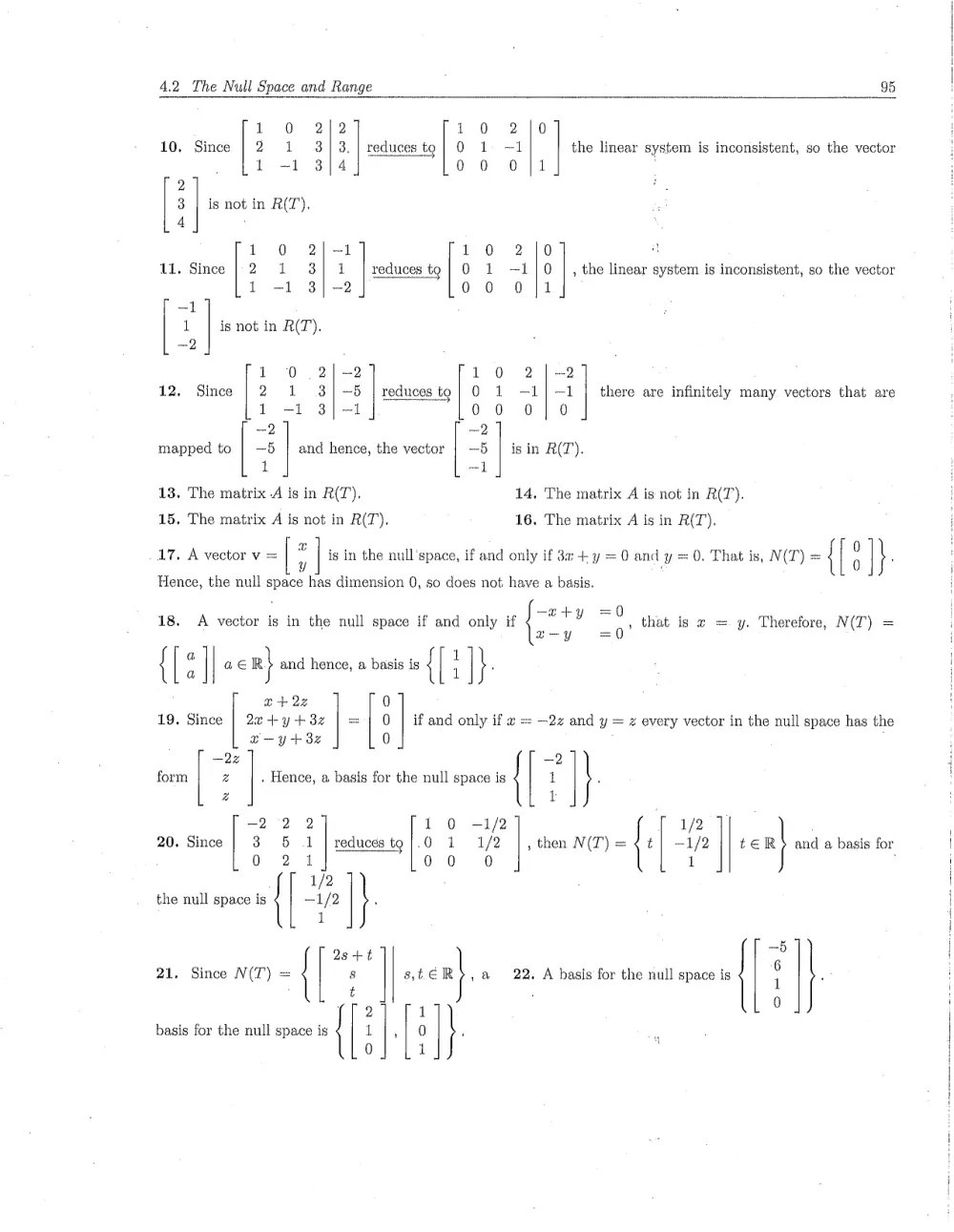
4.2 The Null Space and Range 95
1 0 2/2 1 0 2 40
10, Since | 2 1 3) 3.] reducesto| 0 1. ~1 the linear system is inconsistent, so the vector
Lo -1 3/4 00 0j1 :
[ 2
3 | is not in R(T),
L 4
1 0 2) +1 1 0 240
11. Since | 2 1 38) 1 | reducesto| 0 1 —1] 0 |, the linear system is inconsistent, so the vector
1 -1 3 |-2 00 O0/}1
[ —1
1 | is not in R(T).
| -2
1 0 2) -2 10 2/2
12. Since | 2 1 3/5 | reducestg| 0 1 -—1]-—1 ] there are infinitely many vectors that are
1 -1 3]~-1 00 O07 0
- —2
mapped to | ~—5 | and hence, the vector | ~5 | isin R(T).
| E
13, The matrix A is in R(T), 14, The matrix A is not in R(T).
15. The matrix A is not in R(T). 16, The matrix A is in R(T).
17. A vector v = | ) is in the null‘space, if and only if 8a -+y = 0 and y = 0. That is, N(T) = {| ; \} .
Hence, the null space has dimension 0, so does not. have a basis.
-a+y =0
ay =0" that is = y. Therefore, N(T)
Hl
18. A vector is in the null space if and only if
{| ‘ ar} and hence, a basis is {| : |}.
L+ 2% 0
19, Since | 2a-+-y+3z | = | 0 | if and only if x = —2z and y = z every vector in the null space has the
w-—y+3z 0 :
—2z —2
form z | . Hence, a basis for the null space is 1
t
|
f—-2 2 2 1 0 —1/2 1/2 7
20. Since | 3 5 1 | reduces to 0 1 1/2 | , then N(T) = {: | —1/2 | te x} and a basis for
lo 21 00 0 1
1/2]
the null space is —1/2
1
Is +t 3
21. Since N(T) = 8 s,t€R>,a 22. A basis for the null space is 1
. t
0
(f 2 1
basis for the null space is | 1 | ; 0 | .
0 1
96 Chapter 4 Linear Transformations
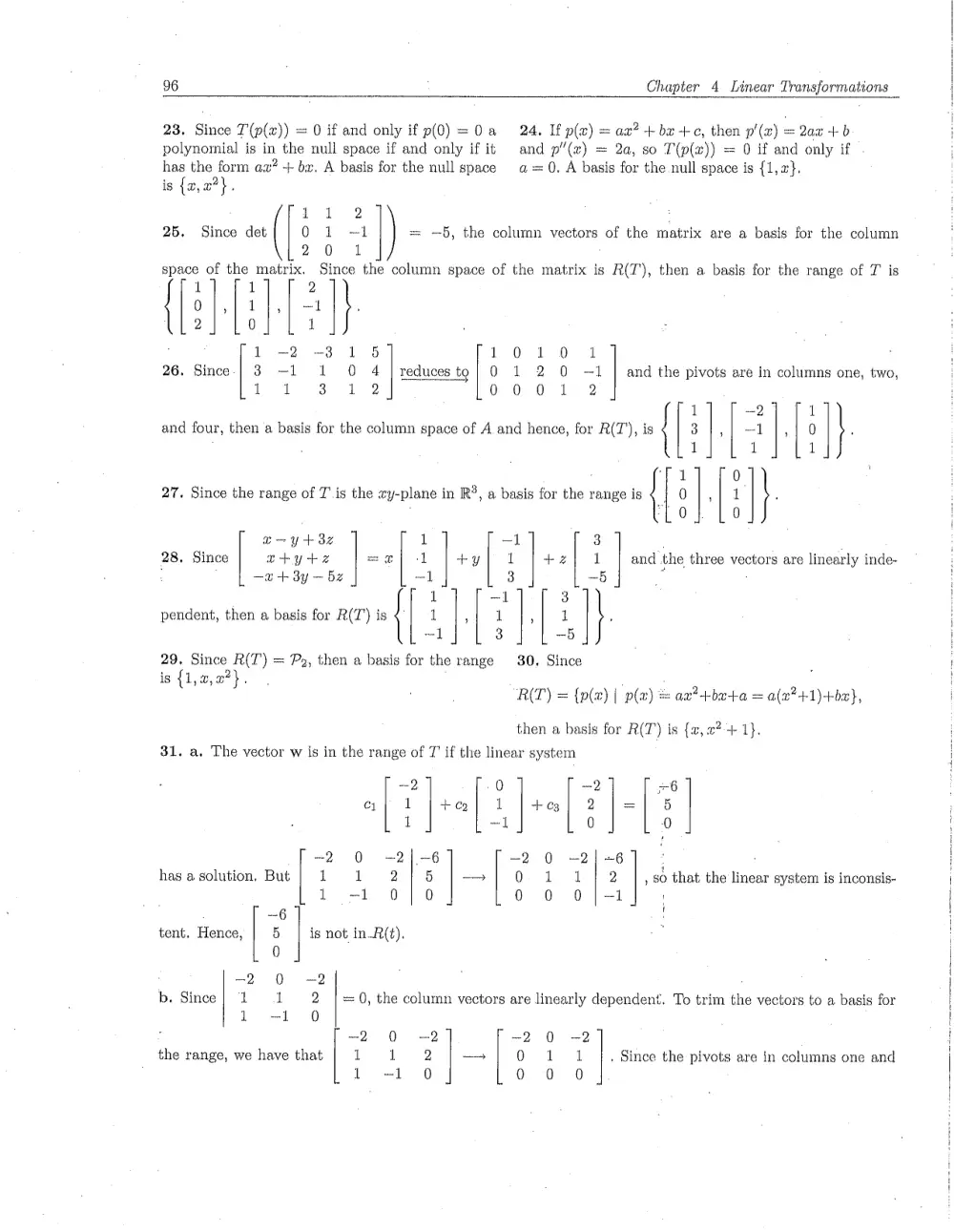
23, Since T(p(x)) = 0 if and only if p(0)=Oa 24. If p(x) = ax? + ba +e, then p'(z) = 2ax +b
polynomial is in the null space if and only if it and p’(x) = 2a, so T(p(x)) = 0 if and only if -
has the form ax? + bx. A basis for the null space a = 0. A basis for the null space is {1,2}.
is {v, 27}.
1 1 2
25. Since det (| 04 -1 } = —6, the column vectors of the matrix are a basis for the column
20 1
space of the matrix. Since the column space of the matrix is R(T), then a basis for the range of T is
thE
. 1 -2 -3 1 5 1010 1
26. Since | 3 -1 1 O 4 | reducestg| 0 1 2 0 -1 | and the pivots are in columns one, two,
1 ot 38 1 2 000 1 2
—2 1
and four, then a basis for the column space of A. and hence, for R(T), is | 3 | , | -1 | , 0 | .
: 1 1 1
1 0
27. Since the range of Tis the zy-plane in R°, a basis for the range is | 0 | ; | 1 | .
; “TO 0
w-y+3z 1 —1 3
28, Since atytz se @ | -L +y}] ol +2] 1 and the three vectors are linearly inde-
: : —2 + 8y — Bz 1 3 -5 : :
l -1 3
pendent, then a basis for R(T’) is 1 , 1 ; 1
~1 3 -5
29, Since R(T) = Pg, then a basis for the range 30. Since
is {1,2,27},
R(T) = {p(x) | p(w) = aa*-+-ba+a = a(2?+-1)-+b2},
then a basis for R(T) is {a, 2? + 1}.
31. a, The vector w is in the range of T if the linear system
—2 0 —2 6
Cy 1 + eg 1 +3 2 = 5
1 -1 0 0
-2 0 -2|-6 —-2 0 -2
has a solution, But 1 1 27 5 — Oo 1 ii
~6
2 | , so that the linear system is inconsis-
1 -1 0] 0 0 0 0 }-1 1
6 i
tent. Hence, | 5 | is not in-R(t).
0
—~2 0 -2
b. Since | ‘1 1 2 |= 0, the column vectors are linearly dependent. To trim the vectors to a basis for
1 -1 0
-—2 0 —2 -2 0 -2
the range, we have that 1 1 2 oS 0 tii . Since the pivots are in columns one and
1-1 0 0 0 0
4.2 The Null Space and Range ‘ 97
. 2 0 .
two, a basis for the range is 1 | : 1 .¢. Since dim(N(T)) + dim(R(T)) = dimi(IR?) = 3 and
1
dim(R(T')) = 2, then dim(N(T)) = 1.
-1
—2 —l 0 -l
32, a. The vector | 1 | isin R(T), b. 2 1,) 5],]) -1 c. Since
2 1 0 2
dim(N(T)) + dim(R(T)) = 3 and dim(R(L)) = 3, then dim(N(TL)) = 0. .-- .
33. a. The polynomial 2a? — 4x + 6 is not in R(T). b. Since the null space of 7’ is the set. of all con-
stant functions, then dim(N(L)) = 1 and hence, dim(R(T)) = 2. A basis for the range is {T'(x),T(2*)} =
{-2¢-+1,0? +a}.
34. a. The polynomial 2?—2—2 is not in R(T). b. Since the null space of T is the set of all polynomials of the
form ax?, then dim(N(T')) = 1 and hence, dim(R(T)) = 2. A basis for the range is {7(1), T(2)} = {2,2 ~1}.
35. Any linear transformations that maps three space to the entire xy-plane will work.’ For example, the
x
mapping to the zy-plane is T’ {| y } = ' .
z !
86, Define TR? R?, wy T (| *])—=[ 8]. ‘Then N(L) = {[|
37. a. The range R(T’) is the subspace of P, consisting of all polynomials of degree n ~ 1 or less. b.
dim(R(T)) =n — ¢. Since dim(R(L)) + dim(N(T)) = dim(Pp) = n +1, then dim(N(T)) = 1.
38, A polynomial is in the null space provided it 39. a, dim(R(T)) = 2 b, dim(N(T)) =
has degree k ~ 1 or less. Hence dim(N(T)) =k
40. Since dim(V) = dim(N(T)) + dim(R(T)) = 2dim(N(T)), then the dimension of V is an even number,
LE R} = R(T),
op} a d “he _ _ 0 2b . f
41, If B= al? then T(B) = AB- BA= 2 9 |) that :
N(T) = {[6 a adeR} = {ol 4 0 | tale || adr}, Hence a basis for N(T) is
1 0 0 0 .
: 0 O0;7,0 1 :
42. If B is an n x n matrix, thon T(B*) = (B*)' = B and hence, R(T) = Maxn.
43, a. Notice that (A+A‘)! = A'+A = A+ A’, so that the range of T is a subset of the symmetric matrices.
Also if B is any symmetric matrix, then T ($B) = 4B+4B' = B. Therefore, R(T) is the set of all symmetric
matrices, b. Since a matrix A is in N(T) if and only if T(A) = A+ A! = 0, which is if and only if A= —A‘,
then the null space of T is the set of skew-symmetric matrices.
44, a. Notice that (A+ A‘)! = A'—A = —(A—A‘), so that the range of ri is a subset of the skew-symmetric
matrices. Also if B is any skew-symmetric matrix, then T (3B) = 4B —4B! = B. Therefore, R(T) is the set
of all skew-symmetric matrices. b. Since a matrix A is in N(T) if and only if T(A) = A—A® = 0, which is if
and only if A-= A‘, then the null space of T is the set of symmetric matrices,
45, Ifthe matrix A is invertible and B is any nxn matrix, then T(A7!B) = A(A7!B) = B,so R(T) = Mnxn-
46, a, A basis for the range of T consists of the column vectors of A corresponding to the pivot columns of
the echelon form of A, Any zero rows of A correspond to diagonal entries that are 0, so the echelon form of
A will have pivot columns corresponding to each nonzero diagonal term, Hence, the range of T is spanned
by the nonzero column vectors of A and the number of nonzero vectors equals the number of pivot columns
of A. b, Since dim(N(T)) = n = dim(R(T)), then the dimension of the null space of T is the number of
zeros on the diagonal.
i
i
i
i