
MATH 218 Problems Solution Manual Chapter 4.3, Fall 2011
American University of Beirut · Elementary Linear Algebra with Applications · 3 pages · with solution
More MATH 218 files
- Problems Solution Chapter 6.1 · Spring 2012Chapter · with solutionView
- Homework Chapter 8 · Fall 2012ChapterView
- Chapter Summary · Fall 2011ChapterView
- Problems Solution Manual Chapter 1.5 · Fall 2011Chapter · with solutionView
- Problems Solution Manual Chapter 1.2 · Fall 2011Chapter · with solutionView
- Problems Solution Manual Chapter 1.4 · Fall 2011Chapter · with solutionView
- Problems Solution Manual Chapter 1.1 · Fall 2011Chapter · with solutionView
- Problems Solution Manual Chapter 1.3 · Fall 2011Chapter · with solutionView
Show the text of this chapter
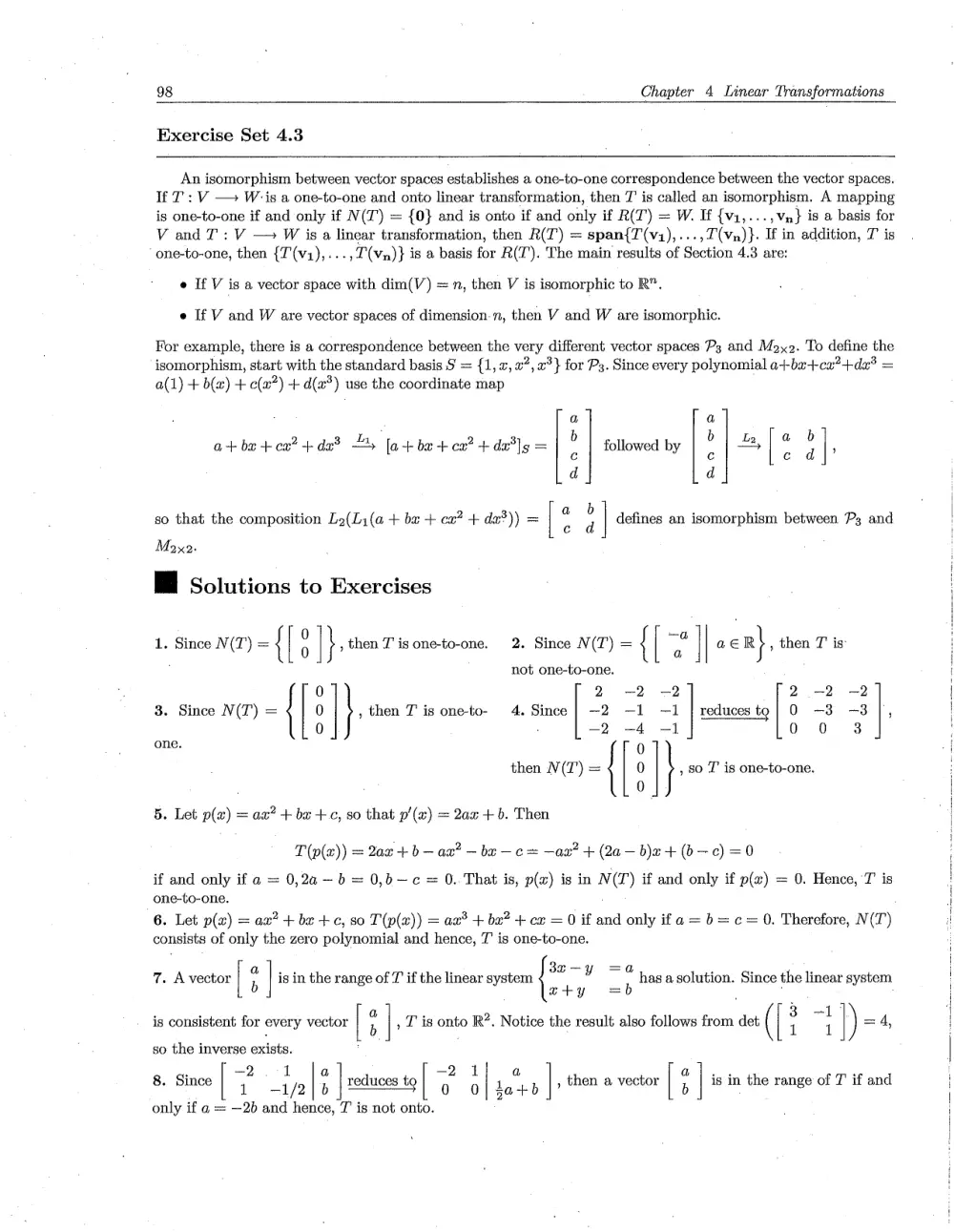
98 Chapter 4 Linear Transformations
Exercise Set 4.3
An isomorphism between vector spaces establishes a one-to-one correspondence between the vector spaces.
If T : V —> W-is a one-to-one and onto linear transformation, then T is called an isomorphism. A mapping
is one-to-one if and only if N(Z') = {0} and is onto if and only if R(T) = W. If {vi,..., Vn} is a basis for
V and T: V — W is a linear transformation, then R(T) = span{T (vi), ...,T(vn)}. If in addition, T is
one-to-one, then {T'(v1),---,I'(Vn)} is a basis for R(T). The main results of Section 4.3 are:
e If V is a vector space with dim(V) =n, then V is isomorphic to R”.
e If V and W are vector spaces of dimension-n, then V and W are isomorphic.
For example, there is a correspondence between the very different vector spaces P3 and Mox2. To define the
isomorphism, start with the standard basis § = {1, x, x, x} for Ps. Since every polynomial a--bz-++cx?-+da? =
a(1) + b(a) + c(x”) + d(a*) use the coordinate map
a a
a+ bax +cx? + dx? A, [a + ba + cx? + da®]g = followed by ? 2) ¢ a:
d d
so that the composition Lo(Li(a + ba + cz? + da*)) = : y defines an isomorphism between P3 and
Mox2.
WM Solutions to Exercises
acer}, then T is:
1. Since N(T) = {| J} een 2s one-to-one. 2. Since N(T) = { Y
not one-to-one.
oo
0 2 -2 -2 2 -2 —-2
3. Since N(T) = 0 , then T is one-to- 4. Since | ~2 -—1 —1 | reducestg| 0 ~—3 -—3 |,
0 : —-2 -4 -1 0 0 8
one. 0
then N(T’) = 0 , so J’ is one-to-one.
0
5. Let p(a) = ax? + ba +c, so that p(x) = 2ax + b. Then
T(p(a)) = 2ax + b — aw? — ba — c= —ax? + (2a — b)a + (b—-c) =0
if and only if a = 0,2a —- 6 = 0,b-—c = 0.. That is, p(x) is in N(L) if and only if p(x) = 0. Hence, T is
one-to-one.
6. Let p(a) = ax? + ba +c, so T(p(x)) = ax® + bu? + ca = 0 if and only if a = b = c= 0. Therefore, N(T)
consists of only the zero polynomial and hence, T' is one-to-one.
3a-y =
7. A vector t is in the range of T if the linear system + ; has a solution. Since the linear system
aty = :
is consistent for every vector t , T is onto R?. Notice the result also follows from det (| : a }) =A,
so the inverse exists.
. —2 I al. —2 1 a
8. since | 1 ia] | reduces 0 0
La +b , then a vector t is in the range of T if and
only if a = —2b and hence, T is not onto.
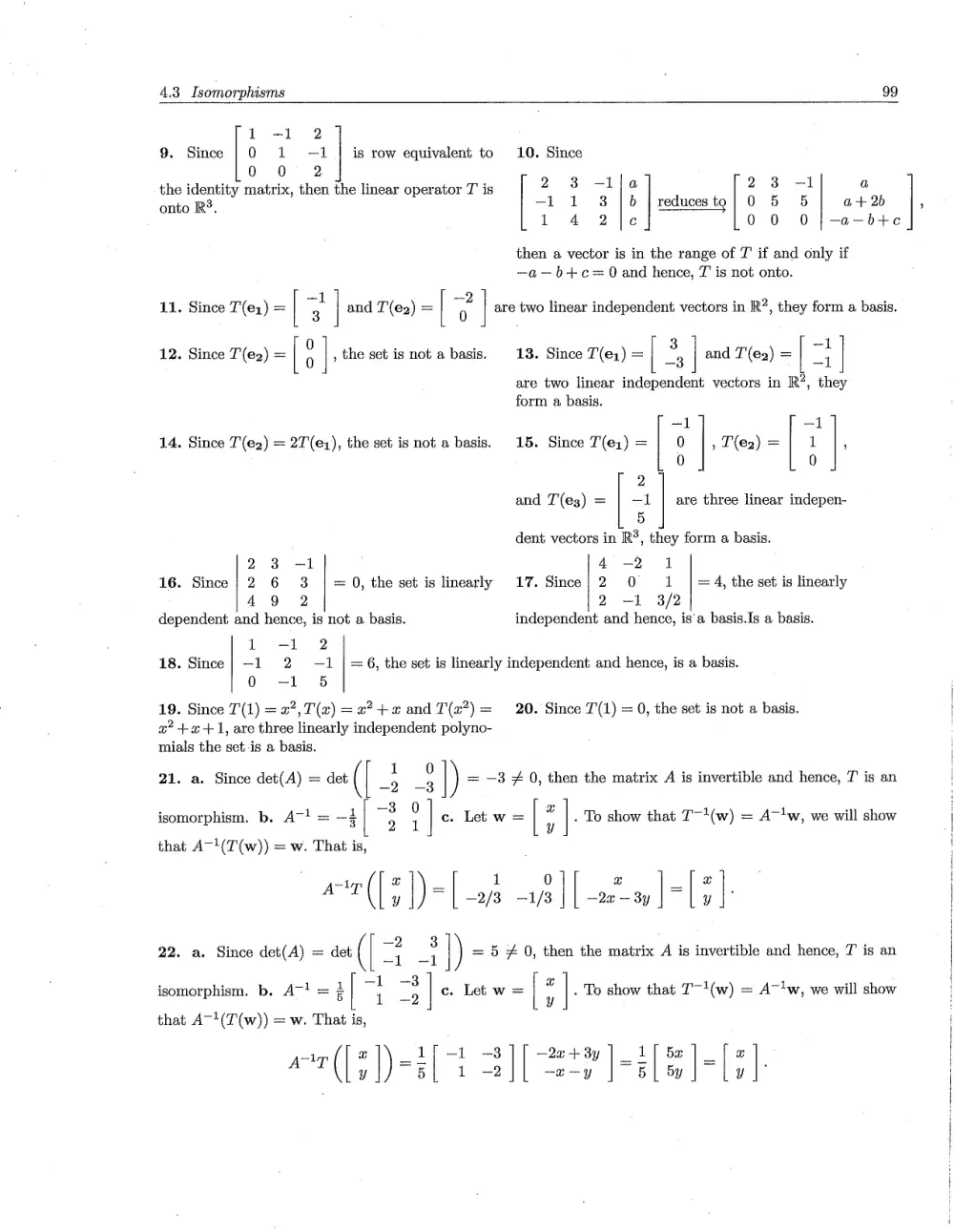
4.3 Isomorphisms 99
1 -i 2
9. Since | 0 1 —1 | is row equivalent to 10. Since
0 0 2
the identity matrix, then the linear operator T is 2 3 vl}a 23 -1 a
onto R3. -1 1 38 |b |reducestg| 0 5 5 a+ 2b
1 4 2 0 0 0 }-a-b+ec
then a vector is in the range of T if and only if
—a—b+c=0 and hence, T is not onto.
~1
11. Since T(e1) = 3
and T(eg) = “2 are two linear independent vectors in R?, they form a basis.
0
, the set is not a basis. 13. Since T(e1) = { and T(e2) = -
12. Since T(e2) =
are two linear independent vectors in R?, they
oo
form a basis.
-1 -1
14. Since T(e2) = 2T (ex), the set is not a basis. 15. Since T(e1)= | 0 |,7(e2)=] 1 |,
0 0
2
and Tes) = | —1 | are three linear indepen-
5
dent vectors in R*, they form a. basis.
2 3 -1 4-2 1
16. Since} 2 6 3 | = 0, the set is linearly 17. Since| 2 0 1 | =4, the set is linearly
49 2 2 -1 3/2
dependent and hence, is not a basis. independent and hence, is'a basis.Is a basis.
1 -1 2
18. Since| -1 2 —1 | =6, the set is linearly independent and hence, is a basis.
0 -1 5
19. Since T(1) = 2, T(z) =2? +a and T(x?) = 20. Since T(1) = 0, the set is not a basis.
a? -+2+-1, are three linearly independent polyno-
mials the set -is a basis.
21. a. Since det(A) = det (| 1 0
—-2 -3
isomorphism. b. A! = —} 3 : c. Let w = y . To show that T-!(w) = A7!w, we will show
that A-!(T(w)) = w. That is,
ar(| , \) = 9/3 “ys | ~20 — By ~ | , |:
—2 3
-1 -1
-1 -3
1 —2
\) = —3 # 0, then the matrix A is invertible and hence, T is an
22. a. Since det(A) = det (| \) = 5 £0, then the matrix A is invertible and hence, T is an
isomorphism. b. A7! = 4 c. Let w = ) . To show that T-!(w) = A-tw, we will show
that A~'(T(w)) = w. That is,
ens )osft SB) doa 81° (7)
I
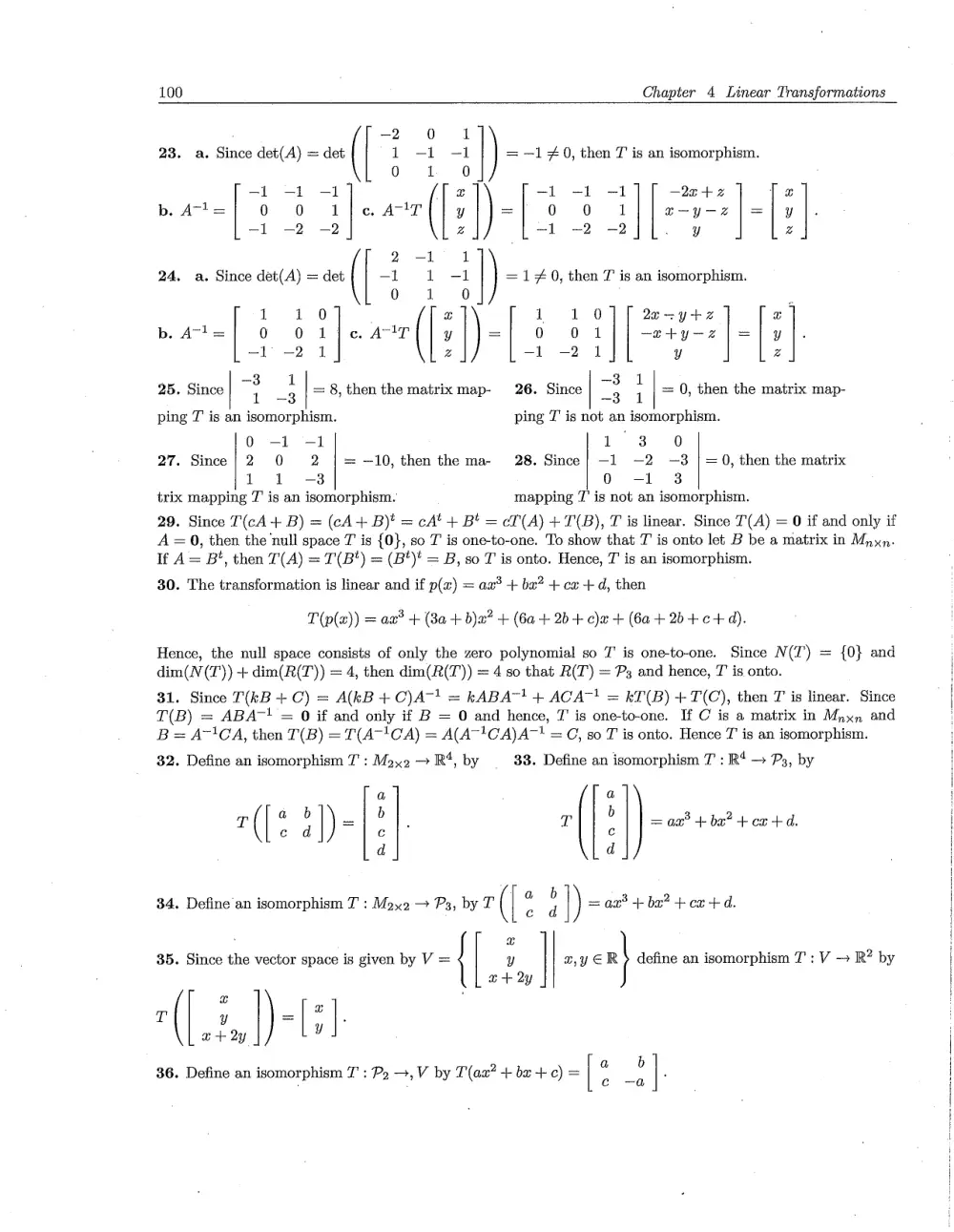
100 Chapter 4 Linear Transformations
. f-2 0 1]
23. a. Since det(A) = det 1-1 -1 = —1 0, then T is an isomorphism.
o 1 0
-1 -1 -1 ‘Ta a a -1 20 + 2 Ta
b. A7h= 0 0 1lfeAtr y 1 e-y-z\/=|y].
| -1 -2 -2 z f 2 -2 sy z
f 2-1 1]
24. a. Since det(A) = det -l1 1 -1 =10, then T is an isomorphism.
| o 1 of :
fF 1 10 x 1 1.0 Qe zy+Z x
b At=}] 0 Otfe Art] y|)=] 0 0 1] ] -e+y—-z2] =] yf.
| -1 -2 1 z -1 -2 1 y z
. —3 1 . . -3 1 .
25. Since 1 -3/= 8, then the matrix map- 26. Since 31/7 0, then the matrix map-
ping T is an isomorphism. ping T' is not an isomorphism.
0 -1 -1 1°38 0
27. Since | 2 0 2 | =-—10, then the ma- 28. Since} —1 -2 -3 | =O, then the matrix
1 1 -8 0 -1 38
mapping 7’ is not an isomorphism.
trix mapping T is an isomorphism.
29. Since T(cA+.B) = (cA+B)' = cA’ + Bt = cT'(A) + T(B), T is linear. Since T(A) = 0 if and only if
A =0, then the‘null space T is {0}, so T is one-to-one. To show that T' is onto let B be a matrix in Myxn.
If A= B!, then T(A) = T(B*) = (B’)' = B, so T is onto. Hence, T is an isomorphism.
30. The transformation is linear and if p(x) = ax + ba + ca +d, then
T(p(a)) = aa® + (3a + b)a + (6a + 2b + c)a + (6a + 2b+e+d).
Hence, the null space consists of only the zero polynomial so T' is one-to-one. Since N(T) =
dim(N(T)) + dim(R(L)) = 4, then dim(R(L)) = 4 so that R(T) = Ps and hence, T is onto.
31. Since T(kB+C) = A(kB+C)A-! = KABA“! + ACA“! = kT(B) +T(C), then T is linear. Since
T(B) = ABA“ = 0 if and only if B = 0 and hence, J’ is one-to-one. If C is a matrix in Mp, and
B= A7!CA, then T(B) = T(A-'CA) = A(A~1C.A)A™! = CG, 80 T is onto. Hence T is an isomorphism.
32. Define an isomorphism T : Mox2 — R*, by 33. Define an isomorphism T : R* — P3, by
7 a b _
r([¢ al)-
34. Define an isomorphism T : Mgx2 > P3, by T (|
{0} and
= ax® + ba? + cr+d.
aoce
AXacs
) = aa? + ba? + ca +d.
a b
ed
fy
35. Since the vector space is given by V = } | y
(3, JE)
36. Define an isomorphism J’: P2 >, V by T'(aa? + ba +c) = ‘ - .
| z,ye x} define an isomorphism T : V + R? by