
MATH 218 Problems Solution Manual Chapter 4.4, Fall 2011
American University of Beirut · Elementary Linear Algebra with Applications · 6 pages · with solution


More MATH 218 files
- Problems Solution Chapter 6.1 · Spring 2012Chapter · with solutionView
- Homework Chapter 8 · Fall 2012ChapterView
- Chapter Summary · Fall 2011ChapterView
- Problems Solution Manual Chapter 1.5 · Fall 2011Chapter · with solutionView
- Problems Solution Manual Chapter 1.2 · Fall 2011Chapter · with solutionView
- Problems Solution Manual Chapter 1.4 · Fall 2011Chapter · with solutionView
- Problems Solution Manual Chapter 1.1 · Fall 2011Chapter · with solutionView
- Problems Solution Manual Chapter 1.3 · Fall 2011Chapter · with solutionView
Show the text of this chapter
44 Matrix Transformation of a Linear Transformation ; 101
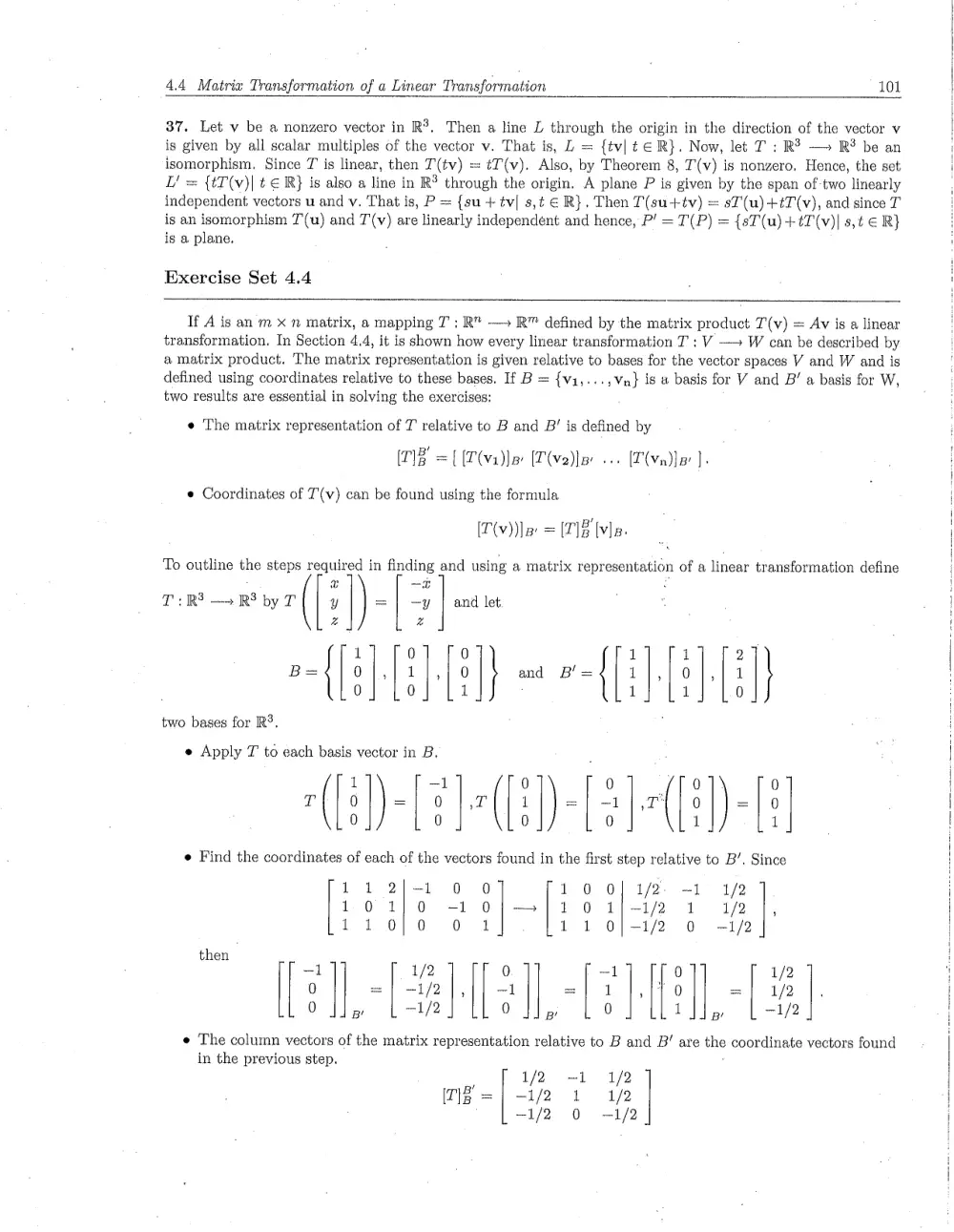
37, Let v be a nonzero vector in R°, Then a line L through the origin in the direction of the vector v
is given by all scalar multiples of the vector v. That is, L = {tv| t € R}, Now, let T : R? —> R® be an
isomorphism, Since T is linear, then T'(tv) = tT(v). Also, by Theorem 8, T(v) is nonzero, Hence, the set
L' = {tT(v)| t € R} is also a line in R® through the origin. A plane P is given by the span of-two linearly
independent vectors u and v. That is, P = {su + tv| s,¢ € R}, Then T(su+tv) = sT(u)+tT(v), and since T
is an isomorphism T(u) and T’(v) are linearly independent and hence, P! = T(P) = {sT(u)+tT(v)| s,t € R}
is a plane.
Exercise Set 4.4
If A is an m xX n matrix, a mapping T’; R” —+ R™ defined by the matrix product T(v) = Av is a linear
transformation. In Section 4.4, it is shown how every linear transformation T : V —+ W can be described by
a matrix product, The matrix representation is given relative to bases for the vector spaces V and W and is
defined using coordinates relative to these bases. If B = {v1,..., Vn} is a basis for V and BY’ a basis for W,
two results are essential in solving the exercises:
¢ The matrix representation of T relative to B and B’ is defined by
(TB = ((va)}o (wa)har «.. (vn) J
¢ Coordinates of T(v) can be found using the formula
[T(w))]a" = (1B Ie.
To outline the steps required in finding and using a matrix representation of a linear transformation define
a —&
y = |] —-y | and let.
z z
1 0
B= ol,/ 1], and B’= , ,
0 0 :
; 0 0
Tr 0 =| 0
1 l
e Apply T to each basis vector in B,
¢ Find the coordinates of each of the vectors found in the first step relative to B’. Since
ren 2(
ROO
Ree
EO,
Orn
two bases for R°,
ll
(i) EDL
11 2/-1 0 0 10 0] 1/2 -1 1/2
10 1/0 -1 0}/—5]1 0 1/-1f2 1 1/2 J,
1 10/0 01 1 1 0/-1/2 0 -1/2
Lela TE TL Cad
¢ The column vectors of the matrix representation relative to B and B’ are the coordinate vectors found
in the previous step.
, 1/2 -1 1/2
[T]B =|] -1/2 1 1/2
—1/2 0 -1/2
102 Chapter 4 Linear Transformations
¢ The coordinates of any vector T(v) can be found using the matrix product
[T(v))] a: = (NE Wve.
-4
rsDi Lee AAI]
Since B is the standard basis the coordinates of a vector are just the components, so
1 1/2 -1 1/2 17 4 1/2
T —2 = —1/2 1 1/2 —2 |= | -9/2 |.
PSD) [Se SBS} Le]
This vector is not T(v), but the coordinates relative to the basis B’. Then
(DESH sG- (3)
Other useful formulas that involve combinations of linear transformations and the matrix representation
are:
1. :
e As an example, let v = —2 , then after applying the operator’T the coordinates relative to B’ is
given by
o(S+T]5 = (SIF +712 ° (KT)B = kITIZ «(Sor |B = [S]B IIR) (Ta =((T]a)" © (P™]e = ((T]e)™!
W Solutions to Exercises
1. a. Let B = {e1,e2} be the standard basis. To find the matrix representation for A relative to B, the column
vectors are the coordinates of T(e1) and T(eg) relative to B. Recall the’coordinates of a vector relative to
the standard basis are just the components of the vector. Hence, [T]z = [-[T(e1]z [T(ee]e ] = 2 7 .
b. The direct computation is T : = ’ and using part (a), the result is
C2 IR)
Pa-[3 Ue )-E)
3. a. Let. B = {e1,e2,e3} be the standard basis, Then (Tle
-1 1 2 1 3 fs
0 8 41 . b. The direct computation is T —2 = —3 |, and using part (a) the result is
b. The direct computation is T > = 4 and using part (a), the result is
i
‘(Peale (P(eela (Teale ] =
LQ -1 3 2
EEE
4.4 Matria Transformation of a Linear Transformation 103
0 2 2 :
0 b. The direct computation is T | —5 | = 5 | , and using part (a) the
~l 1 ~l
ao -EEIELE)
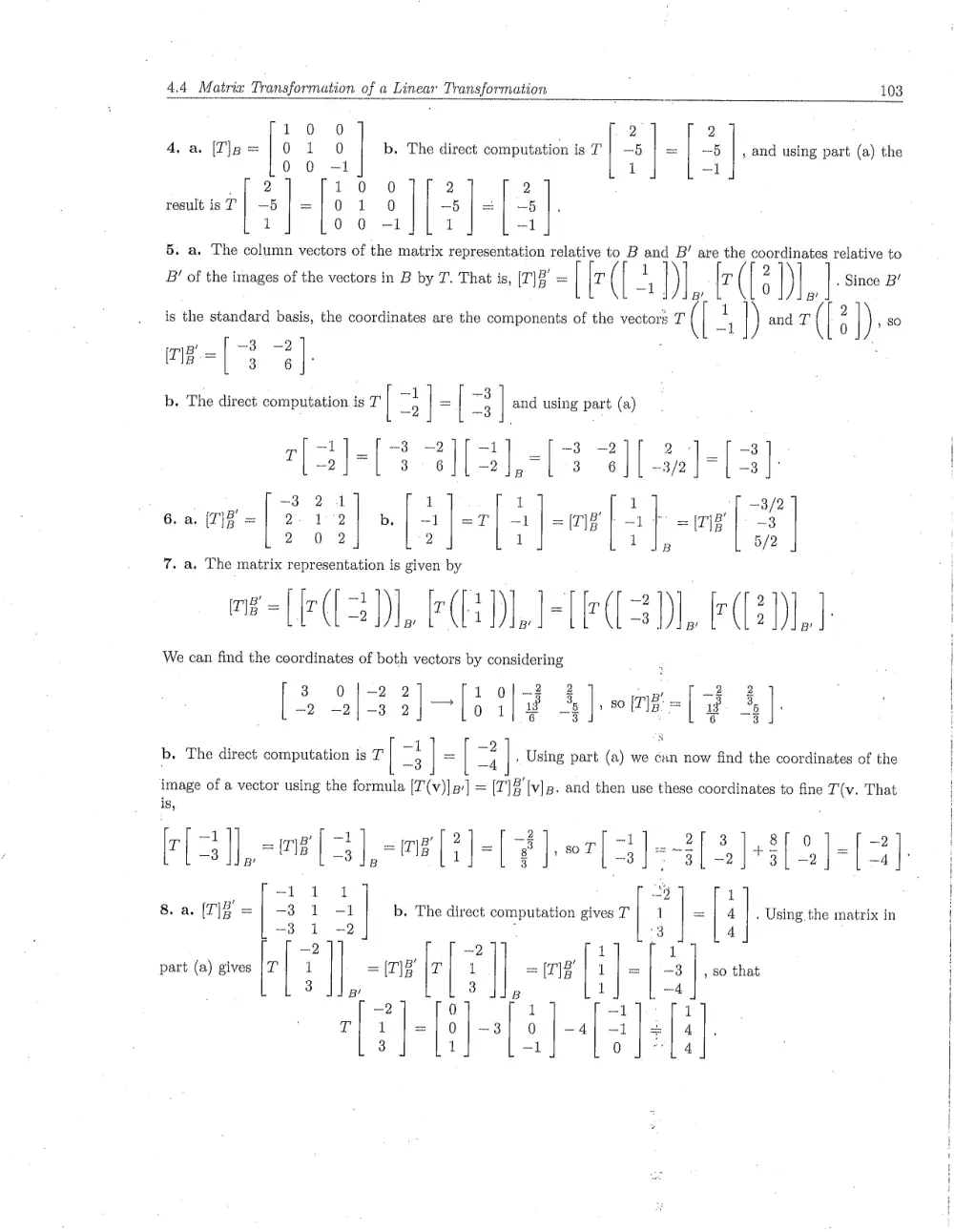
5. a. The column vectors of the matrix representation relative to B and B’ are the coordinates relative to
B’ of the images of the vectors in B by T. That is, [T]3’ = Ir ([ i i} [r (| * )) . Since B’
J/ JB Br
is the standard basis, the coordinates are the components of the vectors T (| A }) and T (| ; \) » SO
/ ~3 2 .
Bl 3
mig=[~3 eI]:
—1
b, The direct computation is T’ 2 = 3 and using part (a)
rl 2 ]ef-3 -2][-1] ~[-3 -2 2 -]_f-3
2/7 [ 3 6][-2],>[ 3 6]| -3/2}*{-3 |:
~3 2 4 1 1 —3/2
6a. (TR =| 2 1°2} by 1 fer} -1 | =[rye fb -1 > =e] -3
2 02 2 ‘ il, 5/2
7. a, The matrix representation is given by
| DI, lr ([ DI |
—3 | , BI
m= (EDL P(e DEP
We can find the coordinates of both vectors by considering
38 01-2 2 _,} 1 0
—2 -2/-3 2 0 1
b. The direct computation is T vi = ~2 . Using part (a) we can now find the coordinates of the
4,a. [T]B =a
ORO
ww
—3 -4
image of a vector using the formula. [T'(v)]’] = [7]8 [v]g. and then use these coordinates to fine T(v. That
is,
cain
us
RD
°
Ny
cm
L
a
i
i
rls, eee ss}e-sf 4] af 4] -[]}
1 a) 1
8. a. (T]B ‘| 301 b. The direct computation gives T >| 1 | = 4 | . Using the matrix in
8 ; : “3 4
—2 l 1
part (a) gives i =(T]2 |T] 1 =(T}2 | 1 | =] —3 |, so that
3 |i, 1} | ~4
—2 0 1 -1 : 1
1 }=|o}-3} 0 |-4}-1 fe fa].
3 1 1 0 L 4
|
|
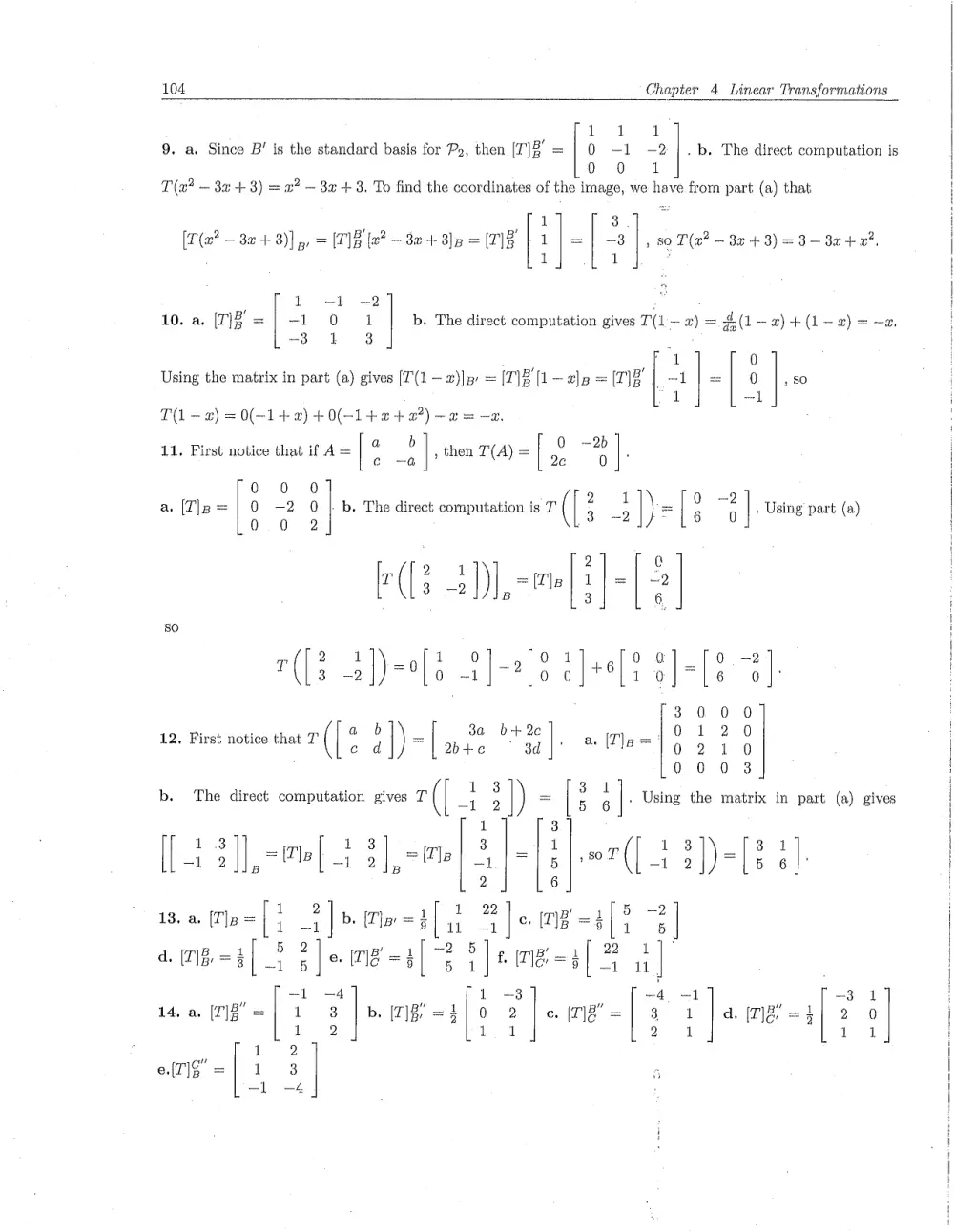
104 Chopter 4 Linear Transformations
11 1)
9, a. Since B’ is the standard basis for Py, then [7]2° = | 0 -1l ~2 | . b. The direct computation is
0 0 1
T (a? — 84 +3) = 2? — 3x +3. To find the coordinates of the image, we have from part (a) that
= [TB [e? - Se +3)e = (212
[T (a? — 3a + 3)] »,
1 3
| = | -3 | , 80 D(a? — 8a +3) = 3 — 8a +2”,
1 1 °
1 -1 -2
10. a. [T}B' = | -1 0 1 | b. The direct computation gives T(1— 2) = 4 (1-2) + (1-2) =~.
-3 1 8
1
Fou 0
Using the matrix in part (a) gives [T(1—2)|e = (7) (1 —e]e = (1) 1 | = | 0 | , SO
1
T(L-«) =0(-1+2)+0(-1+a+a*)-2=~a,
11. First notice that if A= ‘ - , then T(A) = 0 2b .
2c 0
oe 0 0 2 1 0 ~2
a. [T]p= | 0 -2 O | b. The direct computation is T {| 5 = , Using part (a)
0 0 2 3-2 |} > 6 0
r([3 3 ))] =i
1
|
so \
i
|
3
by\_ Ba b+ 2c r,-{0 1 2
d|)=la+e sal) *MB=)o 9 |
b. The direct computation gives T (| 4 ; \) =
12, First notice that T (|
a a8
|
4.4 Matriz Transformation of a Linear Transformation : 105
0 0 , 0 0 ; Qo ol 016
ba (TB =| 1 0}b WB =] 0 lle WS =}] 0 Of] a [SZ = [° 0 |
, 0 1/2 1/2 0 1/2 0
, 10 , 00 0
e. [S]Z(T]2 = 01 TIE (S]B, = | 0 1 0 | £ The function $07 is the identity map, that is,
00 1
(So T)(aa +b) = aw +b so S reverses the action of T,
2, 0 0 2 2 Q -2 2
q 0 -2 2 -2 0 0 -2 2
Bil Be
16a (Me =a] 3 4 1 9 | MIB=] yg 1 <1.
-3 1 -1 0 0 0 2 2
4 0 0 0 2 0 0 2 1 0 -1 -1
7 -2 0 -6 2 7 0 2 2 0 Oo 1 1 +i
Bid Bit Boo
oe =a) 1 9 3 7) %Ule=a} yy 41} le =]o 1-1 4
-3 0 5 1 -l1 -1 1 1 10 1 1
17. [T]e = ; 3 . The transformation T 18. The transformation rotates a vector by @ ra-
dians in the counterclockwise direction.
reflects a vector across the w-axis,
19. [T]p = ol . 20. Since T(A) = A~ Al = [ = mar
0 0 0 0
; _{ 0 4, -1 0
then [T]g = 0-1 1 0
00 0 0
B! 10
21. [T)Z =[1001 22. a, [-85]o = 815] =-3| | |
[ 6
mL)
5 2 31
23. a. 2T+S)e=2[T]e+[Sln=| _1 7 24. a. (ToS]e=(TlalSja=| 5 3
~4 —3
b. 33 bios
24 a 2 -2 -2
25. a [So T]z = (S]a[Z]B = [i ‘| b. 26. a, 2T]B = 2[T]s = 0 4 4
2 2 2
~ [ —10
10 b. | 16
| 10
3 3° «4 2 0 -2
27. a, [-3T +25]n= | 2 -6 -6 28. a. [ToS|x=[Tja[Sja=| 2 0 2
3-3 -1 . ~2 0 2
3 [ -8
b. | —26 b. | 4
79 L 8
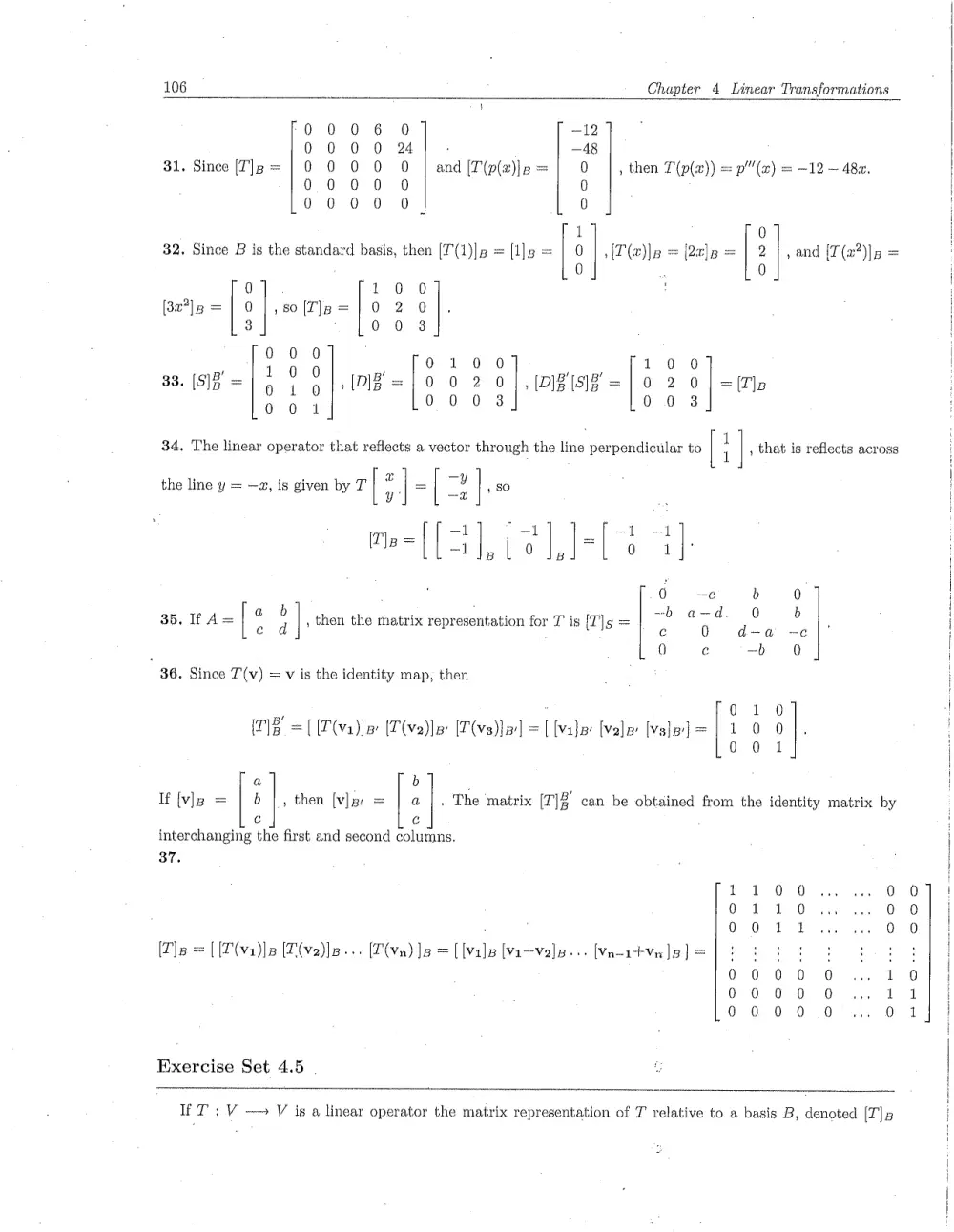
106 Chapter 4 Linear Transformations
°0 00 6 0 —12
00 0 0 24 . —48
31. Since [T]p = | 0 0 0 0 O | and [T(p(@)jp= | 0 |, then T(p(x)) = p(x) = -12 — 482.
0000 0 o |
000 0 0 0
oor
0
32. Since B is the standard basis, then (T(1)]z = [l]z = | (T(«))p = alg = | 2 | , and [T(2?)]_ =
0
0 100 :
(3e7]5=| 0|,s0(T]p=-|0 2 0].
3 - 100 3
33. [S]2 =
OoOrooe
0 0
2 | =
0 3
CoOrsa
34. The linear operator that reflects a vector through the line perpendicular to ; , that is reflects across
me-((, [e]gleF2 a]
-b a-d 0 b
e 0 d-a@ ~c
0 c —b 0
the line y = —a, is given by T e = | md , So
35. If A= ‘ y , then the matrix representation for T is [T]g =
36. Since T(v) = v is the identity map, then
0 1 0
(TB = (va) le ((va)| er (P(vs)]B'] = [ [vale [vale [vale] = | 100 | .
00 1
a ; b :
If [v]z = | 6 |, then (v]g- = | @ |. The matrix [T]3’ can be obtained from the identity matrix by
c ¢
interchanging the first and second columns.
37.
1100 0
0110 0
. 0011...
[Tle = [[P(va)]a Mva)la-.. (Cyn) Ja = [Ivale [vatvale... Wa-atvn|a}=] ois! :
00 0 0 1
0000 0 1
00 0 0 0
Exercise Set 4.5 .
If: V —>» V is a linear operator the matrix representation of T relative to a basis B, denoted [T]a