
MECH 314 Problems 10, Spring 2014
American University of Beirut · Introduction to Fluids Engineering · 7 pages

More MECH 314 files
Show the text of this problems
J
2. SURFACE TENSION
Al
i 2 P PISTON
LL TE ED a a
STRAW
A liquid drop is held at the end of a Straw, as sketched.
its volume controlled by the position of the piston.
Gravity is negligible. Show that if the drop’s volume is
changed by a (slow) displacement of the piston, the net work
done on the system comprised of the liquid and its bounding
surface is equal to the product of the surface tension
coefficient and the incremental change in the system’s
surface area. Explain why it follows that the surface
tension coefficient can be interpreted as an internal energy
per unit surface area.
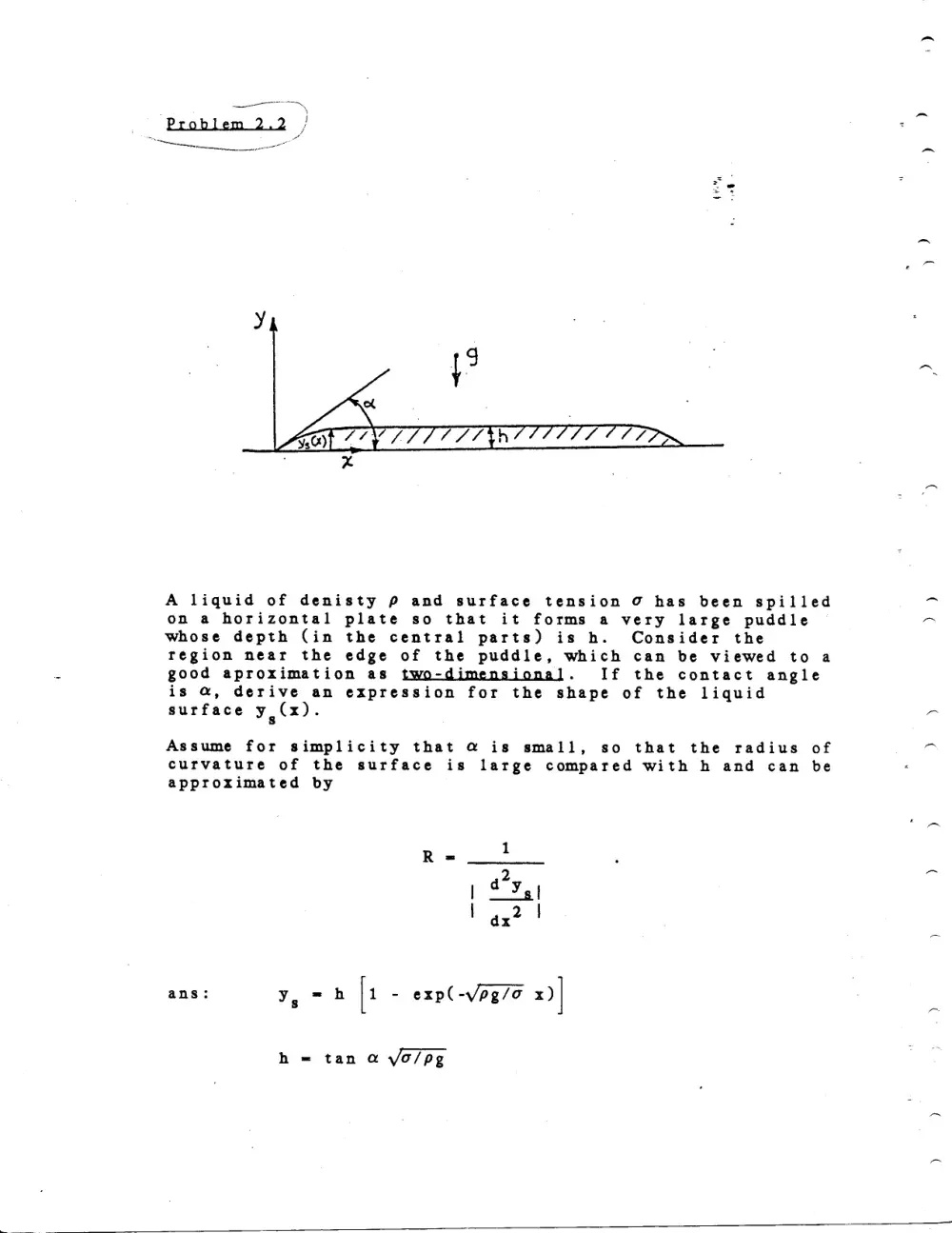
A liquid of denisty p and surface tension 9 has been spilled
on a horizontal plate so that it forms a very large puddle
whose depth (in the central parts) is h. Consider the
region near the edge of the puddle, which can be viewed to a
good approximation as two-dimensional. If the contact angle
is @, derive an expression for the shape of the liquid
surface y,(x).
Assume for simplicity that @ is small, so that the radius of
curvature of the surface is large compared with h and can be
approximated by
R=}
2
| 2 Yet
1 gx? !
ans: y,7 4 [2 - exp(-Vpg/a x)
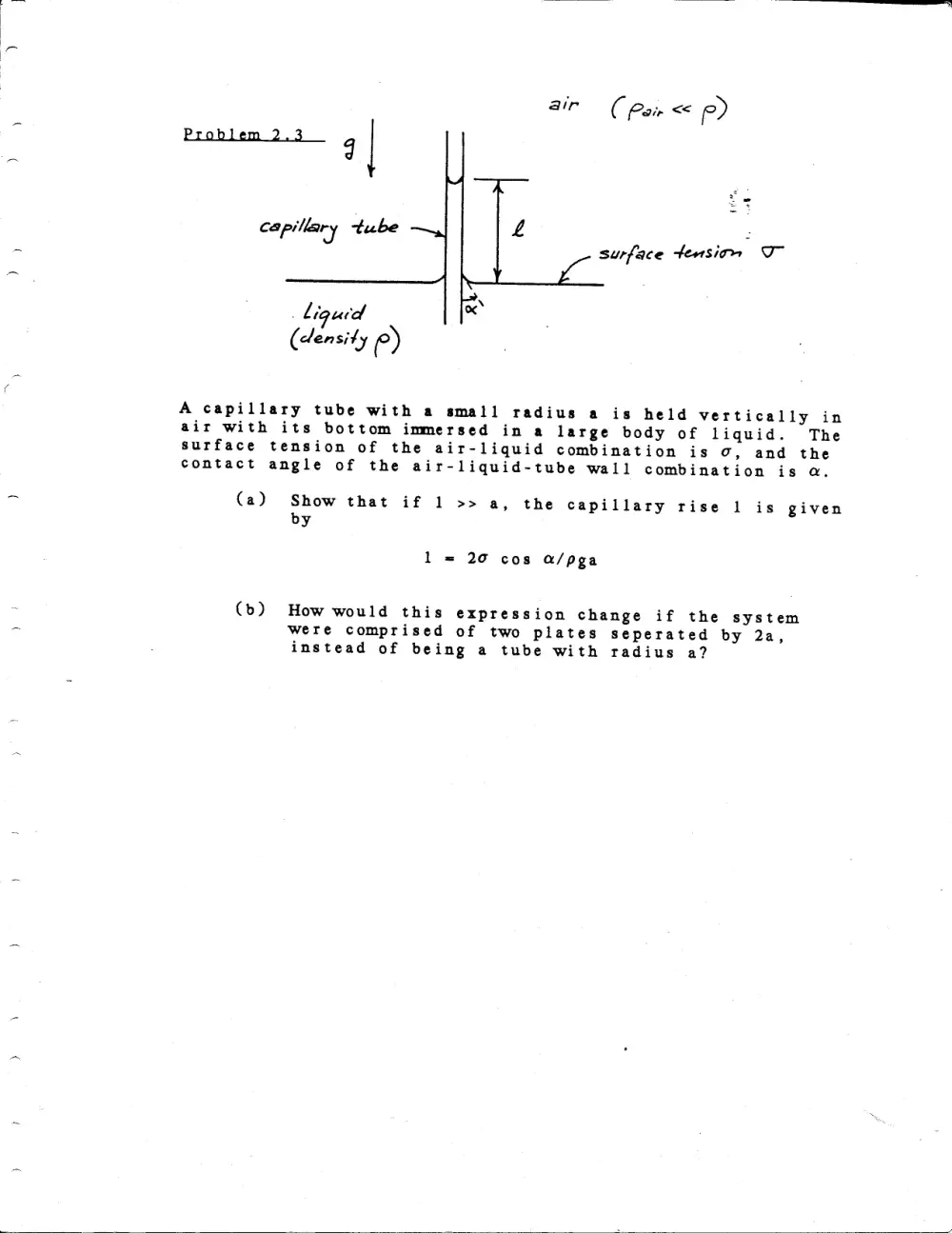
air ( Pain «<< Pp)
. Ligucd
(density re)
A capillary tube with a small radius a is held vertically in
air with its bottom immersed in a large body of liquid. The
surface tension of the air-liquid combination is o, and the
contact angle of the air-liquid-tube wall combination is a.
(a) Show that if 1 >> a, the capillary rise 1 is given
by
1 = 20 cos a/pga
(ob) How would this expression change if the system
were comprised of two plates seperated by 2a,
instead of being a tube with radius a?
au
cy
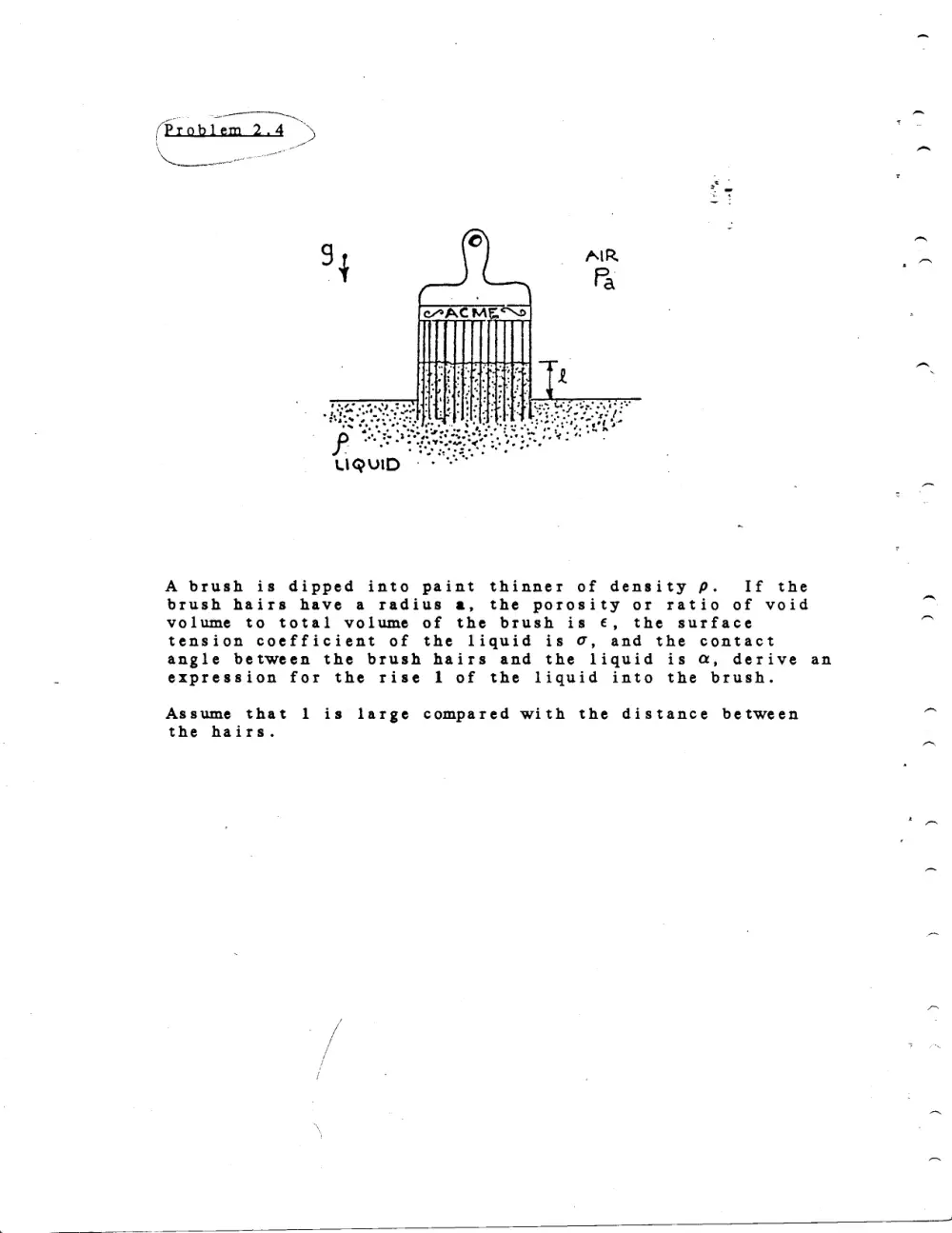
A brush is dipped into paint thinner of density p. If the
brush hairs have a radius a, the porosity or ratio of void
volume to total volume of the brush is €, the surface
tension coefficient of the liquid is o, and the contact
angle between the brush hairs and the liquid is a, derive an
expression for the rise 1 of the liquid into the brush.
Assume that 1 is large compared with the distance between
the hairs.
AIR 2
pues
Conner
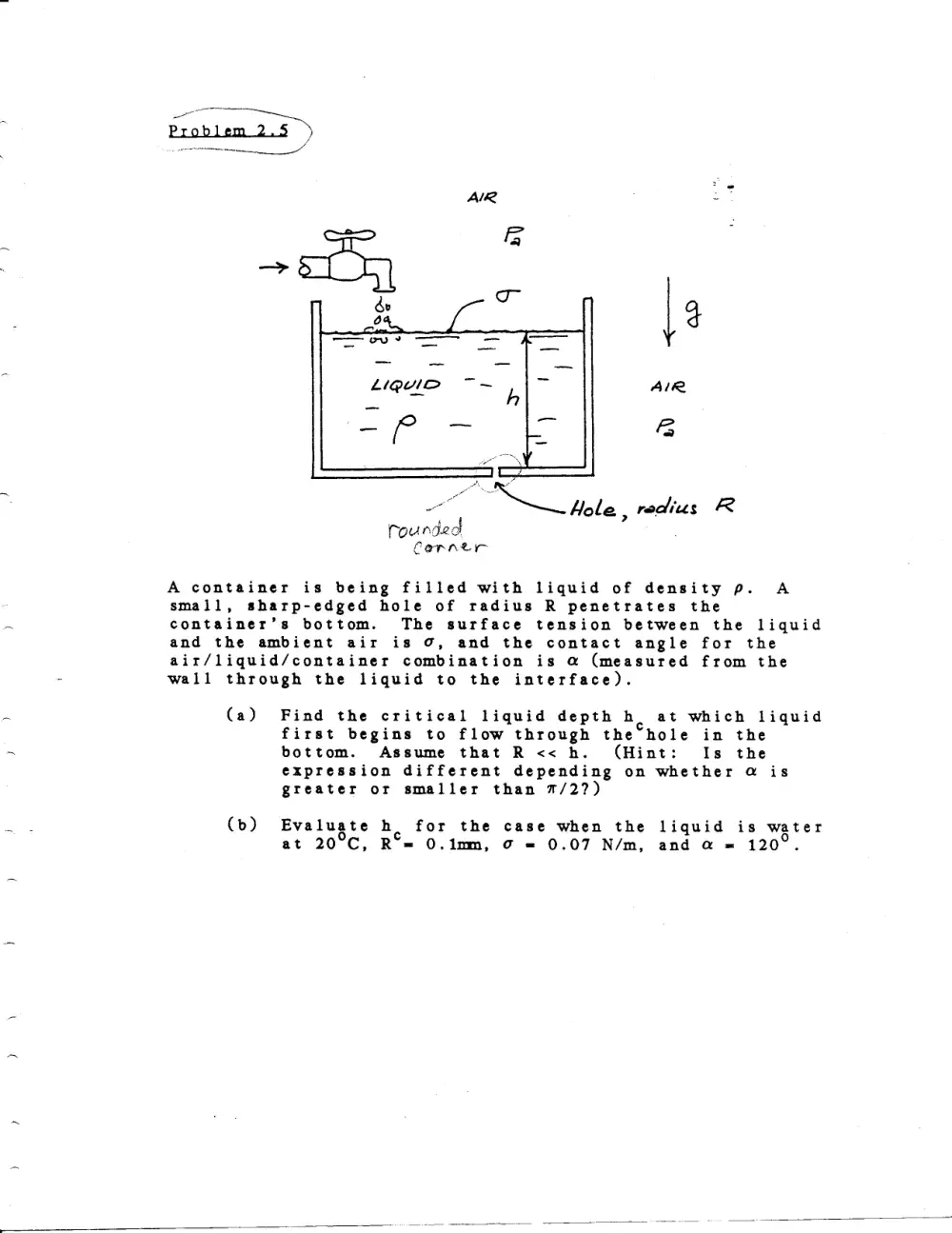
A container is being filled with liquid of density p. A
small, sharp-edged hole of radius R penetrates the
container’s bottom. The surface tension between the liquid
and the ambient air is 9, and the contact angle for the
air/liquid/container combination is @ (measured from the
wall through the liquid to the interface).
(a)
(b)
Find the critical liquid depth A, at which liquid
first begins to flow through the “hole in the
bottom. Assume that R << h. (Hint: Is the
expression different depending on whether @ is
greater or smaller than 7/27)
Evaluate hy for the case when the liquid is water
at 20°C, R°= 0.1mm, o = 0.07 N/m, and a = 120°
ar
The water strider, or pond skater, is a slender insect,
about 1/2 cm long, that runs or “skates” over the surfaces
of ponds and streams. It stays easily on the surface
because its feet (tarsi) are equipped with numerous fine,
nonwetting hairs.
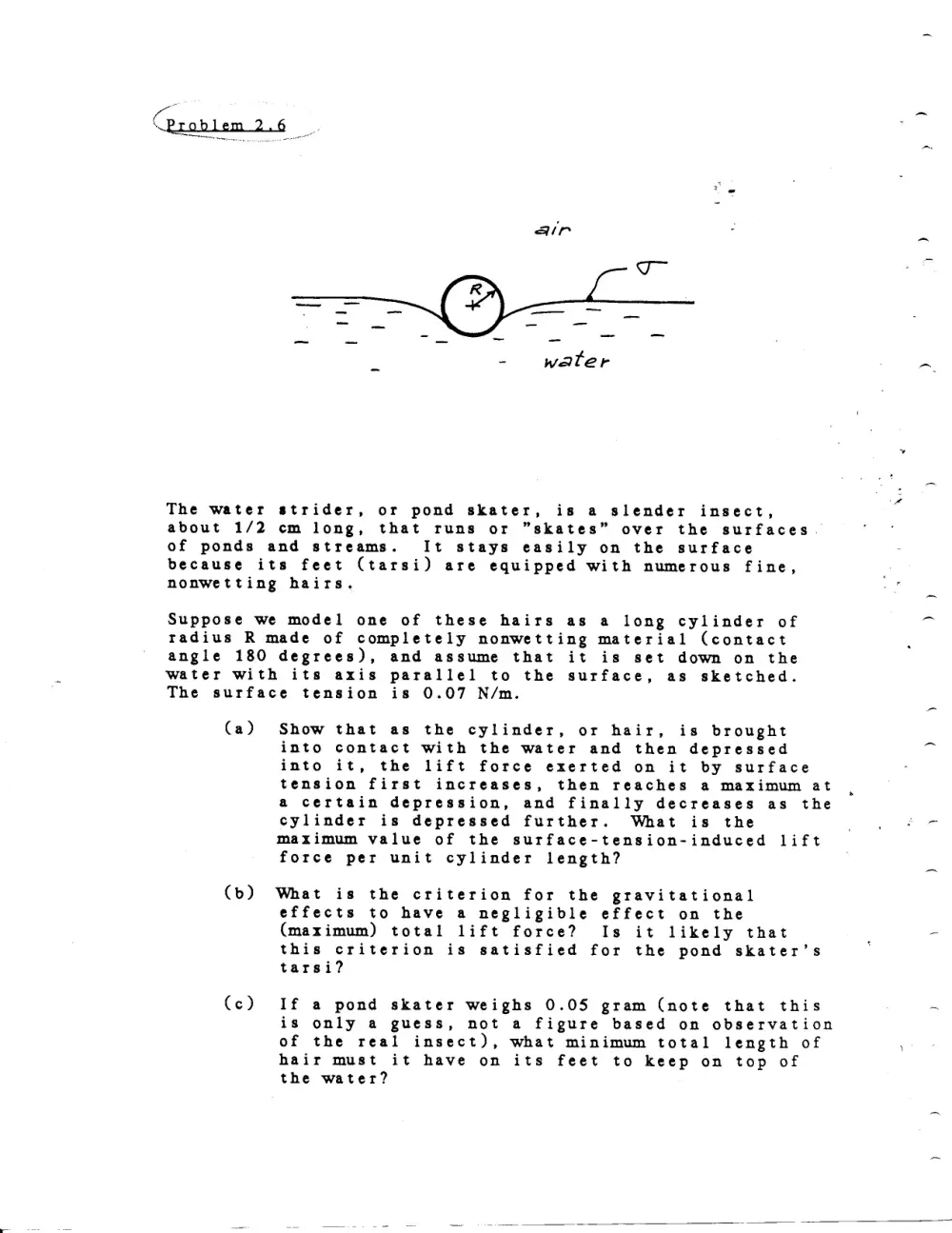
Suppose we model one of these hairs as a long cylinder of
tadius R made of completely nonwetting material (contact
angle 180 degrees), and assume that it is set down on the
water with its axis parallel to the surface, as sketched.
The surface tension is 0.07 N/m.
(a) Show that as the cylinder, or hair, is brought
into contact with the water and then depressed
into it, the lift force exerted on it by surface
tension first increases, then reaches a maximum at
a certain depression, and finally decreases as the
cylinder is depressed further. What is the
maximum value of the surface-tension-induced lift
force per unit cylinder length?
(b) What is the criterion for the gravitational
effects to have a negligible effect on the
(maximum) total lift force? Is it likely that
this criterion is satisfied for the pond skater’s
tarsi?
(c) If a pond skater weighs 0.05 gram (note that this
is only a guess, not a figure based on observation
of the real insect), what minimum total length of
hair must it have on its feet to keep on top of
the water?
~
E
AIR | PLATE AIR
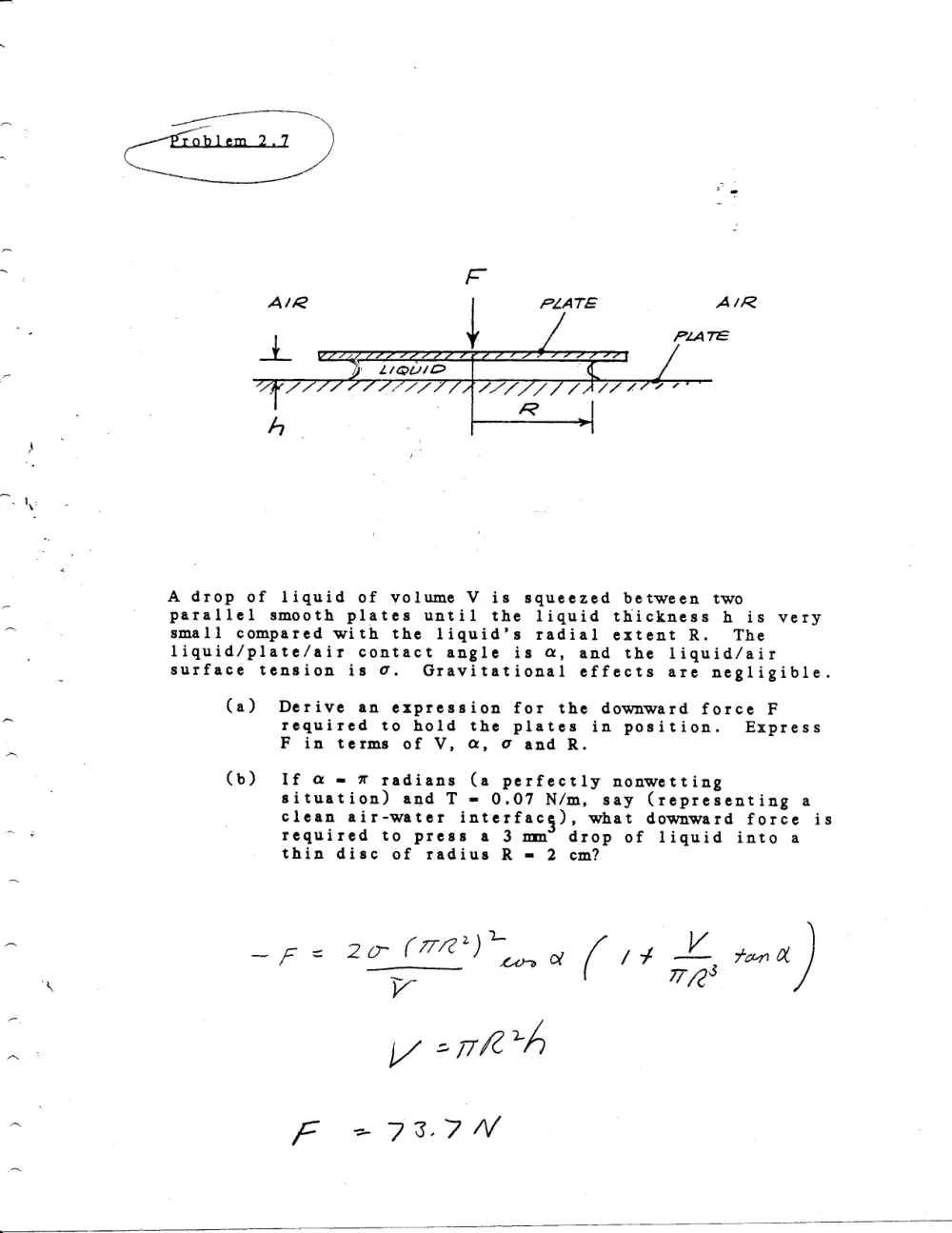
A drop of liquid of volume V is squeezed between two
parallel smooth plates until the liquid thickness h is very
small compared with the liquid’s radial extent R. The
liquid/plate/air contact angle is @, and the liquid/air
surface tension is o. Gravitational effects are negligible.
(a)
(bo)
Derive an expression for the downward force F
tequired to hold the plates in position. Express
F in terms of V, @, o and R.
If a = 7 radians (a perfectly nonwetting
situation) and T = 0.07 N/m, say (representing a
clean air-water interface), what downward force is
required to press a 3 mm drop of liquid into a
thin disc of radius R = 2 cm?