
MECH 314 Problems 11, Spring 2014
American University of Beirut · Introduction to Fluids Engineering · 8 pages
More MECH 314 files
Show the text of this problems
MECH 314 Introduction to Fluid Mechanics
May 2, 2009
American University of Beirut, Spring 2009
Handout # Problems on Viscous Flow
Problems on Viscous Flow
“Advanced Fluid Mechanics Problems” by Shapiro and Sonin
Problems 6.1, 6.3, 6.7, 6.10, 6.16, 6.20, 6.23
Problem 6.1
Problem 6.1:
Problem 6.7:
Pa
P1
h
Q(x)
q(x)
x
L
100
kg
OIL
5 cm
0.002 cm
10 cm
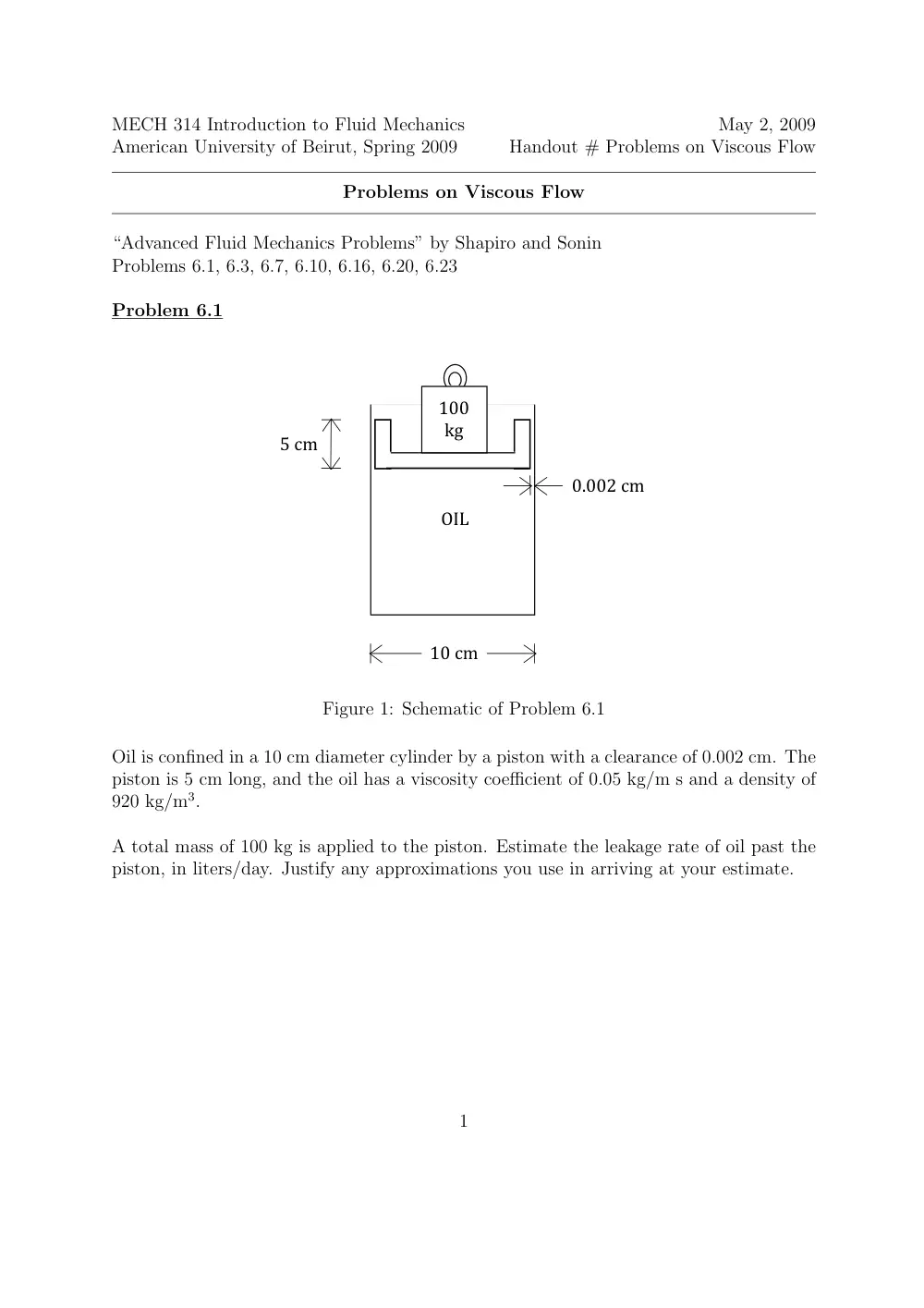
Figure 1: Schematic of Problem 6.1
Oil is confined in a 10 cm diameter cylinder by a piston with a clearance of 0.002 cm. The
piston is 5 cm long, and the oil has a viscosity coefficient of 0.05 kg/m s and a density of
920 kg/m3.
A total mass of 100 kg is applied to the piston. Estimate the leakage rate of oil past the
piston, in liters/day. Justify any approximations you use in arriving at your estimate.
1
Problem 6.3
Problem 6.3:
h(t)
Po
Q
D
F
h
d
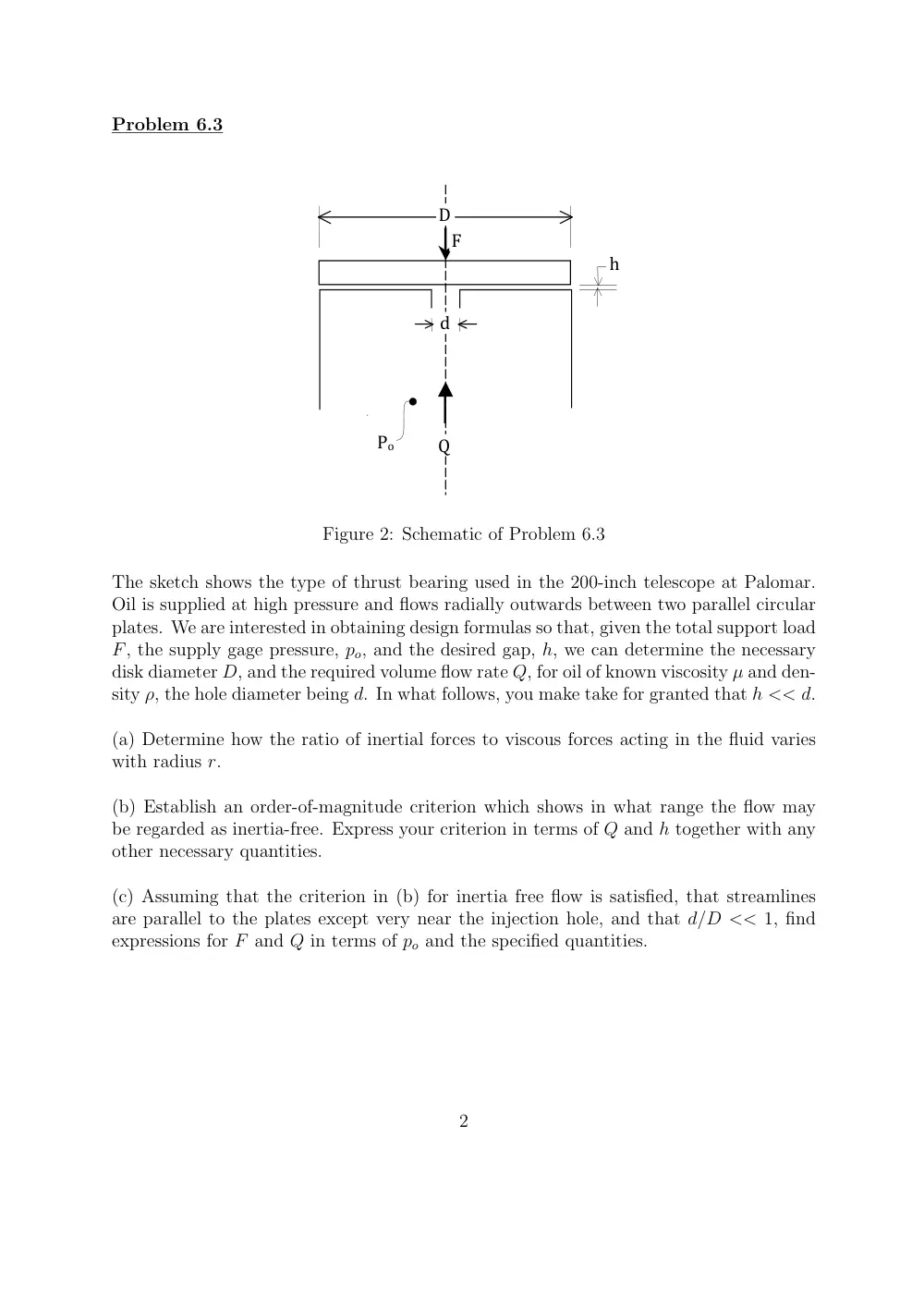
Figure 2: Schematic of Problem 6.3
The sketch shows the type of thrust bearing used in the 200-inch telescope at Palomar.
Oil is supplied at high pressure and flows radially outwards between two parallel circular
plates. We are interested in obtaining design formulas so that, given the total support load
F, the supply gage pressure, po, and the desired gap, h, we can determine the necessary
disk diameter D, and the required volume flow rate Q, for oil of known viscosity µ and den-
sity ρ, the hole diameter being d. In what follows, you make take for granted that h << d.
(a) Determine how the ratio of inertial forces to viscous forces acting in the fluid varies
with radius r.
(b) Establish an order-of-magnitude criterion which shows in what range the flow may
be regarded as inertia-free. Express your criterion in terms of Q and h together with any
other necessary quantities.
(c) Assuming that the criterion in (b) for inertia free flow is satisfied, that streamlines
are parallel to the plates except very near the injection hole, and that d/D << 1, find
expressions for F and Q in terms of po and the specified quantities.
2
Problem 6.7
Problem 6.7:
Pa
P1
h
Q(x)
q(x)
x
L
10 cm
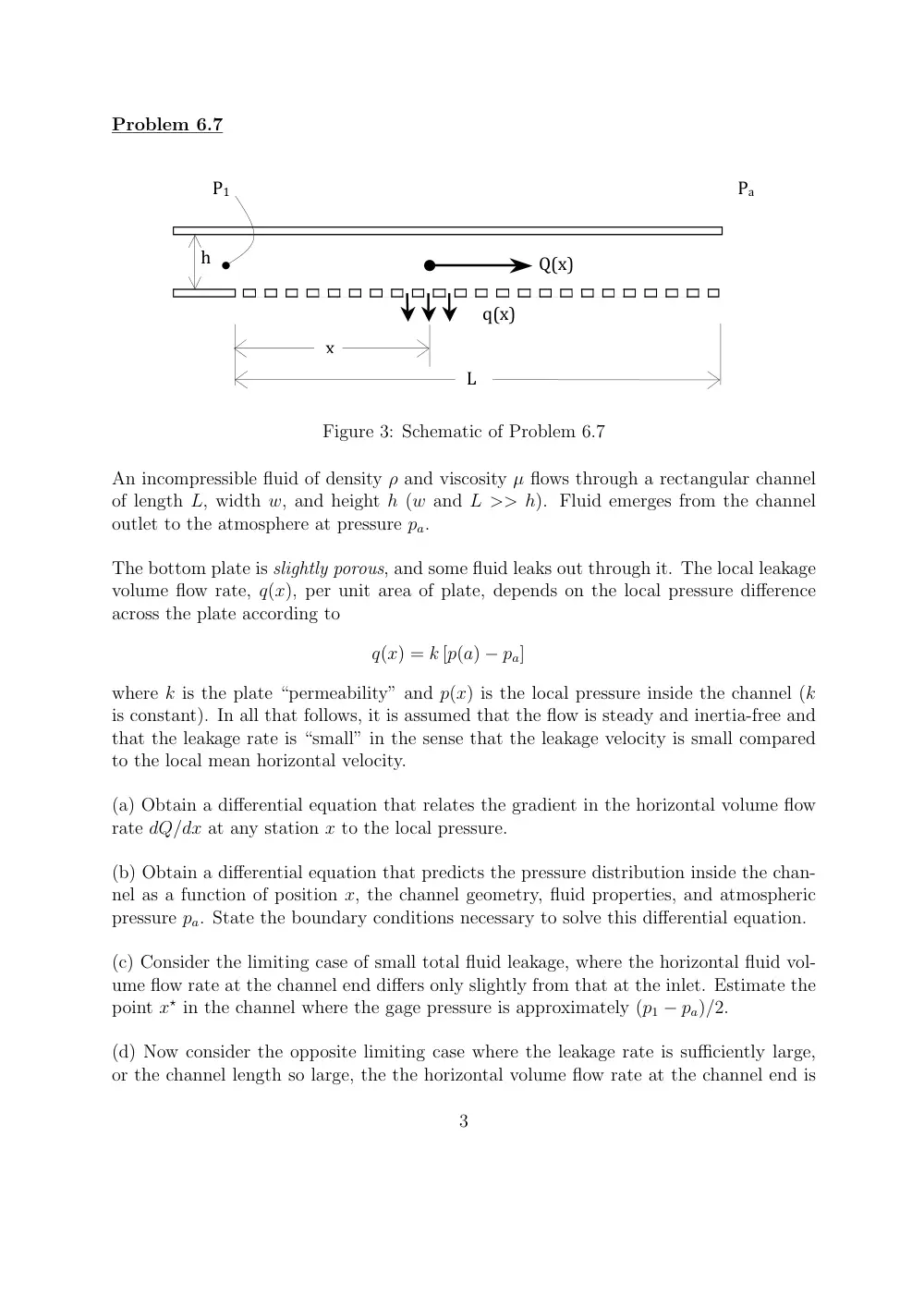
Figure 3: Schematic of Problem 6.7
An incompressible fluid of density ρ and viscosity µ flows through a rectangular channel
of length L, width w, and height h (w and L >> h). Fluid emerges from the channel
outlet to the atmosphere at pressure pa.
The bottom plate is slightly porous, and some fluid leaks out through it. The local leakage
volume flow rate, q(x), per unit area of plate, depends on the local pressure difference
across the plate according to
q(x) = k [p(a) − pa]
where k is the plate “permeability” and p(x) is the local pressure inside the channel (k
is constant). In all that follows, it is assumed that the flow is steady and inertia-free and
that the leakage rate is “small” in the sense that the leakage velocity is small compared
to the local mean horizontal velocity.
(a) Obtain a differential equation that relates the gradient in the horizontal volume flow
rate dQ/dx at any station x to the local pressure.
(b) Obtain a differential equation that predicts the pressure distribution inside the chan-
nel as a function of position x, the channel geometry, fluid properties, and atmospheric
pressure pa. State the boundary conditions necessary to solve this differential equation.
(c) Consider the limiting case of small total fluid leakage, where the horizontal fluid vol-
ume flow rate at the channel end differs only slightly from that at the inlet. Estimate the
point x⋆ in the channel where the gage pressure is approximately (p1 − pa)/2.
(d) Now consider the opposite limiting case where the leakage rate is sufficiently large,
or the channel length so large, the the horizontal volume flow rate at the channel end is
3
very small compared with that at the inlet. Use an order of magnitude analysis of your
differential equation in part (b) to estimate the point x⋆ in the channel where the gage
pressure is approximately (p1 − pa)/2.
(e) Solve the differential equation in (b) and show that your solution reduces to your
answers in (c) and (d) in the appropriate limits.
4
Problem 6.10
Problem 6.16:
viscous liquid
y
x
h(x,t)
θ
g
air, Pa
α
y
x
U
h(x)
αx
L
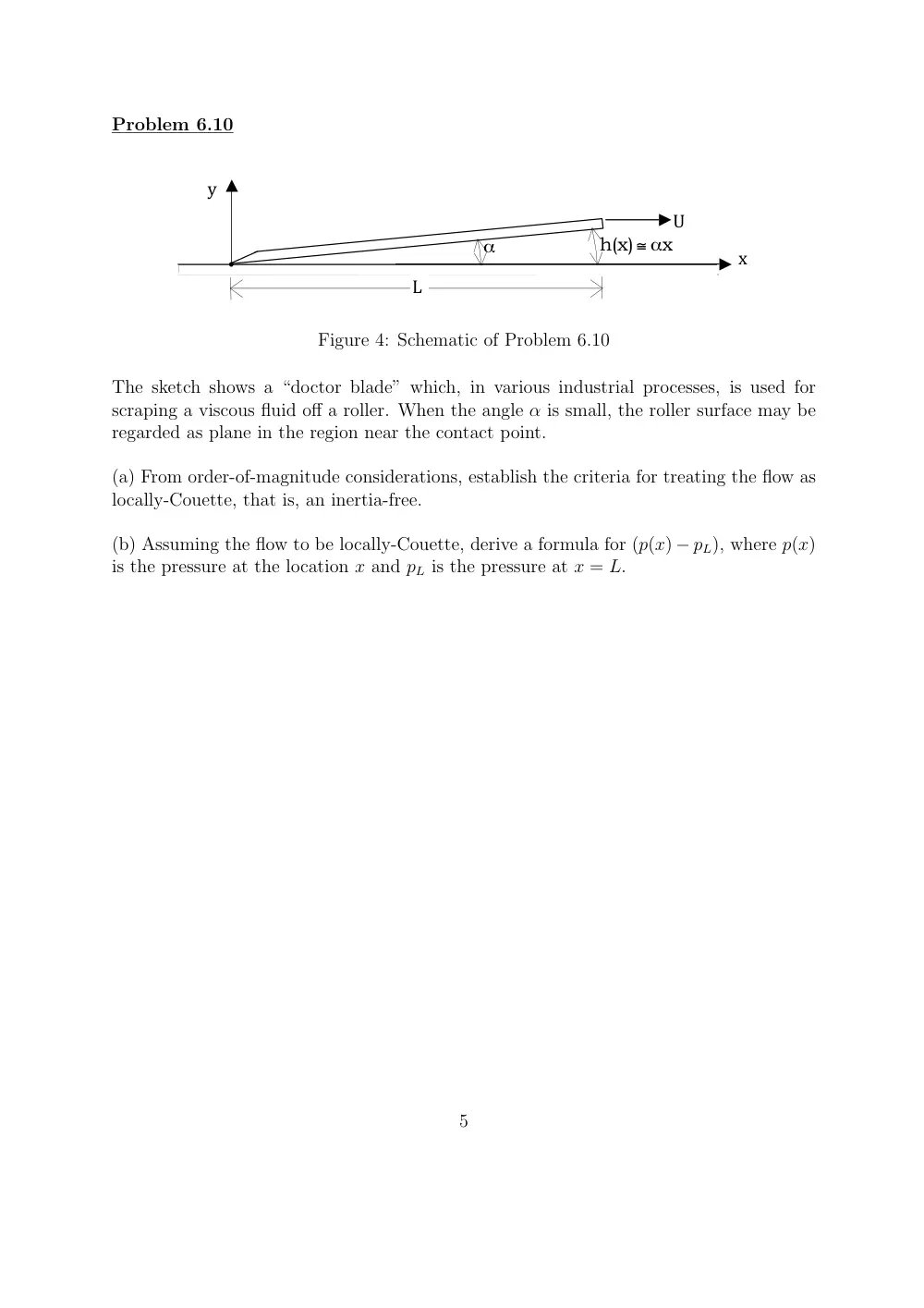
Figure 4: Schematic of Problem 6.10
The sketch shows a “doctor blade” which, in various industrial processes, is used for
scraping a viscous fluid off a roller. When the angle α is small, the roller surface may be
regarded as plane in the region near the contact point.
(a) From order-of-magnitude considerations, establish the criteria for treating the flow as
locally-Couette, that is, an inertia-free.
(b) Assuming the flow to be locally-Couette, derive a formula for (p(x) − pL), where p(x)
is the pressure at the location x and pL is the pressure at x = L.
5
Problem 6.16
Problem 6.16:
viscous liquid
y
x
h(x,t)
θ
g
air, Pa
α
x
h(x)
αx
L
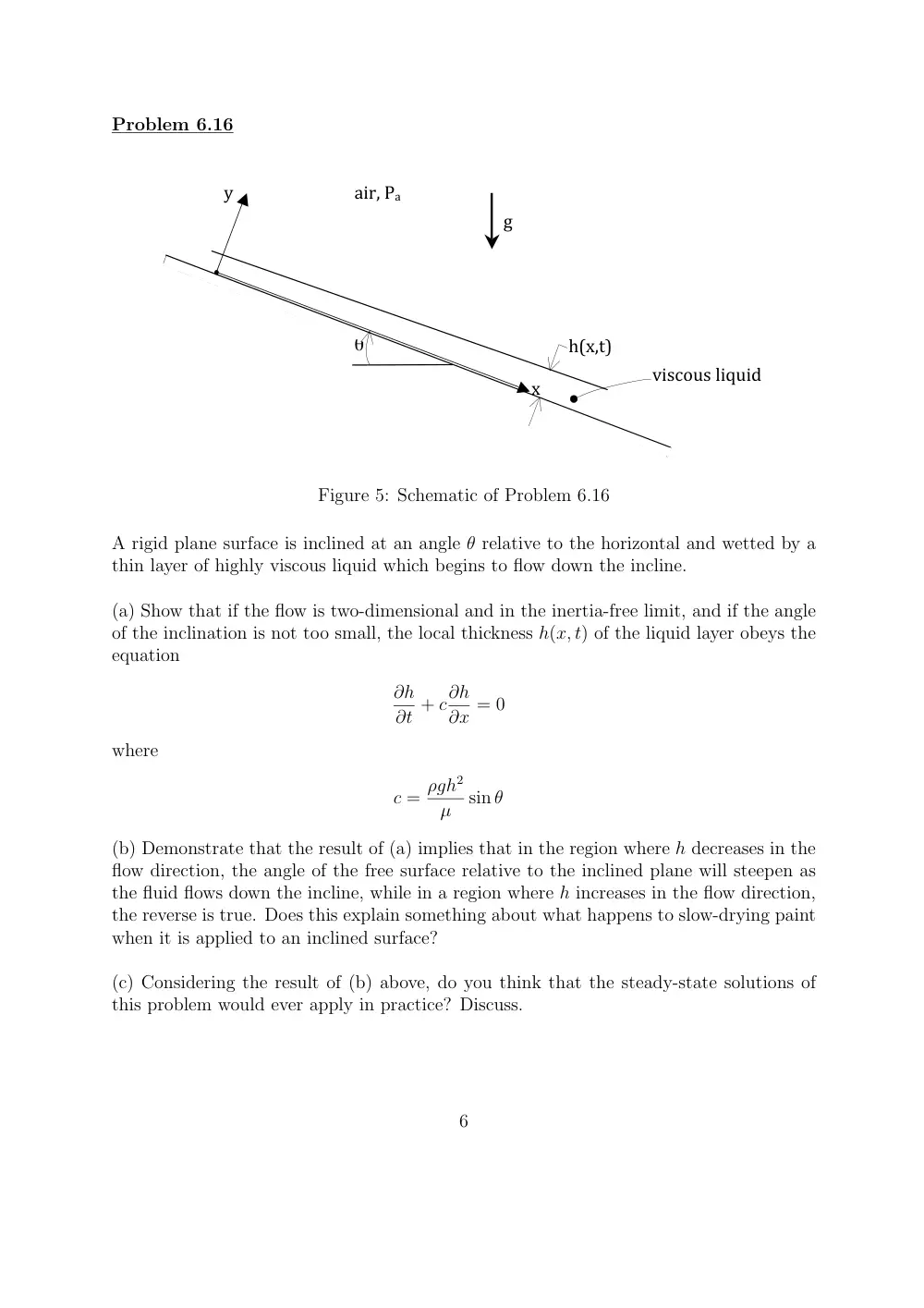
Figure 5: Schematic of Problem 6.16
A rigid plane surface is inclined at an angle θ relative to the horizontal and wetted by a
thin layer of highly viscous liquid which begins to flow down the incline.
(a) Show that if the flow is two-dimensional and in the inertia-free limit, and if the angle
of the inclination is not too small, the local thickness h(x, t) of the liquid layer obeys the
equation
∂h
∂t + c∂h
∂x = 0
where
c = ρgh2
µ
sin θ
(b) Demonstrate that the result of (a) implies that in the region where h decreases in the
flow direction, the angle of the free surface relative to the inclined plane will steepen as
the fluid flows down the incline, while in a region where h increases in the flow direction,
the reverse is true. Does this explain something about what happens to slow-drying paint
when it is applied to an inclined surface?
(c) Considering the result of (b) above, do you think that the steady-state solutions of
this problem would ever apply in practice? Discuss.
6
Problem 6.20
Problem 6.19:
Problem 6.23:
Problem 6.3:
h(t)
Pa
r
V(t)
R
θ(t)
hinge, radius R
viscous fluid
Pa
ρ, µ
L
Po
Q
D
F
h
d
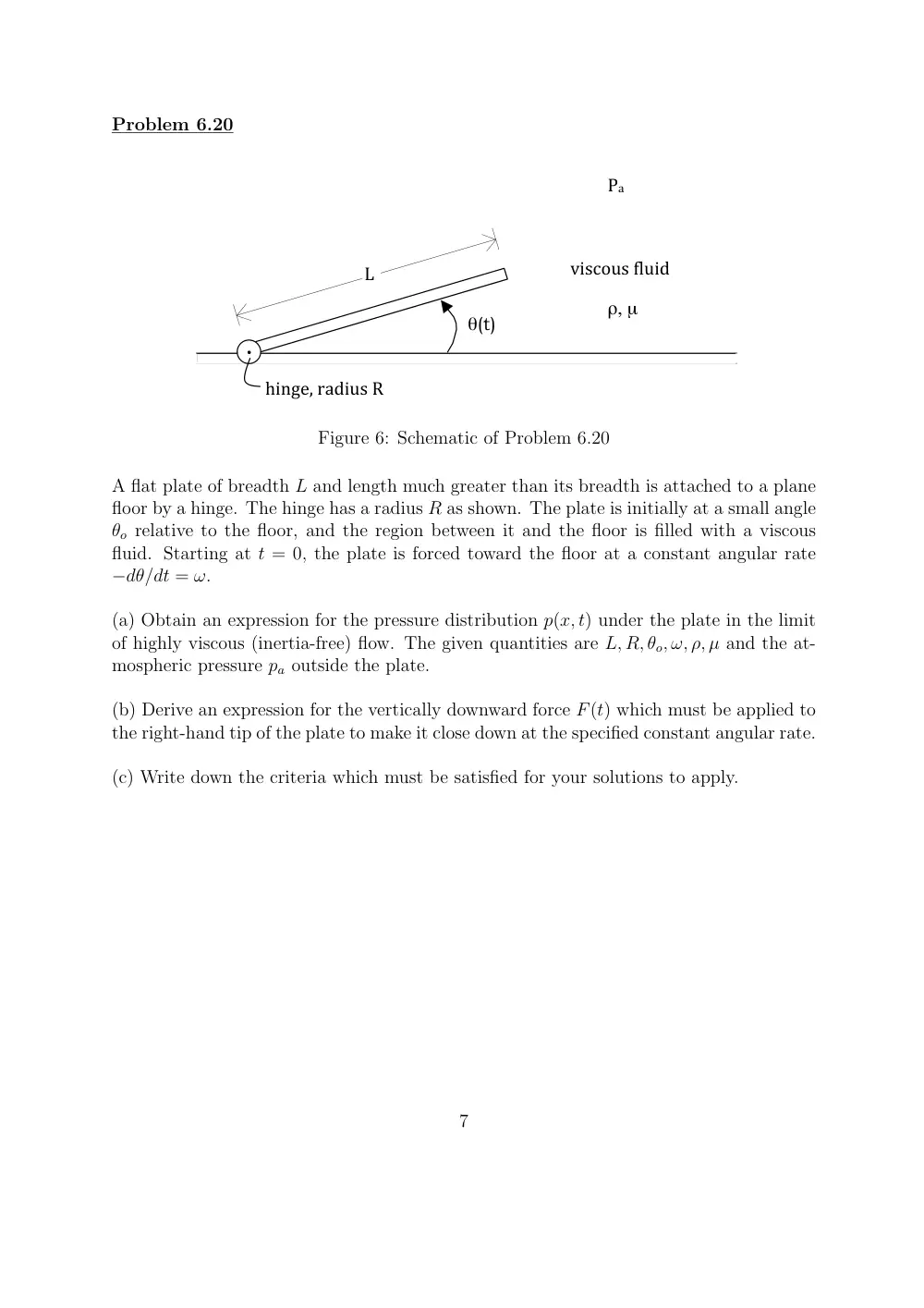
Figure 6: Schematic of Problem 6.20
A flat plate of breadth L and length much greater than its breadth is attached to a plane
floor by a hinge. The hinge has a radius R as shown. The plate is initially at a small angle
θo relative to the floor, and the region between it and the floor is filled with a viscous
fluid. Starting at t = 0, the plate is forced toward the floor at a constant angular rate
−dθ/dt = ω.
(a) Obtain an expression for the pressure distribution p(x, t) under the plate in the limit
of highly viscous (inertia-free) flow. The given quantities are L, R, θo, ω, ρ, µ and the at-
mospheric pressure pa outside the plate.
(b) Derive an expression for the vertically downward force F(t) which must be applied to
the right-hand tip of the plate to make it close down at the specified constant angular rate.
(c) Write down the criteria which must be satisfied for your solutions to apply.
7
Problem 6.23
Problem 6.23:
Problem 6.3:
h(t)
Pa
r
V(t)
R
θ(t)
hinge, radius R
Po
Q
D
F
h
d
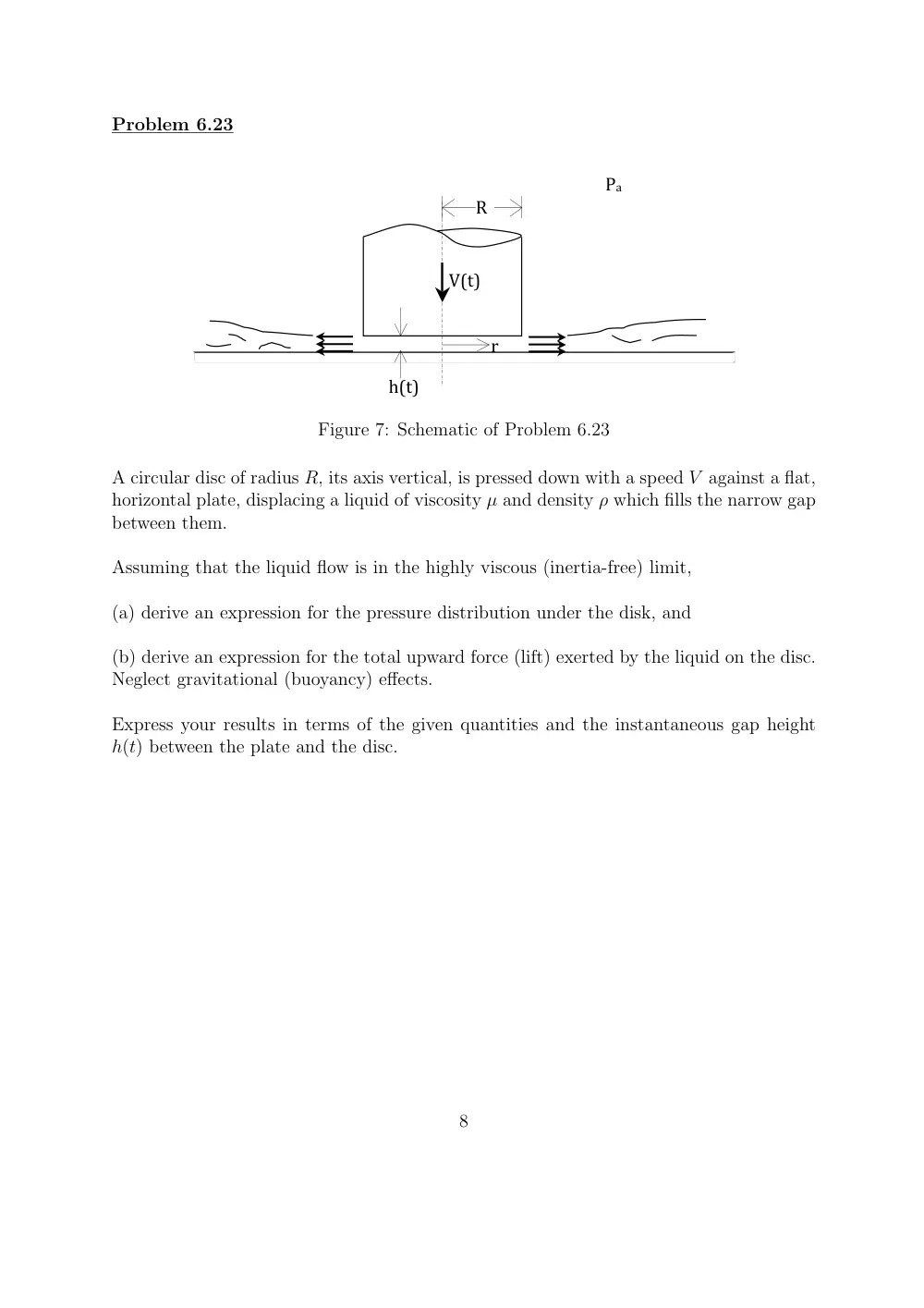
Figure 7: Schematic of Problem 6.23
A circular disc of radius R, its axis vertical, is pressed down with a speed V against a flat,
horizontal plate, displacing a liquid of viscosity µ and density ρ which fills the narrow gap
between them.
Assuming that the liquid flow is in the highly viscous (inertia-free) limit,
(a) derive an expression for the pressure distribution under the disk, and
(b) derive an expression for the total upward force (lift) exerted by the liquid on the disc.
Neglect gravitational (buoyancy) effects.
Express your results in terms of the given quantities and the instantaneous gap height
h(t) between the plate and the disc.
8