
MECH 430 Final, Spring 2007
American University of Beirut · Instrumentation and Measurements · 4 pages

More MECH 430 files
Show the text of this final exam
AMERICAN UNIVERSITY OF BEIRUT
MECH 430 Instrumentation & Measurements
Final Exam – June 11th, 2007
Time Allowed: 2 hours
Closed Book – A non-programmable calculator is allowed.
Test Rules
•
Test period = 120 minutes.
•
Explain everything in order for me to give you part marks
•
If you are stuck on a part SKIP it and then come back later.
•
Sharing calculators is not allowed.
IMPORTANT: Write your name on this question booklet and hand it in with your script
book.
Name: ………………………………………………
Student Number: ………………………………….
Question 1 and 4 are mandatory
Choose among questions 2 or 3
MECH 430 Instrumentation & Measurements – Final (Spring 2007)
Problem I (40marks) (comprehensive)
1) What is a hot-wire anemometer and what is it used for? What is a thermal transport mass
flowmeter used for and how is it made? What is an ultrasonic flowmeter?
2) Explain the different types of RTD’s and what the advantages of each are.
3) How can you use a capacitor as a (1) microphone, as a (2) level sensor, as a (3) proximity
sensor?
4) What is an Eddy current displacement sensor? Draw a diagram for such a sensor and explain
how it works. What is the typical range and resolution of such a sensor?
5) How would you design a measurement system using an LVDT (from signal to ADC).
Explain why we use a phase sensitive demodulator in such a measurement system.
6) What is the main problem that can occur from unsuitable grounding? Explain with means of
a graph.
7) The DAQ that you used in your lab includes both an instrumentation amplifier and an A/D
converter. Explain what the instrumentation amplifier is and draw its circuit. Why not just
used an inverting amplifier? Why not just use a non-inverting amplifier. What are the
different issues you want to consider if you want to connect a sensor to this DAQ?
8) Consider the following types of position sensors: inductive, capacitive, eddy current,
ultrasonic. For the following conditions, indicate which of these types are not suitable and
explain why:
a. Environment with variable humidity,
b. Target object made of aluminum,
c. Target object made of steel,
d. Target object made of plastic,
e. Target object several feet away from sensor location
f. Environment with significant temperature fluctuations
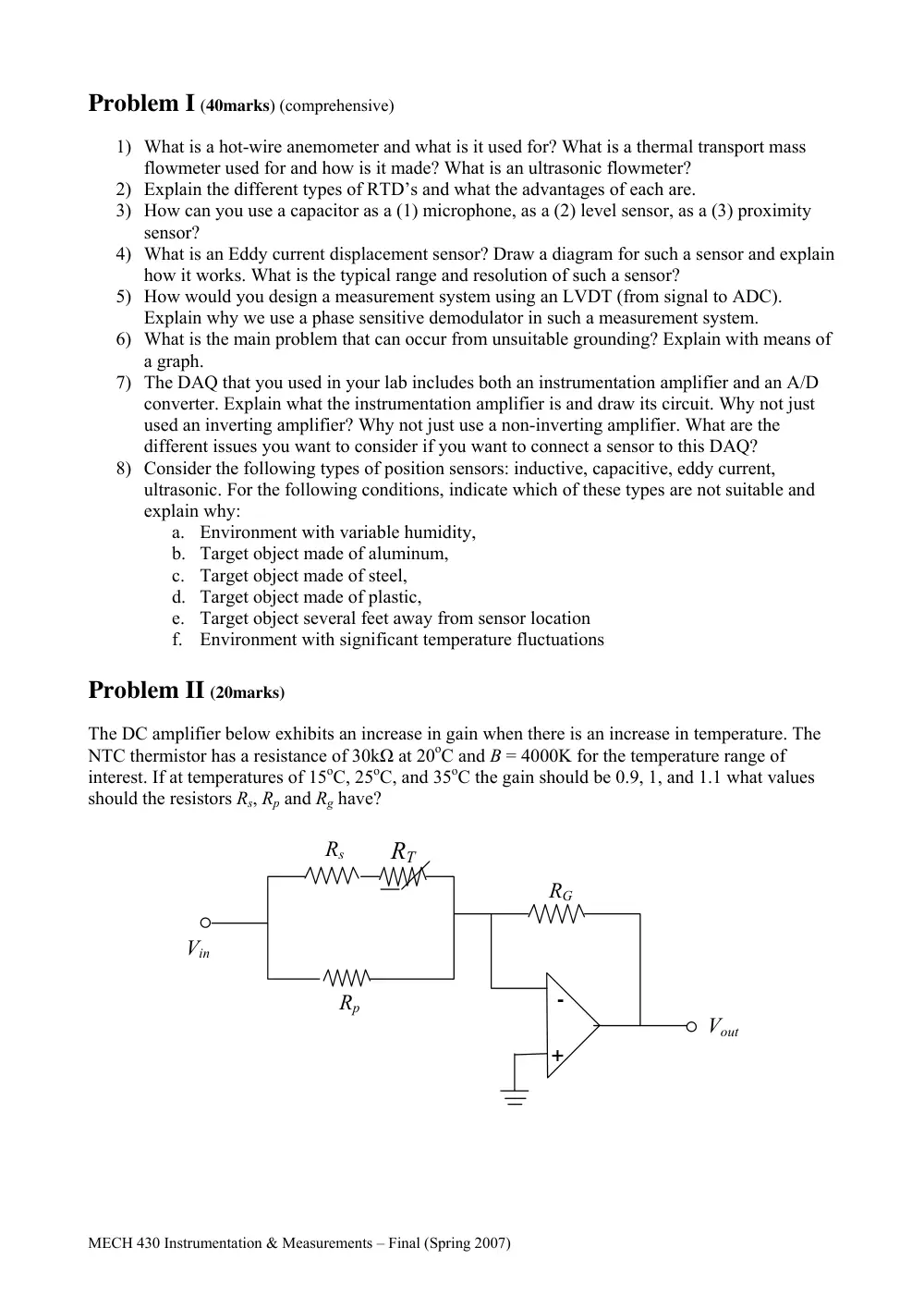
Problem II (20marks)
The DC amplifier below exhibits an increase in gain when there is an increase in temperature. The
NTC thermistor has a resistance of 30kΩ at 20oC and B = 4000K for the temperature range of
interest. If at temperatures of 15oC, 25oC, and 35oC the gain should be 0.9, 1, and 1.1 what values
should the resistors Rs, Rp and Rg have?
+
-
Rs
RT
Rp
Vin
RG
Vout
MECH 430 Instrumentation & Measurements – Final (Spring 2007)
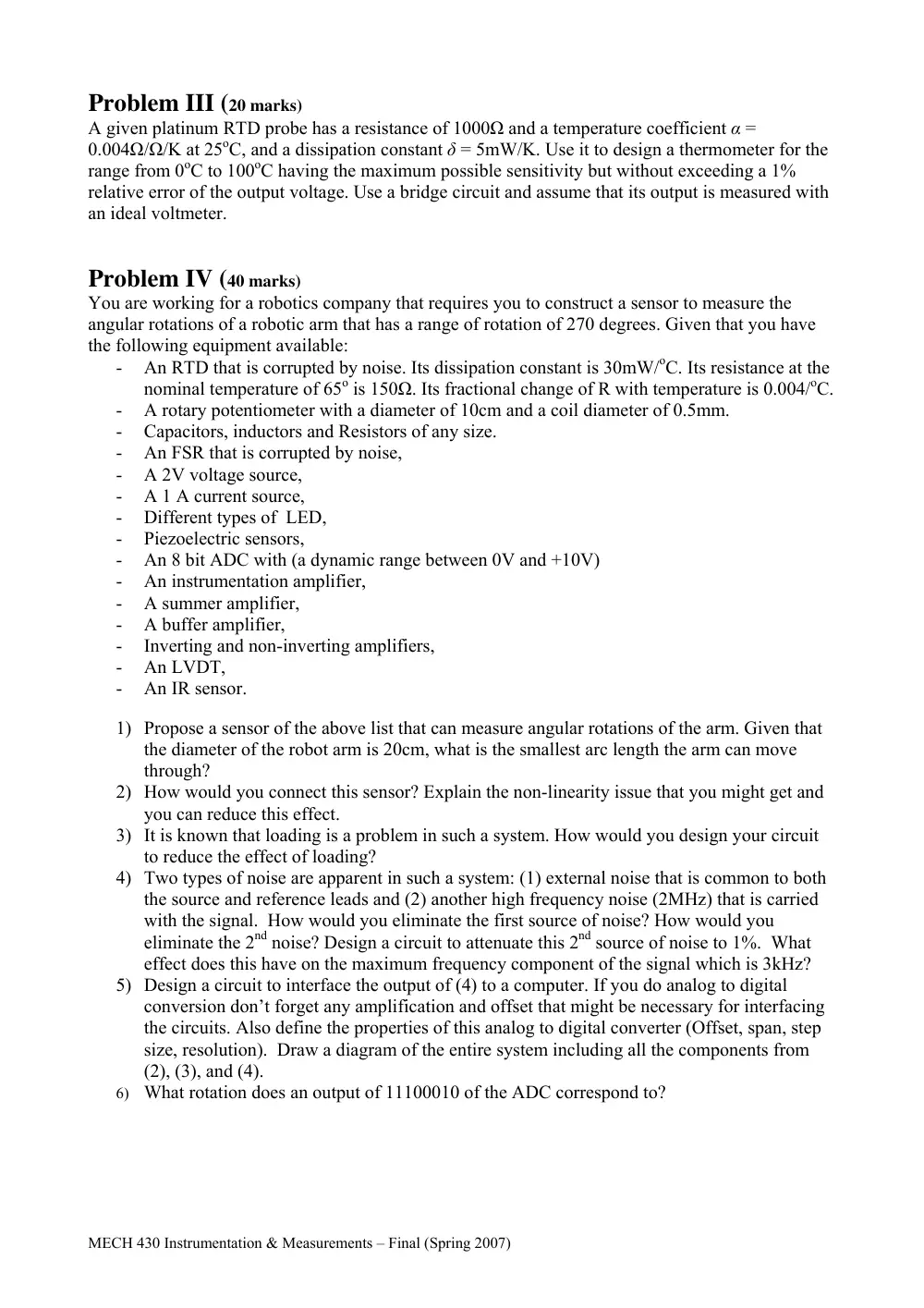
Problem III (20 marks)
A given platinum RTD probe has a resistance of 1000Ω and a temperature coefficient α =
0.004Ω/Ω/K at 25oC, and a dissipation constant δ = 5mW/K. Use it to design a thermometer for the
range from 0oC to 100oC having the maximum possible sensitivity but without exceeding a 1%
relative error of the output voltage. Use a bridge circuit and assume that its output is measured with
an ideal voltmeter.
Problem IV (40 marks)
You are working for a robotics company that requires you to construct a sensor to measure the
angular rotations of a robotic arm that has a range of rotation of 270 degrees. Given that you have
the following equipment available:
-
An RTD that is corrupted by noise. Its dissipation constant is 30mW/oC. Its resistance at the
nominal temperature of 65o is 150Ω. Its fractional change of R with temperature is 0.004/oC.
-
A rotary potentiometer with a diameter of 10cm and a coil diameter of 0.5mm.
-
Capacitors, inductors and Resistors of any size.
-
An FSR that is corrupted by noise,
-
A 2V voltage source,
-
A 1 A current source,
-
Different types of LED,
-
Piezoelectric sensors,
-
An 8 bit ADC with (a dynamic range between 0V and +10V)
-
An instrumentation amplifier,
-
A summer amplifier,
-
A buffer amplifier,
-
Inverting and non-inverting amplifiers,
-
An LVDT,
-
An IR sensor.
1) Propose a sensor of the above list that can measure angular rotations of the arm. Given that
the diameter of the robot arm is 20cm, what is the smallest arc length the arm can move
through?
2) How would you connect this sensor? Explain the non-linearity issue that you might get and
you can reduce this effect.
3) It is known that loading is a problem in such a system. How would you design your circuit
to reduce the effect of loading?
4) Two types of noise are apparent in such a system: (1) external noise that is common to both
the source and reference leads and (2) another high frequency noise (2MHz) that is carried
with the signal. How would you eliminate the first source of noise? How would you
eliminate the 2nd noise? Design a circuit to attenuate this 2nd source of noise to 1%. What
effect does this have on the maximum frequency component of the signal which is 3kHz?
5) Design a circuit to interface the output of (4) to a computer. If you do analog to digital
conversion don’t forget any amplification and offset that might be necessary for interfacing
the circuits. Also define the properties of this analog to digital converter (Offset, span, step
size, resolution). Draw a diagram of the entire system including all the components from
(2), (3), and (4).
6) What rotation does an output of 11100010 of the ADC correspond to?
MECH 430 Instrumentation & Measurements – Final (Spring 2007)
)
1/
1( /
T0
T
B
o
T
R e
R
−
=
))
(
1(
T0
T
R
R
o
−
+
=
α
1
2
R
R
v
v
i
o
= −
1
2
1
R
R
v
v
i
o
+
=
m
ref
OUT
x
x
V
V
=
ref
OUT
R V
R
R
V
2
1
1
+
=
100%
1
⎟×
⎠
⎞
⎜
⎝
= ⎛
N
r
(
)
2
/
1
1
c
I
o
f
f
V
V
+
=
(
)
2
/
1
/
c
c
I
o
f
f
f
f
V
V
+
=
RC
fc
1/ 2π
=
(
)
min
0
1
1
2
1
1
2
2
2
2
V
FS
b
b
b
b
n
n
n
n
X
+
×
×
+
×
+
+
×
+
×
=
−
− +
−
−
−
L
V
(
)
[
]
N
p
s
s
w
w
w
A
2
2
/
10log1
)
(
+ε
=
1
10
max /10
−
=
A
ε
s
a
nf
f
f
−
=
(
)(
)
R
o
R V
R
R
R
R R
R R
V
3
2
4
1
4
2
1 3
+
+
−
=
)
( )sin(
wt
CAx t
vs =
(
)
[
wt ]
x t
CA
wt
CA x t
v
v
p
s
( ) 1 cos 2
5.0
)
)sin (
(
2
2
2
−
=
=
×
Asin(wt)
vp =
MECH 430 Instrumentation & Measurements – Final (Spring 2007)