
PHY 201 Chapter 21, Fall 2012
Lebanese American University · Electricit and Magnetism · 6 pages · Dr. Husam Abu-Safe


More PHY 201 files
Show the text of this chapter
2/12/2013
1
Chapter 21
Electric Charge
21.2 Electric Charge:
21.3 Conductors and Insulators
Conductors are materials through which charge can move freely; examples include metals (such as
copper in common lamp wire), the human body, and tap water.
Nonconductors—also called insulators—are materials through which charge cannot move freely;
examples include rubber, plastic, glass, and chemically pure water.
Semiconductors are materials that are intermediate between conductors and insulators; examples
include silicon and germanium in computer chips.
Superconductors are materials that are perfect conductors, allowing charge to move without any
hindrance.
The properties of conductors and insulators are due to the structure and electrical nature of atoms.
Atoms consist of positively charged protons, negatively charged electrons, and electrically neutral
neutrons. The protons and neutrons are packed tightly together in a central nucleus.
When atoms of a conductor come together to form the solid, some of their outermost (and so most
loosely held) electrons become free to wander about within the solid, leaving behind positively
charged atoms ( positive ions).We call the mobile electrons conduction electrons.
There are few (if any) free electrons in a nonconductor.
2/12/2013
2
21.3 Conductors and Insulators
21.4 Coulomb’s Law
This force of repulsion or attraction due to the
charge properties of objects is called an
electrostatic force.
The equation giving the force for charged particles
is called Coulomb’s law:
where particle 1 has charge q1 and particle 2 has
charge q2, and F is the force on particle 1.
Here iis a unit vector along an axis extending
through the two particles, r is the distance between
them, and k is a constant.
The SI unit of charge is the coulomb.
The constant
The quantity 0 is called the permittivity constant
21.4 Coulomb’s Law
Current is the rate dq/dt at which charge moves past
a point or through a region
in which i is the current (in amperes) and dq (in
coulombs) is the amount of charge moving past a point
or through a region in time dt (in seconds).
Therefore,
2/12/2013
3
21.4 Coulomb’s Law
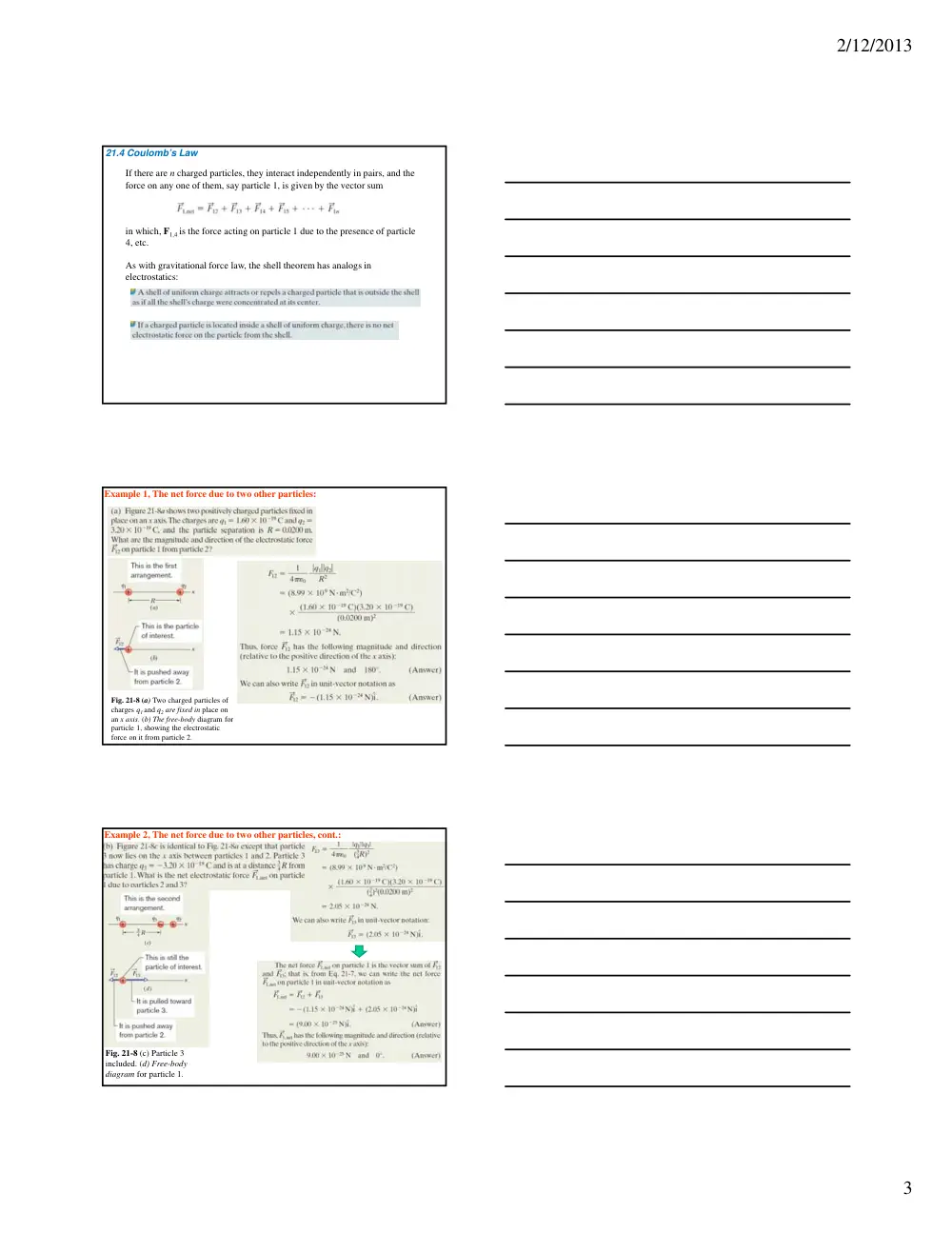
If there are n charged particles, they interact independently in pairs, and the
force on any one of them, say particle 1, is given by the vector sum
in which, F1,4 is the force acting on particle 1 due to the presence of particle
4, etc.
As with gravitational force law, the shell theorem has analogs in
electrostatics:
Example 1, The net force due to two other particles:
Fig. 21-8 (a) Two charged particles of
charges q1 and q2 are fixed in place on
an x axis. (b) The free-body diagram for
particle 1, showing the electrostatic
force on it from particle 2.
Example 2, The net force due to two other particles, cont.:
Fig. 21-8 (c) Particle 3
included. (d) Free-body
diagram for particle 1.
2/12/2013
4
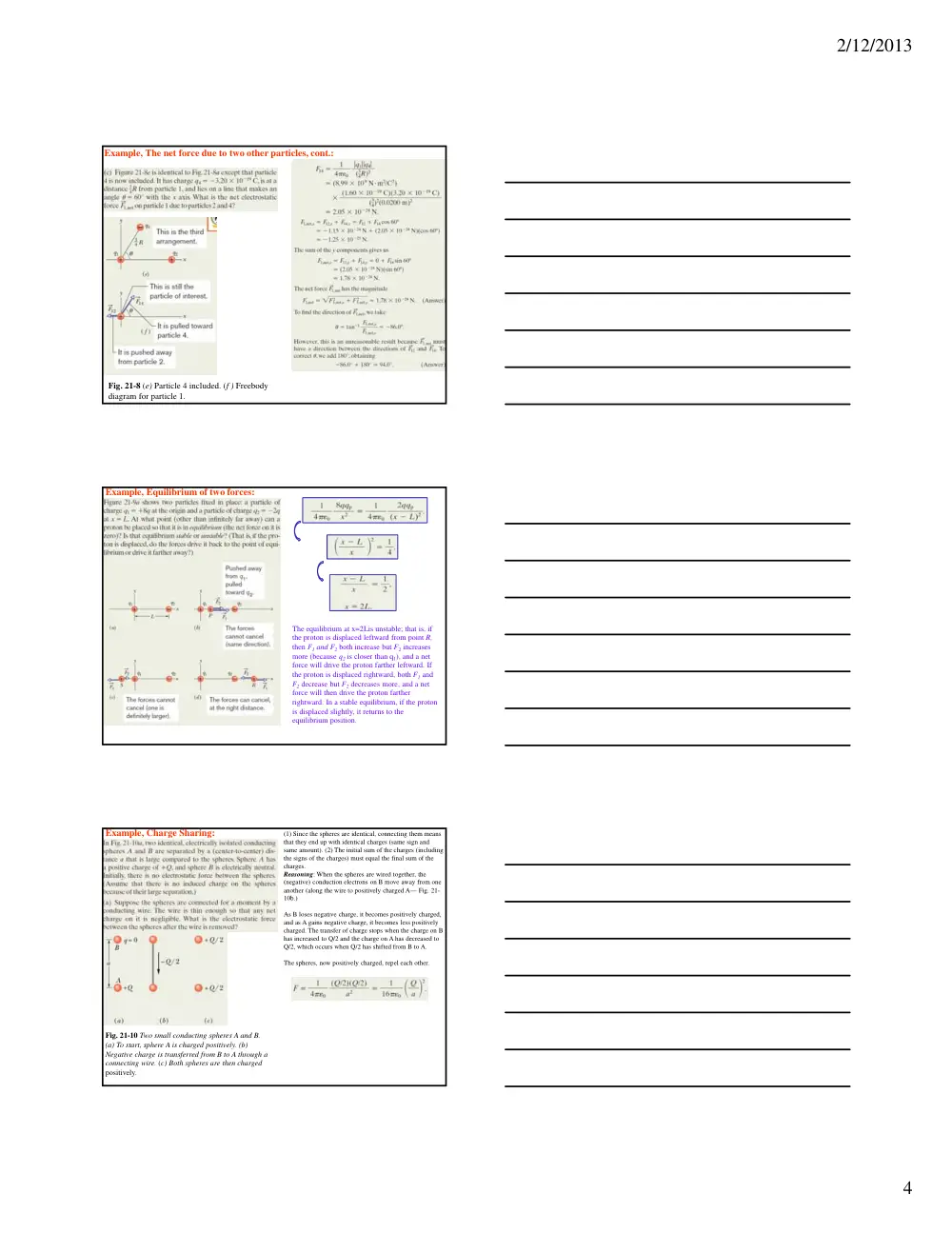
Example, The net force due to two other particles, cont.:
Fig. 21-8 (e) Particle 4 included. (f ) Freebody
diagram for particle 1.
Example, Equilibrium of two forces:
The equilibrium at x=2Lis unstable; that is, if
the proton is displaced leftward from point R,
then F1 and F2 both increase but F2 increases
more (because q2 is closer than q1), and a net
force will drive the proton farther leftward. If
the proton is displaced rightward, both F1 and
F2 decrease but F2 decreases more, and a net
force will then drive the proton farther
rightward. In a stable equilibrium, if the proton
is displaced slightly, it returns to the
equilibrium position.
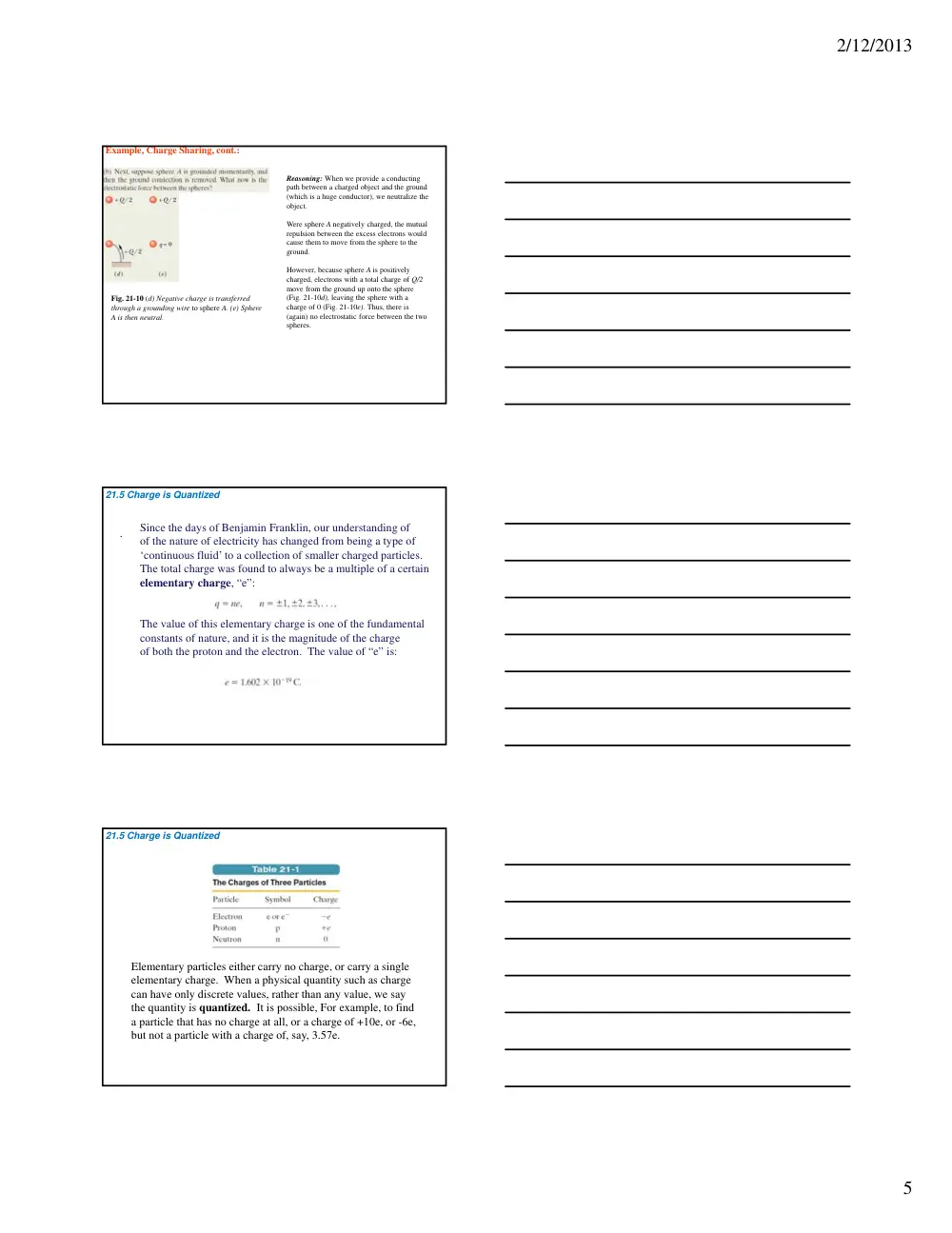
Example, Charge Sharing:
Fig. 21-10 Two small conducting spheres A and B.
(a) To start, sphere A is charged positively. (b)
Negative charge is transferred from B to A through a
connecting wire. (c) Both spheres are then charged
positively.
(1) Since the spheres are identical, connecting them means
that they end up with identical charges (same sign and
same amount). (2) The initial sum of the charges (including
the signs of the charges) must equal the final sum of the
charges.
Reasoning: When the spheres are wired together, the
(negative) conduction electrons on B move away from one
another (along the wire to positively charged A— Fig. 21-
10b.)
As B loses negative charge, it becomes positively charged,
and as A gains negative charge, it becomes less positively
charged. The transfer of charge stops when the charge on B
has increased to Q/2 and the charge on A has decreased to
Q/2, which occurs when Q/2 has shifted from B to A.
The spheres, now positively charged, repel each other.
2/12/2013
5
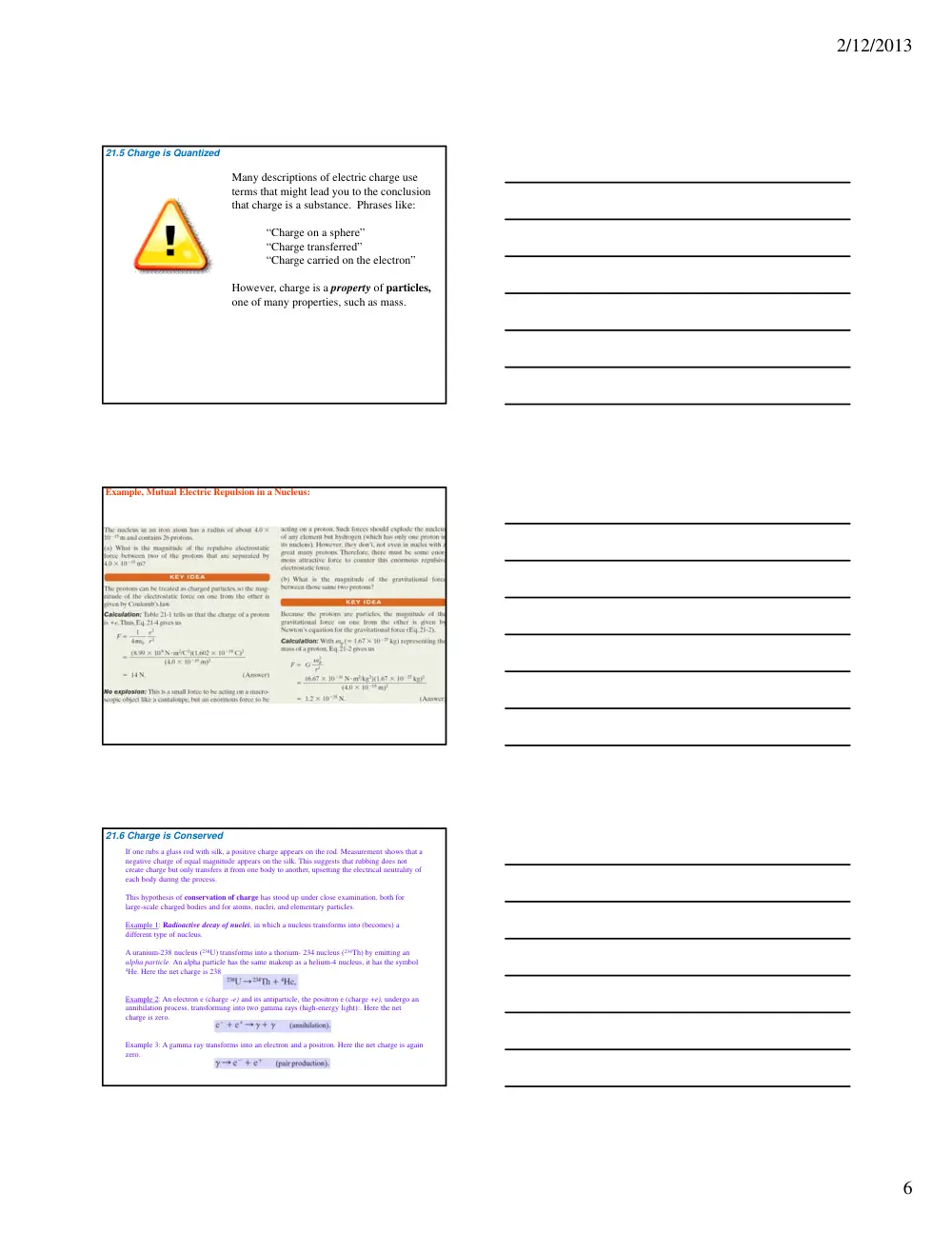
Example, Charge Sharing, cont.:
Fig. 21-10 (d) Negative charge is transferred
through a grounding wire to sphere A. (e) Sphere
A is then neutral.
Reasoning: When we provide a conducting
path between a charged object and the ground
(which is a huge conductor), we neutralize the
object.
Were sphere A negatively charged, the mutual
repulsion between the excess electrons would
cause them to move from the sphere to the
ground.
However, because sphere A is positively
charged, electrons with a total charge of Q/2
move from the ground up onto the sphere
(Fig. 21-10d), leaving the sphere with a
charge of 0 (Fig. 21-10e). Thus, there is
(again) no electrostatic force between the two
spheres.
21.5 Charge is Quantized
.
Since the days of Benjamin Franklin, our understanding of
of the nature of electricity has changed from being a type of
‘continuous fluid’ to a collection of smaller charged particles.
The total charge was found to always be a multiple of a certain
elementary charge, “e”:
The value of this elementary charge is one of the fundamental
constants of nature, and it is the magnitude of the charge
of both the proton and the electron. The value of “e” is:
21.5 Charge is Quantized
Elementary particles either carry no charge, or carry a single
elementary charge. When a physical quantity such as charge
can have only discrete values, rather than any value, we say
the quantity is quantized. It is possible, For example, to find
a particle that has no charge at all, or a charge of +10e, or -6e,
but not a particle with a charge of, say, 3.57e.
2/12/2013
6
Many descriptions of electric charge use
terms that might lead you to the conclusion
that charge is a substance. Phrases like:
“Charge on a sphere”
“Charge transferred”
“Charge carried on the electron”
However, charge is a property of particles,
one of many properties, such as mass.
21.5 Charge is Quantized
Example, Mutual Electric Repulsion in a Nucleus:
21.6 Charge is Conserved
If one rubs a glass rod with silk, a positive charge appears on the rod. Measurement shows that a
negative charge of equal magnitude appears on the silk. This suggests that rubbing does not
create charge but only transfers it from one body to another, upsetting the electrical neutrality of
each body during the process.
This hypothesis of conservation of charge has stood up under close examination, both for
large-scale charged bodies and for atoms, nuclei, and elementary particles.
Example 1: Radioactive decay of nuclei, in which a nucleus transforms into (becomes) a
different type of nucleus.
A uranium-238 nucleus (238U) transforms into a thorium- 234 nucleus (234Th) by emitting an
alpha particle. An alpha particle has the same makeup as a helium-4 nucleus, it has the symbol
4He. Here the net charge is 238.
Example 2: An electron e (charge -e) and its antiparticle, the positron e (charge +e), undergo an
annihilation process, transforming into two gamma rays (high-energy light):. Here the net
charge is zero.
Example 3: A gamma ray transforms into an electron and a positron. Here the net charge is again
zero.