
EECE 210 Final, Spring 2016
American University of Beirut · Electric Circuits · 10 pages


More EECE 210 files
- Final · Fall 2018Final examView
- Final Exam-solution · Fall 2016Final exam · with solutionView
- Final With Solution · Fall 2014Final exam · with solutionView
- Final · Fall 2013Final examView
- Problems For Final -with Some Solutions · Fall 2012Final exam · with solutionView
- Final with Solution · Fall 2011Final exam · with solutionView
- Final · Fall 2010Final examView
- Final · Fall 2009Final examView
Show the text of this final exam
AMERICAN UNIVERSITY OF BEIRUT
FACULTY OF ENGINEERING & ARCHITECTURE
Name:.......................................
FINAL EXAM
(EECE210) ELECTRIC CIRCUITS
CLOSED BOOK (2 HRS)
•
Programmable Calculators are not allowed
KEY: a c d c c b d a c a c d c d b c a
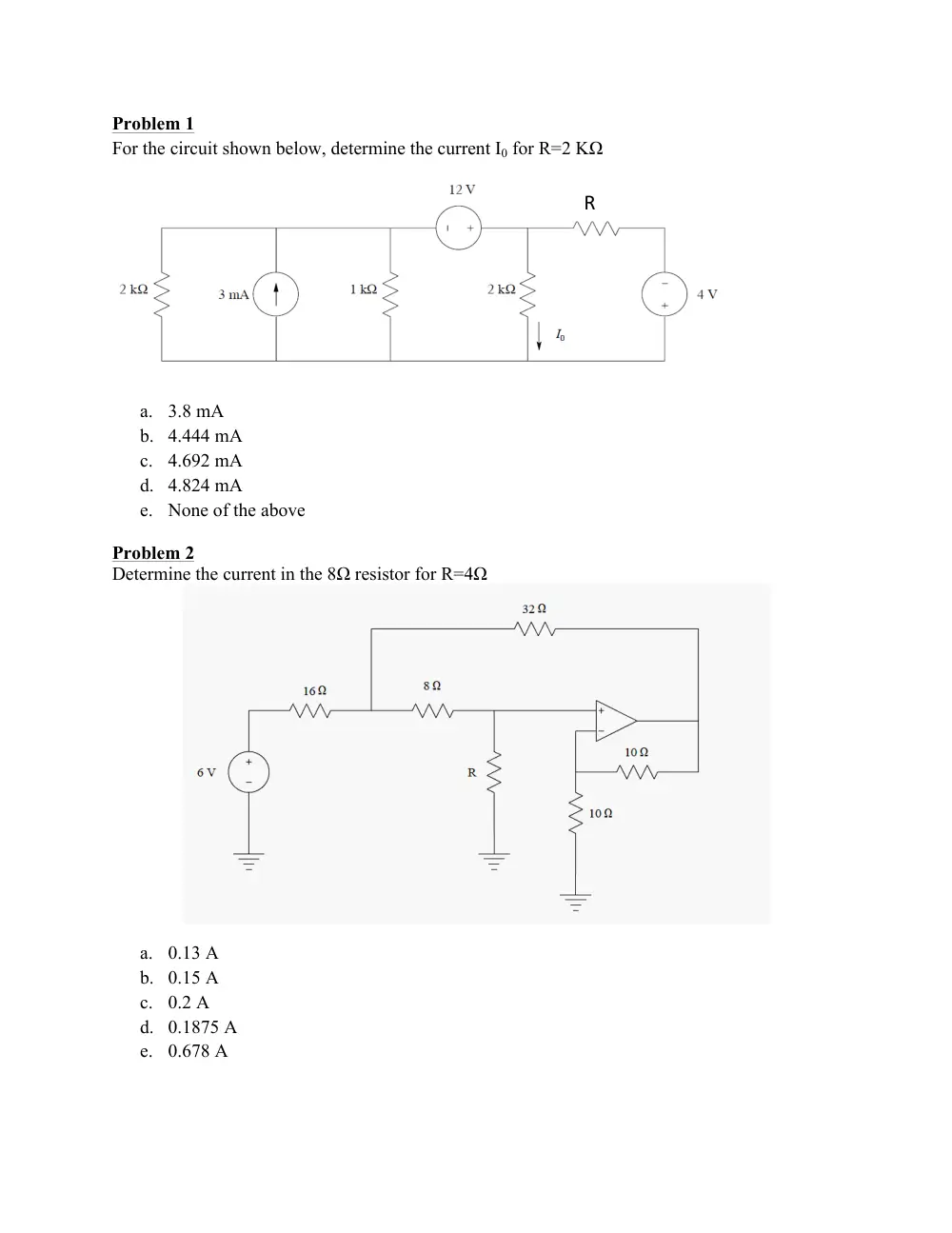
Problem 1
For the circuit shown below, determine the current I0 for R=2 KΩ
a. 3.8 mA
b. 4.444 mA
c. 4.692 mA
d. 4.824 mA
e. None of the above
Problem 2
Determine the current in the 8Ω resistor for R=4Ω
a. 0.13 A
b. 0.15 A
c. 0.2 A
d. 0.1875 A
e. 0.678 A
R
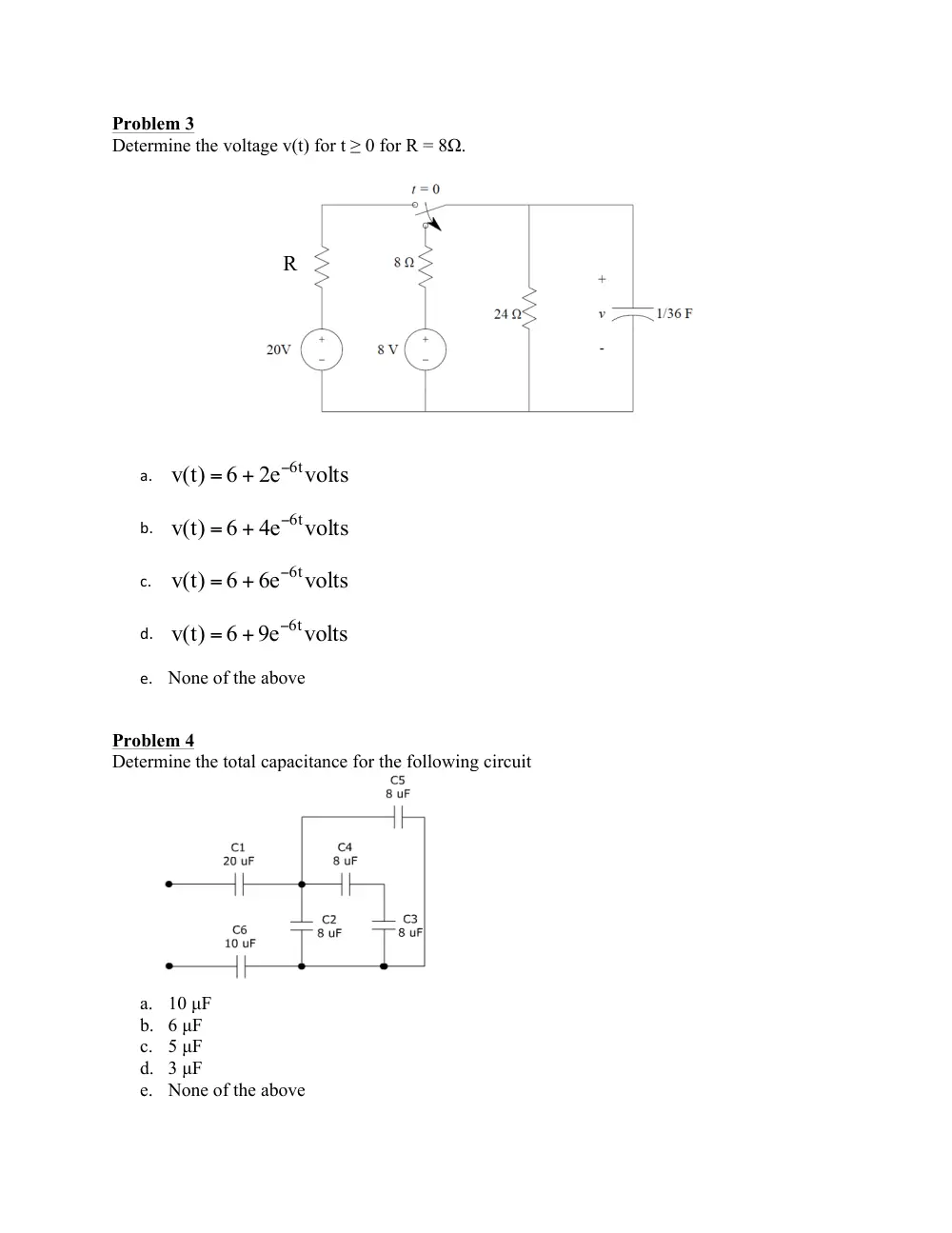
Problem 3
Determine the voltage v(t) for t ≥ 0 for R = 8Ω.
a.
volts
2e
6
)t(
v
−6t
+
=
b.
volts
4e
6
)t(
v
−6t
+
=
c.
volts
6e
6
)t(
v
−6t
+
=
d.
volts
9e
6
)t(
v
−6t
+
=
e. None of the above
Problem 4
Determine the total capacitance for the following circuit
a. 10 µF
b. 6 µF
c. 5 µF
d. 3 µF
e. None of the above
R
Problem 5
Find the Thévenin resistance with respect to the terminals a, b for the circuit shown below.
a) 37.5 Ω
b) 9.375 Ω
c) 18.75 Ω
d) 26.5 Ω
e) None of the above
Problem 6
If Vs = 5 mV in the circuit shown below, find Vo. Assume that the op-amp is ideal and
operating in the linear region.
a) 5.45V
b) 1.36 V
c) 4.09 V
d) 2.72 V
e) None of the above
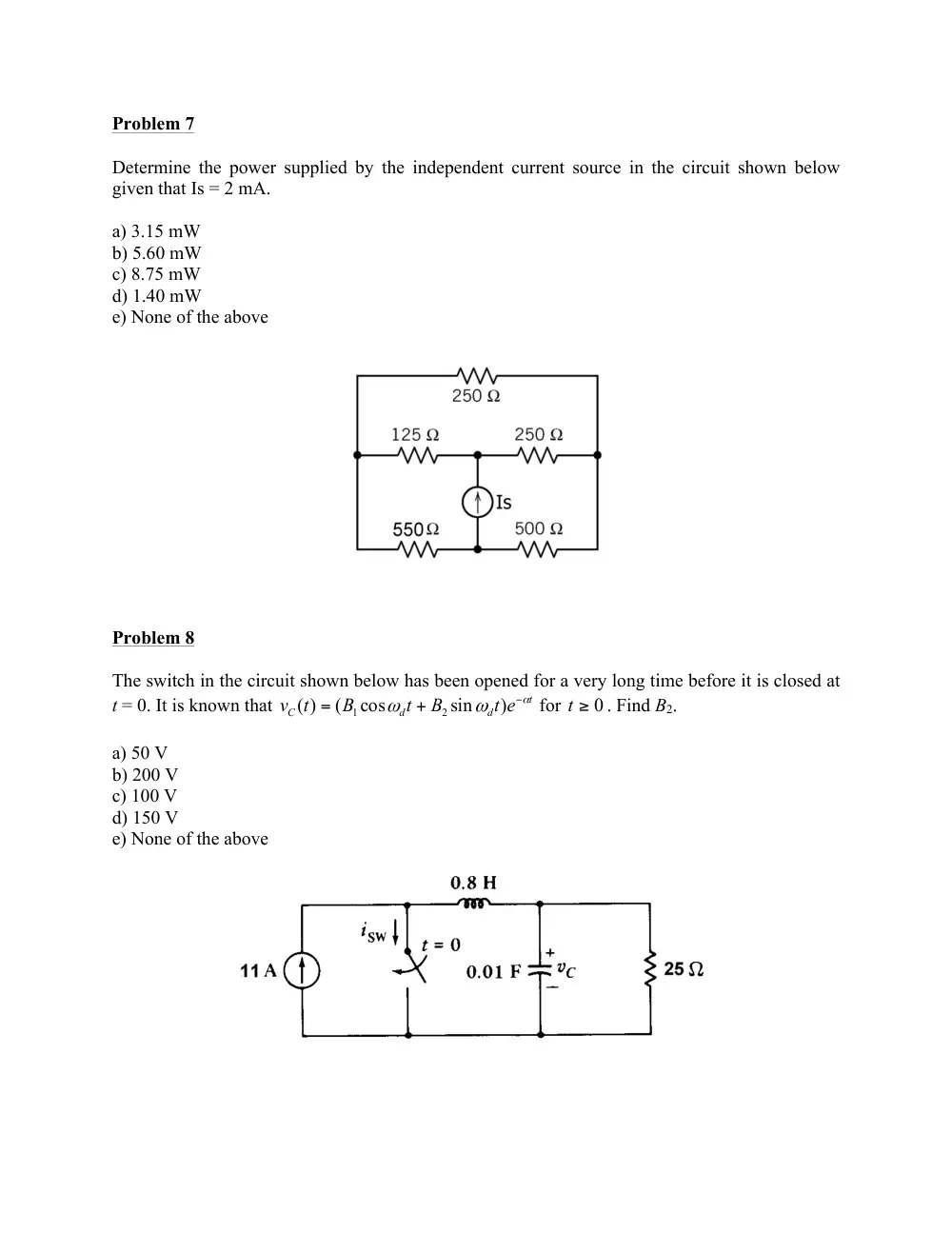
Problem 7
Determine the power supplied by the independent current source in the circuit shown below
given that Is = 2 mA.
a) 3.15 mW
b) 5.60 mW
c) 8.75 mW
d) 1.40 mW
e) None of the above
Problem 8
The switch in the circuit shown below has been opened for a very long time before it is closed at
t = 0. It is known that
t
d
d
C
t e
B
t
B
t
v
α
ω
ω
−
+
=
)
sin
cos
(
( )
2
1
for
t ≥ 0
. Find B2.
a) 50 V
b) 200 V
c) 100 V
d) 150 V
e) None of the above
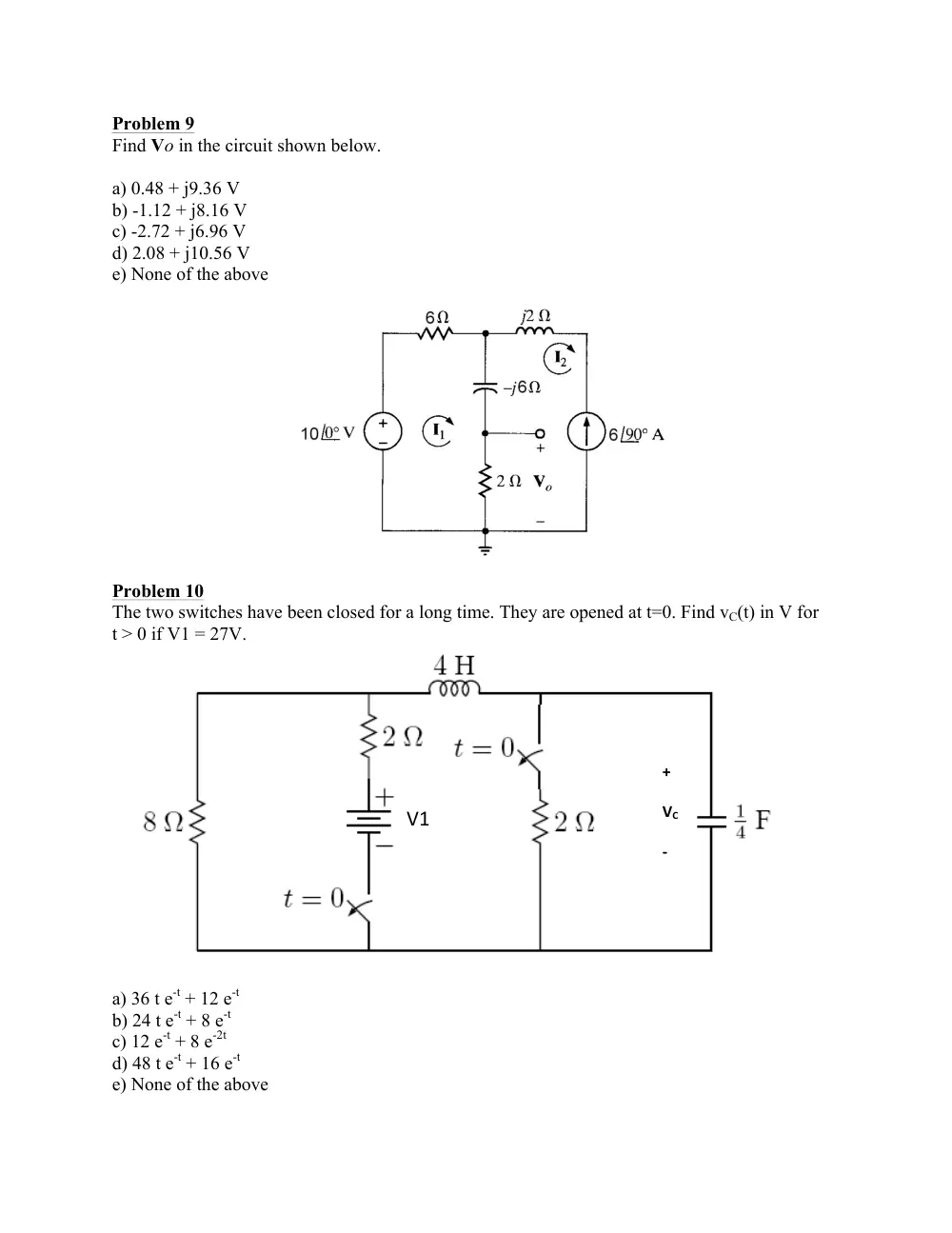
Problem 9
Find Vo in the circuit shown below.
a) 0.48 + j9.36 V
b) -1.12 + j8.16 V
c) -2.72 + j6.96 V
d) 2.08 + j10.56 V
e) None of the above
Problem 10
The two switches have been closed for a long time. They are opened at t=0. Find vC(t) in V for
t > 0 if V1 = 27V.
a) 36 t e-t + 12 e-t
b) 24 t e-t + 8 e-t
c) 12 e-t + 8 e-2t
d) 48 t e-t + 16 e-t
e) None of the above
+
VC
-
V1
Problem 11
The switch has been closed for a long time. It is opened at t=0. Find iL(t) in A
If I = 4A.
a) 2(2 – e-4t)
b) 4(2 – e-4t)
c) (2 – e-4t)
d) (1 – e-4t)
e) None of the above
Problem 12
The switch has been closed for a long time. It is opened at t=0. Find i(t) in A
If L = 4H.
a) 1 – 0.137 e-47.91t + 3.087 e-1.37t
b) 1 – 0.137 e-47.91t + 3.137 e-2.09t
c) 1 – 0.087 e-48.63t + 3.087 e-1.37t
d) 1 – 0.319 e-45.62t + 3.319 e-4.38t
e) None of the above
iL
I
L
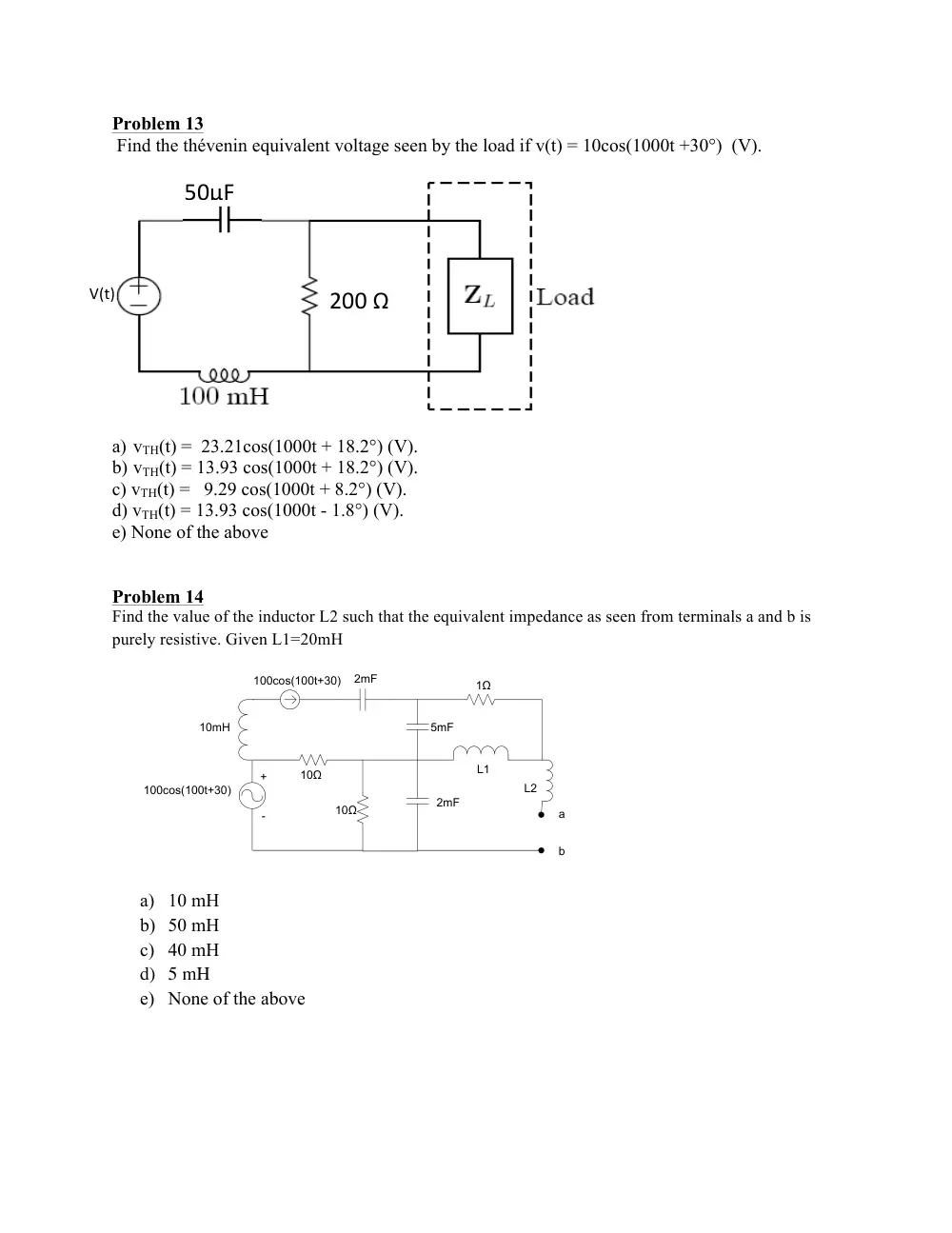
Problem 13
Find the thévenin equivalent voltage seen by the load if v(t) = 10cos(1000t +30°) (V).
a) vTH(t) = 23.21cos(1000t + 18.2°) (V).
b) vTH(t) = 13.93 cos(1000t + 18.2°) (V).
c) vTH(t) = 9.29 cos(1000t + 8.2°) (V).
d) vTH(t) = 13.93 cos(1000t - 1.8°) (V).
e) None of the above
Problem 14
Find the value of the inductor L2 such that the equivalent impedance as seen from terminals a and b is
purely resistive. Given L1=20mH
a
b
+
-
10mH
2mF
100cos(100t+30)
5mF
L1
L2
10Ω
100cos(100t+30)
10Ω
2mF
1Ω
a) 10 mH
b) 50 mH
c) 40 mH
d) 5 mH
e) None of the above
50µF
V(t)
200 Ω
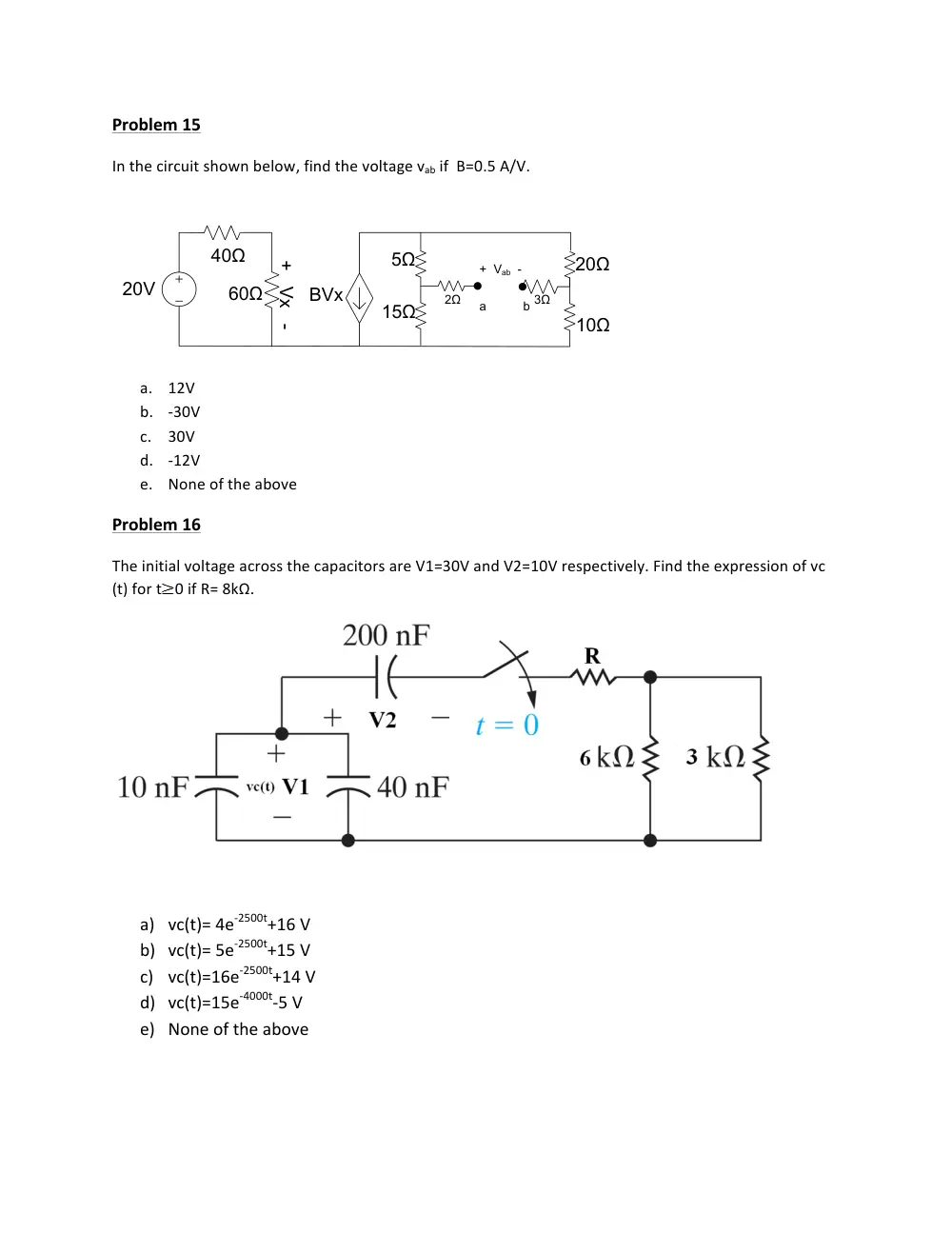
Problem 15
In the circuit shown below, find the voltage vab if B=0.5 A/V.
40Ω
20V
60Ω
BVx
+ Vx -
5Ω
+ Vab -
a
15Ω
2Ω
3Ω
b
20Ω
10Ω
a. 12V
b. -30V
c. 30V
d. -12V
e. None of the above
Problem 16
The initial voltage across the capacitors are V1=30V and V2=10V respectively. Find the expression of vc
(t) for t 0 if R= 8kΩ.
a) vc(t)= 4e-2500t+16 V
b) vc(t)= 5e-2500t+15 V
c) vc(t)=16e-2500t+14 V
d) vc(t)=15e-4000t-5 V
e) None of the above
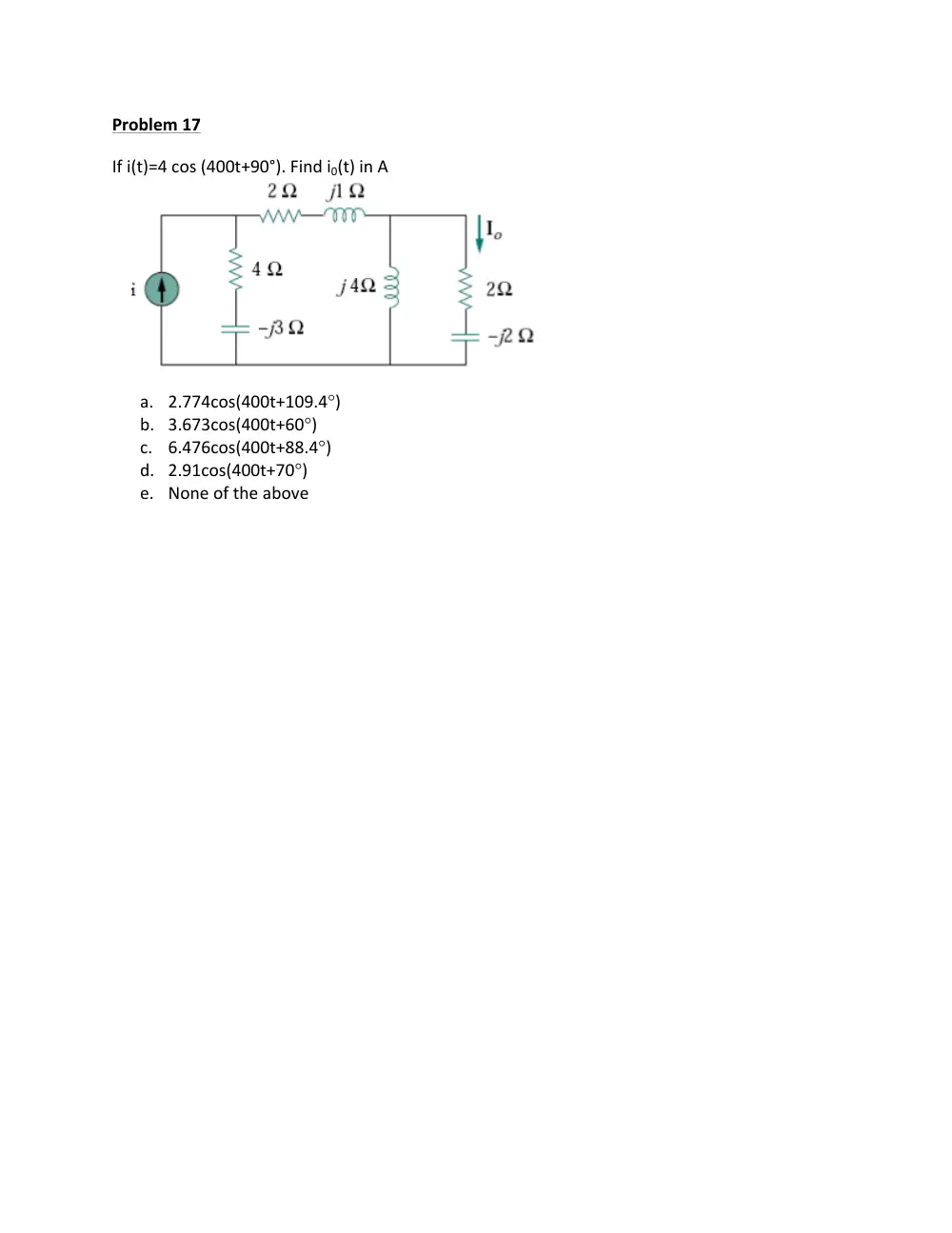
Problem 17
If i(t)=4 cos (400t+90°). Find i0(t) in A
a. 2.774cos(400t+109.4°)
b. 3.673cos(400t+60°)
c. 6.476cos(400t+88.4°)
d. 2.91cos(400t+70°)
e. None of the above