
EECE 340 Chapter 1, Fall 2011
American University of Beirut · Signals and Systems · 23 pages · Prof. Karim Kabalan



Showing the first 10 of 23 pages. Download the PDF to see all of it.
More EECE 340 files
Show the text of this chapter
EECE 340
EECE 340
Signals and Systems
Catalogue description
Si
l
d
t
li
ti
i
i
t
t
i
f
�
Signals and systems, linear time-invariant systems, review of
Fourier series representation of periodic signals, Fourier
transform and its applications, discrete-time Fourier transform,
Ti
d f
h
i
i
f i
l
d
Time and frequency characterization of signals and systems,
sampling, introduction to communication systems, review of
the Laplace transform, the Z-Transform. .
Required or Elective
� Required for CCE and EE
Prerequisites by Topic
Calculus, Differential Equations, Matrices,
Fourier Series, Fourier transform, and Laplace
transform. Computer Simulation skills using
Matlab, or similar packages.
Textbook
C.L. Phillips, J.M. Parr, and E.A. Riskin,
Signals, Systems, and Transformers, Prentice
g
y
Hall, 4rd Edition, 2008.
Course objectives
�
T
i t
d
t d
t
t
th
l fi ld
f
�
To introduce students to the general field of
communication engineering.
�
To develop in students mathematical, scientific, and
p
,
,
computational skills relevant to communication
systems.
�
To
teach
students
analysis
techniques
when
�
To teach students analysis techniques when
formulating and solving communication problems.
�
To cultivate skills pertinent to the communication
i
i
d
i
d
h
i
engineering design and synthesis.
�
To foster effective interaction skills and teamwork
communication.
communication.
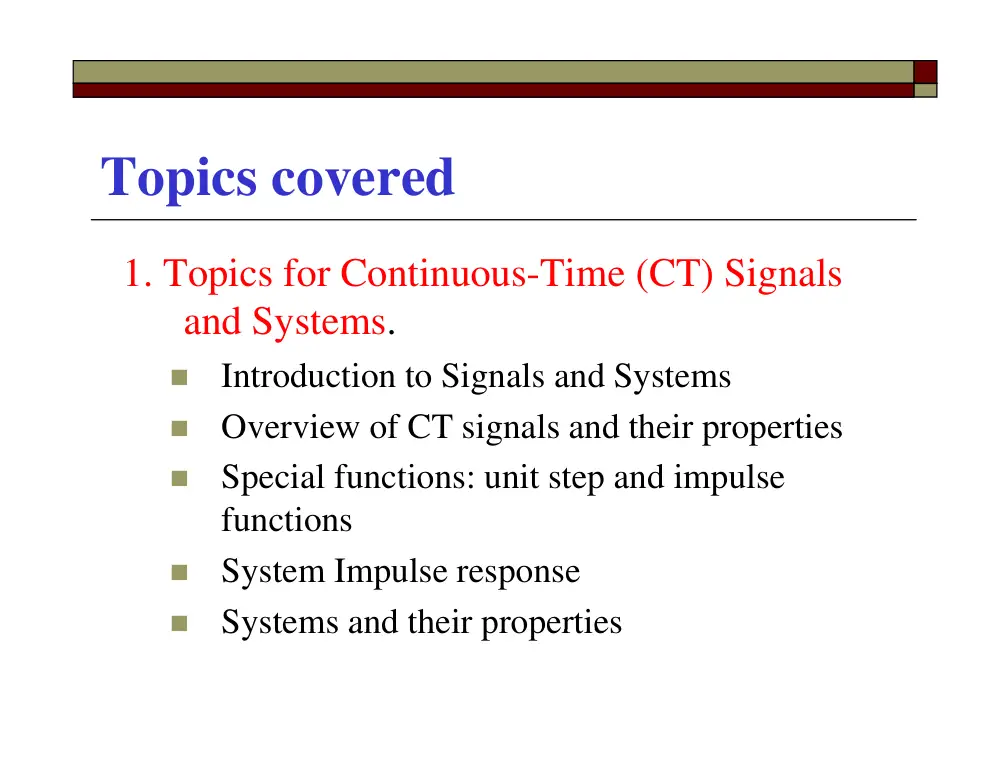
Topics covered
1. Topics for Continuous-Time (CT) Signals
and Systems.
y
�
Introduction to Signals and Systems
�
Overview of CT signals and their properties
�
Overview of CT signals and their properties
�
Special functions: unit step and impulse
functions
�
System Impulse response
�
Systems and their properties
�
Systems and their properties
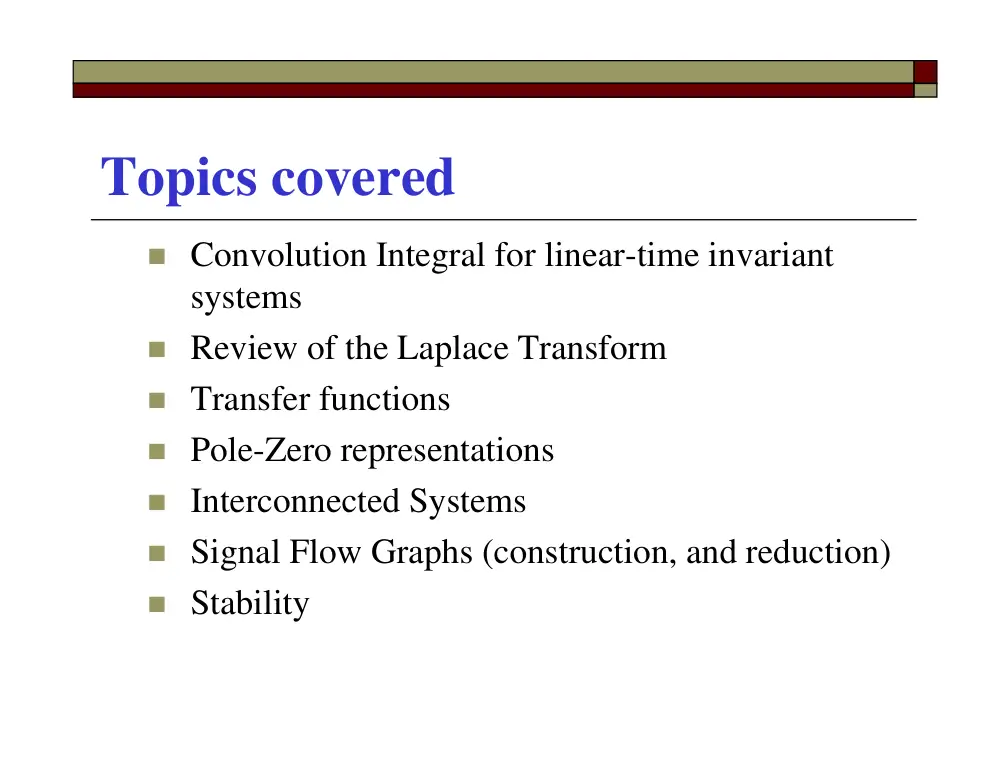
Topics covered
� Convolution Integral for linear-time invariant
systems
R
i
f h L
l
T
f
� Review of the Laplace Transform
� Transfer functions
� Pole-Zero representations
� Interconnected Systems
� Signal Flow Graphs (construction, and reduction)
� Stability
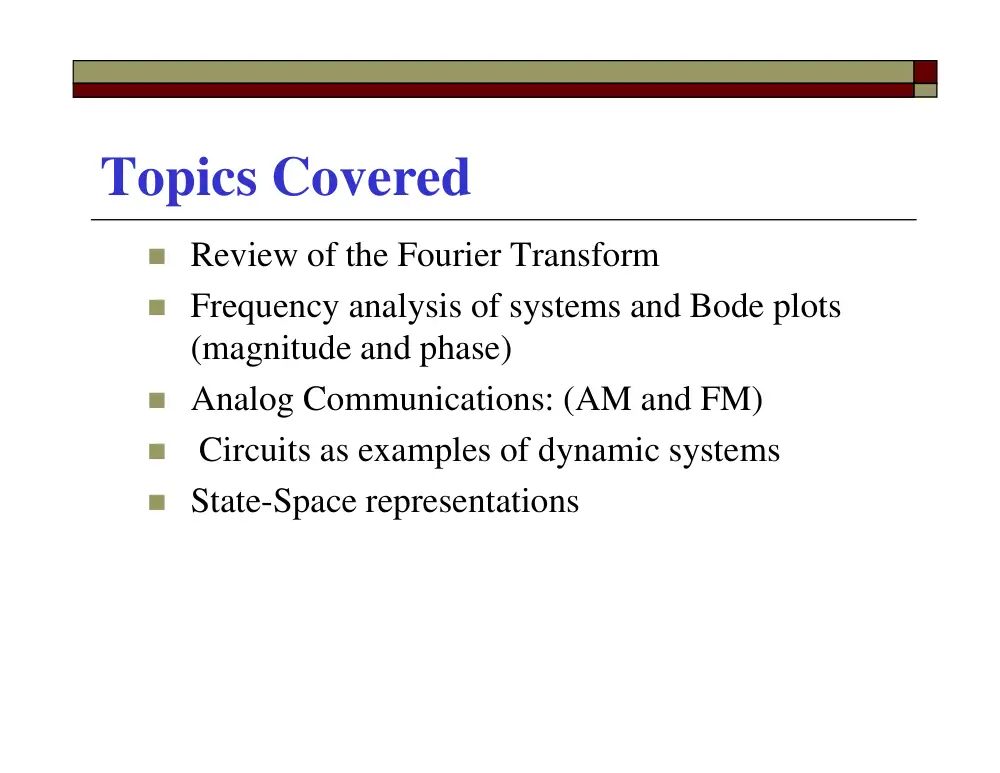
Topics Covered
� Review of the Fourier Transform
� Frequency analysis of systems and Bode plots
(
i d
d h
)
(magnitude and phase)
� Analog Communications: (AM and FM)
�
Circuits as examples of dynamic systems
� State-Space representations
Topics covered
2 T
i
f
di
i
(DT) i
l
d
2. Topics for discrete-time (DT) signals and
Systems
O
i
f DT i
l
d h i
i
� - Overview of DT signals and their properties
� - DT Convolution
� - Sampling Theorem
� - Sampling of Sinusoids
� - Discrete-Time Fourier Transform
� - Aliasing
�
Aliasing
Topics Covered
�
Z t
f
� - Z-transform
� - Difference equations and their solution using Z-
transform
� - Causality and Stability
� - System representations (Direct Form I and II)
� - State-Space representation of DT systems
� - Discrete-Fourier Transform (DFT)
�
Fast Fourier Transform (FFT)
� - Fast-Fourier Transform (FFT)
� - Effect of zero-insertion
� - Introduction to filter design (FIR,
�
Introduction to filter design (FIR,
Class/laboratory schedule
� three 50-minute lectures per week
Course outcomes
�
Students are knowledgeable in the field of
continuous-time signals and systems.
�
Students are able to apply Laplace transform
for the representation and analysis of
continuous-time systems
�
Students have a basic understanding of
�
Students have a basic understanding of
control stability problem.
Course outcomes
� Students are able to apply Fourier series and
transforms for the analysis and representation
of LTI continuous-time signals and systems
� Students are able to apply Fourier analysis as
a tool for understanding analog
communication systems.
� Students are able to represent LTI continuous-
time system in state-space representations.
time system in state space representations.
Course outcomes
S d
d
d h
li
� Students understand the sampling
phenomena and are able to apply it under
ll
di i
all conditions.
� Students are knowledgeable in the field
g
of Discrete-time signals and systems.
� Students are able to apply z-transform
� Students are able to apply z transform
transform for the representation and
analysis of continuous-time systems
analysis of continuous time systems.
Course outcomes
S d
f
ili
i h h diff
� Students are familiar with the different
methods for representation of LTI Discrete-
time systems
time systems.
� Students are able to apply Fourier series and
transforms for the analysis and representation
transforms for the analysis and representation
of LTI Discrete-time systems
� Students demonstrate knowledge of the
� Students demonstrate knowledge of the
Discrete-time Fourier analysis for periodic
signals
signals.
Course outcomes
St d
t d
t t k
l d
i
� Students demonstrate knowledge in
computing the DFT and the FFT for non-
periodic signals.
periodic signals.
� Students are able to represent LTI discrete-
time system in state-space representations.
� Students will demonstrate an ability to
interact and communicate effectively with
d t
peers and teams.
� Students are introduced to filter design (FIR,
IIR
IIR
Resources of the course
� Textbook,
� Class notes
� previous exams
� Moodle
� Moodle
Evaluation methods
� Assignments (5 %)
� Quiz I (25% )
(
)
� Quiz II (25 %)
� Final Exam (40 %)
� Final Exam (40 %)
� Project (5 %)
� Extra Project: up to 5 grades
Attendance Policy
R
l
A
d
i
d i
hi
l
� Regular Attendance is expected in this class.
� A Student who, for any reason attends less than two-
thirds of the lectures will be required to withdraw
thirds of the lectures, will be required to withdraw
from the course with a grade of W.
� Final grade takes into consideration the number of
g
absences according to the following equation
If n is the number of absences, then
Final Grade = Old Grade – 0.75(n-4)
Computer usage
� Matlab
Instructor
� Karim Kabalan
Bechtel, ECE Department
p
Ext: 3528
Email: kabalan@aub edu lb
Email: kabalan@aub.edu.lb
Office Hours
� By appointment