
EECE 340 Chapter 12, Fall 2011
American University of Beirut · Signals and Systems · 13 pages · Prof. Karim Kabalan



Showing the first 10 of 13 pages. Download the PDF to see all of it.
More EECE 340 files
Show the text of this chapter
Chapter 12
The Discrete-Time Fourier Series
(DTFS)
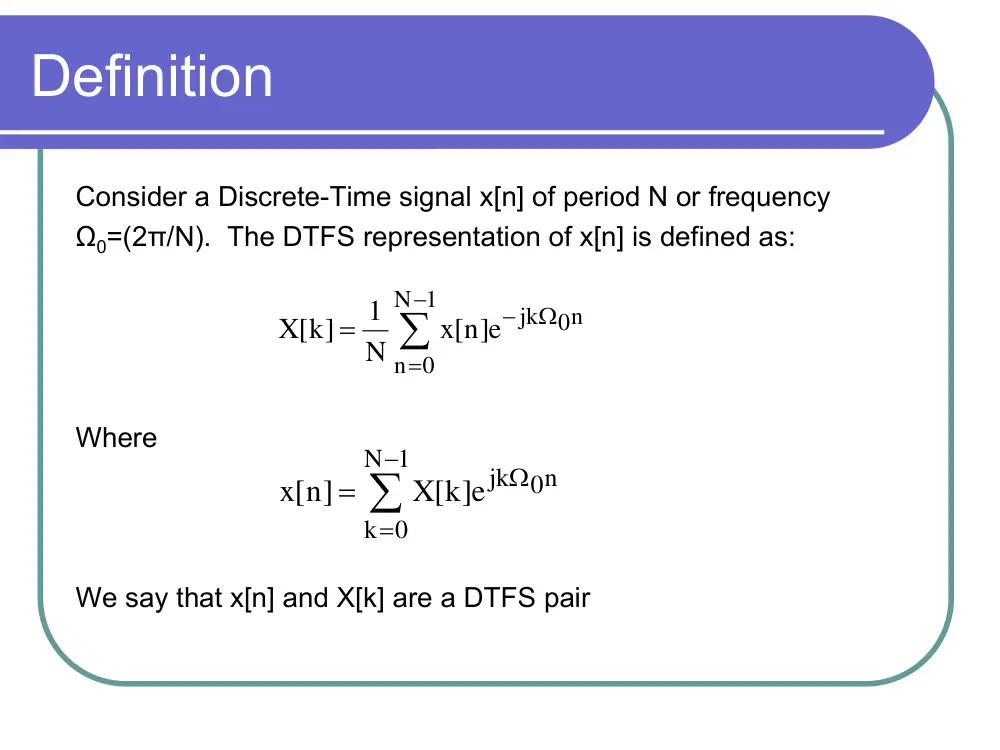
Definition
Consider a Discrete-Time signal x[n] of period N or frequency
Ω0=(2π/N). The DTFS representation of x[n] is defined as:
Where
We say that x[n] and X[k] are a DTFS pair
∑
−
=
− Ω
=
1
N
0
n
jk 0n
x[n e]
N
1
[k]
X
∑
−
=
Ω
=
1
N
0
k
X[k e] jk 0n
x[n]
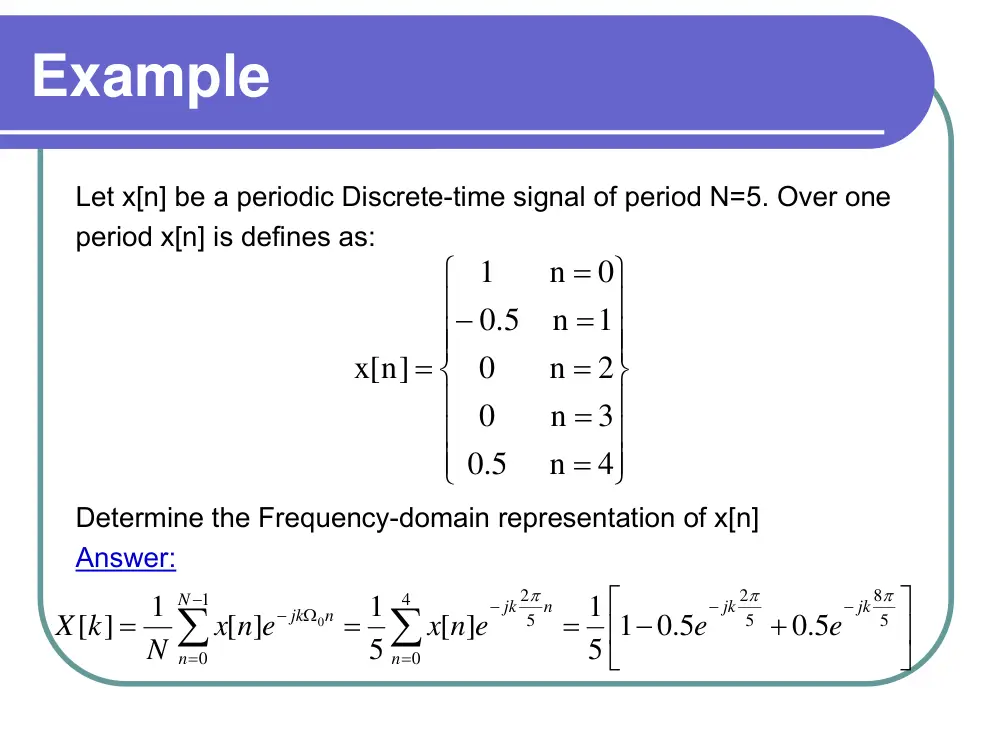
Example
Let x[n] be a periodic Discrete-time signal of period N=5. Over one
period x[n] is defines as:
Determine the Frequency-domain representation of x[n]
Answer:
⎪
⎪
⎪
⎭
⎪⎪
⎪
⎬
⎫
⎪
⎪
⎪
⎩
⎪⎪
⎪
⎨
⎧
=
=
=
=
−
=
=
4
n
5.0
3
n
0
2
n
0
1
n
5.0
0
n
1
[n]
x
⎥
⎦
⎤
⎢
⎣
⎡
+
−
=
=
=
−
−
=
−
−
=
− Ω
∑
∑
5
8
5
2
4
0
5
2
1
0
5.0
5.0
5 1
1
[ ]
5
1
[ ]
1
]
[
0
π
π
π
jk
jk
n
n
jk
N
n
jk n
e
e
x n e
x n e
N
X k
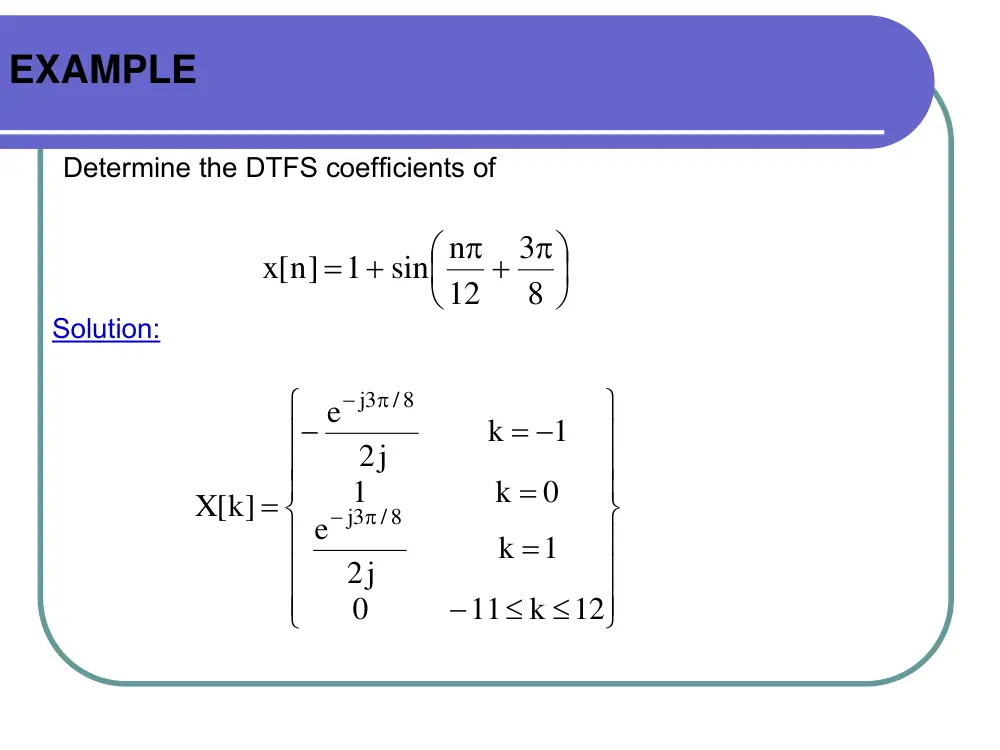
EXAMPLE
Determine the DTFS coefficients of
Solution:
⎟⎠
⎞
⎜⎝
⎛
π + π
= +
8
3
12
sin n
1
[n]
x
⎪
⎪
⎪
⎭
⎪⎪
⎪
⎬
⎫
⎪
⎪
⎪
⎩
⎪⎪
⎪
⎨
⎧
≤
≤
−
=
=
= −
−
=
π
−
π
−
12
k
11
0
1
k
2j
e
0
k
1
1
k
2j
e
X[k]
/ 8
3j
/ 8
3j
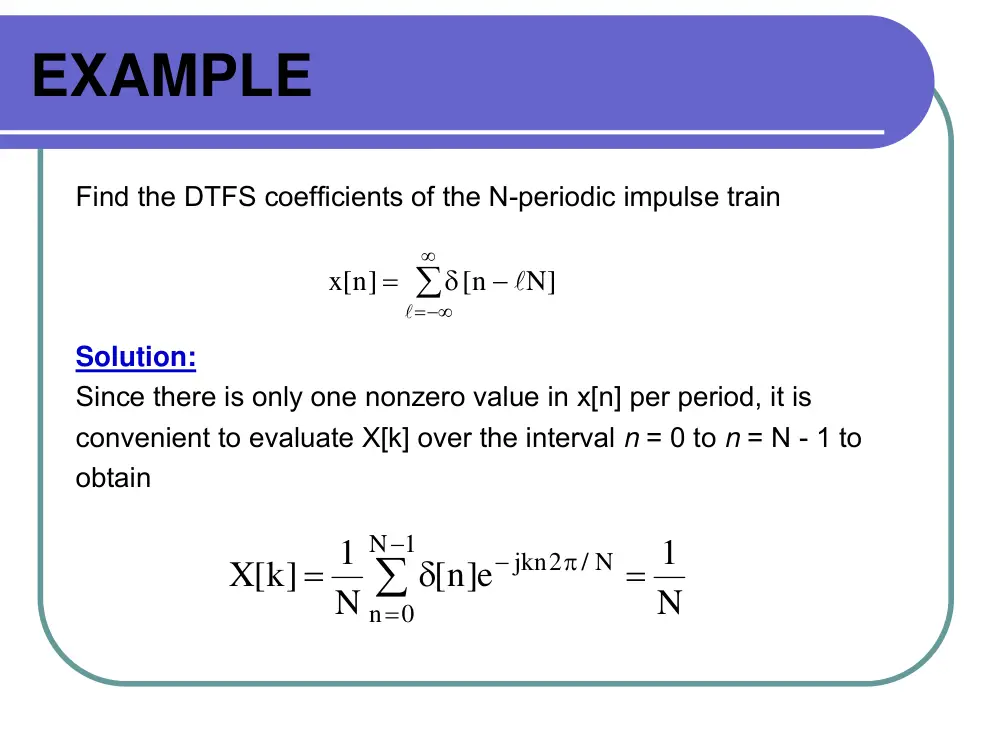
EXAMPLE
Find the DTFS coefficients of the N-periodic impulse train
Solution:
Since there is only one nonzero value in x[n] per period, it is
convenient to evaluate X[k] over the interval n = 0 to n = N - 1 to
obtain
∑
∞
=−∞
−
δ
=
�
� ]
N
[ n
[n]
x
N
1
[n e]
N
1
X[k]
1
N
0
n
jkn2 / N
=
δ
=
∑
−
=
π
−
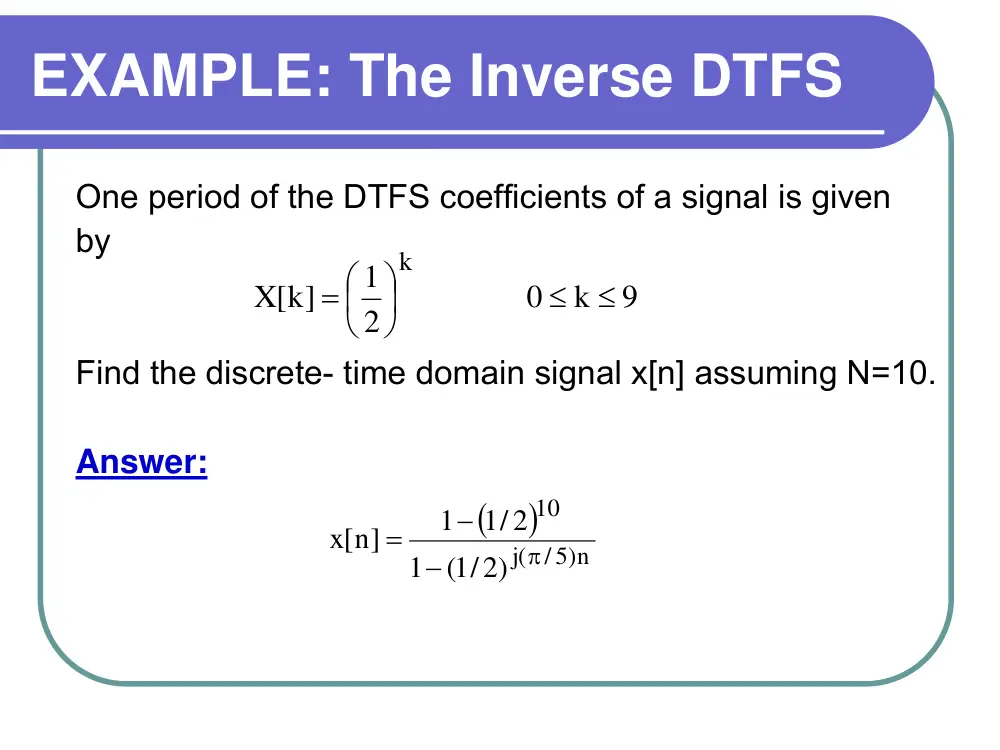
EXAMPLE: The Inverse DTFS
One period of the DTFS coefficients of a signal is given
by
Find the discrete- time domain signal x[n] assuming N=10.
Answer:
9
k
0
2
1
X[k]
k
≤
≤
⎟
⎠
⎞
⎜
⎝
⎛
=
(
)
/ 5)n
(j
10
1( / 2)
1
1/ 2
1
x[n]
π
−
−
=
EXAMPLE:
DTFS Representation
of a Square wave
Find the DTFS coefficients for the N-periodic square wave given by
That is, each period contains 2M+1 consecutive ones and the
remaining {N-(2M+1)} values are zero. Note that this definition
requires that N > 2M + 1.
⎭
⎬
⎫
⎩
⎨
⎧
≤
≤
−
=
Over the rest of the period
0
M
n
M
1
x[n]
Solution
The period is N, so Ω0=2π/N. It is convenient in this case to
evaluate the DTFS of x[n] over indices n = -M to n = N - M - 1. We
thus have
We perform the change of variable on the index of summation by
letting m=n+M to obtain
∑
∑
−
=
Ω
−
−
−
−
=
Ω
−
=
=
M
M
n
n
jk
M 1
N
M
n
n
jk
0
0
e
N
1
x[n e]
N
1
[k]
X
∑
∑
=
Ω
−
Ω
=
−
− Ω
=
=
M
2
0
m
0m
jk
0M
jk
M
2
0
m
jk 0 (m M)
e
N
e
e
N
1
X[k]
Solution
Now, for k=0, ±N, ±2N, ±3N, …, we have
for k=0, ±N, ±2N, ±3N, …, we may sum the geometric series to
obtain
1
e
e
0
jk
jk 0
=
=
Ω
−
Ω
0, N, 2N, ...
for k
N
1
2M
1
N
1
X[k]
M
2
m 0
±
±
=
+
=
=
∑
=
(
)
(
/ 2)
sin k
2
/)1
(2M
sin k
N
1
e
1
e
1
N
e
X[k]
0
0
jk
)1
(2M
jk
M
jk
0
0
0
Ω
+
Ω
⎟ =
⎟
⎠
⎞
⎜
⎜
⎝
⎛
−
−
=
Ω
−
+
Ω
−
Ω
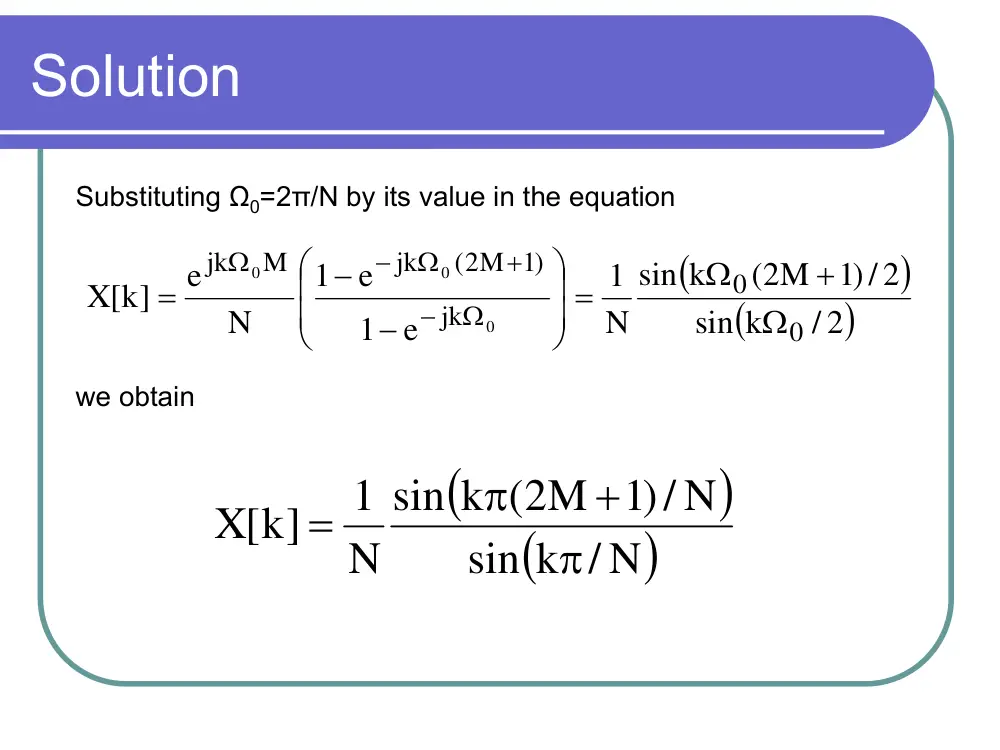
Solution
Substituting Ω0=2π/N by its value in the equation
we obtain
(
)
(
/ 2)
sin k
2
/)1
(2M
sin k
N
1
e
1
e
1
N
e
X[k]
0
0
jk
)1
(2M
jk
M
jk
0
0
0
Ω
+
Ω
⎟ =
⎟
⎠
⎞
⎜
⎜
⎝
⎛
−
−
=
Ω
−
+
Ω
−
Ω
(
)
(
sin k / N)
N
/)1
sin k (2M
N
1
X[k]
π
+
π
=
Solution
The above equation
is also valid for k=0,
±N, ±2N, ±3N, …
using L”Hopital’s
rule.
Convolution of periodic signals
� This subsection addresses the convolution of two signals that are
periodic functions of time. The convolution of periodic signals
does not occur naturally in the context of evaluating the input-
output relationships of systems, since any system with a periodic
impulse response is unstable. However, the convolution of
periodic signals often occurs in the context of signal analysis and
manipulation.
� The discrete-time convolution of two N-periodic sequences x[n]
and z[n] is defined as:
∑
−
=
−
=
⊗
=
1
N
k 0
k]
x[k [z] n
[z n]
x[n]
[y n]
Convolution of periodic signals
� This is the periodic convolution of x[n] and z[n]. The signal y[n]
is N periodic, so the DTFS is the appropriate representation for
all three signals: x[ n], z[n], and y[n].
� Thus, convolution of time signals transforms to multiplication of
DTFS coefficients
X[k] Z[k]
Y[k]
[z n]
x[n]
[y n]
N
DTFT , 2
⋅
=
⎯
⎯⎯
→
←
⊗
=
π