
PHYS 210 Chapter 5, Fall 2012
American University of Beirut · Introductory Physics II · 2 pages · Dr. Samih Isber

More PHYS 210 files
Show the text of this chapter
Class Problems Chapter 5
5. An electron of mass 9.11 10–31 kg has an initial speed of 3.00 105 m/s. It
travels in a straight line, and its speed increases to 7.00 105 m/s in a distance of
5.00 cm. Assuming its acceleration is constant, (a) determine the force exerted on
the electron and (b) compare this force with the weight of the electron, which we
neglected.
14. Three forces, given by F1 2.00ˆ i 2.00ˆ j
N , F2 5.00ˆ i 3.00ˆ j
N,
and F3 45.0ˆ i
N , act on an object to give it an acceleration of magnitude
3.75 m/s2. (a) What is the direction of the acceleration? (b) What is the mass of
the object? (c) If the object is initially at rest, what is its speed after 10.0 s? (d)
What are the velocity components of the object after 10.0 s?
21.
The systems shown in Figure P5.21 are in equilibrium. If the spring scales
are calibrated in newtons, what do they read? (Neglect the masses of the pulleys
and strings, and assume the incline in part (c) is frictionless.)
Figure P5.21
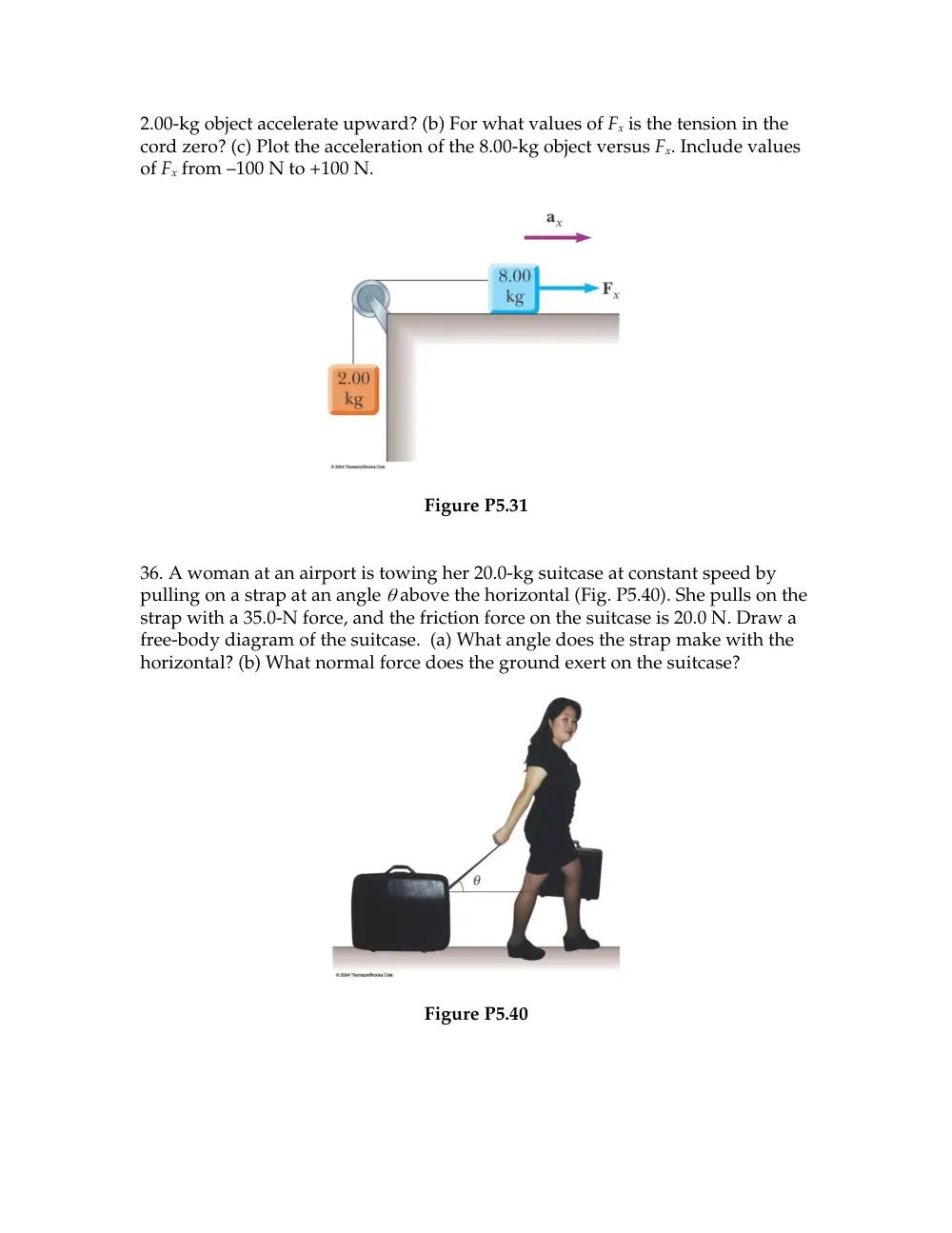
27. In the system shown in Figure P5.31, a horizontal force Fx acts on the 8.00-kg
object. The horizontal surface is frictionless. (a) For what values of Fx does the
2.00-kg object accelerate upward? (b) For what values of Fx is the tension in the
cord zero? (c) Plot the acceleration of the 8.00-kg object versus Fx. Include values
of Fx from –100 N to +100 N.
Figure P5.31
36. A woman at an airport is towing her 20.0-kg suitcase at constant speed by
pulling on a strap at an angle above the horizontal (Fig. P5.40). She pulls on the
strap with a 35.0-N force, and the friction force on the suitcase is 20.0 N. Draw a
free-body diagram of the suitcase. (a) What angle does the strap make with the
horizontal? (b) What normal force does the ground exert on the suitcase?
Figure P5.40