
PHYS 210 Chapter 6, Fall 2012
American University of Beirut · Introductory Physics II · 2 pages · Dr. Samih Isber
More PHYS 210 files
Show the text of this chapter
Class Problems of Chapter VI
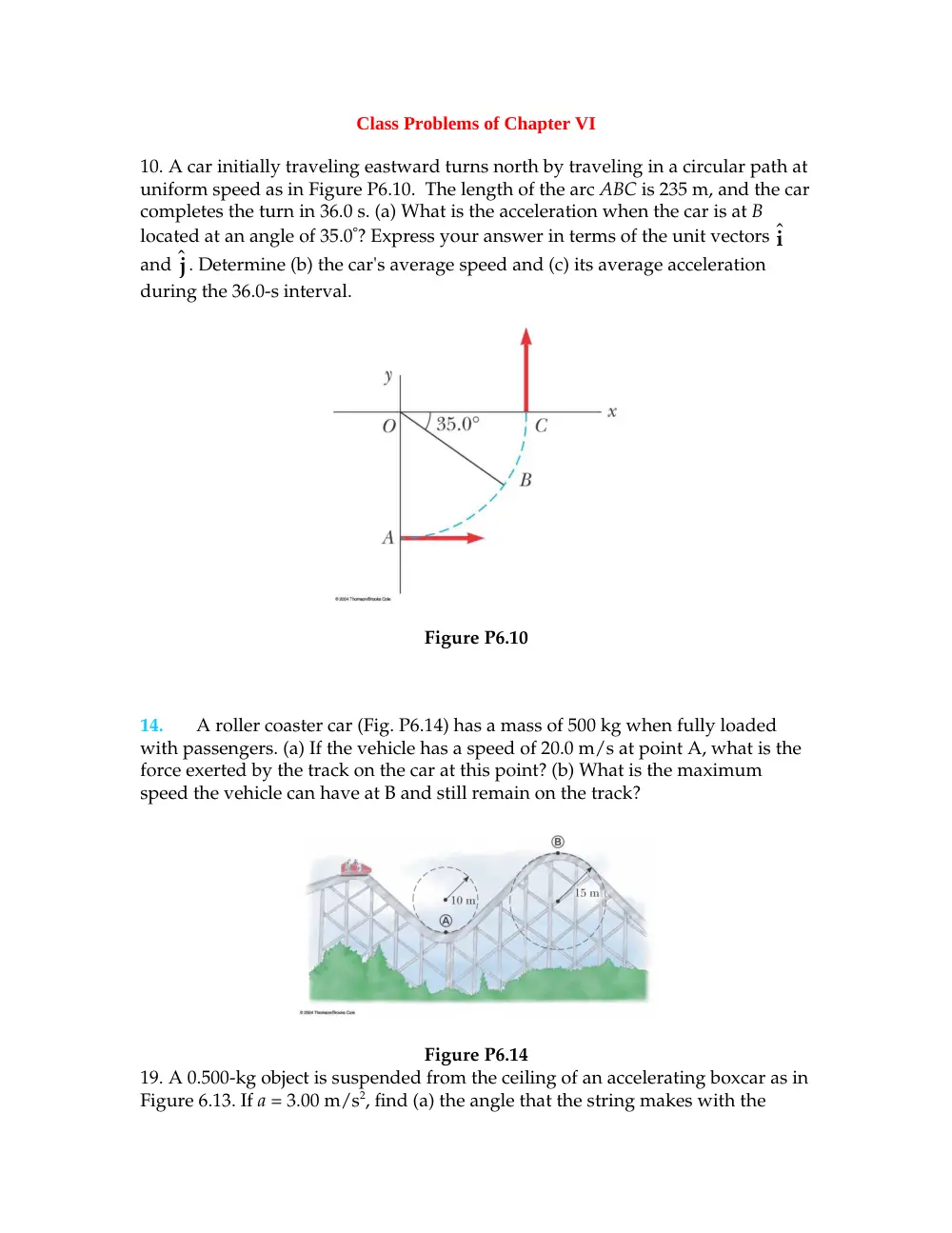
10. A car initially traveling eastward turns north by traveling in a circular path at
uniform speed as in Figure P6.10. The length of the arc ABC is 235 m, and the car
completes the turn in 36.0 s. (a) What is the acceleration when the car is at B
located at an angle of 35.0? Express your answer in terms of the unit vectors ˆ i
and ˆ j . Determine (b) the car's average speed and (c) its average acceleration
during the 36.0-s interval.
Figure P6.10
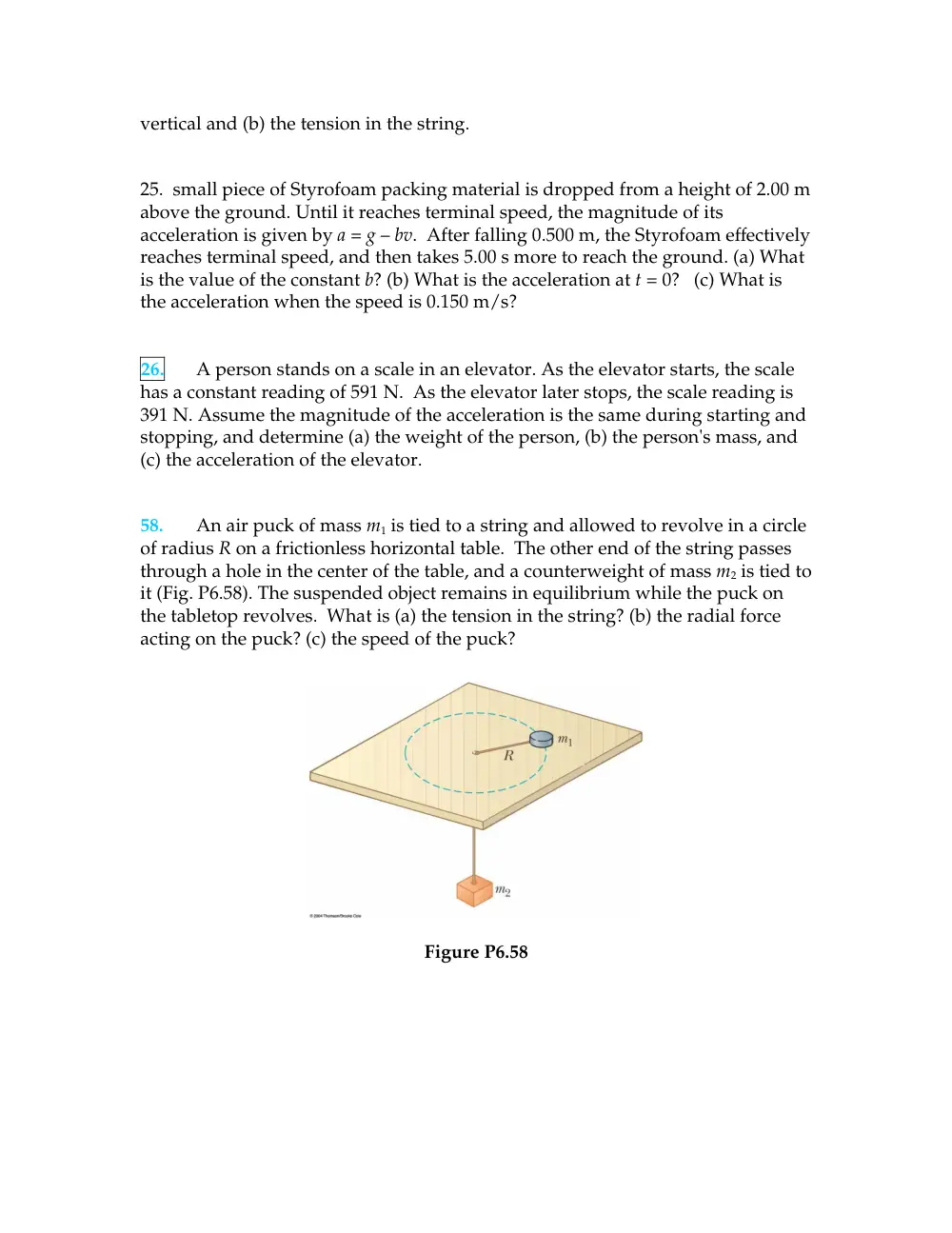
14.
A roller coaster car (Fig. P6.14) has a mass of 500 kg when fully loaded
with passengers. (a) If the vehicle has a speed of 20.0 m/s at point A, what is the
force exerted by the track on the car at this point? (b) What is the maximum
speed the vehicle can have at B and still remain on the track?
Figure P6.14
19. A 0.500-kg object is suspended from the ceiling of an accelerating boxcar as in
Figure 6.13. If a = 3.00 m/s2, find (a) the angle that the string makes with the
vertical and (b) the tension in the string.
25. small piece of Styrofoam packing material is dropped from a height of 2.00 m
above the ground. Until it reaches terminal speed, the magnitude of its
acceleration is given by a = g – bv. After falling 0.500 m, the Styrofoam effectively
reaches terminal speed, and then takes 5.00 s more to reach the ground. (a) What
is the value of the constant b? (b) What is the acceleration at t = 0? (c) What is
the acceleration when the speed is 0.150 m/s?
26.
A person stands on a scale in an elevator. As the elevator starts, the scale
has a constant reading of 591 N. As the elevator later stops, the scale reading is
391 N. Assume the magnitude of the acceleration is the same during starting and
stopping, and determine (a) the weight of the person, (b) the person's mass, and
(c) the acceleration of the elevator.
58.
An air puck of mass m1 is tied to a string and allowed to revolve in a circle
of radius R on a frictionless horizontal table. The other end of the string passes
through a hole in the center of the table, and a counterweight of mass m2 is tied to
it (Fig. P6.58). The suspended object remains in equilibrium while the puck on
the tabletop revolves. What is (a) the tension in the string? (b) the radial force
acting on the puck? (c) the speed of the puck?
Figure P6.58