
PHYS 210 Chapter Heat, Fall 2012
American University of Beirut · Introductory Physics II · 2 pages · Dr. Samih Isber

More PHYS 210 files
Show the text of this chapter
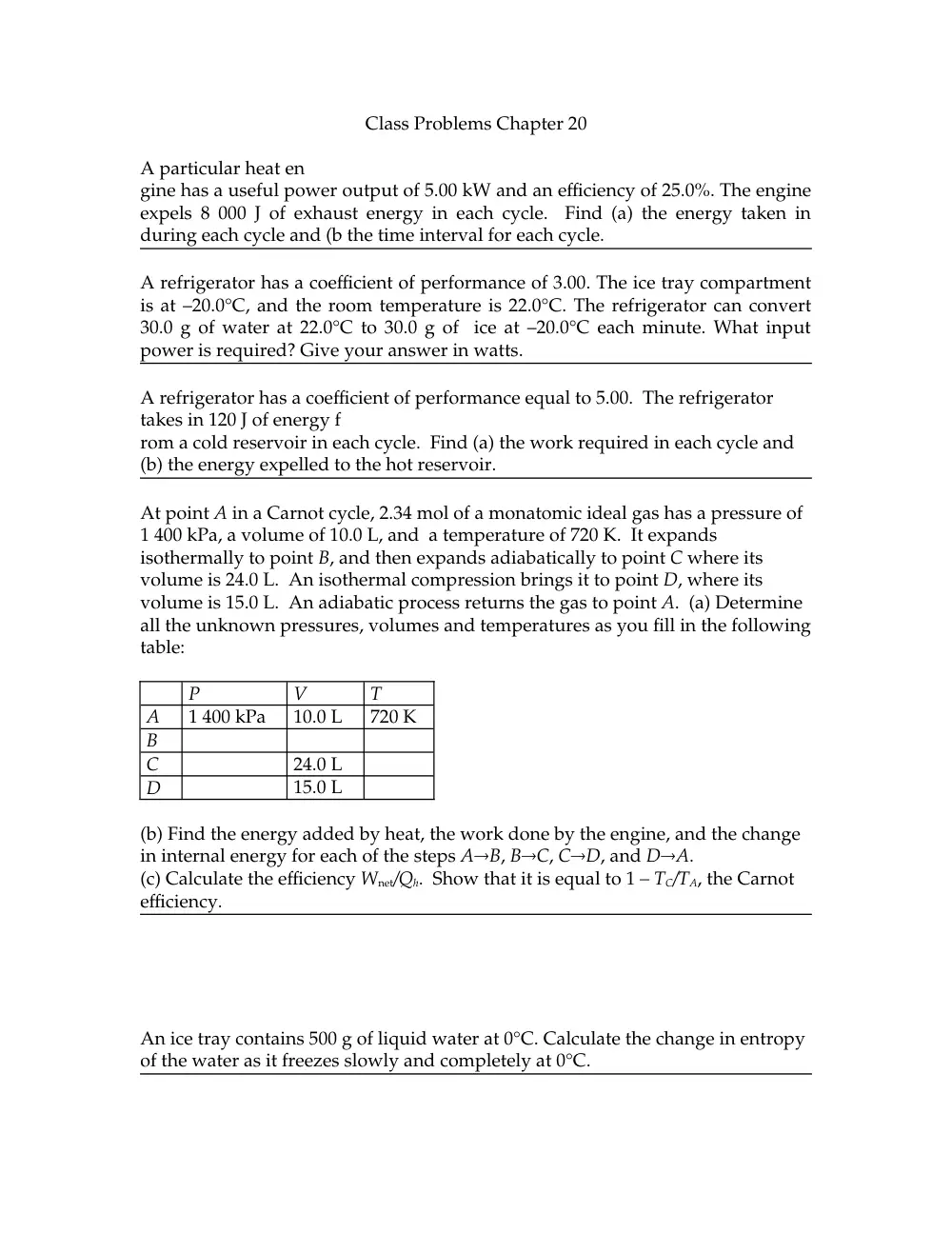
Class Problems Chapter 20
A particular heat en
gine has a useful power output of 5.00 kW and an efficiency of 25.0%. The engine
expels 8 000 J of exhaust energy in each cycle. Find (a) the energy taken in
during each cycle and (b the time interval for each cycle.
A refrigerator has a coefficient of performance of 3.00. The ice tray compartment
is at –20.0°C, and the room temperature is 22.0°C. The refrigerator can convert
30.0 g of water at 22.0°C to 30.0 g of ice at –20.0°C each minute. What input
power is required? Give your answer in watts.
A refrigerator has a coefficient of performance equal to 5.00. The refrigerator
takes in 120 J of energy f
rom a cold reservoir in each cycle. Find (a) the work required in each cycle and
(b) the energy expelled to the hot reservoir.
At point A in a Carnot cycle, 2.34 mol of a monatomic ideal gas has a pressure of
1 400 kPa, a volume of 10.0 L, and a temperature of 720 K. It expands
isothermally to point B, and then expands adiabatically to point C where its
volume is 24.0 L. An isothermal compression brings it to point D, where its
volume is 15.0 L. An adiabatic process returns the gas to point A. (a) Determine
all the unknown pressures, volumes and temperatures as you fill in the following
table:
P
V
T
A
1 400 kPa
10.0 L
720 K
B
C
24.0 L
D
15.0 L
(b) Find the energy added by heat, the work done by the engine, and the change
in internal energy for each of the steps AB, BC, CD, and DA.
(c) Calculate the efficiency Wnet/Qh. Show that it is equal to 1 – TC/TA, the Carnot
efficiency.
An ice tray contains 500 g of liquid water at 0°C. Calculate the change in entropy
of the water as it freezes slowly and completely at 0°C.
The temperature at the surface of the Sun is approximately 5 700 K, and the
temperature at the surface of the Earth is approximately 290 K. What entropy
change occurs when 1 000 J of energy is transferred by radiation from the Sun to
the Earth?
A 1.00-mol sample of H2 gas is contained in the left-hand side of the container
shown in Figure P22.45, which has equal volumes left and right. The right-hand
side is evacuated. When the valve is opened, the gas streams into the right-hand
side. What is the final entropy change of the gas? Does the temperature of the gas
change?
Figure P22.45
A 1.00-mol sample of an ideal monatomic gas, initially at a pressure of 1.00 atm
and a volume of 0.025 0 m3, is heated to a final state with a pressure of 2.00 atm
and a volume of 0.040 0 m3. Determine the change in entropy of the gas in this
process.