
PHYS 210 Chapter 7, Spring 2012
American University of Beirut · Introductory Physics II · 42 pages · Dr. Samih Isber
Showing the first 10 of 42 pages. Download the PDF to see all of it.
More PHYS 210 files
Show the text of this chapter
Chapter 7
Chapter 7
Kinetic Energy and Work
Kinetic Energy and Work
Forms of Energy
Forms of Energy
Mechanical
Mechanical
focus for now
focus for now
chemical
chemical
electromagnetic
electromagnetic
nuclear
nuclear
Using Energy Considerations
Using Energy Considerations
Energy can be transformed from one
Energy can be transformed from one
form to another
form to another
Essential to the study of physics,
Essential to the study of physics,
chemistry, biology, geology, astronomy
chemistry, biology, geology, astronomy
Can be used in place of Newton’s
Can be used in place of Newton’s
laws to solve certain problems more
laws to solve certain problems more
simply
simply
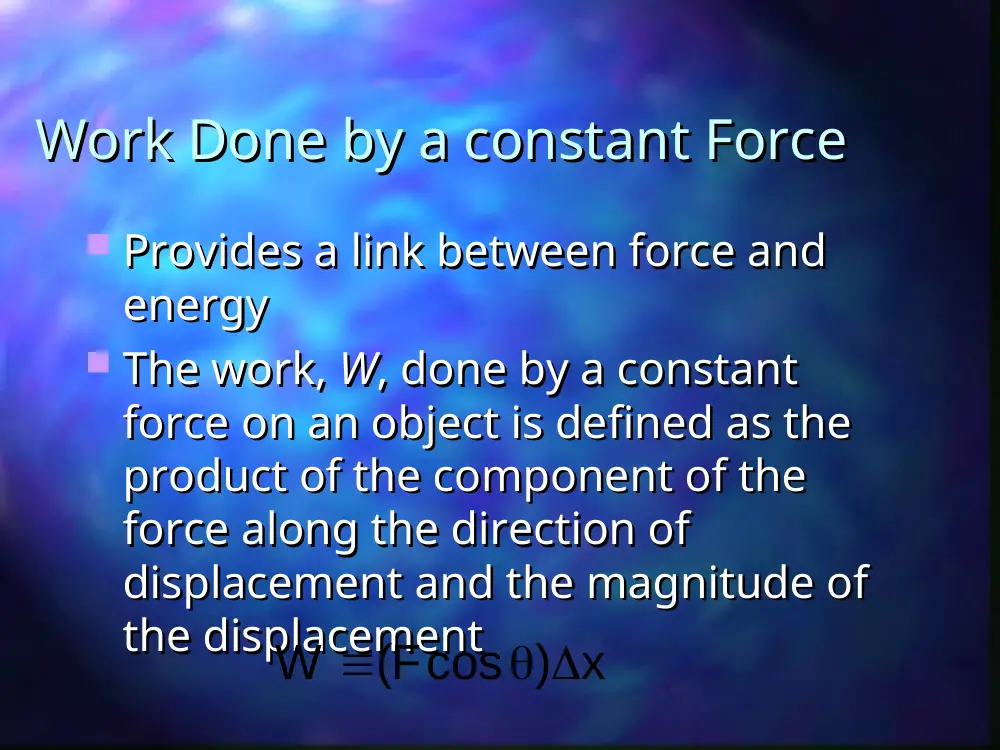
Work Done by a constant Force
Work Done by a constant Force
Provides a link between force and
Provides a link between force and
energy
energy
The work,
The work, W
W, done by a constant
, done by a constant
force on an object is defined as the
force on an object is defined as the
product of the component of the
product of the component of the
force along the direction of
force along the direction of
displacement and the magnitude of
displacement and the magnitude of
the displacement
the displacement
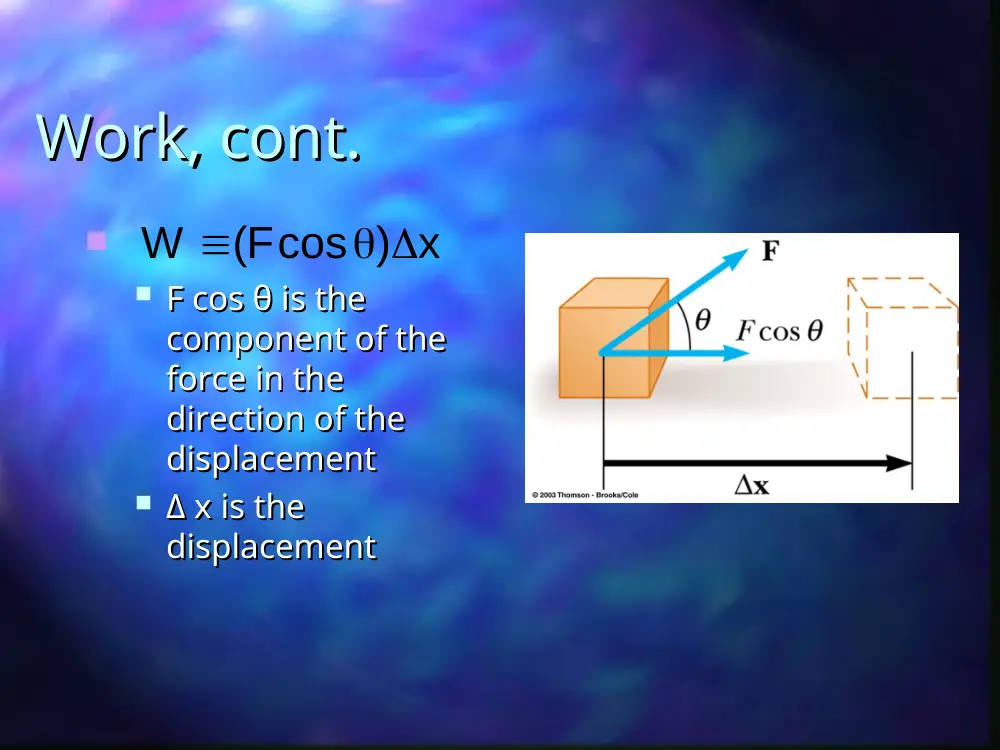
(Fcos ) x
W
Work, cont.
Work, cont.
F cos θ is the
F cos θ is the
component of the
component of the
force in the
force in the
direction of the
direction of the
displacement
displacement
Δ x is the
Δ x is the
displacement
displacement
(Fcos ) x
W
Work, cont.
Work, cont.
This gives no information about
This gives no information about
the time it took for the displacement to
the time it took for the displacement to
occur
occur
the velocity or acceleration of the object
the velocity or acceleration of the object
Units of Work
Units of Work
SI
SI
Newton • meter = Joule
Newton • meter = Joule
N • m = J
N • m = J
US Customary
US Customary
foot • pound
foot • pound
ft • lb
ft • lb
– no special name
no special name
More About Work
More About Work
Scalar quantity
Scalar quantity
The work done by a force is zero when the
The work done by a force is zero when the
force is perpendicular to the displacement
force is perpendicular to the displacement
cos 90° = 0
cos 90° = 0
If there are multiple forces acting on an
If there are multiple forces acting on an
object, the total work done is the algebraic
object, the total work done is the algebraic
sum of the amount of work done by each
sum of the amount of work done by each
force
force
More About Work, cont.
More About Work, cont.
Work can be positive or negative
Work can be positive or negative
Positive if the force and the
Positive if the force and the
displacement are in the same direction
displacement are in the same direction
Negative if the force and the
Negative if the force and the
displacement are in the opposite
displacement are in the opposite
direction
direction
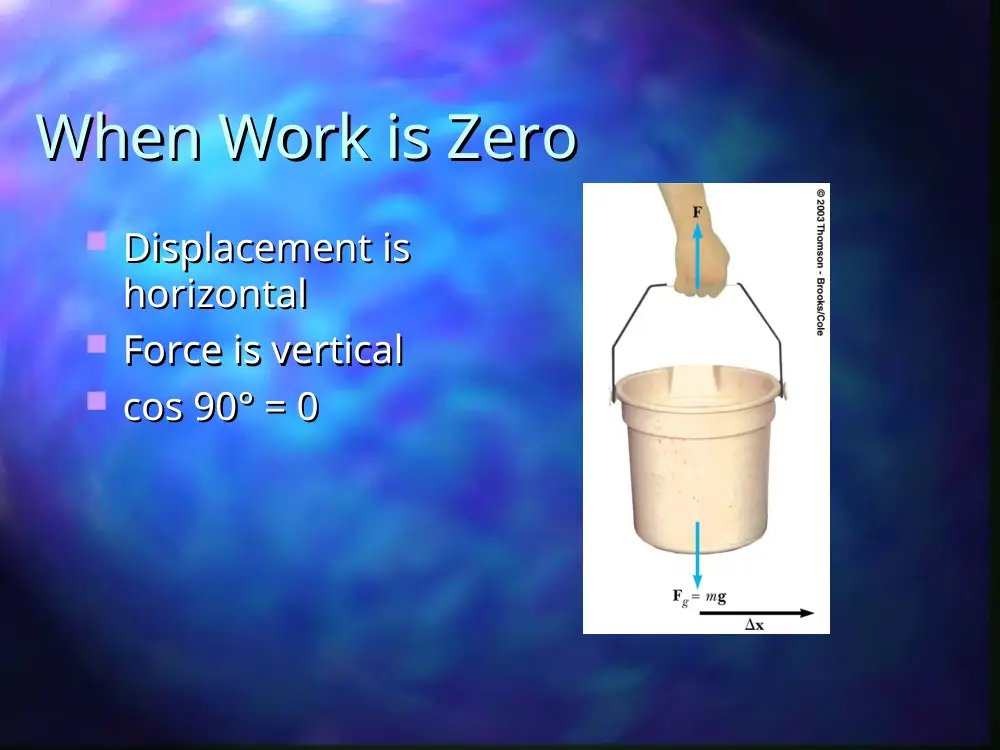
When Work is Zero
When Work is Zero
Displacement is
Displacement is
horizontal
horizontal
Force is vertical
Force is vertical
cos 90° = 0
cos 90° = 0
Work Can Be Positive or
Work Can Be Positive or
Negative
Negative
Work done by F is
Work done by F is
positive when
positive when
lifting the box
lifting the box
The Scalar Product of Two
The Scalar Product of Two
vectors
vectors
Scalar product or
Scalar product or
dot product is a
dot product is a
mathematical tool.
mathematical tool.
A.B
A.B = |A||
= |A|| B|
B|
cos(
cos())
|A| and |B| are the magnitudes of
|A| and |B| are the magnitudes of
vectors
vectors A
A and
and B
B..
is the angle between
is the angle between AA and
and BB..
The Scalar Product of Two
The Scalar Product of Two
vectors
vectors
Comparing
Comparing A.B
A.B = |A||B|
= |A||B| cos(
cos(),
),
with
with
We see that the work is the dot
We see that the work is the dot
product between the force and the
product between the force and the
displacement:
displacement:
W =
W = FF..rr
r
F
W
cos )
(
The Scalar Product of Two
The Scalar Product of Two
vectors
vectors
The Scalar product is commutative:
The Scalar product is commutative:
A.B
A.B =
= B.A
B.A
The scalar Product obey the distributive
The scalar Product obey the distributive
law of Multiplication:
law of Multiplication:
A.(B + C) = A.B + A.C
A.(B + C) = A.B + A.C
The Scalar Product of Two
The Scalar Product of Two
vectors
vectors
If
If AA is perpendicular to
is perpendicular to BB, then:
, then:
A.B
A.B = 0
= 0
It follows that the dot product between two
It follows that the dot product between two
units vectors is:
units vectors is:
Since the units vectors I, j and k are
Since the units vectors I, j and k are
mutually perpendicular one to another.
mutually perpendicular one to another.
Also we have:
Also we have:
1
ˆ ˆ
ˆ ˆ
ˆ ˆ
k k
j j
i
i
0
ˆ ˆ
ˆ ˆ
ˆ ˆ
k j
i k
i j
The Scalar Product of Two
The Scalar Product of Two
vectors
vectors
A k
A j
A i
z
y
x
ˆ
ˆ
ˆ
A
B k
B j
B i
B
z
y
x
ˆ
ˆ
ˆ
z
z
y
y
x
x
z
y
x
z
y
x
A B
A B
B
A
B k
B j
B i
A k
A j
A i
B
A
ˆ
ˆ
ˆ
ˆ
ˆ
ˆ
Consider the following vectors:
Consider the following vectors:
| cos( )
||
|
A B
A B
A B
A B
A B
z
z
y
y
x
x
Example:
Example:
The vectors
The vectors AA and
and BB are given by:
are given by:
Determine the scalar product
Determine the scalar product A.B
A.B
Find the angle
Find the angle between
between AA and
and BB
j
i
3ˆ
ˆ
A 2
j
i
B
ˆ 2 ˆ
Solution:
Solution:
| cos( )
||
|
4
B A B
A
j
i
3ˆ
ˆ
A 2
j
i
B
ˆ 2 ˆ
1.
2.
4
3 2
)1
2 (
B
A
5.0
5
13
4
cos( )
13
3
2
|
2
2
A
|
5
2
)1
(
|
2
2
B
|
= 60.2°
Example:
Example:
A particle moving in the xy-plane undergo
A particle moving in the xy-plane undergo
a displacement in meters,
a displacement in meters,
as a constant force in Newtons
as a constant force in Newtons
acts on the particle.
acts on the particle.
1. Calculate the work done by
1. Calculate the work done by FF..
2. Calculate the magnitudes of
2. Calculate the magnitudes of FF and
and rr..
W =
W = FF..rr = 5
= 5
2 + 2
2 + 2
3 = 16 J
3 = 16 J
j
i
r
ˆ
0.3
ˆ
0.2
j
i
F
ˆ
0.2
ˆ
0.5
m
r
6.3
13
3
2
|
|
2
2
N
F
4.5
29
2
5
|
|
2
2
Work Done by a varying
Work Done by a varying
Force
Force
Consider a particle being
Consider a particle being
displaced along the x-axis
displaced along the x-axis
under the action of a force
under the action of a force
that varies with position.
that varies with position.
In the small interval
In the small interval x,
x,
FFx x can be considered to be
can be considered to be
constant and the work for
constant and the work for
the small displacement
the small displacement xx::
W = F
W = Fxx xx
Work Done by a varying
Work Done by a varying
Force
Force
If we imagine that the
If we imagine that the
FFxx versus
versus xx is divided
is divided
into a large number of
into a large number of
intervals, the total
intervals, the total
work done for the
work done for the
displacement from
displacement from xxii
to
to xxff is given by:
is given by:
f
i
x
x
Fx x
W
Work Done by a varying
Work Done by a varying
Force
Force
When the number of
When the number of
small intervals is very
small intervals is very
large we can
large we can
approximate the
approximate the
discrete sum (
discrete sum () into a
) into a
continues integral:
continues integral:
f
i
f
i
x
x
x
x
x
x
F dx
x
F
lim
x 0
Work Done by a varying
Work Done by a varying
Force
Force
The work is the
The work is the
area under the
area under the
curve.
curve.
f
i
x
x
Fxdx
W
Example:
Example:
A force acting on
A force acting on
a particle varies
a particle varies
with x, as shown
with x, as shown
in the adjacent
in the adjacent
figure. Calculate
figure. Calculate
the work done by
the work done by
the force as the
the force as the
particle moves
particle moves
from x = 0 to
from x = 0 to
x=6.0 m.
x=6.0 m.
Solution:
Solution:
The work is the area
The work is the area
under the curve =
under the curve =
Area of the
Area of the
trapezoid:
trapezoid:
2
Height
Large Base Small Base)
Area
(
25 J
2
5
6 4)
W Area
(
Example
Example
The adjacent Figure a) shows two
horizontal forces that act on a
block that is sliding to the right
across a frictionless floor. Figure
b) shows three plots of the
block’s kinetic energy K versus
time t. Which of the plots best
corresponds to the following
three situations: (a) F1 = F2, (b)
F1 > F2 , (c) F1 < F2 ?
Example:
Example:
In the below figure, a greased pig has a choice of three
frictionless slides along which to slide to the ground. Rank
the slides according to how much work the gravitational
force does on the pig during the descent, greatest first.
Work done by a spring:
Work done by a spring:
A block being pulled
A block being pulled
from
from xxii = 0 to
= 0 to xxff =
= xxmax
max on
on
a frictionless surface by a
a frictionless surface by a
force
force FFapp
app. The applied
. The applied
force is equal in
force is equal in
magnitude and opposite
magnitude and opposite
in direction to the spring
in direction to the spring
force F
force Fss at all times.
at all times.
FFss = -kx
= -kx
2
max
2
1 kx
kxdx
Fxdx
max
f
i
x
0
x
x
s
W
Work done by a spring:
Work done by a spring:
The work done by F
The work done by Fapp
app = -W
= -Wss
FFapp
app = kx
= kx
2max
2
1 kx
kxdx
Fxdx
max
f
i
x
0
x
x
app
W
Kinetic Energy
Kinetic Energy
Energy associated with the motion of
Energy associated with the motion of
an object
an object
Scalar quantity with the same units as
Scalar quantity with the same units as
work
work
Work is related to kinetic energy
Work is related to kinetic energy
2 mv2
KE 1
Work-Kinetic Energy
Work-Kinetic Energy
Theorem
Theorem
When work is done by a net force on
When work is done by a net force on
an object and the only change in the
an object and the only change in the
object is its speed, the work done is
object is its speed, the work done is
equal to the change in the object’s
equal to the change in the object’s
kinetic energy
kinetic energy
Speed will increase if work is positive
Speed will increase if work is positive
Speed will decrease if work is negative
Speed will decrease if work is negative
KE
KE
KE
W
i
f
net
Work and Kinetic Energy
Work and Kinetic Energy
An object’s kinetic
An object’s kinetic
energy can also be
energy can also be
thought of as the
thought of as the
amount of work the
amount of work the
moving object could
moving object could
do in coming to rest
do in coming to rest
The moving
The moving
hammer has kinetic
hammer has kinetic
energy and can do
energy and can do
work on the nail
work on the nail
Example:
Example:
A 6.0 kg block initially
A 6.0 kg block initially
at rest is pulled to
at rest is pulled to
the right along a
the right along a
horizontal
horizontal
frictionless surface
frictionless surface
by a constant
by a constant
horizontal force of 12
horizontal force of 12
N. Find the speed of
N. Find the speed of
the block after it has
the block after it has
moved 3 m.
moved 3 m.
Solution:
Solution:
Neither of the
Neither of the
vertically directed
vertically directed
forces (m
forces (mgg and
and nn) )
does work on the
does work on the
block, Since the
block, Since the
displacement is
displacement is
horizontal. Applying
horizontal. Applying
the work kinetic
the work kinetic
energy theorem:
energy theorem:
W
WFF = F.
= F.x =
x = KE
KE
F.
F.x = ½ m(v
x = ½ m(vff))2
2 – ½ m(v
– ½ m(vii))22
But v
But vii = 0
= 0
3.5 m/s
6
12 3
2
m
2.F.Δ.
f
v
x
Transferring Energy
Transferring Energy
By Work
By Work
By applying a force
By applying a force
Produces a
Produces a
displacement of the
displacement of the
system
system
Transferring Energy
Transferring Energy
Heat
Heat
The process of
The process of
transferring heat by
transferring heat by
collisions between
collisions between
molecules
molecules
Transferring Energy
Transferring Energy
Mechanical Waves
Mechanical Waves
a disturbance
a disturbance
propagates
propagates
through a medium
through a medium
Examples include
Examples include
sound, water,
sound, water,
seismic
seismic
Transferring Energy
Transferring Energy
Electrical
Electrical
transmission
transmission
transfer by means
transfer by means
of electrical current
of electrical current
Transferring Energy
Transferring Energy
Electromagnetic
Electromagnetic
radiation
radiation
any form of
any form of
electromagnetic
electromagnetic
waves
waves
Light, microwaves,
Light, microwaves,
radio waves
radio waves
Notes About Conservation of
Notes About Conservation of
Energy
Energy
We can neither create nor destroy
We can neither create nor destroy
energy
energy
Another way of saying energy is
Another way of saying energy is
conserved
conserved
Power
Power
Often also interested in the
Often also interested in the rate
rate at which
at which
the energy transfer takes place
the energy transfer takes place
Power
Power is defined as this rate of energy
is defined as this rate of energy
transfer
transfer
SI units are Watts (W)
SI units are Watts (W)
Fv
t
W
P
2
2
s
m
kg
s
J
W
Power, cont.
Power, cont.
US Customary units are generally hp
US Customary units are generally hp
need a conversion factor
need a conversion factor
746 W
s
550 ft lb
1hp
The instantaneous power is defined as: