
PHYS 210 Chapter 6, Spring 2012
American University of Beirut · Introductory Physics II · 32 pages · Dr. Samih Isber
Showing the first 10 of 32 pages. Download the PDF to see all of it.
More PHYS 210 files
Show the text of this chapter
Chapter 6
Chapter 6
Force and Motion II
Force and Motion II
Forces of Friction
Forces of Friction
When an object is in motion on a
When an object is in motion on a
surface or through a viscous medium,
surface or through a viscous medium,
there will be a resistance to the
there will be a resistance to the
motion
motion
This is due to the interactions between
This is due to the interactions between
the object and its environment
the object and its environment
This is resistance is called the
This is resistance is called the force of
force of
friction
friction
More About Friction
More About Friction
Friction is proportional to the normal force
Friction is proportional to the normal force
The force of static friction is generally
The force of static friction is generally
greater than the force of kinetic friction
greater than the force of kinetic friction
The coefficient of friction (µ) depends on
The coefficient of friction (µ) depends on
the surfaces in contact
the surfaces in contact
The direction of the frictional force is
The direction of the frictional force is
opposite the direction of motion
opposite the direction of motion
The coefficients of friction are nearly
The coefficients of friction are nearly
independent of the area of contact
independent of the area of contact
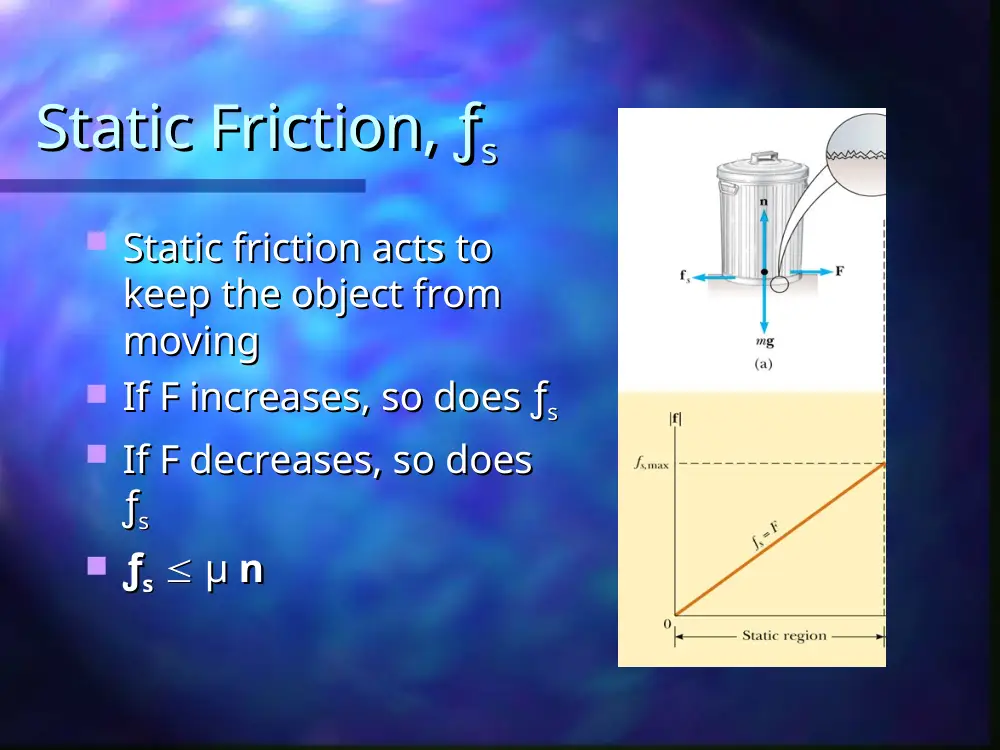
Static Friction, ƒ
Static Friction, ƒss
Static friction acts to
Static friction acts to
keep the object from
keep the object from
moving
moving
If F increases, so does ƒ
If F increases, so does ƒss
If F decreases, so does
If F decreases, so does
ƒƒss
ƒƒss
µ
µ nn
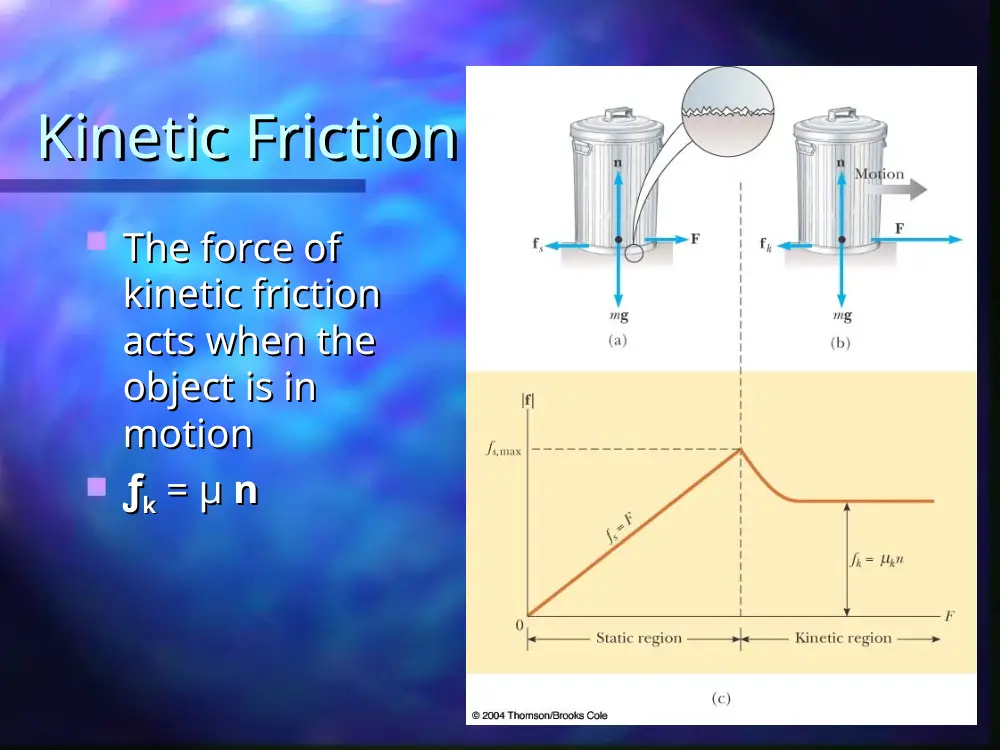
Kinetic Friction
Kinetic Friction
The force of
The force of
kinetic friction
kinetic friction
acts when the
acts when the
object is in
object is in
motion
motion
ƒƒkk = µ
= µ nn
Example:
Example:
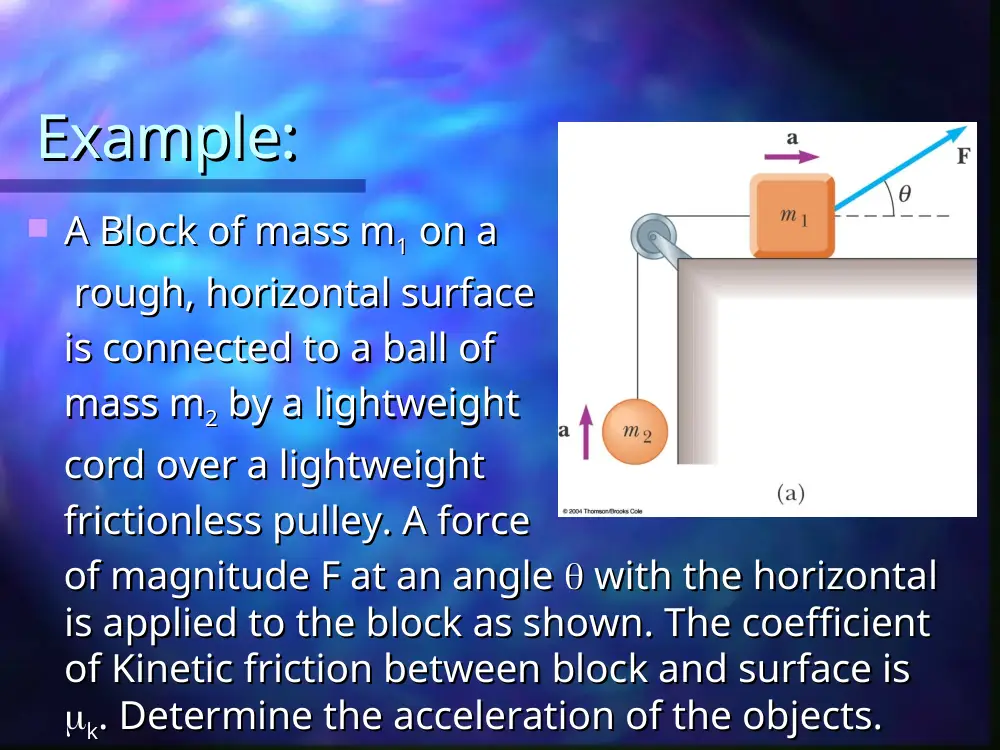
A Block of mass m
A Block of mass m11 on a
on a
rough, horizontal surface
rough, horizontal surface
is connected to a ball of
is connected to a ball of
mass m
mass m22 by a lightweight
by a lightweight
cord over a lightweight
cord over a lightweight
frictionless pulley. A force
frictionless pulley. A force
of magnitude F at an angle
of magnitude F at an angle with the horizontal
with the horizontal
is applied to the block as shown. The coefficient
is applied to the block as shown. The coefficient
of Kinetic friction between block and surface is
of Kinetic friction between block and surface is
kk. Determine the acceleration of the objects.
. Determine the acceleration of the objects.
Solution:
Solution:
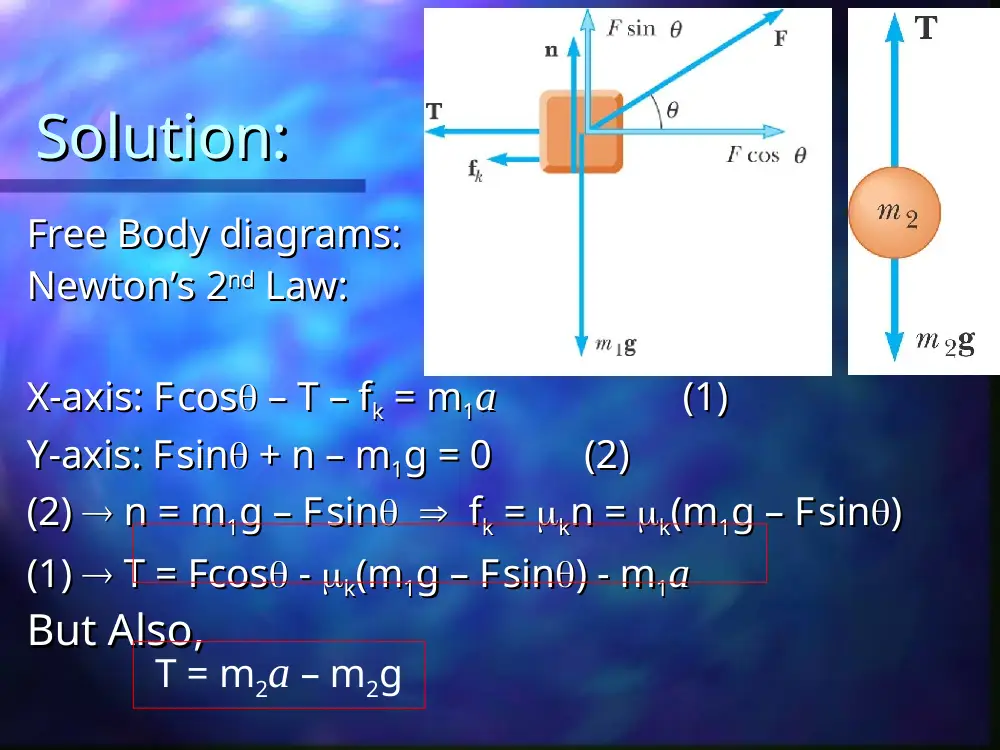
Free Body diagrams:
Free Body diagrams:
Newton’s 2
Newton’s 2nd
nd Law:
Law:
X-axis: F
X-axis: F cos
cos – T – f
– T – fkk = m
= m11a
a
(1)
(1)
Y-axis: F
Y-axis: F sin
sin + n – m
+ n – m11g = 0
g = 0
(2)
(2)
(2)
(2)
n = m
n = m11g – F
g – F sin
sin
ffkk =
= kkn =
n = kk((m
m11g – F
g – F sin
sin))
(1)
(1)
T = Fcos
T = Fcos -
- kk((m
m11g – F
g – F sin
sin) -
) - m
m11aa
But Also,
But Also,
T = m2a – m2g
Solution Cont’d:
Solution Cont’d:
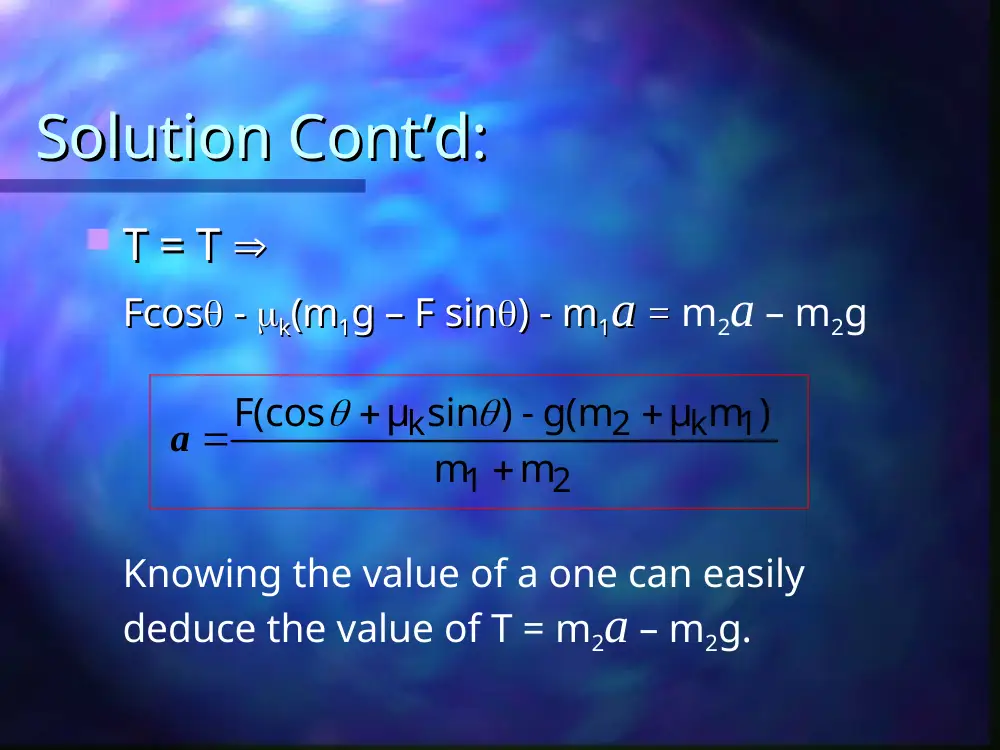
T = T
T = T
Fcos
Fcos -
- kk((m
m11g – F sin
g – F sin) -
) - m
m11aa =
= m2a – m2g
Knowing the value of a one can easily
deduce the value of T = m2a – m2g.
2
1
1
k
2
k
m
m
μ m )
μ sin ) - g(m
F(cos
a
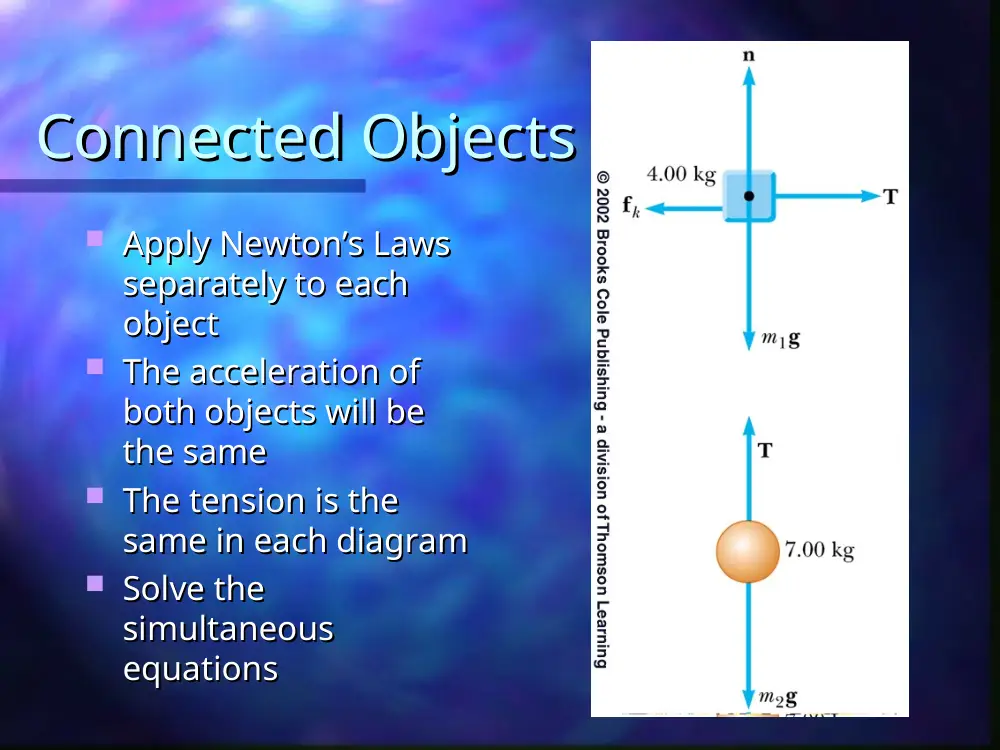
Connected Objects
Connected Objects
Apply Newton’s Laws
Apply Newton’s Laws
separately to each
separately to each
object
object
The acceleration of
The acceleration of
both objects will be
both objects will be
the same
the same
The tension is the
The tension is the
same in each diagram
same in each diagram
Solve the
Solve the
simultaneous
simultaneous
equations
equations
More About Connected
More About Connected
Objects
Objects
Treating the system as one object
Treating the system as one object
allows an alternative method or a
allows an alternative method or a
check
check
Use only external forces
Use only external forces
Not the tension – it’s internal
Not the tension – it’s internal
The mass is the mass of the system
The mass is the mass of the system
Doesn’t tell you anything about any
Doesn’t tell you anything about any
internal forces
internal forces
Newton’s Law applied to
Newton’s Law applied to
uniform circular motion:
uniform circular motion:
A particle moving with uniform speed v in a circular
A particle moving with uniform speed v in a circular
path of radius r, experiences a centripetal
path of radius r, experiences a centripetal
acceleration
acceleration aacc that has a magnitude:
that has a magnitude:
aacc is directed toward the
is directed toward the
center of the circle and is
center of the circle and is
always
always to v.
to v.
r
v2
c
| a |
Newton’s Law applied to
Newton’s Law applied to
uniform circular motion Cont’d:
uniform circular motion Cont’d:
If we apply Newton’s law along the radial
If we apply Newton’s law along the radial
direction,
direction,
F acts toward the center
F acts toward the center
of the circle.
of the circle.
r
m v
m
F
2
c
a
Newton’s Law applied to
Newton s Law applied to
uniform circular motion Cont’d
uniform circular motion Cont’d
Ex:
Ex:
The ball is put in a
The ball is put in a
circular motion on a
circular motion on a
frictionless table.
frictionless table.
If the string breaks at
If the string breaks at
some point how the
some point how the
ball moves afterward?
ball moves afterward?
Tangential (
Tangential (aatt) and Radial (
) and Radial (aaN
N) )
Acceleration
Acceleration
In the case when the speed changes along
In the case when the speed changes along
a circular path the total Acceleration vector
a circular path the total Acceleration vector
is given by:
is given by:
aa =
= aatt +
+ aaN
N
Where,
Where,
|a
|aN
N| = v
| = v22/r (directed toward the center of the circle)
/r (directed toward the center of the circle)
|a
|att| = (directed tangent to the circle)
| = (directed tangent to the circle)
dt
d|v|
Tangential (
Tangential (aatt) and Radial (
) and Radial (aaN
N) )
Acceleration Cont’d:
Acceleration Cont’d:
at
aN
a
aa =
= aatt +
+ aaNN
||aaNN| = v
| = v22/r/r
dt
||aatt| = d|v|
| =
Example
Example
The above figure shows the path of a park ride that travels at
constant speed through five circular arcs of radii R0, 2R0, and
3R0. Rank the arcs according to the magnitude of the
centripetal force on a rider traveling in the arcs, greatest first.
423.15
Application:
Application:
A ball of mass m= 0.500 Kg is attached to the
A ball of mass m= 0.500 Kg is attached to the
end of a cord 1.50 m long. The ball is whirled
end of a cord 1.50 m long. The ball is whirled
in a horizontal circle.
in a horizontal circle.
If the ball can withstand a maximum tension
If the ball can withstand a maximum tension
of 50.0 N, what is the maximum speed the
of 50.0 N, what is the maximum speed the
ball can attain before the cord breaks.
ball can attain before the cord breaks.
x
Solution:
Solution:
Applying Newton’s Law:
Maximum tension correspond to max v:
r
m v
m
F
2
c
a
r
m v
T
2
x
mg
N
T
m/s
m
T
r
V
Max
Max
12 2.
150
5.0
50
5.1
Example:
Example:
A small object of mass
A small object of mass
m is suspended from a
m is suspended from a
string of length L. The
string of length L. The
object revolves with
object revolves with
constant speed v in a
constant speed v in a
horizontal circle of
horizontal circle of
radius r, Find an
radius r, Find an
expression for v as
expression for v as
function of T, r and m?
function of T, r and m?
Solution:
Solution:
Applying Newton’s
Applying Newton’s
Law:
Law:
Projection along the
Projection along the
horizontal axis:
horizontal axis:
Projection along the
Projection along the
vertical axis:
vertical axis:
a
m
T
m g
r
m v
)
Tsin(
2
(1)
mg
Tcos( )
(2)
r.g.tanθ
v
r g
v
tan
2
Dividing (1) by (2)
Example:
Example:
A 1500-kg car moving on a
A 1500-kg car moving on a
flat,
horizontal
road
flat,
horizontal
road
negotiates
a
curve,
(See
negotiates
a
curve,
(See
Figure). If the radius of the
Figure). If the radius of the
curve is 35.0 m and the
curve is 35.0 m and the
coefficient of static friction
coefficient of static friction
between the tires and dry
between the tires and dry
pavement is 0.500, find the
pavement is 0.500, find the
maximum speed the car can
maximum speed the car can
have and still make the turn
have and still make the turn
successfully.
successfully.
Solution:
Solution:
Force of friction enables
Force of friction enables
the car to remains in its
the car to remains in its
circular path.
circular path.
a
m
n
f
m g
s
Projection along the radius:
μ mg
μ n
f
s
s
s, max
r
m v
f
2
s
But,
r
mg m v
μ
2max
s
13.1m/s
9.80 35.0
0.500
μ .g.r
v
s
max
More Applications:
More Applications:
A small sphere of mass
A small sphere of mass
m is attached to the end
m is attached to the end
of a cord of length R and
of a cord of length R and
set into motion in a
set into motion in a
vertical circle about a
vertical circle about a
fixed point O. Determine
fixed point O. Determine
the tension in the cord
the tension in the cord
at any instant when the
at any instant when the
speed of the sphere is v
speed of the sphere is v
and the cord makes an
and the cord makes an
angle
angle with the vertical.
with the vertical.
Solution:
Solution:
Note that along the path
Note that along the path
the speed is not
the speed is not
constant.
constant.
R
m v
T
mgcos
-
2
a
m
T
m g
Projection along the radius:
Projection along the radius:
gcos
R
m v
T
2
Application Cont’d
Application Cont’d
gcos
R
m v
T
2
What speed would the ball have
as it passes over the top of the
circle if the tension in the cord
goes to zero instantaneously?
At the top = 180°
vtop gR
T = 0, (i.e. cord breaks)
g
R
m v
T
2
Motion in the Presence of
Motion in the Presence of
Resistive Forces:
Resistive Forces:
The medium through which the object
The medium through which the object
moves exerts a resistive force
moves exerts a resistive force RR on it.
on it.
The medium can be either a liquid or a gas.
The medium can be either a liquid or a gas.
Some examples are the air resistance
Some examples are the air resistance
associated with moving vehicles (called also
associated with moving vehicles (called also
air Drag) and the viscous forces that act on
air Drag) and the viscous forces that act on
a object moving through a liquid.
a object moving through a liquid.
Resistive Forces:
Resistive Forces:
The direction of the resistive force
The direction of the resistive force RR is always
is always
opposite to the direction of motion.
opposite to the direction of motion.
The Magnitude of
The Magnitude of RR is proportional to the
is proportional to the
speed of the object:
speed of the object:
RR = -
= -bb vv
vv is the velocity of the object and
is the velocity of the object and bb is a
is a
constant whose value depends on the
constant whose value depends on the
properties of the medium and on the shape
properties of the medium and on the shape
and dimensions of the object.
and dimensions of the object.
Terminal Speed
Terminal Speed
When the Drag force ( upward air
When the Drag force ( upward air
resistance for example) equals the
resistance for example) equals the
driving force (downward force of
driving force (downward force of
gravity), the net force on the object is
gravity), the net force on the object is
zero.
zero.
The constant speed of the object is
The constant speed of the object is
the
the terminal speed
terminal speed
Application:
Application:
Consider a small
Consider a small
sphere of mass m
sphere of mass m
released from rest
released from rest
in a liquid as shown
in a liquid as shown
in the adjacent
in the adjacent
figure, assuming
figure, assuming
that the buoyant
that the buoyant
force is negligible,
force is negligible,
describe the
describe the
motion of the
motion of the
sphere.
sphere.
Application Cont’d:
Application Cont’d:
The forces acting
The forces acting
on the sphere are:
on the sphere are:
1) Resistive Force:
1) Resistive Force:
RR =-
=-bb vv
2) The gravitational
2) The gravitational
Force:
Force:
FFgg = m
= mgg
Application Cont’d:
Application Cont’d:
Applying Newton’s law:
Applying Newton’s law:
We can obtain the terminal
We can obtain the terminal
speed by putting dv/dt = 0.
speed by putting dv/dt = 0.
mg –
mg – bb vvTT = 0
= 0
mg
R
y
(+)
b
vT mg
dt
mdv
v
mg-
b
m v
g
dt
dv
b
Application Cont’d:
Application Cont’d:
The Equation
The Equation
is called a differential equation.
is called a differential equation.
m v
g
dt
dv
b