
PHYS 210 Chapter 5, Spring 2012
American University of Beirut · Introductory Physics II · 43 pages · Dr. Samih Isber

Showing the first 10 of 43 pages. Download the PDF to see all of it.
More PHYS 210 files
Show the text of this chapter
Chapter 5
Chapter 5
Force and Motion I
Force and Motion I
Classical Mechanics
Classical Mechanics
Describes the relationship between
Describes the relationship between
the motion of objects in our everyday
the motion of objects in our everyday
world and the forces acting on them
world and the forces acting on them
Conditions when Classical Mechanics
Conditions when Classical Mechanics
does not apply
does not apply
very tiny objects (< atomic sizes)
very tiny objects (< atomic sizes)
objects moving near the speed of light
objects moving near the speed of light
Forces
Forces
Usually think of a force as a push or
Usually think of a force as a push or
pull
pull
Vector quantity
Vector quantity
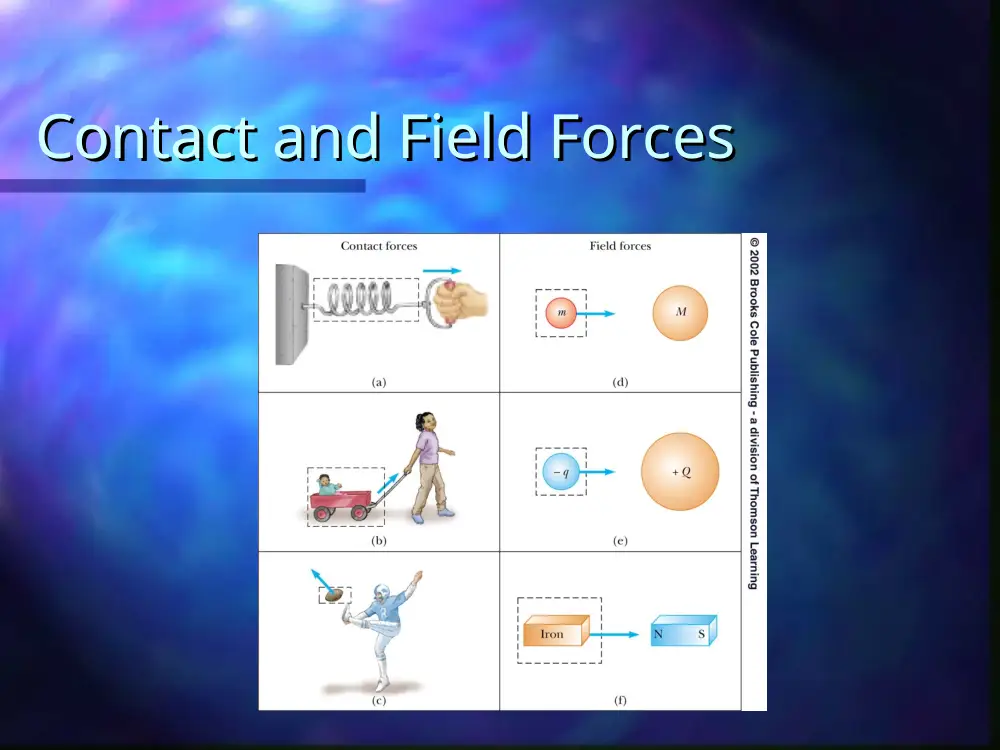
May be contact or field force
May be contact or field force
Contact and Field Forces
Contact and Field Forces
Fundamental Forces
Fundamental Forces
Types
Types
Strong nuclear force
Strong nuclear force
Electromagnetic force
Electromagnetic force
Weak nuclear force
Weak nuclear force
Gravity
Gravity
Characteristics
Characteristics
All field forces
All field forces
Listed in order of decreasing strength
Listed in order of decreasing strength
Only gravity and electromagnetic in mechanics
Only gravity and electromagnetic in mechanics
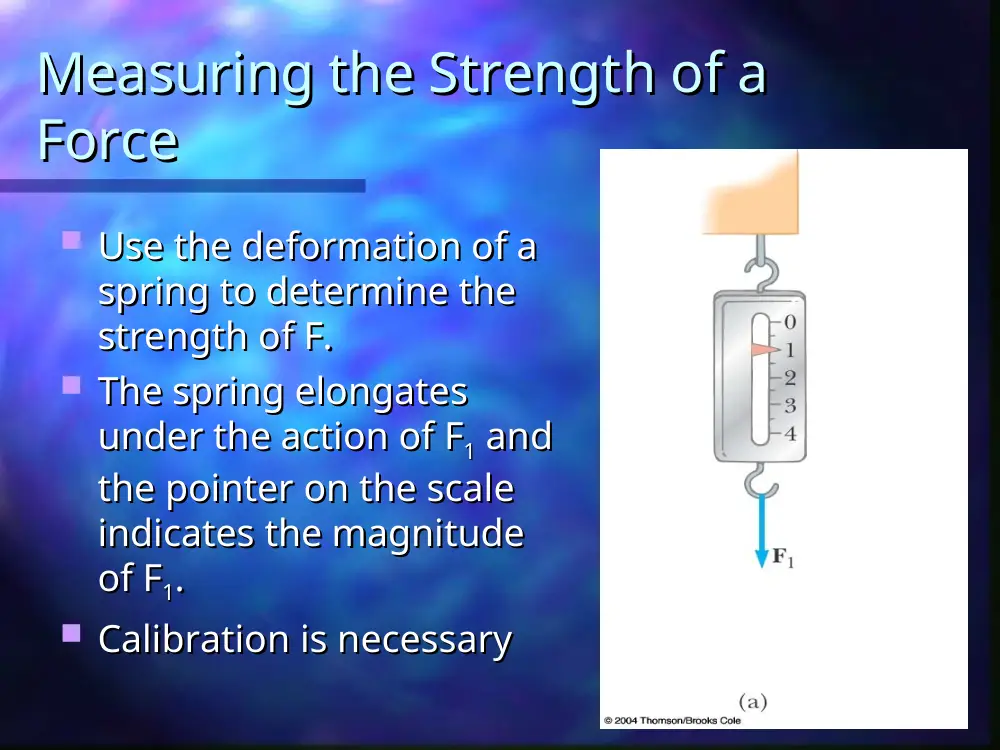
Measuring the Strength of a
Measuring the Strength of a
Force
Force
Use the deformation of a
Use the deformation of a
spring to determine the
spring to determine the
strength of F.
strength of F.
The spring elongates
The spring elongates
under the action of F
under the action of F11 and
and
the pointer on the scale
the pointer on the scale
indicates the magnitude
indicates the magnitude
of F
of F11. .
Calibration is necessary
Calibration is necessary
Newton’s First Law
Newton’s First Law
If no forces act on an object, it
If no forces act on an object, it
continues in its original state of
continues in its original state of
motion; that is, unless something
motion; that is, unless something
exerts an external force on it, an
exerts an external force on it, an
object at rest remains at rest and an
object at rest remains at rest and an
object moving with some velocity
object moving with some velocity
continues with that same velocity.
continues with that same velocity.
Newton’s First Law, cont.
Newton’s First Law, cont.
External force
External force
any force that results from the interaction
any force that results from the interaction
between the object and its environment
between the object and its environment
Alternative statement of Newton’s First
Alternative statement of Newton’s First
Law
Law
When there are no external forces acting
When there are no external forces acting
on an object, the acceleration of the
on an object, the acceleration of the
object is zero.
object is zero.
Inertia
Inertia
Is the tendency of an object to
Is the tendency of an object to
continue in its original motion
continue in its original motion
Mass
Mass
A measure of the resistance of an
A measure of the resistance of an
object to changes in its motion due to
object to changes in its motion due to
a force
a force
Scalar quantity
Scalar quantity
SI units are kg
SI units are kg
Newton’s Second Law
Newton’s Second Law
The acceleration of an object is directly
The acceleration of an object is directly
proportional to the net force acting on it
proportional to the net force acting on it
and inversely proportional to its mass.
and inversely proportional to its mass.
FF and
and aa are both vectors
are both vectors
Can also be applied three-dimensionally
Can also be applied three-dimensionally
Units of Force
Units of Force
SI unit of force is a Newton (N)
SI unit of force is a Newton (N)
US Customary unit of force is a pound
US Customary unit of force is a pound
(lb) N. B. (1 N = 0.225 lb)
(lb) N. B. (1 N = 0.225 lb)
2
s
1kg m
1N
A sphere and a block are
connected by a string placed
over a pulley.
The two objects are at rest at
the same level, as shown in the
Figure.
A teacher performs the following
demonstration:
The block is now pulled down and held while in its new position,
as shown in Figure 2.
The teacher asks the class to predict what will happen in this real
situation when the block is released, and to give a reason
supporting the prediction.
A teacher performs the following
demonstration:
1.
The block will move down because the
gravitational force on the block will be
greater at this lower level.
2. The block will remain stationary because
there will be no resultant force on the
block.
3. The block will move up and return to its
original position because this will
conserve potential energy.
4. The block will move up and return to its
original position because that was its
equilibrium position.
More Question:
The adjacent figure shows
overhead views of four
situations in which forces act on
a block that lies on a frictionless
floor. If the force magnitudes
are chosen properly, in which
situations is it possible that the
block is (a) stationary and (b)
moving with a constant
velocity?
Gravitational Force
Gravitational Force
Mutual force of attraction between
Mutual force of attraction between
any two objects
any two objects
Expressed by Newton’s Law of
Expressed by Newton’s Law of
Universal Gravitation:
Universal Gravitation:
2
2
1
g
r
F G m m
Weight
Weight
The magnitude of the gravitational
The magnitude of the gravitational
force acting on an object of mass
force acting on an object of mass m
m
near the Earth’s surface is called the
near the Earth’s surface is called the
weight
weight ww of the object
of the object
w = m g
w = m g is a special case of Newton’s
is a special case of Newton’s
Second Law
Second Law
g
g can also be found from the Law of
can also be found from the Law of
Universal Gravitation
Universal Gravitation
More about weight
More about weight
Weight is
Weight is not
not an inherent property of
an inherent property of
an object
an object
mass
mass is
is an inherent property
an inherent property
Weight depends upon location
Weight depends upon location
Newton’s Third Law
Newton’s Third Law
If two objects interact, the force F
If two objects interact, the force F12
12
exerted by object 1 on object 2 is
exerted by object 1 on object 2 is
equal in magnitude but opposite in
equal in magnitude but opposite in
direction to the force F
direction to the force F21
21 exerted by
exerted by
object 2 on object 1.
object 2 on object 1.
Equivalent to saying a single isolated
Equivalent to saying a single isolated
force cannot exist
force cannot exist
Newton’s Third Law cont.
Newton’s Third Law cont.
FF12
12 may be called
may be called
the
the action
action force
force
and F
and F21
21 the
the reaction
reaction
force
force
Actually, either
Actually, either
force can be the
force can be the
action or the
action or the
reaction force
reaction force
The action and
The action and
reaction forces act
reaction forces act
on
on different
different
objects
objects
Some Action-Reaction Pairs
Some Action-Reaction Pairs
n and n’
n and n’
n is the
n is the normal
normal
force, the force the
force, the force the
table exerts on the
table exerts on the
TV
TV
n is always
n is always
perpendicular to
perpendicular to
the surface
the surface
n’ is the reaction –
n’ is the reaction –
the TV on the table
the TV on the table
n = - n’
n = - n’
More Action-Reaction pairs
More Action-Reaction pairs
FFgg and F
and Fgg’’
FFgg is the force the
is the force the
Earth exerts on the
Earth exerts on the
object
object
FFgg’ is the force the
’ is the force the
object exerts on the
object exerts on the
earth
earth
FFgg = -F
= -Fgg’’
Forces Acting on an Object
Forces Acting on an Object
Newton’s Law uses
Newton’s Law uses
the forces acting
the forces acting on
on
an object
an object
n and F
n and Fgg are acting
are acting
on the object
on the object
n’ and F
n’ and Fgg’ are acting
’ are acting
on other objects
on other objects
The adjacent Figure shows four
choices for the direction of a
force of magnitude F to be
applied to a block on an inclined
plane. The directions are either
horizontal or vertical. (For
choices a and b, the force is not
enough to lift the block off the
plane.) Rank the choices
according to the magnitude of
the normal force on the block
from the plane, greatest first.
Forces Acting on an Object Ex.:
Forces Acting on an Object Ex.:
Applying Newton’s Laws
Applying Newton’s Laws
Assumptions
Assumptions
Objects behave as particles
Objects behave as particles
can ignore rotational motion (for now)
can ignore rotational motion (for now)
Masses of strings or ropes are negligible
Masses of strings or ropes are negligible
Interested only in the forces acting on
Interested only in the forces acting on
the object
the object
Free Body Diagram
Free Body Diagram
Must identify all the forces acting on
Must identify all the forces acting on
the object of interest
the object of interest
Choose an appropriate coordinate
Choose an appropriate coordinate
system
system
If the free body diagram is incorrect,
If the free body diagram is incorrect,
the solution will likely be incorrect
the solution will likely be incorrect
Equilibrium
Equilibrium
An object either at rest or moving
An object either at rest or moving
with a constant velocity is said to be
with a constant velocity is said to be
in
in equilibrium
equilibrium
The net force acting on the object is
The net force acting on the object is
zero
zero
F 0
Equilibrium cont.
Equilibrium cont.
Easier to work with the equation in
Easier to work with the equation in
terms of its components:
terms of its components:
Fx 0
Fy 0
Solving Equilibrium
Solving Equilibrium
Problems
Problems
Make a sketch of the situation described in
Make a sketch of the situation described in
the problem
the problem
Draw a free body diagram for the isolated
Draw a free body diagram for the isolated
object under consideration and label all the
object under consideration and label all the
forces acting on it
forces acting on it
Resolve the forces into x- and y-
Resolve the forces into x- and y-
components, using a convenient
components, using a convenient
coordinate system
coordinate system
Apply equations, keeping track of signs
Apply equations, keeping track of signs
Solve the resulting equations
Solve the resulting equations
Equilibrium Example – Free
Equilibrium Example – Free
Body Diagrams
Body Diagrams
Newton’s Second Law
Newton’s Second Law
Problems
Problems
Similar to equilibrium except
Similar to equilibrium except
Use components
Use components
aaxx or a
or ayy may be zero
may be zero
ma
F
x
x
ma
F
y
y
ma
F
Solving Newton s Second
Solving Newton s Second
Law
Law
Problems
Problems
Make a sketch of the situation described in
Make a sketch of the situation described in
the problem
the problem
Draw a free body diagram for the isolated
Draw a free body diagram for the isolated
object under consideration and label all the
object under consideration and label all the
forces acting on it
forces acting on it
If more than one object is present, draw free body
If more than one object is present, draw free body
diagram for each object
diagram for each object
Resolve the forces into x- and y-
Resolve the forces into x- and y-
components, using a convenient
components, using a convenient
coordinate system
coordinate system
Apply equations, keeping track of signs
Apply equations, keeping track of signs
Solve the resulting equations
Solve the resulting equations
Inclined Planes
Inclined Planes
Choose the
Choose the
coordinate system
coordinate system
with x along the
with x along the
incline and y
incline and y
perpendicular to
perpendicular to
the incline
the incline
Replace the force
Replace the force
of gravity with its
of gravity with its
components
components
Example:
Example:
A car of mass m is on
A car of mass m is on
a icy driveway inclined
a icy driveway inclined
at angle
at angle as shown in
as shown in
the adjacent Figure.
the adjacent Figure.
Find the acceleration
Find the acceleration
of the car, assuming
of the car, assuming
No Friction
No Friction..
Solution:
Solution:
Chose of x- and y-axes.
Chose of x- and y-axes.
Free Body diagram.
Free Body diagram.
Newton’s 2
Newton’s 2nd
nd Law:
Law:
m
mgg +
+ nn = m
= maa
Projection along the x-axis:
Projection along the x-axis:
mgsin(
mgsin() = m
) = maaxx
Projection along the y-axis:
Projection along the y-axis:
mgcos(
mgcos() + n = 0
) + n = 0
ax = gsin()
More Examples:
More Examples:
Two Blocks of masses m
Two Blocks of masses m11 and m
and m22, with m
, with m11 >
>
m
m22, are placed in contact with each other on a
, are placed in contact with each other on a
frictionless horizontal surface. A constant
frictionless horizontal surface. A constant
force
force FF is applied to m
is applied to m11 as shown.
as shown.
a) Find the magnitude of the acceleration of
a) Find the magnitude of the acceleration of
the system?
the system?
b) Determine the magnitude of the contact
b) Determine the magnitude of the contact
force between the two blocks?
force between the two blocks?
Solution:
Solution:
Both Blocks must
Both Blocks must
experience the
experience the
same acceleration
same acceleration
since they are in
since they are in
contact.
contact.
FF is the only force
is the only force
acting horizontally:
acting horizontally:
F = (m
F = (m11+m
+m22))aax
x
2
1
m
m
F
ax
Solution Cont’d:
Solution Cont’d:
Free body diagram of
Free body diagram of
m
m11..
Along the x-axis, we
Along the x-axis, we
have:
have:
F – P
F – P21
21 = m
= m11aaxx
x
y
2
1
m
m
F
x
a
2
1
1
21
m
m
F
m
F
P
m F
m
m
P
2
1
2
21
Solution:
Solution:
Note that one can get
Note that one can get
PP12
12 from m
from m22::
Along the x-axis:
Along the x-axis:
PP12
12 = m
= m22aaxx
2
1
m
m
F
x
a
m F
m
m
P
2
1
2
12
We see that |
We see that |PP12
12|= |
|= |PP21
21||
Example, The Atwood Machine:
Example, The Atwood Machine:
Two object of unequal masses
Two object of unequal masses
(m
(m22>m
>m11) are hung vertically
) are hung vertically
over a frictionless pulley of
over a frictionless pulley of
negligible mass.
negligible mass.
Determine the magnitude of
Determine the magnitude of
the acceleration of the two
the acceleration of the two
objects and the tension in the
objects and the tension in the
lightweight cord.
lightweight cord.
Solution Atwood Machine:
Solution Atwood Machine:
m
m22 will move down and m
will move down and m11
will move up with the same
will move up with the same aa..
N.B. The tensions in the cord
N.B. The tensions in the cord
from both side are equal
from both side are equal
since mass of pulley is
since mass of pulley is
negligible and there is no
negligible and there is no
Friction.
Friction.
a
a
Atwood Cont’d:
Atwood Cont’d:
a
Drawing the free body diagram and
Drawing the free body diagram and
applying Newton’s second Law.
applying Newton’s second Law.
Projection along the direction of motion
(upwards for m1)
-m1g + T = m1a T = m1g + m1a
a
1
1
m
T
m g
a
2
2
m
T
m g
Projection along the direction of motion (downwards for
m2)
m2g - T = m2a T = m2g – m2a
Atwood Cont’d:
Atwood Cont’d:
T = T m1g + m1a = m2g – m2a
m g
m
m
m
1
2
1
2
a
(m2 – m1)g = Net Force
(m2 + m1) = Total mass
N.B.