
PHYS 210 Problems Chapter 16 and 17 Solutions, Fall 2010
American University of Beirut · Introductory Physics II · 206 pages · with solution


Showing the first 10 of 206 pages. Download the PDF to see all of it.
More PHYS 210 files
Show the text of this chapter
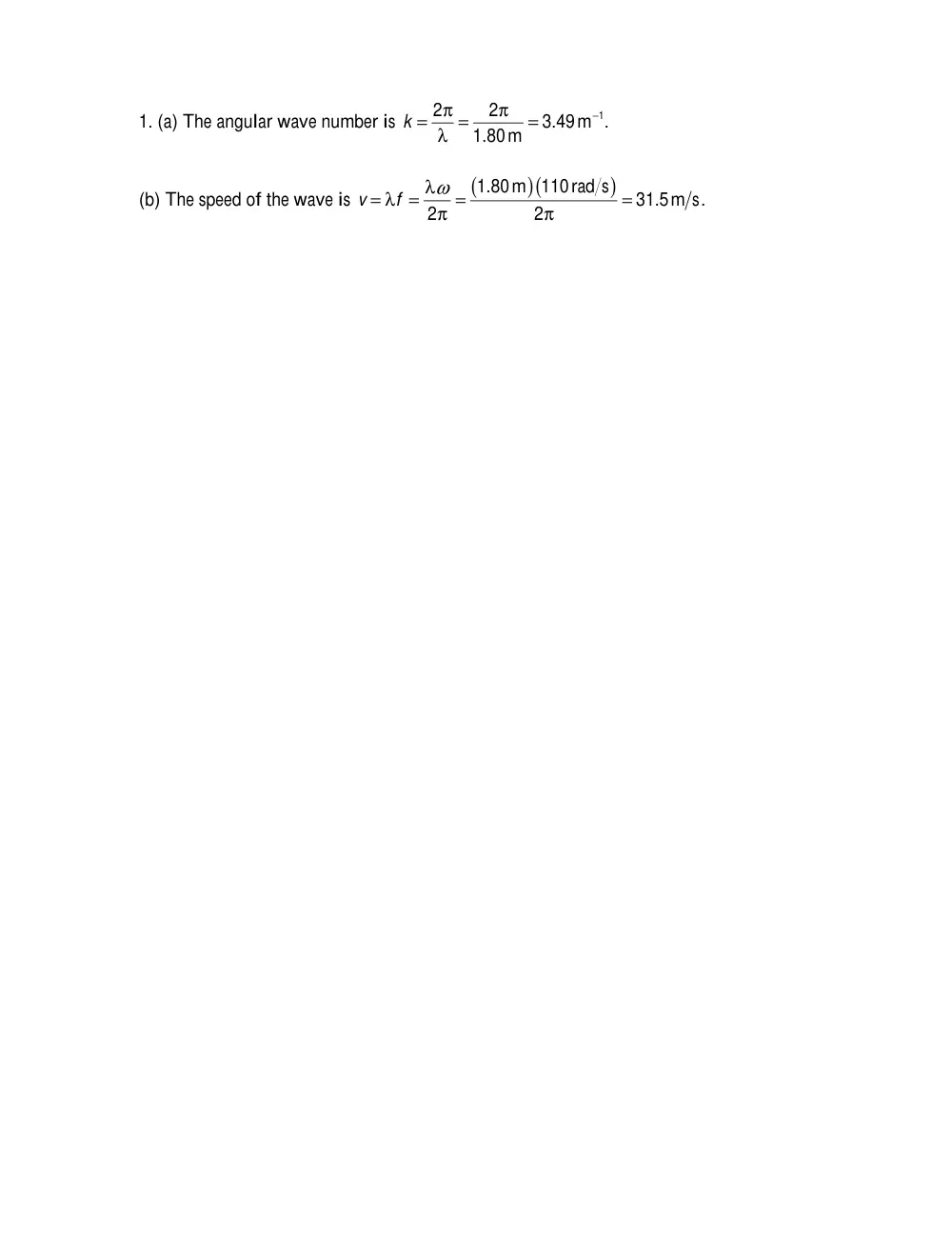
1. (a) The angular wave number is
1
2
2
3.49m .
1.80m
k
−
π
π
=
=
=
λ
(b) The speed of the wave is
(
)(
1.80m 110rad s)
31.5m s.
2
2
v
f
= λ = λω
=
=
π
π
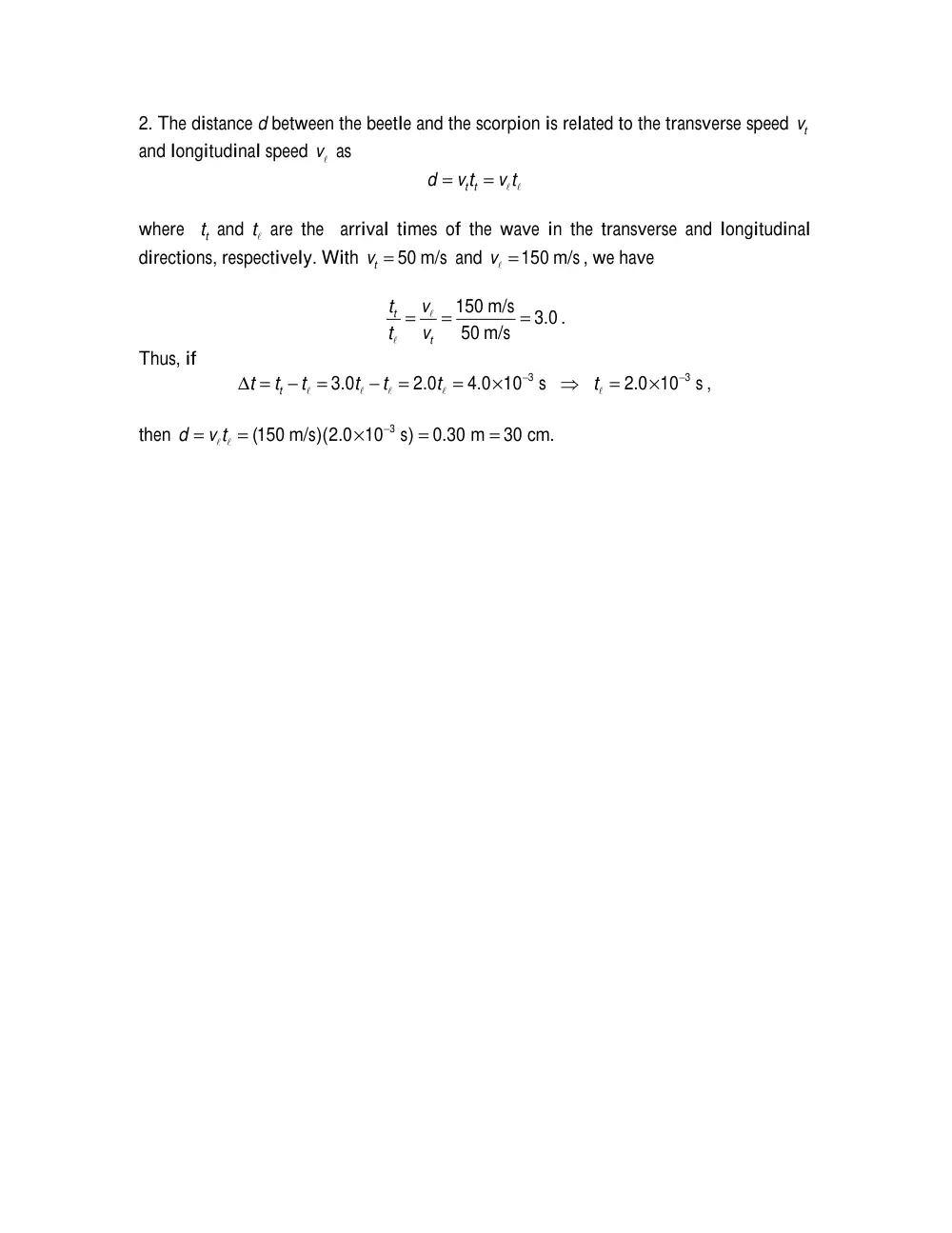
2. The distance d between the beetle and the scorpion is related to the transverse speed
tv
and longitudinal speed v� as
t t
d
v t
v t
=
=
� �
where
tt and t� are the arrival times of the wave in the transverse and longitudinal
directions, respectively. With
tv = 50 m/s
and
v =150 m/s
�
, we have
150 m/s
3.0
50 m/s
t
t
t
v
t
= v
=
=
�
�
.
Thus, if
3
3
3.0
2.0
4.0 10
s
2.0 10
s ,
t
t
t
t
t
t
t
t
−
−
Δ =
−
=
−
=
=
×
�
=
×
�
�
�
�
�
then
(150 m/s)(2.0 10 3
s)
0.30 m
30 cm.
d
v t
−
=
=
×
=
=
� �
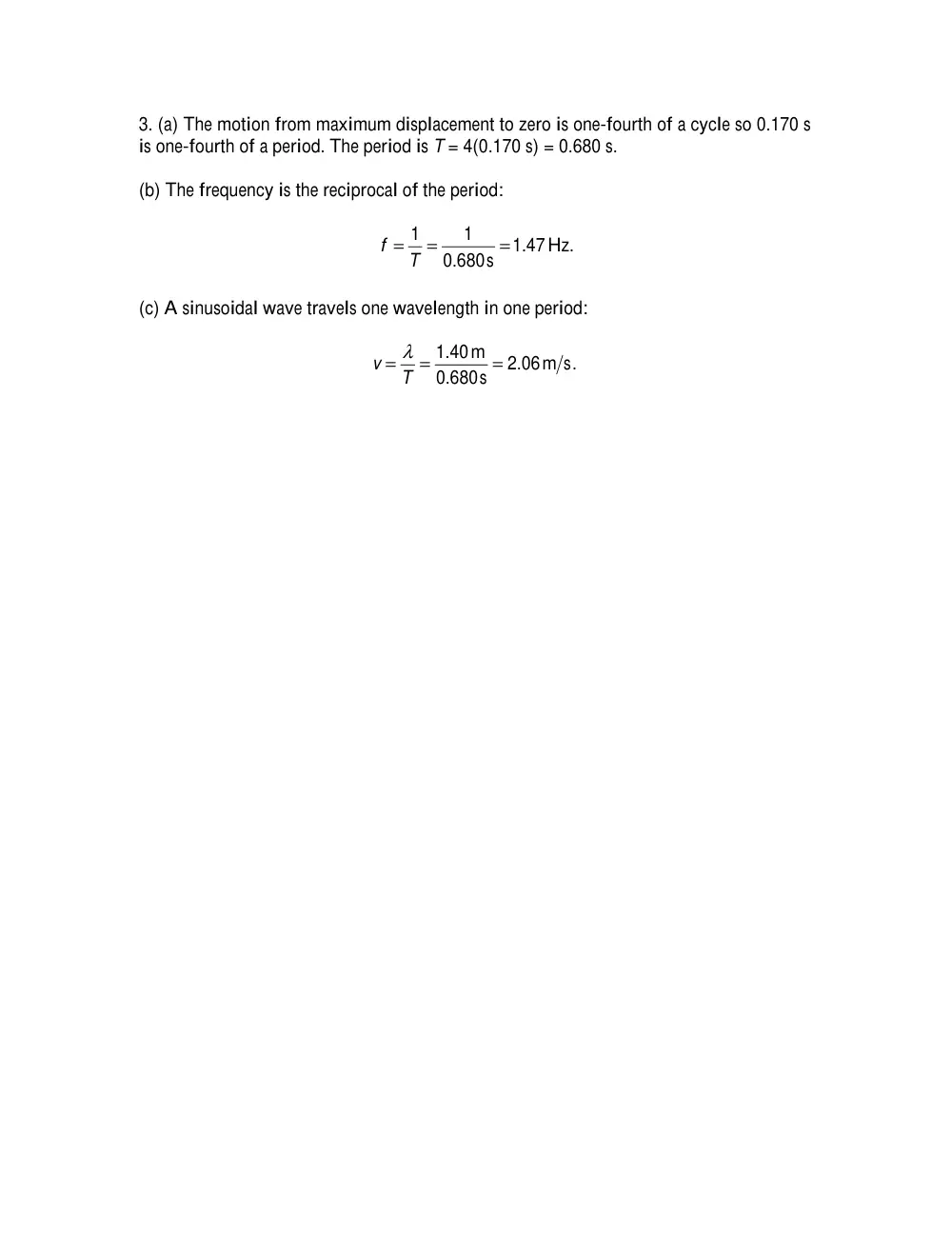
3. (a) The motion from maximum displacement to zero is one-fourth of a cycle so 0.170 s
is one-fourth of a period. The period is T = 4(0.170 s) = 0.680 s.
(b) The frequency is the reciprocal of the period:
1
1
1.47Hz.
0.680s
f
= T
=
=
(c) A sinusoidal wave travels one wavelength in one period:
1.40m
2.06m s.
0.680s
v
= T
=
=
λ
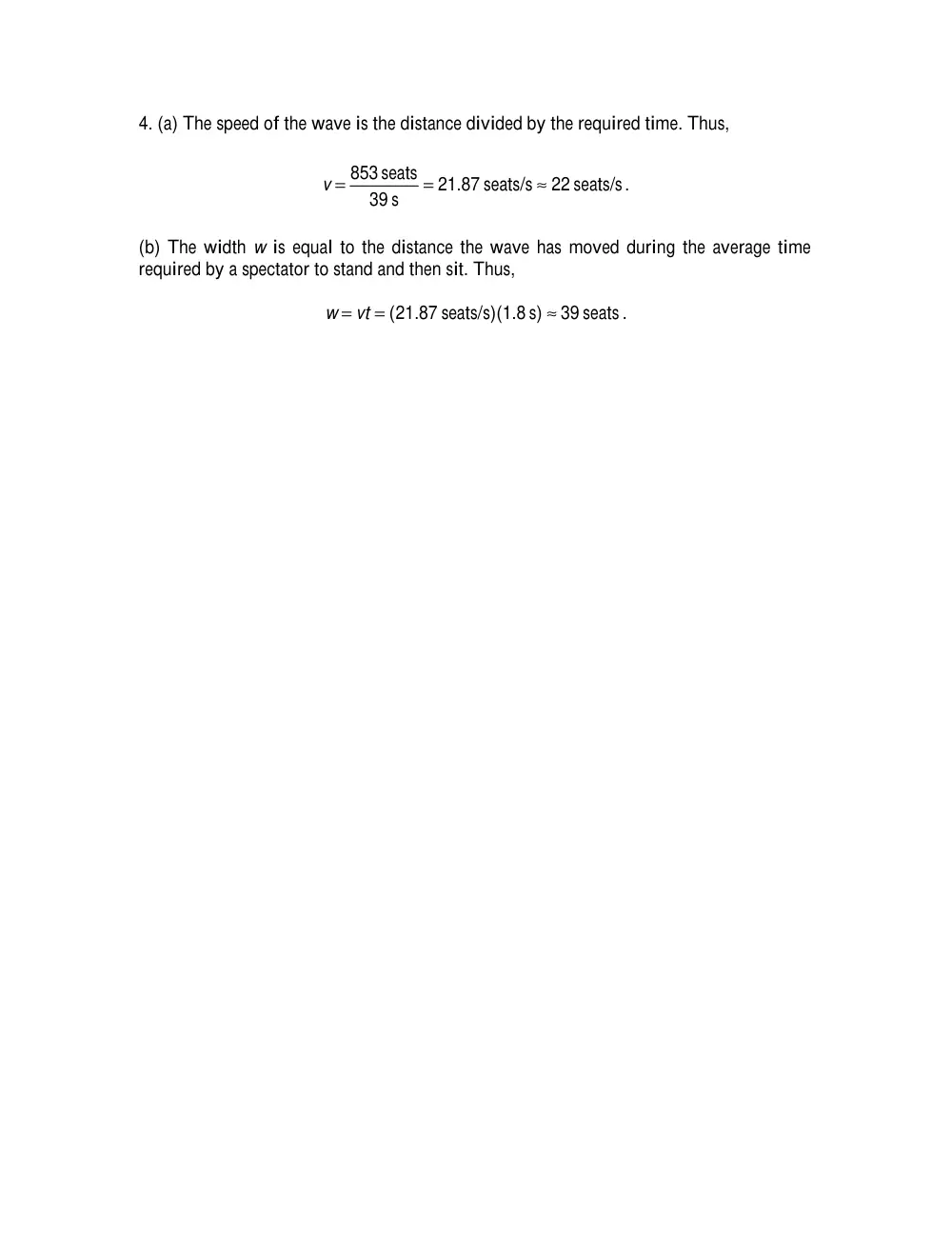
853 seats
21.87 seats/s
22 seats/s
39 s
v =
=
≈
.
(b) The width w is equal to the distance the wave has moved during the average time
required by a spectator to stand and then sit. Thus,
(21.87 seats/s)(1.8 s)
39 seats
w
= vt
=
≈
.
4. (a) The speed of the wave is the distance divided by the required time. Thus,
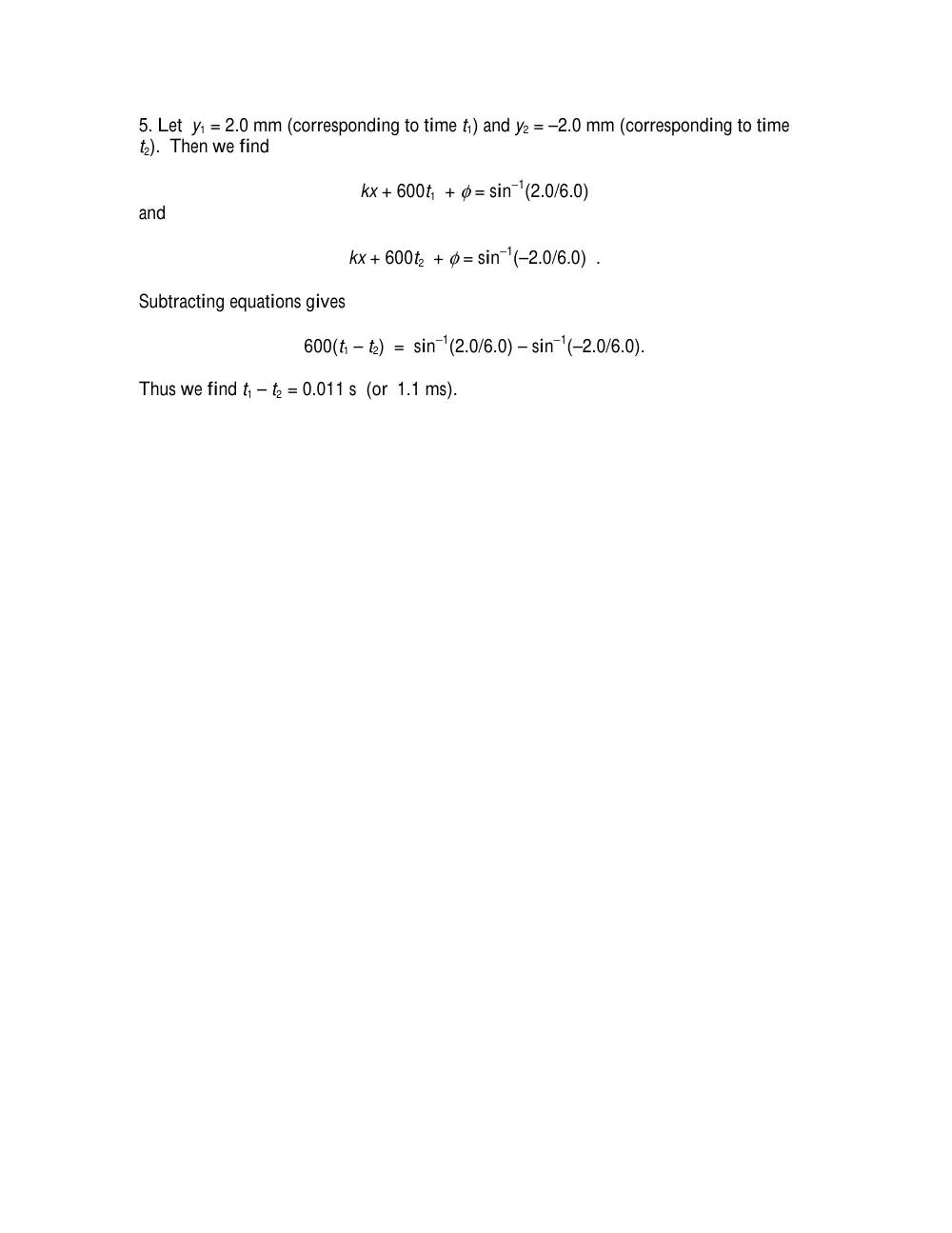
5. Let y1 = 2.0 mm (corresponding to time t1) and y2 = –2.0 mm (corresponding to time
t2). Then we find
kx + 600t1 + φ = sin−1(2.0/6.0)
and
kx + 600t2 + φ = sin−1(–2.0/6.0) .
Subtracting equations gives
600(t1 – t2) = sin−1(2.0/6.0) – sin−1(–2.0/6.0).
Thus we find t1 – t2 = 0.011 s (or 1.1 ms).
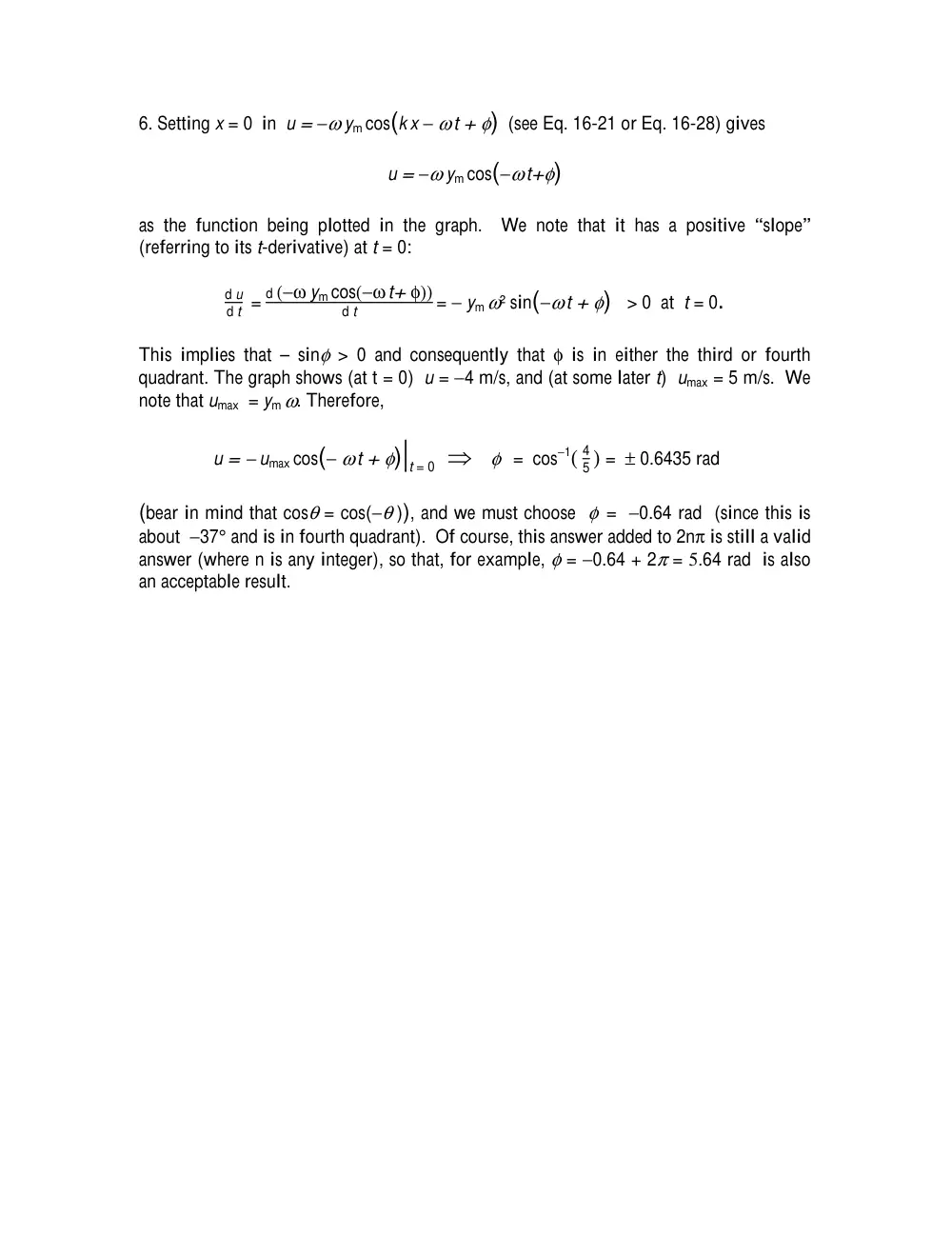
6. Setting x = 0 in u = −ω ym cos(k x − ωt + φ) (see Eq. 16-21 or Eq. 16-28) gives
u = −ω ym cos(−ωt+φ)
as the function being plotted in the graph. We note that it has a positive “slope”
(referring to its t-derivative) at t = 0:
d u
d t = d (−ω ym cos(−ωt+ φ))
d t
= − ym ω² sin(−ωt + φ) > 0 at t = 0.
This implies that – sinφ > 0 and consequently that φ is in either the third or fourth
quadrant. The graph shows (at t = 0) u = −4 m/s, and (at some later t) umax = 5 m/s. We
note that umax = ym ω. Therefore,
u = − umax cos(− ωt + φ)|t = 0 �
φ = cos−1( 4
5 ) = ± 0.6435 rad
(bear in mind that cosθ = cos(−θ )), and we must choose φ = −0.64 rad (since this is
about −37° and is in fourth quadrant). Of course, this answer added to 2nπ is still a valid
answer (where n is any integer), so that, for example, φ = −0.64 + 2π = 5.64 rad is also
an acceptable result.
7. Using v = fλ, we find the length of one cycle of the wave is
λ = 350/500 = 0.700 m = 700 mm.
From f = 1/T, we find the time for one cycle of oscillation is T = 1/500 = 2.00 × 10⁻³ s =
2.00 ms.
(a) A cycle is equivalent to 2π radians, so that π/3 rad corresponds to one-sixth of a cycle.
The corresponding length, therefore, is λ/6 = 700/6 = 117 mm.
(b) The interval 1.00 ms is half of T and thus corresponds to half of one cycle, or half of
2π rad. Thus, the phase difference is (1/2)2π = π rad.
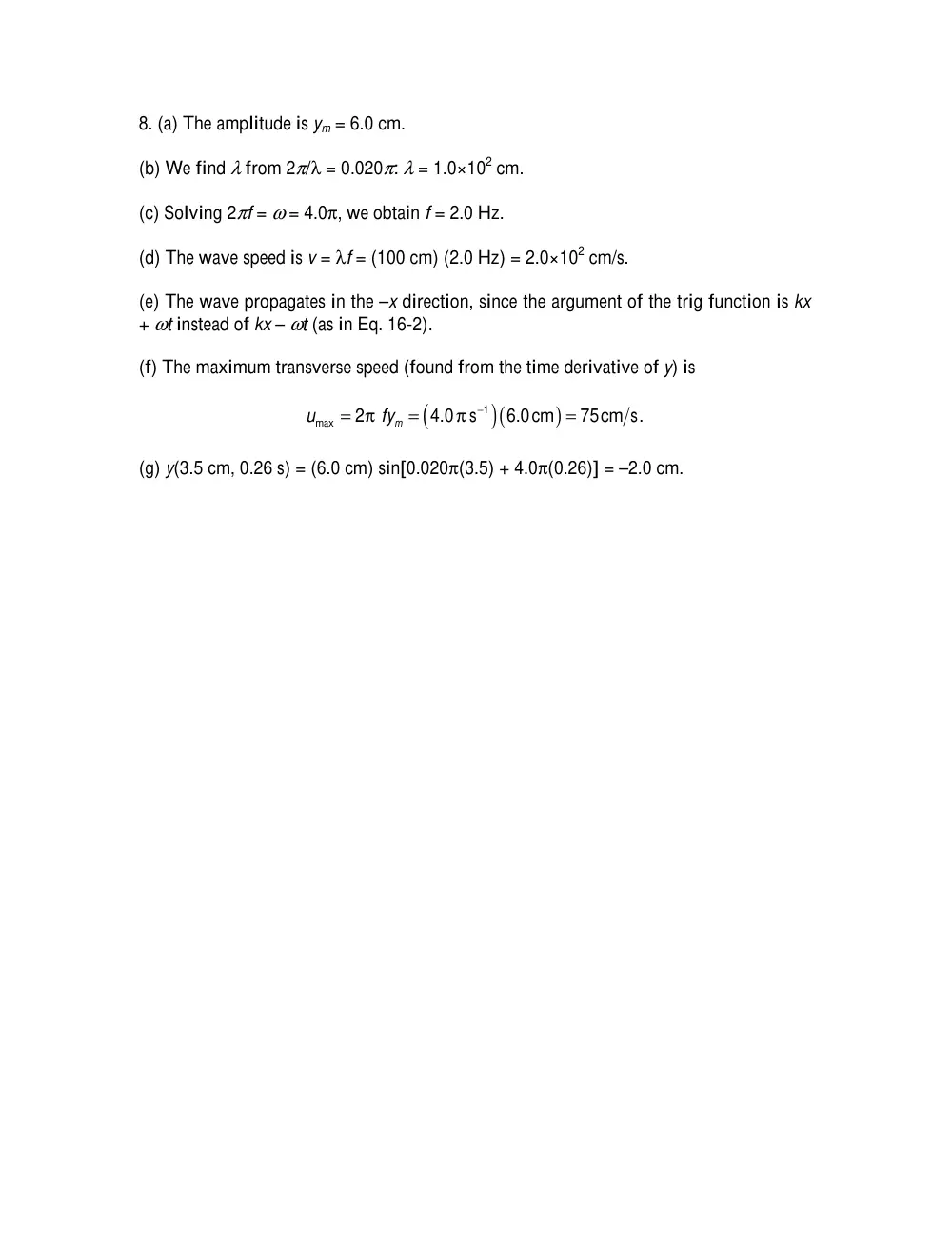
8. (a) The amplitude is ym = 6.0 cm.
(b) We find λ from 2π/λ = 0.020π: λ = 1.0×102 cm.
(c) Solving 2πf = ω = 4.0π, we obtain f = 2.0 Hz.
(d) The wave speed is v = λf = (100 cm) (2.0 Hz) = 2.0×102 cm/s.
(e) The wave propagates in the –x direction, since the argument of the trig function is kx
+ ωt instead of kx – ωt (as in Eq. 16-2).
(f) The maximum transverse speed (found from the time derivative of y) is
(
)(
)
1
max
2
4.0
s
6.0cm
75cm s.
m
u
fy
−
= π
=
π
=
(g) y(3.5 cm, 0.26 s) = (6.0 cm) sin[0.020π(3.5) + 4.0π(0.26)] = –2.0 cm.
(f) The function describing the wave can be written as
(
)
0.040sin 5
400
y
x
t
φ
=
−
+
where distances are in meters and time is in seconds. We adjust the phase constant φ to
satisfy the condition y = 0.040 at x = t = 0. Therefore, sin φ = 1, for which the “simplest”
root is φ = π/2. Consequently, the answer is
0.040sin 5
400
2 .
y
x
t
π
�
�
=
−
+
�
�
�
�
(g) The sign in front of ω is minus.
9. (a) Recalling from Ch. 12 the simple harmonic motion relation um = ymω, we have
16
400rad/s.
ω = 0.040
=
Since ω = 2πf, we obtain f = 64 Hz.
(b) Using v = fλ, we find λ = 80/64 = 1.26 m
≈1.3 m
.
(c) The amplitude of the transverse displacement is
2
4.0 cm
4.0 10 m.
ym
−
=
=
×
(d) The wave number is k = 2π/λ = 5.0 rad/m.
(e) The angular frequency, as obtained in part (a), is
2
16/ 0.040
4.0 10 rad/s.
ω =
=
×
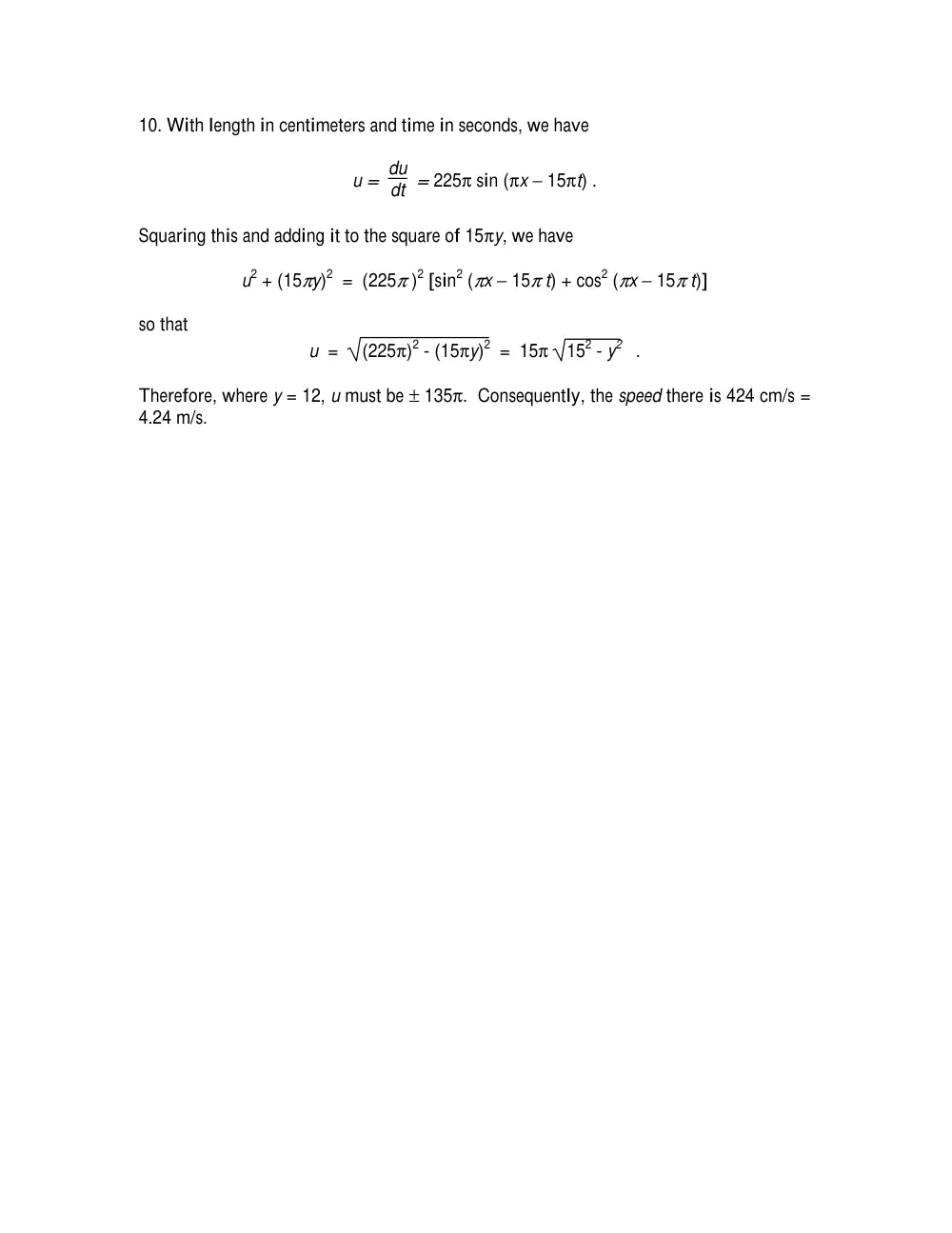
10. With length in centimeters and time in seconds, we have
u = du
dt = 225π sin (πx − 15πt) .
Squaring this and adding it to the square of 15πy, we have
u2 + (15πy)2 = (225π )2 [sin2 (πx − 15π t) + cos2 (πx − 15π t)]
so that
u =
(225π)2 - (15πy)2 = 15π
152 - y2 .
Therefore, where y = 12, u must be ± 135π. Consequently, the speed there is 424 cm/s =
4.24 m/s.
(d) We choose the minus sign (between kx and ωt) in the argument of the sine function
because the wave is shown traveling to the right [in the +x direction] – see section 16-5).
Therefore, with SI units understood, we obtain
y = ym sin(kx −kvt) ≈ 0.0030 sin(16 x − 2.4 �10
2 t) .
11. (a) The amplitude ym is half of the 6.00 mm vertical range shown in the figure, i.e.,
3.0 mm.
m
y =
(b) The speed of the wave is v = d/t = 15 m/s, where d = 0.060 m and t = 0.0040 s. The
angular wave number is k = 2π/λ where λ = 0.40 m. Thus,
k = 2π
λ = 16 rad/m .
(c) The angular frequency is found from
ω = k v = (16 rad/m)(15 m/s)=2.4�102 rad/s.
12. The slope that they are plotting is the physical slope of sinusoidal waveshape (not to
be confused with the more abstract “slope” of its time development; the physical slope is
an x-derivative whereas the more abstract “slope” would be the t-derivative). Thus,
where the figure shows a maximum slope equal to 0.2 (with no unit), it refers to the
maximum of the following function:
d y
d x =
d ym sin(k x − ωt)
d x
= ym k cos(k x − ωt) .
The problem additionally gives t = 0, which we can substitute into the above expression
if desired. In any case, the maximum of the above expression is ym k , where
2
2
15.7 rad/m
0.40 m
k
π
π
= λ
=
=
.
Therefore, setting ym k equal to 0.20 allows us to solve for the amplitude ym . We find
0.20
0.0127 m 1.3 cm
15.7 rad/m
m
y =
=
≈
.
(d) The angular frequency is ω = 2π/T = π/5 = 0.63 rad/s.
(e) As found in part (a), the phase is φ
=π
.
(f) The sign is minus since the wave is traveling in the +x direction.
(g) Since the frequency is f = 1/T = 0.10 s, the speed of the wave is v = fλ = 2.0 cm/s.
(h) From the results above, the wave may be expressed as
( , )
4.0sin
4.0sin
10
5
10
5
x
t
x
t
y x t
π
π
π
π
π
�
�
�
�
=
−
+
= −
−
�
�
�
�
�
�
�
�
.
Taking the derivative of y with respect to t, we find
( , )
4.0
cos 10
5
y
x
t
u x t
t
t
π
π
∂
� π
�
�
�
=
=
−
�
�
�
�
∂
�
�
�
�
which yields u(0,5.0) = –2.5 cm/s.
13. From Eq. 16-10, a general expression for a sinusoidal wave traveling along the +x
direction is
( , )
sin(
)
m
y x t
y
kx
ωt
φ
=
−
+
(a)
The
figure
shows
that
at
x
=
0,
(0, )
sin(
)
m
y
t
y
ωt
φ
=
−
+
is a positive sine function, i.e.,
(0, )
sin
.
m
y
t
y
ωt
= +
Therefore, the phase constant must
be φ
=π
. At t =0, we then have
( ,0)
sin(
)
sin
m
m
y x
y
kx
y
kx
π
=
+
= −
which is a negative sine function. A plot of y(x,0) is
depicted on the right.
(b) From the figure we see that the amplitude is ym = 4.0 cm.
(c) The angular wave number is given by k = 2π/λ = π/10 = 0.31 rad/cm.
14. From v =
τ μ , we have
new
new
new
old
old
old
2.
v
v
τ
μ
τ
μ
=
=
15. The wave speed v is given by v = τ μ , where τ is the tension in the rope and μ is
the linear mass density of the rope. The linear mass density is the mass per unit length of
rope:
μ = m/L = (0.0600 kg)/(2.00 m) = 0.0300 kg/m.
Thus,
500 N
129m s.
0.0300kg m
v =
=
2
2
1
1
1
2
2
2
2
4
.
4
d
d
d
d
μ
πρ
μ
πρ
�
�
=
= �
�
�
�
Therefore, the ratio of diameters is
1
1
2
2
3.0
3.2.
0.29
d
d
μ
μ
=
=
=
16. The volume of a cylinder of height � is V = πr2 � = πd2 � /4. The strings are long,
narrow cylinders, one of diameter d1 and the other of diameter d2 (and corresponding
linear densities μ1 and μ2). The mass is the (regular) density multiplied by the volume: m
= ρV, so that the mass-per-unit length is
2
2
4
4
m
d
d
ρ
ρ
μ
�
�
�
π
π
=
=
=
and their ratio is
17. (a) The amplitude of the wave is ym=0.120 mm.
(b) The wave speed is given by v = τ μ , where τ is the tension in the string and μ is the
linear mass density of the string, so the wavelength is λ = v/f = τ μ /f and the angular
wave number is
(
)
1
2
0.50kg m
2
2
100Hz
141m .
10N
k
f
−
π
=
= π
= π
=
λ
μ
τ
(c) The frequency is f = 100 Hz, so the angular frequency is
ω = 2πf = 2π(100 Hz) = 628 rad/s.
(d) We may write the string displacement in the form y = ym sin(kx + ωt). The plus sign is
used since the wave is traveling in the negative x direction. In summary, the wave can be
expressed as
(
)
(
)
(
)
1
1
0.120mm sin
141m
+ 628s
.
y
x
t
−
−
�
�
=
�
�
18. We use
/
v =
τ μ ∝
τ to obtain
(
)
2
2
2
2
1
1
180m/s
120 N
135N.
170m/s
v
v
�
�
�
�
=
=
=
�
�
�
�
�
�
�
�
τ
τ
19. (a) The wave speed is given by v = λ/T = ω/k, where λ is the wavelength, T is the
period, ω is the angular frequency (2π/T), and k is the angular wave number (2π/λ). The
displacement has the form y = ym sin(kx + ωt), so k = 2.0 m–1 and ω = 30 rad/s. Thus
v = (30 rad/s)/(2.0 m–1) = 15 m/s.
(b) Since the wave speed is given by v = τ μ , where τ is the tension in the string and μ
is the linear mass density of the string, the tension is
(
)(
)
2
2
1.6 10 4
kg m
15m s
0.036 N.
v
τ
μ
−
=
=
×
=
20. (a) Comparing with Eq. 16-2, we see that k = 20/m and ω = 600/s. Therefore, the
speed of the wave is (see Eq. 16-13) v = ω/k = 30 m/s.
(b) From Eq. 16–26, we find
2
2
15
0.017kg m
17g m.
30
= v
=
=
=
τ
μ
The solution is either 0.93 rad or 2.21 rad. In the first case the function has a positive
slope at x = 0 and matches the graph. In the second case it has negative slope and does
not match the graph. We select φ = 0.93 rad.
(i) The string displacement has the form y (x, t) = ym sin(kx + ωt + φ). A plus sign appears
in the argument of the trigonometric function because the wave is moving in the negative
x direction. Using the results obtained above, the expression for the displacement is
(
)
2
1
1
( , )
5.0 10 m sin (16m )
(190s )
0.93 .
−
−
−
�
�
=
×
+
+
�
�
y x t
x
t
21. (a) We read the amplitude from the graph. It is about 5.0 cm.
(b) We read the wavelength from the graph. The curve crosses y = 0 at about x = 15 cm
and again with the same slope at about x = 55 cm, so
λ = (55 cm – 15 cm) = 40 cm = 0.40 m.
(c) The wave speed is
/
,
v =
τ μ where τ is the tension in the string and μ is the linear
mass density of the string. Thus,
3
3.6 N
12 m/s.
25 10 kg/m
v
−
=
=
×
(d) The frequency is f = v/λ = (12 m/s)/(0.40 m) = 30 Hz and the period is
T = 1/f = 1/(30 Hz) = 0.033 s.
(e) The maximum string speed is
um = ωym = 2πfym = 2π(30 Hz) (5.0 cm) = 940 cm/s = 9.4 m/s.
(f) The angular wave number is k = 2π/λ = 2π/(0.40 m) = 16 m–1.
(g) The angular frequency is ω = 2πf = 2π(30 Hz) = 1.9×10² rad/s
(h) According to the graph, the displacement at x = 0 and t = 0 is 4.0 × 10⁻² m. The
formula for the displacement gives y(0, 0) = ym sin φ. We wish to select φ so that
5.0 × 10⁻² sin φ = 4.0 × 10⁻².
22. (a) The general expression for y (x, t) for the wave is y (x, t) = ym sin(kx – ωt), which,
at x = 10 cm, becomes y (x = 10 cm, t) = ym sin[k(10 cm – ωt)]. Comparing this with the
expression given, we find ω = 4.0 rad/s, or f = ω/2π = 0.64 Hz.
(b) Since k(10 cm) = 1.0, the wave number is k = 0.10/cm. Consequently, the wavelength
is λ = 2π/k = 63 cm.
(c) The amplitude is
5.0 cm.
m
y =
(d) In part (b), we have shown that the angular wave number is k = 0.10/cm.
(e) The angular frequency is ω = 4.0 rad/s.
(f) The sign is minus since the wave is traveling in the +x direction.
Summarizing the results obtained above by substituting the values of k and ω into the
general expression for y (x, t), with centimeters and seconds understood, we obtain
( , )
5.0sin (0.10
4.0 ).
y x t
x
t
=
−
(g) Since
/
/
,
v
k
=
=
ω
τ μ the tension is
2
1 2
2
2
1 2
(4.0g /cm)(4.0s )
6400g cm/s
0.064 N.
(0.10cm )
−
−
=
=
=
⋅
=
k
ω μ
τ
(250N)(10.0m)
158m/s.
0.100kg
=
=
=
L
v
m
τ
Here τ is the tension in the wire and L/m is the linear mass density of the wire. The
coordinate of the meeting point is
3
10.0m
(158m/s)(30.0 10 s)
7.37m.
2
x
−
+
×
=
=
This is the distance from the left end of the wire. The distance from the right end is L – x
= (10.0 m – 7.37 m ) = 2.63 m.
23. The pulses have the same speed v. Suppose one pulse starts from the left end of the
wire at time t = 0. Its coordinate at time t is x1 = vt. The other pulse starts from the right
end, at x = L, where L is the length of the wire, at time t = 30 ms. If this time is denoted
by t0 then the coordinate of this wave at time t is x2 = L – v(t – t0). They meet when x1 =
x2, or, what is the same, when vt = L – v(t – t0). We solve for the time they meet: t = (L +
vt0)/2v and the coordinate of the meeting point is x = vt = (L + vt0)/2. Now, we calculate
the wave speed:
24. (a) The tension in each string is given by τ = Mg/2. Thus, the wave speed in string 1
is
2
1
1
1
(500g)(9.80m/s )
28.6m/s.
2
2(3.00g/m)
Mg
v
τ
μ
μ
=
=
=
=
(b) And the wave speed in string 2 is
2
2
2
(500g)(9.80m/s )
22.1m/s.
2
2(5.00g/m)
Mg
v
μ
=
=
=
(c) Let
1
1
1
2
2
2
/(2
)
/(2
)
v
M g
v
M g
=
=
=
μ
μ
and M1 + M2 = M. We solve for M1 and
obtain
1
2
1
500g
187.5g
188g.
1
/
1 5.00/3.00
M
M
μ
μ
=
=
=
≈
+
+
(d) And we solve for the second mass: M2 = M – M1 = (500 g – 187.5 g) ≈ 313 g.
25. (a) The wave speed at any point on the rope is given by v = τ μ , where τ is the
tension at that point and μ is the linear mass density. Because the rope is hanging the
tension varies from point to point. Consider a point on the rope a distance y from the
bottom end. The forces acting on it are the weight of the rope below it, pulling down, and
the tension, pulling up. Since the rope is in equilibrium, these forces balance. The weight
of the rope below is given by μgy, so the tension is τ = μgy. The wave speed is
/
.
=
=
v
gy
gy
μ
μ
(b) The time dt for the wave to move past a length dy, a distance y from the bottom end,
is d
d
d
t
y v
y
gy
=
=
and the total time for the wave to move the entire length of the
rope is
0
0
d
2
2
.
L
L
y
y
L
t
g
g
gy
=
=
=
�
26. Using Eq. 16–33 for the average power and Eq. 16–26 for the speed of the wave, we
solve for f = ω/2π:
avg
3
2
1
1
2(85.0W)
198 Hz.
2
2 (7.70 10 m)
/
(36.0 N)(0.260kg / 2.70m)
m
P
f
y
μ τ μ
−
=
=
=
π
π
×
27. We note from the graph (and from the fact that we are dealing with a cosine-squared,
see Eq. 16-30) that the wave frequency is f = 1
2 ms = 500 Hz, and that the wavelength λ =
0.20 m. We also note from the graph that the maximum value of dK/dt is 10 W. Setting
this equal to the maximum value of Eq. 16-29 (where we just set that cosine term equal to
1) we find
1
2 μ v ω2 ym
2 = 10
with SI units understood. Substituting in μ = 0.002 kg/m, ω = 2πf and v = f λ , we solve
for the wave amplitude:
ym =
10
2π2μλ f 3 = 0.0032 m .
28. Comparing
1
1
( , )
(3.00 mm)sin[(4.00 m )
(7.00 s ) ]
y x t
x
t
−
−
=
−
to the general expression
( , )
sin(
)
m
y x t
y
kx
ωt
=
−
, we see that
4.00 m 1
k
−
=
and
ω = 7.00 rad/s
. The speed of the
wave is
1
/
(7.00 rad/s)/(4.00 m ) 1.75 m/s.
v
k
ω
−
=
=
=
29. The wave
1
1
1/2
( , )
(2.00 mm)[(20 m )
(4.0 s ) ]
y x t
x
t
−
−
=
−
is of the form (
)
h kx
−ωt
with
angular wave number
20 m 1
k
−
=
and angular frequency
ω = 4.0 rad/s
. Thus, the speed of
the wave is
1
/
(4.0 rad/s)/(20 m )
0.20 m/s.
v
k
ω
−
=
=
=
30. The wave
1
1
( , )
(4.00 mm) [(30 m )
(6.0 s ) ]
y x t
h
x
t
−
−
=
+
is of the form (
)
h kx
−ωt
with
angular wave number
30 m 1
k
−
=
and angular frequency
ω = 6.0 rad/s
. Thus, the speed
of the wave is
1
/
(6.0 rad/s)/(30 m )
0.20 m/s.
v
k
ω
−
=
=
=
sin(
)
sin(
)
m
m
y
y
kx
t
y
kx
t
ω
ω
φ
=
−
+
−
+
(
)
(
)
1
1
2
2
2
cos
sin
ym
kx
t
φ
ω
φ
=
−
+
,
where φ = π/2. The amplitude is
(
)
1
2
2
m cos
A
y
φ
=
2
cos( / 4)
1.41
m
m
y
y
=
π
=
.
31. The displacement of the string is given by
32. (a) Let the phase difference be φ. Then from Eq. 16–52, 2ym cos(φ/2) = 1.50ym, which
gives
2cos 1 1.50
82.8 .
2
m
m
y
y
φ
− �
�
=
=
°
�
�
�
�
(b) Converting to radians, we have φ = 1.45 rad.
(c) In terms of wavelength (the length of each cycle, where each cycle corresponds to 2π
rad), this is equivalent to 1.45 rad/2π = 0.230 wavelength.
33. (a) The amplitude of the second wave is
9.00 mm
m
y =
, as stated in the problem.
(b) The figure indicates that λ = 40 cm = 0.40 m, which implies that the angular wave
number is k = 2π/0.40 = 16 rad/m.
(c) The figure (along with information in the problem) indicates that the speed of each
wave is v = dx/t = (56.0 cm)/(8.0 ms) = 70 m/s. This, in turn, implies that the angular
frequency is
ω = k v =1100 rad/s = 1.1×10³ rad/s.
(d) The figure depicts two traveling waves (both going in the –x direction) of equal
amplitude ym. The amplitude of their resultant wave, as shown in the figure, is y′m = 4.00
mm. Eq. 16-52 applies:
y′m = 2 ym cos( 1
2 φ2)
� φ2 = 2 cos−1(2.00/9.00) = 2.69 rad.
(e) In making the plus-or-minus sign choice in y = ym sin(k x ± ω t + φ), we recall the
discussion in section 16-5, where it shown that sinusoidal waves traveling in the –x
direction are of the form y = ym sin(k x + ω t + φ). Here, φ should be thought of as the
phase difference between the two waves (that is, φ1 = 0 for wave 1 and φ2 = 2.69 rad for
wave 2).
In summary, the waves have the forms (with SI units understood):
y1 = (0.00900)sin(16 x +1100 t) and y2 = (0.00900)sin(16 x + 1100 t + 2.7 ) .
34. (a) We use Eq. 16-26 and Eq. 16-33 with μ = 0.00200 kg/m and ym = 0.00300 m.
These give v = τ / μ = 775 m/s and
Pavg = 1
2 μv ω2ym
2 = 10 W.
(b) In this situation, the waves are two separate string (no superposition occurs). The
answer is clearly twice that of part (a); P = 20 W.
(c) Now they are on the same string. If they are interfering constructively (as in Fig. 16-
16(a)) then the amplitude ym is doubled which means its square ym
2 increases by a factor
of 4. Thus, the answer now is four times that of part (a); P = 40 W.
(d) Eq. 16-52 indicates in this case that the amplitude (for their superposition) is
2 ymcos(0.2π) = 1.618 times the original amplitude ym. Squared, this results in an increase
in the power by a factor of 2.618. Thus, P = 26 W in this case.
(e) Now the situation depicted in Fig. 16-16(b) applies, so P = 0.
35. The phasor diagram is shown below: y1m and y2m represent the original waves and ym
represents the resultant wave. The phasors corresponding to the two constituent waves
make an angle of 90° with each other, so the triangle is a right triangle. The Pythagorean
theorem gives
2
2
2
2
2
2
1
2
(3.0cm)
(4.0cm)
(25cm)
m
m
m
y
y
y
=
+
=
+
=
.
Thus ym = 5.0 cm.
(d) In the part (c) situation, the amplitude is (8.0 mm + 5.0 mm) = 13 mm.
(e) Using phasor terminology, the angle “between them” in this case is π/2 rad (90º), so
the Pythagorean theorem applies:
2
2
(8.0 mm)
+(5.0 mm)
= 9.4 mm .
36. (a) As shown in Figure 16-16(b) in the textbook, the least-amplitude resultant wave is
obtained when the phase difference is π rad.
(b) In this case, the amplitude is (8.0 mm – 5.0 mm) = 3.0 mm.
(c) As shown in Figure 16-16(a) in the textbook, the greatest-amplitude resultant wave is
obtained when the phase difference is 0 rad.
37. The phasor diagram is shown on the right. We use the cosine
theorem:
2
2
2
2
2
1
2
1
2
1
2
1
2
2
cos
2
cos .
m
m
m
m
m
m
m
m
m
y
y
y
y
y
y
y
y
y
θ
φ
=
+
−
=
+
+
We solve for cos φ :
2
2
2
2
2
2
1
2
1
2
(9.0mm)
(5.0mm)
(7.0mm)
cos
0.10.
2
2(5.0mm)(7.0mm)
m
m
m
m
m
y
y
y
y
y
φ
−
−
−
−
=
=
=
The phase constant is therefore φ = 84°.
38. We see that y1 and y3 cancel (they are 180º) out of phase, and y2 cancels with y4
because their phase difference is also equal to π rad (180º). There is no resultant wave in
this case.
39. (a) Using the phasor technique, we think of these as two “vectors” (the first of
“length” 4.6 mm and the second of “length” 5.60 mm) separated by an angle of φ = 0.8π
radians (or 144º). Standard techniques for adding vectors then lead to a resultant vector
of length 3.29 mm.
(b) The angle (relative to the first vector) is equal to 88.8º (or 1.55 rad).
(c) Clearly, it should in “in phase” with the result we just calculated, so its phase angle
relative to the first phasor should be also 88.8º (or 1.55 rad).
40. (a) The wave speed is given by
3
7.00N
66.1m/s.
2.00
10
kg/1.25m
v
−
=
=
=
×
τ
μ
(b) The wavelength of the wave with the lowest resonant frequency f1 is λ1 = 2L, where L
= 125 cm. Thus,
1
1
66.1 m/s
26.4 Hz.
2(1.25 m)
f = v
=
=
λ
41. Possible wavelengths are given by λ = 2L/n, where L is the length of the wire and n is
an integer. The corresponding frequencies are given by f = v/λ = nv/2L, where v is the
wave speed. The wave speed is given by
/
,
v
L M
τ μ
τ
=
=
where τ is the tension in
the wire, μ is the linear mass density of the wire, and M is the mass of the wire. μ = M/L
was used to obtain the last form. Thus
250 N
(7.91 Hz).
2
2
2
(10.0 m) (0.100 kg)
n
n
L
n
n
f
n
L
M
LM
τ
τ
=
=
=
=
(a) The lowest frequency is
1
7.91 Hz.
f =
(b) The second lowest frequency is
2
f = 2(7.91 Hz) 15.8 Hz.
=
(c) The third lowest frequency is
3
3(7.91 Hz)
23.7 Hz.
f =
=
42. The nth resonant frequency of string A is
,
,
2
2
A
n A
A
v
n
f
l n
L
τ
μ
=
=
while for string B it is
,
,
1
.
2
8
4
B
n B
n A
B
v
n
f
n
f
l
L
τ
μ
=
=
=
(a) Thus, we see f1,A = f4,B. That is, the fourth harmonic of B matches the frequency of A’s
first harmonic.
(b) Similarly, we find f2,A = f8,B.
(c) No harmonic of B would match
3,
3
3
,
2
2
A
A
A
v
f
l
L
τ
μ
=
=
43. (a) The wave speed is given by
,
v
τ μ
=
where τ is the tension in the string and μ is
the linear mass density of the string. Since the mass density is the mass per unit length, μ
= M/L, where M is the mass of the string and L is its length. Thus
(96.0 N) (8.40 m)
82.0 m/s.
0.120 kg
L
v
M
=
=
=
τ
(b) The longest possible wavelength λ for a standing wave is related to the length of the
string by L = λ/2, so λ = 2L = 2(8.40 m) = 16.8 m.
(c) The frequency is f = v/λ = (82.0 m/s)/(16.8 m) = 4.88 Hz.
44. The string is flat each time the particle passes through its equilibrium position. A
particle may travel up to its positive amplitude point and back to equilibrium during this
time. This describes half of one complete cycle, so we conclude T = 2(0.50 s) = 1.0 s.
Thus, f = 1/T = 1.0 Hz, and the wavelength is
10cm/s
10 cm.
1.0Hz
v
λ = f
=
=
45. (a) Eq. 16–26 gives the speed of the wave:
2
3
150 N
144.34 m/s
1.44 10 m/s.
7.20 10
kg/m
v
τ
μ
−
=
=
=
≈
×
×
(b) From the figure, we find the wavelength of the standing wave to be
λ = (2/3)(90.0 cm) = 60.0 cm.
(c) The frequency is
2
1.44 10 m/s
241Hz.
0.600m
v
f
×
=
=
=
λ
46. Use Eq. 16–66 (for the resonant frequencies) and Eq. 16–26 (
/
)
v
τ μ
=
to find fn:
2
2
n
nv
n
f
L
L
τ
μ
=
=
which gives f3 = (3/2L)
iτ
μ .
(a) When τf = 4τi, we get the new frequency
3
3
3
2
.
2
f
f
f
L
τ
=
=
′
μ
(b) And we get the new wavelength
3
3
3
2
.
3
v
L
f
′
′
λ =
=
= λ
′
with n + 1. That is, f1 = nv/2L is the lower frequency and f2 = (n + 1)v/2L is the higher.
The ratio of the frequencies is
2
1
1.
f
n
f
n
+
=
The solution for n is
1
2
1
315 Hz
3.
420 Hz
315 Hz
f
n
f
f
=
=
=
−
−
The lowest possible resonant frequency is f = v/2L = f1/n = (315 Hz)/3 = 105 Hz.
(b) The longest possible wavelength is λ = 2L. If f is the lowest possible frequency then
v = λf = 2Lf = 2(0.75 m)(105 Hz) = 158 m/s.
47. (a) The resonant wavelengths are given by λ = 2L/n, where L is the length of the
string and n is an integer, and the resonant frequencies are given by f = v/λ = nv/2L,
where v is the wave speed. Suppose the lower frequency is associated with the integer n.
Then, since there are no resonant frequencies between, the higher frequency is associated
48. Using Eq. 16-26, we find the wave speed to be
6
65.2 10 N
4412m/s.
3.35kg/ m
v
τ
μ
×
=
=
=
The corresponding resonant frequencies are
,
1,2,3,
2
2
n
nv
n
f
n
L
L
τ
μ
=
=
=
�
(a) The wavelength of the wave with the lowest (fundamental) resonant frequency f1 is λ1
= 2L, where L = 347 m. Thus,
1
1
4412 m/s
6.36 Hz.
2(347 m)
f = v
=
=
λ
(b) The frequency difference between successive modes is
1
4412 m/s
6.36 Hz.
2
2(347 m)
n
n
v
f
f
f
L
−
Δ =
−
=
=
=
49. The harmonics are integer multiples of the fundamental, which implies that the
difference between any successive pair of the harmonic frequencies is equal to the
fundamental frequency. Thus, f1 = (390 Hz – 325 Hz) = 65 Hz. This further implies that
the next higher resonance above 195 Hz should be (195 Hz + 65 Hz) = 260 Hz.
and
= v
L
f
L
λ =
.
(a) Comparing the given function with Eq. 16-60, we obtain k = π/2 and ω = 12π rad/s.
Since k = 2π/λ then
2
4.0m
4.0m.
2
L
π
= π
�
λ =
�
=
λ
(b) Since ω = 2πf then 2
fπ =12 rad/s,
π
which yields
6.0Hz
24m/s.
f
v
f
=
�
=
λ =
(c) Using Eq. 16–26, we have
200 N
24 m/s
/(4.0 m)
v
m
τ
μ
=
�
=
which leads to m = 1.4 kg.
(d) With
3
3(24 m/s)
9.0Hz
2
2(4.0 m)
v
f
L
=
=
=
The period is T = 1/f = 0.11 s.
50. Since the rope is fixed at both ends, then the phrase “second-harmonic standing wave
pattern” describes the oscillation shown in Figure 16–23(b), where (see Eq. 16–65)
51. (a) The amplitude of each of the traveling waves is half the maximum displacement
of the string when the standing wave is present, or 0.25 cm.
(b) Each traveling wave has an angular frequency of ω = 40π rad/s and an angular wave
number of k = π/3 cm–1. The wave speed is
v = ω/k = (40π rad/s)/(π/3 cm–1) = 1.2×102 cm/s.
(c) The distance between nodes is half a wavelength: d = λ/2 = π/k = π/(π/3 cm–1) = 3.0
cm. Here 2π/k was substituted for λ.
(d) The string speed is given by u(x, t) = ∂y/∂t = –ωymsin(kx)sin(ωt). For the given
coordinate and time,
(
)
1
1
9
(40 rad/s) (0.50cm) sin
cm
(1.5cm) sin
40
s
s
0.
3
8
u
−
−
�
�
�
�
� π
�
�
�
= −
π
π
=
�
�
�
�
�
�
�
�
�
�
�
�
�
�
�
�
52. The nodes are located from vanishing of the spatial factor sin 5πx = 0 for which the
solutions are
1 2 3
5
0, ,2 ,3 ,
0,
,
,
5 5 5,
x
x
π =
π
π
π
�
=
�
�
(a) The smallest value of x which corresponds to a node is x = 0.
(b) The second smallest value of x which corresponds to a node is x = 0.20 m.
(c) The third smallest value of x which corresponds to a node is x = 0.40 m.
(d) Every point (except at a node) is in simple harmonic motion of frequency f = ω/2π =
40π/2π = 20 Hz. Therefore, the period of oscillation is T = 1/f = 0.050 s.
(e) Comparing the given function with Eq. 16–58 through Eq. 16–60, we obtain
1
2
0.020sin(5
40
)
and
0.020sin(5
40
)
y
x
t
y
x
t
=
π −
π
=
π +
π
for the two traveling waves. Thus, we infer from these that the speed is v = ω/k = 40π/5π
= 8.0 m/s.
(f) And we see the amplitude is ym = 0.020 m.
(g) The derivative of the given function with respect to time is
(0.040)(40 )sin(5
)sin(40
)
y
u
x
t
t
= ∂
= −
π
π
π
∂
which vanishes (for all x) at times such as sin(40πt) = 0. Thus,
1
2
3
40
0, ,2 ,3 ,
0,
,
,
40 40 40 ,
t
t
π =
π
π
π
�
=
�
�
Thus, the first time in which all points on the string have zero transverse velocity is when
t = 0 s.
(h) The second time in which all points on the string have zero transverse velocity is
when t = 1/40 s = 0.025 s.
(i) The third time in which all points on the string have zero transverse velocity is when
t = 2/40 s = 0.050 s.
y1 = ym sin(kx – ωt), y2 = ym sin(kx + ωt).
The amplitude ym is half the maximum displacement of the standing wave, or 5.0 × 10⁻³
m.
(b) Since the standing wave has three loops, the string is three half-wavelengths long: L =
3λ/2, or λ = 2L/3. With L = 3.0m, λ = 2.0 m. The angular wave number is
k = 2π/λ = 2π/(2.0 m) = 3.1 m–1.
(c) If v is the wave speed, then the frequency is
(
)
(
)
3 100m s
3
50 Hz.
2
2 3.0m
v
v
f
L
=
=
=
=
λ
The angular frequency is the same as that of the standing wave, or
ω = 2π f = 2π(50 Hz) = 314 rad/s.
(d) The two waves are
(
)
(
)
(
)
3
1
1
1
5.0 10
m sin
3.14m
314s
y
x
t
−
−
−
�
�
=
×
−
�
�
and
(
)
(
)
(
)
3
1
1
2
5.0 10
m sin
3.14m
314s
.
y
x
t
−
−
−
�
�
=
×
+
�
�
Thus, if one of the waves has the form ( , )
sin(
)
m
y x t
y
kx
ωt
=
+
, then the other wave must
have the form
'( , )
sin(
)
m
y x t
y
kx
ωt
=
−
. The sign in front of ω for
'( , )
y x t is minus.
53. (a) The waves have the same amplitude, the same angular frequency, and the same
angular wave number, but they travel in opposite directions. We take them to be
(c) We take the derivative with respect to time and obtain, at t = 0.50 s and x = 0.20 m,
(
)
(
)
0.04
cos
cos
0
dy
u
kx
t
dt
ω
ω
=
= −
=
.
d) The above equation yields u = –0.13 m/s at t = 1.0 s.
(e) The sketch of this function at t = 0.50 s for 0 ≤ x ≤ 0.40 m is shown below:
54. From the x = 0 plot (and the requirement of an anti-node at x = 0), we infer a standing
wave function of the form
( , )
(0.04)cos(
)sin(
),
y x t
kx
ωt
= −
where
2 /
rad/s
T
ω
π
π
=
=
,
with length in meters and time in seconds. The parameter k is determined by the
existence of the node at x = 0.10 (presumably the first node that one encounters as one
moves from the origin in the positive x direction). This implies k(0.10) = π/2 so that k =
5π rad/m.
(a) With the parameters determined as discussed above and t = 0.50 s, we find
(0.20 m, 0.50 s)
0.04cos(
)sin(
)
0.040m .
y
kx
ωt
= −
=
(b) The above equation yields (0.30 m, 0.50 s)
0.04cos(
)sin(
)
0 .
y
kx
ωt
= −
=
Nodes occur where cos(kx) = 0 or kx = nπ + π/2, where n is an integer (including zero).
Since k = 1.0π m–1, this means
(
1 )
2 (1.00m)
x
= n
+
. Thus, the smallest value of x which
corresponds to a node is x = 0.500 m (n=0).
(e) The second smallest value of x which corresponds to a node is x = 1.50 m (n=1).
(f) The third smallest value of x which corresponds to a node is x = 2.50 m (n=2).
(g) The displacement is a maximum where cos(kx) = ±1. This means kx = nπ, where n is
an integer. Thus, x = n(1.00 m). The smallest value of x which corresponds to an anti-
node (maximum) is x = 0 (n=0).
(h) The second smallest value of x which corresponds to an anti-node (maximum) is
x =1.00 m
(n=1).
(i) The third smallest value of x which corresponds to an anti-node (maximum) is
x = 2.00 m
(n=2).