
CSC 385 Chapter 22, Fall 2003
Notre Dame University–Louaize · Internet Computing · 16 pages · Dr. Victor Sawma


Showing the first 10 of 16 pages. Download the PDF to see all of it.
More CSC 385 files
Show the text of this chapter
V. Sawma, Internet Computing
1
Chapter 22 - SQL, MySQL, DBI and
ADO
Outline
22.1
Introduction
22.2
Relational Database Model
22.3
Relational Database Overview
22.4
Structured Query Language
22.4.1
Basic SELECT Query
22.4.2
WHERE Clause
22.4.3
GROUP BY Clause
22.4.4
ORDER BY Clause
22.4.5
Merging Data from Multiple Tables
22.4.6
Inserting a Record
22.4.7
Updating a Record
22.4.8
DELETE FROM Statement
22.4.9
TitleAuthor Query from Books.mdb
22.5
MySQL
V. Sawma, Internet Computing
2
Chapter 22 - SQL, MySQL, DBI and
ADO
Outline
22.6
Introduction to DBI
22.6.1
Perl Database Interface
22.6.2
Python DB-API
22.6.3
PHP dbx module
22.7
ActiveX Data Objects (ADO)
22.8
Internet and World Wide Web Resources
V. Sawma, Internet Computing
3
22.1 Introduction
• Database
– Integrated collection of data
• Database management system (DBMS)
– Provides mechanisms for storing and organizing data
– Allows users to access and store data without addressing
internal representation of databases
• Relational databases
– Consist of data corresponding to one another
– Most popular database systems in use
– Uses Structured Query Language (SQL) to create queries
– Examples: Oracle, MS SQL Server, MySQL, Informix
V. Sawma, Internet Computing
4
22.2 Relational Database Model
• Relational database model
– Logical representation of data allowing users to consider
relationships between data
– Consists of tables
• Following figure illustrates Employee table
– Might exist in personnel system
– Table row called record
– Table column called field
– Number field is primary key
• Contains unique data that cannot be duplicated
• Identifies the record
• Examples: social security number, employee ID number, etc.
V. Sawma, Internet Computing
5
22.2 Relational Database Model
Number
Name
Department
Salary
Location
23603
Jones
413
1100
New Jersey
24568
Kerwin
413
2000
New Jersey
34589
Larson
642
1800
Los Angeles
35761
Myers
611
1400
Orlando
47132
Neumann
413
9000
New Jersey
78321
Stephens
611
8500
Orlando
Row/Record
Column/Field
Primary key
Fig. 22.1
Relational database structure.
V. Sawma, Internet Computing
6
22.2 Relational Database Model
• SQL statements
– Use to obtain table subsets
– Complete set of keywords enable programmers to define
complex queries
• Results of query called result sets (or record sets)
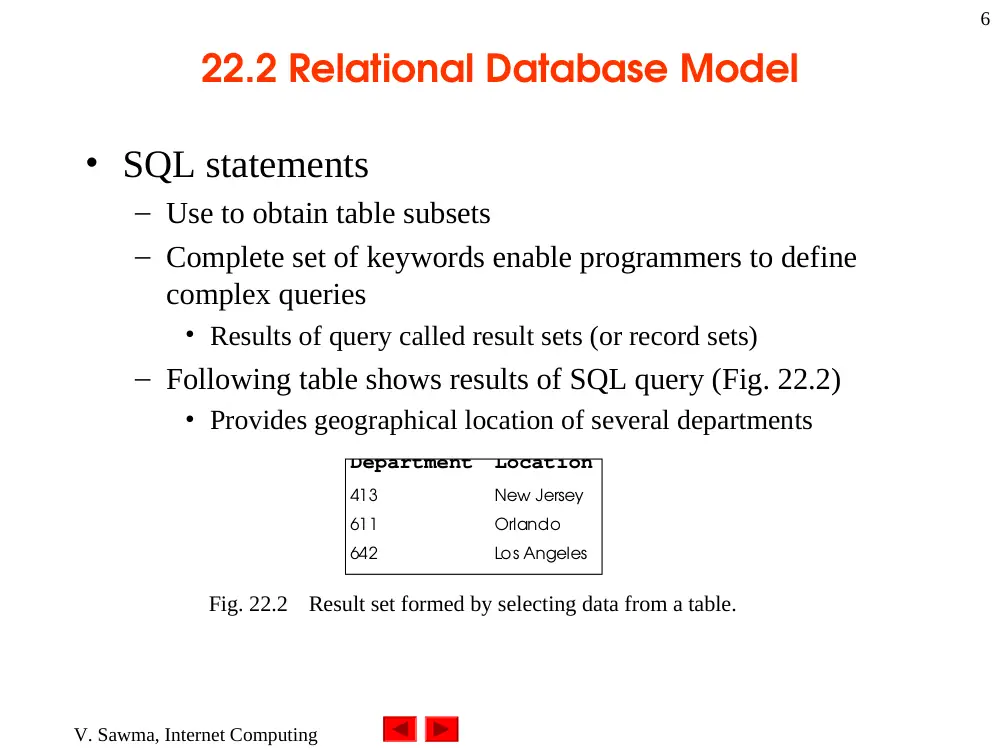
– Following table shows results of SQL query (Fig. 22.2)
• Provides geographical location of several departments
Department
Location
413
New Jersey
642
Los Angeles
611
Orlando
Fig. 22.2
Result set formed by selecting data from a table.
V. Sawma, Internet Computing
7
22.3 Relational Database Overview
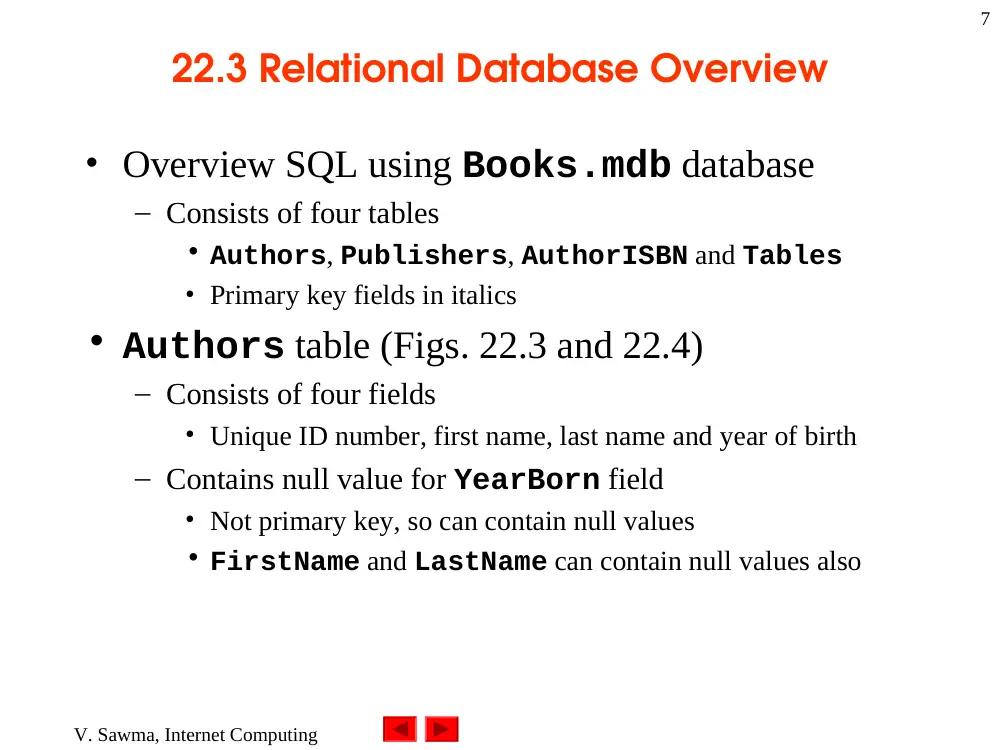
• Overview SQL using Books.mdb database
– Consists of four tables
• Authors, Publishers, AuthorISBN and Tables
• Primary key fields in italics
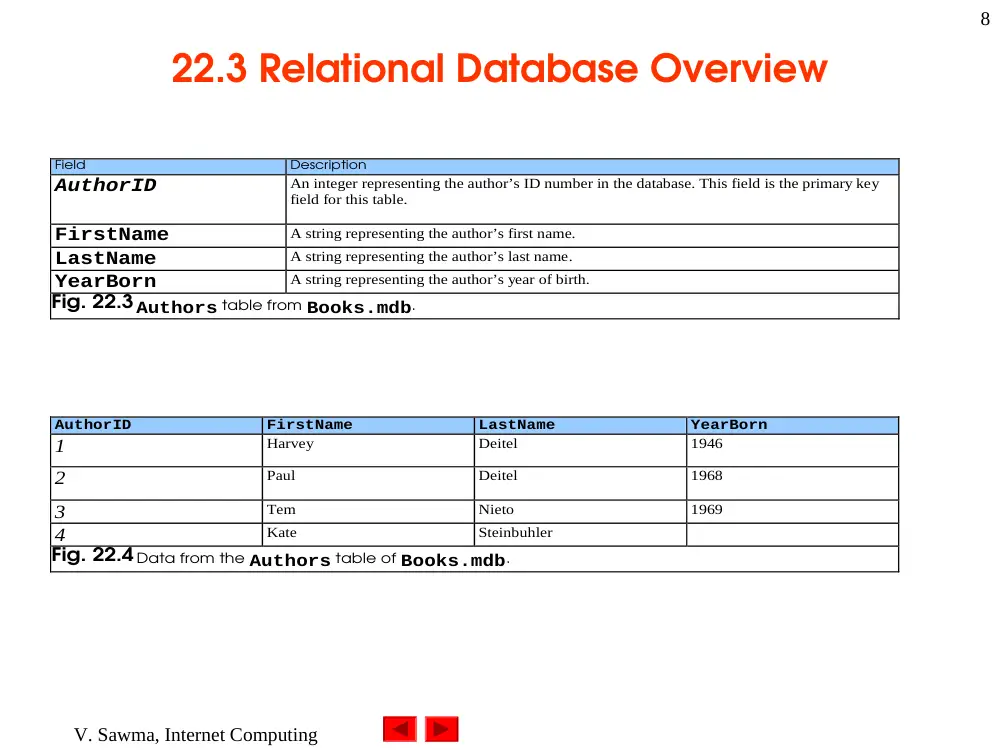
• Authors table (Figs. 22.3 and 22.4)
– Consists of four fields
• Unique ID number, first name, last name and year of birth
– Contains null value for YearBorn field
• Not primary key, so can contain null values
• FirstName and LastName can contain null values also
V. Sawma, Internet Computing
8
22.3 Relational Database Overview
Field
Description
AuthorID
An integer representing the author’s ID number in the database. This field is the primary key
field for this table.
FirstName
A string representing the author’s first name.
LastName
A string representing the author’s last name.
YearBorn
A string representing the author’s year of birth.
Fig. 22.3 Authors table from Books.mdb.
AuthorID
FirstName
LastName
YearBorn
1
Harvey
Deitel
1946
2
Paul
Deitel
1968
3
Tem
Nieto
1969
4
Kate
Steinbuhler
Fig. 22.4 Data from the Authors table of Books.mdb.
V. Sawma, Internet Computing
9
22.3 Relational Database Overview
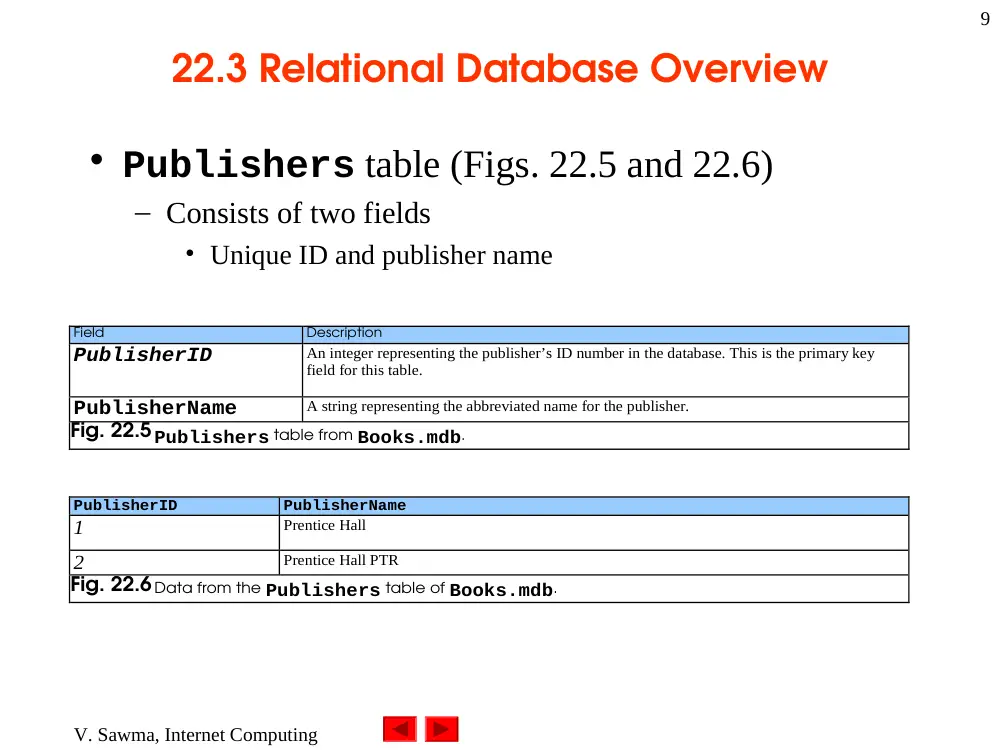
• Publishers table (Figs. 22.5 and 22.6)
– Consists of two fields
• Unique ID and publisher name
Field
Description
PublisherID
An integer representing the publisher’s ID number in the database. This is the primary key
field for this table.
PublisherName
A string representing the abbreviated name for the publisher.
Fig. 22.5 Publishers table from Books.mdb.
PublisherID
PublisherName
1
Prentice Hall
2
Prentice Hall PTR
Fig. 22.6 Data from the Publishers table of Books.mdb.
V. Sawma, Internet Computing
10
22.3 Relational Database Overview
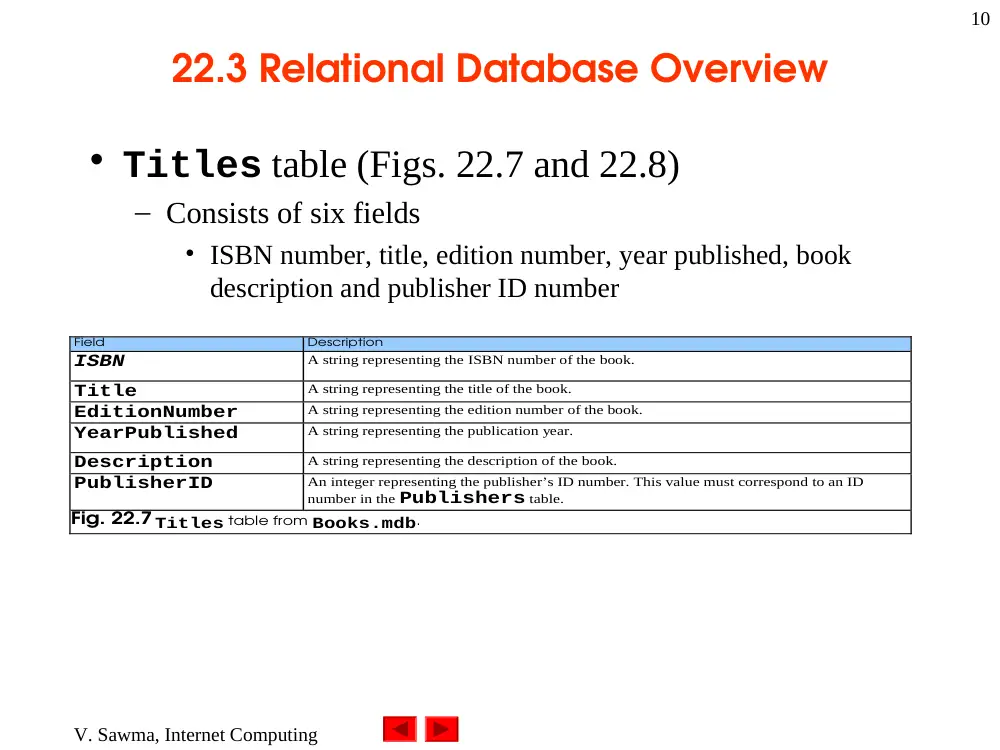
• Titles table (Figs. 22.7 and 22.8)
– Consists of six fields
• ISBN number, title, edition number, year published, book
description and publisher ID number
Field
Description
ISBN
A string representing the ISBN number of the book.
Title
A string representing the title of the book.
EditionNumber
A string representing the edition number of the book.
YearPublished
A string representing the publication year.
Description
A string representing the description of the book.
PublisherID
An integer representing the publisher’s ID number. This value must correspond to an ID
number in the Publishers table.
Fig. 22.7 Titles table from Books.mdb.
V. Sawma, Internet Computing
11
22.3 Relational Database Overview
ISBN
Title
Edition
Number
Year
Published
Publisher
ID
0-13-012507-5
Java How to Program
3
1999
1
0-13-013249-7
Getting Started with Visual C++ 6 with an
Introduction to MFC
1
1999
1
0-13-016143-8
Internet and World Wide Web How to
Program
1
1999
1
0-13-020522-2
Visual Basic 6 How to
Program Instructor's Manual with Solution
Disk
1
1999
1
0-13-028417-3
XML How to Program
1
2001
1
0-13-089571-1
C++ How to Program
3
2001
1
0-13-089572-5
C How to Program
3
2001
1
0-13-271974-6
Java Multimedia Cyber Classroom
1
1996
2
0-13-456955-5
Visual Basic 6 How to
Program
1
1998
1
0-13-899394-7
Java How to Program
2
1997
1
Fig. 22.8 Portion of the data from the Titles table of Books.mdb.
V. Sawma, Internet Computing
12
22.3 Relational Database Overview
• AuthorISBN table (Figs. 22.9 and 22.10)
– Consists of two fields
• ISBN number and author ID number
– Links names of authors with respective book titles
V. Sawma, Internet Computing
13
22.3 Relational Database Overview
Field
Description
ISBN
A string representing the ISBN number for a book. The ISBN number in this field also must
appear in the Titles table.
AuthorID
An integer representing the author’s ID number, which allows the database to connect each
book to a specific author. The ID number in this field must also appear in the Authors
table.
Fig. 22.9 AuthorISBN table from Books.mdb.
ISBN
AuthorID
0-13-010671-2
1
0-13-010671-2
2
0-13-012507-5
1
0-13-013249-7
2
0-13-016143-8
2
0-13-020522-2
3
0-13-032364-0
2
0-13-032364-0
4
0-13-082928-5
3
Fig. 22.10
Portion of the data from the AuthorISBN table of Books.mdb.
V. Sawma, Internet Computing
14
22.3 Relational Database Overview
• Microsoft Access diagram (Fig. 22.11)
– Illustrates relationships between tables in database
– Lines represent table relationships
– One-to-many relationship
• Example: line between Publishers and Titles tables
• Single publisher can have many books in Titles table
V. Sawma, Internet Computing
15
22.3 Relational Database Overview
Fig. 22.11 Table relationships in Books.mdb.
V. Sawma, Internet Computing
16
22.3 Relational Database Overview
• Rule of Entity Integrity
– Every record must have value in primary key field
– Primary key values must be unique
• Foreign key field (or constraints)
– References primary key field in another table
– Specified when creating tables
– Maintains Rule of Referential Integrity
• Every foreign key field value must appear in another table’s
primary key field
• Example: PublisherID field in Titles table
– Enables information from multiple tables to be joined for
analysis